🧪 Fungicides — Types, Classification, and Mode of Action
Comprehensive guide to fungicides including sulphur, copper compounds, Bordeaux mixture, thiocarbamates, systemic fungicides, and antibiotics used in plant disease control with exam tables
From Field to Lab — The Chemical Arsenal Against Plant Disease
In 1882, Professor Millardet of France noticed something curious: grapevines along a roadside, sprayed with a bluish copper-lime mixture to discourage theft, were free of downy mildew while untreated vines were devastated. His accidental discovery of Bordeaux mixture launched the era of chemical plant disease control — an era that continues today with sophisticated systemic fungicides like Vitavax and Bavistin. From ancient sulphur dusting to modern systemic fungicides, understanding the chemical tools available for disease management is one of the highest-weightage topics in agriculture exams.
Chemicals used in Disease Control
- Certain chemicals are toxic to pathogen. Such chemicals check the growth and development of pathogens and kill them. Based on the nature of the pathogen against which these chemicals are used, the latter have been classified into fungicides, bactericides, nematicides, viricides etc. Each class targets a specific group of organisms, enabling precise disease management.
- Fungicides: Latin words: Fungicide → Fungus + caedo (to kill)
- Chemical or physical agents (Heat, UV rays etc) having the potential to kill fungal pathogen come under this category. Although the term fungicide is generally used for chemical agents only. Physical agents like heat treatment and UV radiation are occasionally employed but are not classified as fungicides in common usage.
- Certain chemicals temporarily check the growth of fungal pathogen and do not kill them. Such chemicals are called fungistatic chemicals. These are useful when complete eradication is not necessary or when the crop is sensitive to stronger chemicals.
- Chemicals which check the production of spores in fungi are called anti-sporulant although all such chemicals which protect the plants from fungal pathogen come under the broader definition of fungicide. By preventing spore formation, anti-sporulants limit the spread and reproduction of the pathogen.
NOTE
Three key terms to distinguish: Fungicide = kills fungi, Fungistatic = inhibits fungal growth without killing, Anti-sporulant = prevents spore production. Exams often test these distinctions.
Types of Fungicides
Sulphur fungicides
- Sulphur since ancient times has been used as a fungicide. E.g. Elemental Sulphur and lime sulphur. Pre PG 2020 Sulphur works by disrupting the metabolic processes of fungal cells, and it remains one of the oldest and most widely used fungicidal agents in agriculture.
Copper Compound fungicides
- The fungicidal nature of bone stone, copper sulphate was first of all discovered by Prevost (1807) against Bunt disease. Copper ions are toxic to fungal spores and hyphae, making copper-based compounds highly effective protectant fungicides.
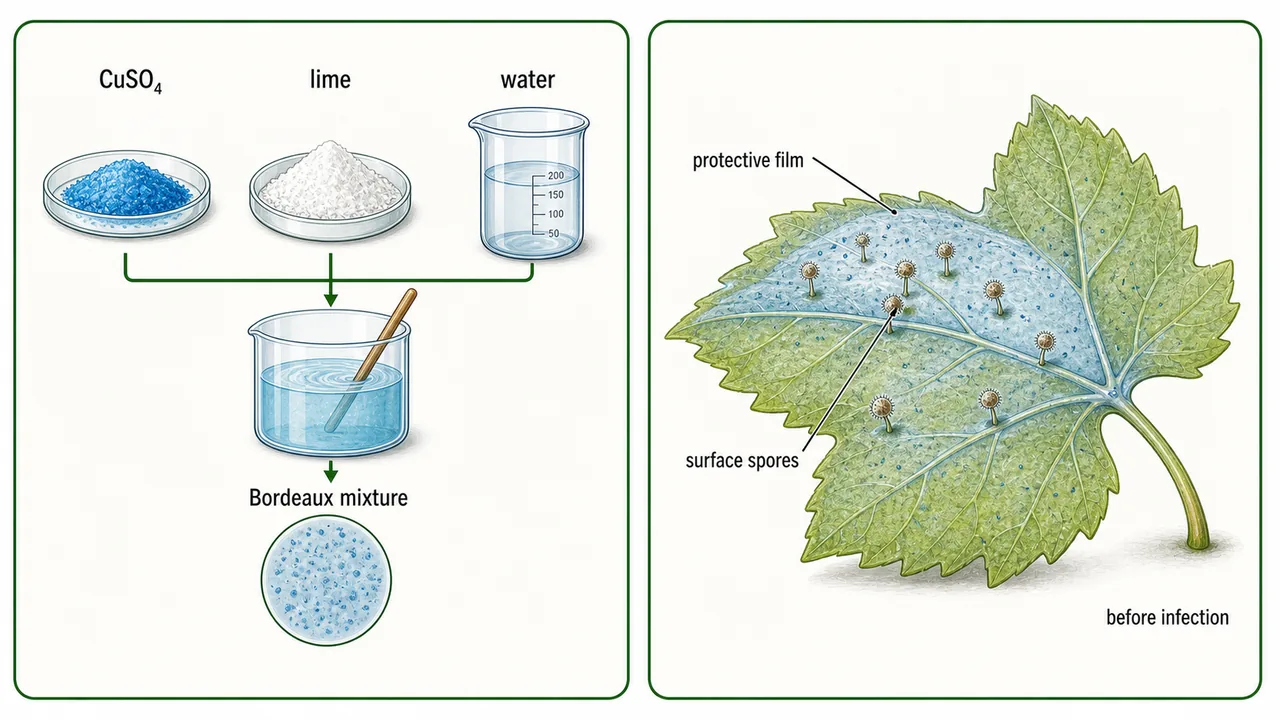
Bordeaux Mixture
- Prof. Millardet of France in 1882 accidentally discovered Bordeaux mixture from the mixture of copper sulphate and lime. This he successfully used to control downey mildew of grape. The discovery was accidental — Millardet noticed that grapevines sprayed with a copper-lime mixture to discourage theft remained free of downy mildew. Millardet first of all prepared Bordeaux mixture by mixing copper sulphate, lime and water in the ratio 8 : 15 : 100 (8 kg of CuSO4 + 15 kg lime + 100 litre water). But this mixture was extremely powerful and caused foliar injury.
- Bordeaux mixture is now prepared in following concentrations:
- (a) 4 : 4 : 50 = 0.8% (4 pounds copper sulphate + 4 pounds lime + 50 gallon water)
- (b) 5 : 5 : 50 = 1.0% (5 pounds copper sulphate + 5 pounds lime + 50 gallon water)
- Nowadays, 5 : 5 : 50 (1.0%) ratio is often used. This concentration provides effective disease control with minimal risk of phytotoxicity (plant injury).
- Thus Bordeaux mixture contains three ingredients:
- Copper sulphate/Blue stone = CuSO4.5 H2O
- Quick lime
- Water
- The following reactions takes place in Bordeaux mixture:
CuSO4. 5H2O + CaO → Cu(OH)2 + CaSO4
- The active ingredient is copper hydroxide Cu(OH)₂, which acts as the fungicidal agent, while calcium sulphate (CaSO4) is a by-product. Because of the lime content, high volume spray is used for the application of Bordeaux mixture.
IMPORTANT
Bordeaux mixture is one of the most asked topics. Remember: Discovered by Millardet (1882), contains CuSO₄ + Quick lime + Water, active ingredient is Cu(OH)₂, modern ratio is 5:5:50 (1.0%).
Bordeaux Mixture — Concentration Table (Kg & Litre)
| Copper Sulphate | Lime | Water | Concentration (%) |
|---|---|---|---|
| 1 kg | 1 kg | 100 litre | 1.0 (Commonly used) |
| 0.8 kg | 0.8 kg | 100 litre | 0.8 |
| 0.6 kg | 0.6 kg | 100 litre | 0.6 |
- Ratio (if values are in Pound & Gallon): 5 : 5 : 50
- Ratio (if values are in Kg & Litre): 1 : 1 : 100
Bordeaux Paste
- Bordeaux paste is a concentrated form of Bordeaux mixture used as a wound dressing on trees.
- Ratio: CuSO₄ : CaO : Water = 1 : 1 : 10 (1 kg copper sulphate + 1 kg lime + 10 litres water). Concentration is 10% (commonly used).
| Copper Sulphate | Lime | Water | Concentration (%) |
|---|---|---|---|
| 1 kg | 1 kg | 10 litre | 10 (Commonly used) |
| 0.8 kg | 0.8 kg | 10 litre | 8 |
| 0.6 kg | 0.6 kg | 10 litre | 6 |
Bordeaux Paint
- Used for painting tree trunks and large wounds.
- Composition: Copper sulphate 1 kg + Quick lime 2 kg + Boiled linseed oil 3 litres.
Burgundy mixture/Soda-Bordeaux mixture
- In this mixture lime is replaced by sodium carbonate or washing soda or soda ash, the rest composition being similar to Bordeaux mixture. In ancient Europe because of the non-availability of Quick lime Mason in 1887 used Sodium carbonate in its place.
- This he did in the city of Burgundy and therefore the name Burgundy mixture. Burgundy mixture is slightly less adhesive than Bordeaux mixture but is easier to prepare when lime is unavailable.
- It is a good substitute for Bordeaux mixture and used in copper-sensitive crops.
- The usual formula contains CuSO₄ : Na₂CO₃ : Water = 1 : 1 : 100 (1 kg copper sulphate + 1 kg sodium carbonate + 100 litres water).

Chestnut compound/Cuprammonium fungicide
- Use of chestnut compound as a fungicide was first of all done by Bewlery in 1921 against Damping off disease of seedlings. Damping off is a devastating soil-borne disease that kills young seedlings at or below the soil surface.
- Chestnut Compound = 2 part by weight of crystalline CuSO4 + 11 parts by or weight of (NH4)2CO3. The ammonium carbonate keeps copper in solution, making the compound effective as a soil drench.
Chaubattia Paste
- This was first of all used at the Government Fruit Research Centre, Almora. It is named after the Chaubattia region in Uttarakhand where the research station is located.
- This was used as a wound dressing fungicide against diseases of apple and pear such as Black stem, brown stem etc. Wound dressing prevents pathogen entry through pruning cuts and mechanical injuries on fruit trees.
- Composition: Copper carbonate 800 g + Red lead powder 800 g + Raw linseed oil 1 litre.
TIP
Useful Formulations Summary for exams:
- Bordeaux mixture: CuSO₄ : CaO : Water = 1 : 1 : 100
- Bordeaux paste: CuSO₄ : CaO : Water = 1 : 1 : 10
- Burgundy mixture: CuSO₄ : Na₂CO₃ : Water = 1 : 1 : 100
- Chaubattia paste: CuCO₃ 800g + Red lead 800g + Linseed oil 1L

Thiocarbamate Fungicides
- The importance of Thiocarbamate in the field of Fungicides is comparable to the discovery of DDT as an insecticide. Though Spergon was the first Organic fungicide to be used commercially. In 1931 Tisdale first observed about the possible use of Thiocarbamate as a Fungicide. Thiocarbamates revolutionized plant disease management by providing broad-spectrum organic alternatives to inorganic copper and sulphur fungicides.
- Thiocarbamate has been grouped into three categories:
Thiuram disulphides
- Among its different compounds only tertramethyl thiuram disulphide is used as a fungicide. This product is called Thiuram/thiram.
- In direct exam-style recall, thiram is commonly remembered as the first dithiocarbamate fungicide.
- It was included in the list of fungicides in 1934 basically as a seed protectant. Seed protectants form a chemical barrier around the seed, shielding it from soil-borne pathogens during germination.
- But later on it was started using as a Foliage protectant and in certain conditions for soil treatment also.
- Its general formulation for its use as spray is 80% W.P. (Wettable Powder) and 50% colloidal suspension.
- For seed treatment usually 50% powder is used. For better results 250 g a.i. (active ingredient) of Thiram is dissolved in 100 litre water and the seeds are soaked in it.
- For soil treatment 10-15 kg a.i. is used.
Metallic dithiocarbamates
- Ferbam:
- It is a Fe (Iron) containing fungicide.
- It was developed by Tisdale and Williams in 1931.
- Its commercial use as a fungicide started in 1943.
- In temperate countries it is used against disease of apple and other fruits.
- For spray its formulation is 0.2 — 0.3% a.i. Its effect decreases on mixing with copper, lime and mercury. This incompatibility must be considered when planning spray schedules in orchards.
- Ziram:
- It is a Zinc containing fungicide.
- This is the most stable among the group of Dithio-carbamate fungicides. Its stability gives it a longer shelf life and more consistent field performance.
- It has been found to be an effective fungicide to control diseases caused by Fungi Imperfecti in fruits and vegetables and also early blight of potato.
- It provides additional advantage in soil deficient in Zn, as the zinc component can serve as a micronutrient supplement for the crop.
- For spray purpose formulations of 0.2 — 0.3% a.i. and 50% W.P. are available in market.
Ethylene bisdithiocarbamates
- Nabam:
- Nabam is a sodium containing fungicide.
- Because of its phytotoxicity and instability it is not usually used in fields. Phytotoxicity means it can cause chemical burns or damage to the plant tissues.
- Although it gives better results on mixing ZnSO4 and lime, which helps to stabilize the compound and reduce its harmful effects on plants.
- Zineb:
- It is a Zn-containing fungicide.
- Except certain sensitive plants Zn is usually not harmful for crops, making Zineb a safe and widely used fungicide.
- It is used to control many diseases in plants.
- It is used for soil treatment to control Damping off and other soil-borne diseases.
- It has nematicidal property and is used to control Meliodogyne spp. (root-knot nematodes), giving it a dual-action benefit.
- Maneb:
- This fungicide is similar to Zineb but in Maneb Zn is replaced by Mn i.e. it is Mn-containing fungicide.
- It was included in the list of fungicides in 1950.
- It is very effective against Foliar diseases especially Blight diseases of potato and tomato. Maneb is particularly valued in regions where late blight causes devastating crop losses.
- Mancozeb: It contains both Zn and Mn. By combining both metals, Mancozeb offers broader spectrum activity and greater stability than either Zineb or Maneb alone, making it one of the most widely used fungicides worldwide.
- Vapam/Metham-Sodium: It is a soil Fumigant which was enlisted in 1954. It is used in partial sterilization of soil for the control of Soil Fungi and nematodes. It also acts as a herbicide, providing triple action against fungi, nematodes, and weeds. S (Sulphur) is an important component in the structural formula of thiocarbamate fungicide.
| S.No. | Fungicides | Metal constituent | Remark |
|---|---|---|---|
| 1 | Thiuram/Thiram | No metal | Used for Seed treatment + Soil treatment Foliage Protectant |
| 2 | Ferbam | Fe | Used for Spraying |
| 3 | Ziram | Zn | Used for Spraying |
| 4 | Nabam | Na | - |
| 5 | Zineb | Zn | Soil treatment + Nematicide |
| 6 | Maneb | Mn | Effective for foliar disease control |
| 7 | Mancozeb | Zn + Mn | Effective for foliar disease control |
| 8 | Vapam | Na | Soil Fumigant + Herbicide |
Other Organic Fungicides
Glyodin
- Wellman and Mecallan (1946) discovered about the fungicidal property of glyoxalidine derivatives which is now available under the trade name Glyodin in market.
- In temperate countries this fungicide is used to control Apple scab and other fruit disease. Apple scab, caused by Venturia inaequalis, is one of the most economically important diseases of apple worldwide.
Dedine/Cyprex
- Dodine as a protectant fungicide became available in 1959.
- It does not harms bees, making it a pollinator-safe option — an important consideration in fruit orchards that depend on bee pollination. It can be safely mixed with ordinary fungicides and insecticides.
- It also has some eradicant property, meaning it can eliminate infections that have already begun, not just prevent new ones.
- Dodine is used to control Apple Scab and other foliar and fruit diseases.
Quinone Compounds
- Chloranil seed treating fungicide became available in the market under the trade name 'Spergon' in 1940. Because of its disintegration in light (photodegradation), it is not used for foliar application — only for seed treatment where light exposure is minimal.
- Dichlone: After the success of Chloranil, Dichlone as a seed treating fungicide was launched in market in 1943 under the trade name 'Phygon'. Besides its seed protectant property it is also used as a foliar protectant, giving it wider applicability than Chloranil.
- Captan: As a protective fungicide captan was enlisted in 1949. It has been proved successful in the treatment of many diseases of fruits, vegetables and ornamental plants. Along with its use as a seed treatment fungicide it is also used to reduce post-harvest losses caused by fungi in storage. Captan is also used for soil drenching @ 0.5% for protection against damping off. Its broad-spectrum activity and low mammalian toxicity make it one of the most popular fungicides.
- Folpet: Its physical and chemical properties are similar to captan and is sold under the trade name 'Phaltan'.
- Difoltan: It is quite similar to Folpet and captan. These three related compounds — Captan, Folpet, and Difoltan — share a similar chemical backbone but differ in their side groups.
- Karathane (Dinocap): It was first of all enlisted in 1954 to control powdery mildew disease in plants. Because of its solubility in oil, it is not used in oil based spray. It is a good substitute of sulphur and therefore used to control powdery mildew in sulphur-sensitive or Sulphur shy plants — plants that show phytotoxic symptoms when treated with sulphur. Upto a certain extent it is also successful in controlling mites, providing both fungicidal and acaricidal benefits.
- Pentachloronitrobenzene (Quintozene): It was enlisted in 1930 for the control of Soil borne pathogens and dry rot of potato. Later on it came to be used to control Rhizoctonia, Sclerotium and other soil fungi. It is persistent in soil and cucurbits and tomato plants are sensitive to it. PCNB (Penta Chloro Nitro Benzene) is a nematicide also. It has mainly antisporulant and fungistatic property — it does not kill the fungus but prevents it from sporulating and growing.
- Organic Tin Compounds: TPTA (Triphenyl Tin acetate) was enlisted under the trade name Brestan whereas TPTA and TPTH (Triphenyl tin hydroxide) under the trade name Denter. TPTA also has insecticidal property. It was enlisted in 1954 to control Potato blight.
- Oils: Nowadays oil-mist spray is used to control Sigatoka disease of Banana. Fungicidal property of oils is only due to physical reasons — the oil film creates a physical barrier that prevents spore germination and blocks gas exchange on the leaf surface.
Antibiotics
Antibiotics are substances produced by living microorganisms that can inhibit or kill other microorganisms. Their use in plant disease control represents a bridge between medicine and agriculture.
Quick Reference: Antibiotics used in Plant Pathology
| Antibiotic | Trade Name | Active Against | Key Feature |
|---|---|---|---|
| Streptomycin + Oxytetracyclin | Agrimycin | Bacteria (Gram +ve & -ve) | Not fungitoxic |
| Cycloheximide | Actidione | Pythium debaryanum | Systemic, narrow safety margin |
| Griseofulvin | — | Powdery mildew | Affects hyphal growth, not spores |
| Aureofungin | — | Broad-spectrum fungi | Developed at Hindustan Antibiotics, India |
| Blasticidin-S | — | Pyricularia oryzae, bacteria | Chemotherapeutant |
| Kasugamycin | — | Pyricularia oryzae, Pseudomonas | Better eradicant than protectant |
- Streptomycin: Streptomycin at 100 ppm or more concentration has been found to be effective against bacterial seed-borne pathogens. But as there is greater possibility of development of resistant strains in bacteria, streptomycin is mixed with Oxytetracyclin (terramycin). This mixture or combination is called Agrimycin. The combination helps delay the emergence of antibiotic-resistant bacterial populations. Streptomycin is effective against both Gram positive and gram negative bacteria. It does not possess fungitoxic property — it is strictly an antibacterial agent.
- Cycloheximide: It is obtained as a byproduct in the production of Streptomycin. Its trade name is Actidione. It is active against Phycomycetic fungus Pythium debaryanum but is ineffective against bacteria. Cycloheximide is a systemic fungicide and is easily absorbed by roots & leaves. Its effect persists for about 5 weeks after spray. But its production is expensive and there is little difference between effective concentration and phytotoxic concentration — this narrow safety margin makes it risky for field use. It can also cause mutagenic effect in plants. It is therefore not used for disease control in agricultural crops.
- Griseofulvin: It was first isolated in 1939 from Penicillium griseofulvum. It is obtained as a byproduct of several species of Penicillium. It is a systemic fungicide. Griseofulvin does not check the germination of spore but affects the growth of hyphae — it distorts hyphal tips by interfering with cell wall formation. Thus it is not a true fungicide. It does not harm bacteria. Griseofulvin is active against Powdery mildew.
- Aureofungin: It is a broad-spectrum systemic antifungal antibiotic. It is used for seed treatment to protect from rot in storage. It was developed at Hindustan Antibiotics Limited in India and represents an important contribution of Indian scientists to plant protection.
- Blasticidin-S: It is produced from Streptomyces griseochromogenes. It is effective against many species of bacteria and certain fungi including Pyricularia oryzae (the rice blast pathogen). Because of its growth inhibition property, it is also used as a Chemotherapeutant — a substance that enters the plant system and helps cure existing infections.
- Kasugamycin: It is obtained from the culture broth of Streptomyces kasugaensis. It is selectively active against Pyricularia oryzae and Pseudomonas spp. Kasugamycin is more effective as an eradicant than as a protectant, meaning it is better at eliminating established infections than preventing new ones.
Systemic Fungicides
IMPORTANT
Systemic fungicides are a high-weightage topic in competitive exams. Pay special attention to trade names (Vitavax, Plantvax, Bavistin) and their target diseases.
- A fungicide which is absorbed and translocated in the system of plant. Unlike contact (protectant) fungicides that remain on the plant surface, systemic fungicides are taken up by the plant and move through its vascular system, providing internal protection against pathogens. This makes them particularly effective against deep-seated and internally seed-borne infections.
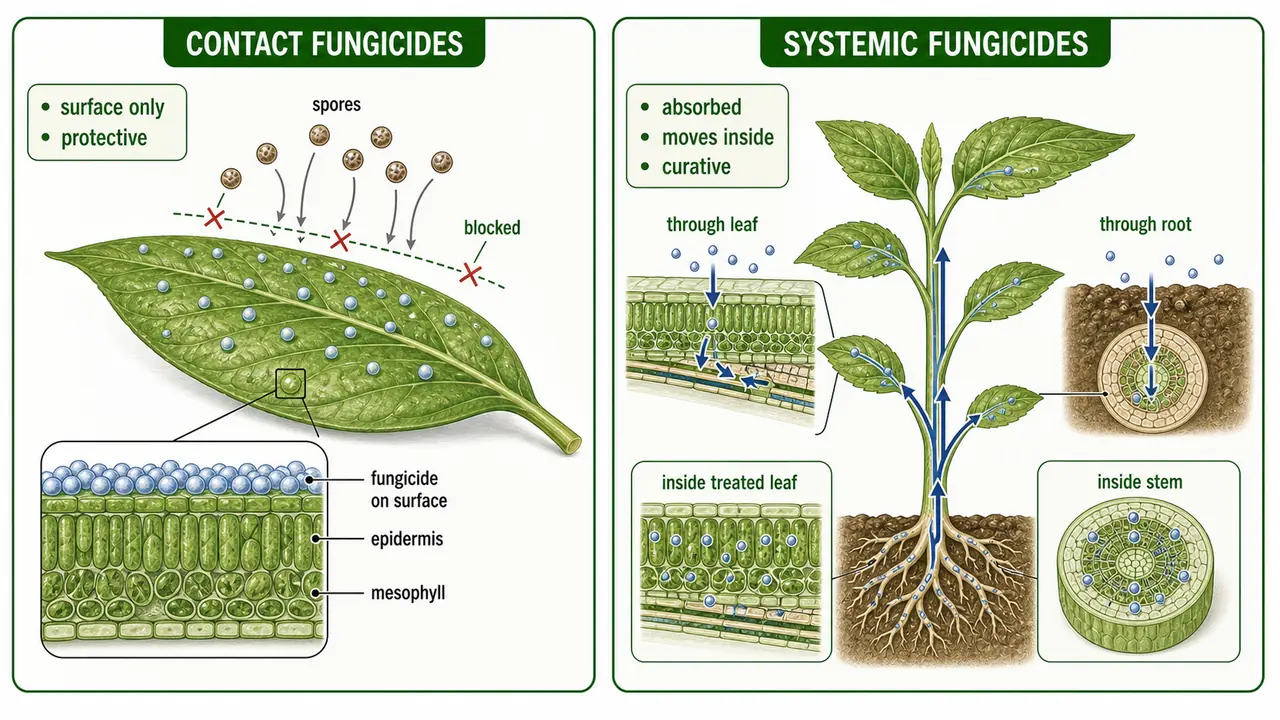
Oxathiin
- Oxathiin was developed by Von Schmeling and Kulka in 1966. This was a landmark development as it was among the first truly systemic fungicides developed for agricultural use.
- Carboxin or DMOC/DCMO:
- Its trade name is Vitavax.
- It is a proven chemical against Basidiomycetes fungi (Smut). Basidiomycetes include the smut and rust fungi that cause some of the most destructive cereal diseases.
- Fungi such as Verticillium alboatrum and Monilia cineraria f. americana can also be controlled by carboxin as they are sensitive to this systemic fungicide.
- Vitavax is used for seed dressing and soil drenching in order to control Loose smut of cereals (internally seed borne) and Rhizoctonia disease of cotton and sugarbeet.
- This chemical is not very stable & completely degrades in soil within 10-30 days. This rapid degradation means it has low environmental persistence, which is both an advantage (less residue) and a limitation (short-lived protection).
- Vitavax is used to control Loose smuts (Ustilago nuda, Ustilago avena) and bunts.
- Oxycarboxin/DNOCD/DCMOD:
- Its trade name is Plantvax.
- It is used in controlling diseases related to fungi imperfecti (Deuteromycetes), which is the largest group of fungi causing plant diseases.
- The diseases caused by members of fungi imperfecti are — Early blight of potato, Alternaria leaf spot of crucifers, leaf blight of wheat, Leaf spot of groundnut, stripe disease of barley, leaf spot of rice (Helminthosporium), blast of rice, Ripe fruit rot and Dieback of chillies, Wilt of pigeon pea, wilt of cotton, wilt of linseed, fusarium wilt or Panama disease of banana, wilt of sugarcane.
- Smut: Vitavax
- Rust: Plantvax
TIP
Memory aid: Vitavax for smut (Vita = life, smut kills grain life), Plantvax for Rust (Plantvax protects the plant from rust). Both are Oxathiin derivatives.
Pyrimidine derivatives
- Methyrimol: It is effective against powdery mildew of cucurbits, cineraria, chrysanthemum and sugarbeet. Pyrimidine derivatives specifically target the sterol biosynthesis pathway in fungi.
- Ethirimol: It is like methyrimol and effectively controls powdery mildew of Crucifers (cabbage, cauliflower, mustard family).
Benzimidazole
- It comes under the name of Benomyl or Bavistin or Benlate.
- It is a superior systemic fungicide which acts as a good eradicant and protectant — giving it dual functionality against both existing and new infections.
- It has ovicidal action against mites eggs, providing additional pest management benefits.
- Benzimidazole is effective against certain fungal diseases of crops such as rice blast, diseases caused by Cercospora, Verticillium of cotton, powdery mildew and black spot of rose, but has less effect on Helminthosporium spp. & Phycomycetes. Understanding which fungi are resistant to a particular fungicide is crucial for effective disease management.
Chloroneb
- It is almost completely fungistatic and relatively non-fungicidal in action — meaning it inhibits fungal growth without actually killing the fungus.
- It is easily absorbed by plant roots and its concentration is more in root and lower part of the stem. It is therefore used in supplemented seed treatment and soil treatment to protect plants from seedling disease during planting. This root-concentrated distribution makes it ideal for controlling soil-borne pathogens that attack seedlings.
- Chloroneb is active against Rhizoctonia spp. It can be mixed with most of the pesticides and organomercurials used in seed treatment, offering good compatibility with existing treatment protocols.
Thiabendazole (TBZ)
- Although TBZ was enlisted as an antihelminthic (anti-worm drug), it is a broad spectrum systemic fungicide. This crossover from veterinary medicine to plant pathology illustrates how chemicals can have multiple applications.
- This fungicide is transported from the roots to the leaves of plant and sometimes in the reverse direction also — demonstrating both acropetal (upward) and occasionally basipetal (downward) translocation.
- It does not undergo disintegration in plant tissues, ensuring long-lasting internal protection.
- It is effective against Blue and green moulds of citrus fruits, which are major causes of post-harvest losses.
- When applied @ 120g/100kg it successfully controls seed borne bunt, Fusarium nivale and Septoria nodorum.
- Verticillium wilt can be successfully controlled if soil treatment is undertaken @30kg/ha.
Terrazole/OM-2424
- It is an effective fungicide for the control of seed and seedling disease of Maize, Cotton, Sorghum, Soybean, bean, potato, tomato and cucumis. Its wide crop range makes it a versatile tool for nursery and early-season protection.
Organo-phosphorus compounds
- This group includes compounds like Hinozan, Kitazin, Inazin etc. which are active against blast disease at a concentration of 400-500 ppm concentration. Rice blast caused by Pyricularia oryzae is one of the most destructive rice diseases globally.
- It becomes toxic at higher concentrations, so dosage must be carefully calibrated.
- It is extensively used in Japan, where rice is the staple crop and blast disease poses a major threat. Among them Kitazin is an effective fungicide because of its excellent systemic behaviour.
Organo-mercurial Fungicides
- Mercuric chloride is an effective Fungicide and bactericide. It is a powerful biocide that kills both fungi and bacteria.
- Because of its high toxicity to humans and animals, it is not used to control plant diseases in the field. It may be used only in laboratory settings and for specific seed treatment applications.
- The general formula of organomercurial derivative is

👉🏻 The examples of Organo-mercurial fungicides are:
- Agrosan GN, Agrox, Aretan/Agallol, Ceresan, Mergamma, Parrygen, Panogen, Puraturb, Semessan.
- Because of their highly toxic nature great care is taken in their use. Proper protective equipment (gloves, masks) must be worn during handling.
- The treated seeds should never be used for human or animal consumption — this is critical for safety.
- Dry seed dressing contains 0.6-15% Hg whereas liquid dressing contains 0.6-2.0% Hg.
- Organomercurials mixed with γ-BHC or dieldrin is used to control insects attacking young seedlings, providing combined fungicidal and insecticidal protection.
Formaldehyde
- It was for the first time used in Germany for seed treatment during the last decade of 19th Century.
- Because of its lesser toxicity it was used as a substitute for CuSO4. In spite of this, use of Formaldehyde for seed treatment has several harmful effects, including potential phytotoxicity at higher concentrations and reduction in germination rates if not properly applied.
| S.No. | Common Name | Other name |
|---|---|---|
| A. | Metallic salts | |
| A1 | Copper Oxychloride (COC) | Blitox, Cupravit, Cuprox, Fytolan, Cupramar, Basic Copper Chloride, Coxysan |
| A2 | Copper Sulphate | Blue vitriol, Bluestone |
| A3 | Cuprous Copper Oxide | Fytomix, Perenox, Fungimar |
| B. | Non-metallic Salts | |
| B1 | Sulphur dust | Brim Stone |
| C. | Organo mercurials | |
| C1 | Ethyl mercury chloride | Ceresan, Granosan |
| C2 | Methoxy ethyl mercury chloride | Aretan, Agallol (3% mercury equivalent) Agallol forte (6% mercury equivalent) Baytan |
| C3 | Phenyl mercury acetate + Ethyl mercury chloride in equal proportion | Agrosan G.N. |
| C4 | Phenyl mercury salicylate | Mercusol, Merculine. |
| D | Carbamate | |
| D1 | Benlate | Benomyl |
| D2 | Carbendazim | Bavistin (Benzanidazole group) |
| E. | Thiocarbamate | |
| E1 | Maneb | Dithane M-22, Manzate, Manesan |
| E2 | Mancozeb | Dithane M-45, Fore, Indofil |
| E3 | Nabam | Chem Bam, Dithane D-14, Parzate |
| E4 | Zineb | Dithane Z-78, Hescathane |
| F. | Dithiocarbamates | |
| F1 | Ferbam | Fermate, Hexaberb, Tribungol |
| F2 | Thiram/Thiuram | Arasan, Thiride, Mercuram |
| F3 | Zram | Cuman, Ziride, Zitox |
| G. | Others | |
| G1 | Fentin Acetate | Brestan |
| G2 | Captan | Merpan, Orthocide |
| G3 | Fentiazon | Celditon |
| G4 | Hinosan | Edifenphos |
| G5 | Karathane | Arathane, Dinocap |
| G6 | PCNB | Brassicol, Tritisan |
| G7 | Plantvax | Oxycarboxin |
| G8 | Vitavax | Carboxin |
| G9 | Median N sodium (Nematicide) | Vapam, Metham |
| H | Antibiotics | |
| H1 | Aureomycin | Acronize, Chlortetracycline |
| H2 | Terramycin | Oxytetracycline, Biostat PA |
| H3 | Streptomycin | Agrimycin |
| H4 | BLA-S | Blasticidin |
| H5 | Kasumin | Kasugamycin |
| Plant Growth Regulator | Ethephon | Ethrel |
Summary Cheat Sheet
| Concept / Topic | Key Details |
|---|---|
| Fungicide (Latin) | Fungus + caedo (to kill); chemical agent that kills fungi |
| Fungistatic | Temporarily inhibits fungal growth without killing |
| Anti-sporulant | Prevents spore production in fungi |
| Sulphur fungicide | Oldest fungicide; used as dust and wettable powder since ancient times |
| Prevost (1807) | First discovered fungicidal nature of copper sulphate against wheat bunt |
| Bordeaux mixture | Millardet (1882); CuSO₄ + Quick lime + Water; ratio 1:1:100 (kg/L) or 5:5:50 (lb/gal); active ingredient = Cu(OH)₂ |
| Bordeaux paste | Ratio 1:1:10; concentration 10%; used as wound dressing on trees |
| Burgundy mixture | Lime replaced by Na₂CO₃ (washing soda); ratio 1:1:100; Mason (1887) |
| Chaubattia paste | CuCO₃ 800g + Red lead 800g + Linseed oil 1L; wound dressing for apple/pear |
| Chestnut compound | Bewlery (1921); CuSO₄ + (NH₄)₂CO₃; controls damping off |
| Spergon (Chloranil) | First organic fungicide (1940); seed treatment only (degrades in light) |
| Thiram (1934) | Thiuram disulphide; seed protectant and foliage protectant |
| Mancozeb | Contains both Zn and Mn; broadest spectrum dithiocarbamate |
| Captan (1949) | Protective fungicide for fruits/vegetables; soil drench @ 0.5% for damping off |
| Karathane / Dinocap (1954) | Controls powdery mildew in sulphur-shy plants |
| Vitavax (Carboxin) | Oxathiin (1966); systemic; controls smut (Basidiomycetes); seed dressing |
| Plantvax (Oxycarboxin) | Controls rust and diseases of Fungi Imperfecti |
| Bavistin / Benomyl | Benzimidazole; systemic; eradicant + protectant; controls rice blast, powdery mildew |
| Agrimycin | Streptomycin + Oxytetracyclin; effective against Gram +ve & -ve bacteria |
| Aureofungin | Broad-spectrum antifungal antibiotic; developed at Hindustan Antibiotics, India |
| Seed Disinfection | Kills internally seed-borne pathogens; uses systemic fungicides or hot water |
| Seed Disinfestation | Kills pathogens on seed surface (externally seed-borne) |
| Seed Protection | Shields germinating seeds from soil-borne pathogens |
| Disease Triangle | Disease = susceptible Host + virulent Pathogen + favourable Environment |
| 6 Principles of control | A-E-E-P-R-T: Avoidance, Exclusion, Eradication, Protection, Resistance, Therapy (first 5 preventive, last curative) |
| Host nutrition & disease | Excess N promotes disease; excess Ca & K increases resistance |
Lesson Doubts
Ask questions, get expert answers