👷🏻♀️Disease Management — Principles, Methods, and Integrated Approaches
Classification of disease control methods including prophylaxis, exclusion, eradication, protection, immunisation, seed treatment types, and the disease triangle concept with exam tables
From Field to Lab — Prevention is Better Than Cure
A progressive farmer in Punjab rotates wheat with mustard every season, treats seeds with Vitavax before sowing, removes wild barberry bushes (alternate host for wheat rust) from field borders, and selects resistant varieties — all without knowing that each of these practices targets a different side of the disease triangle (host, pathogen, environment). Disease management is not about a single magic spray; it is a system of multiple defences working together.
- Till the appearance of disease symptom the pathogen has taken command over the plant. By the time symptoms become visible, the pathogen has already established itself deeply in the host tissue, making curative treatment difficult.
- In order to avoid such a situation it is essential to protect plants from disease i.e. protective and preventive measures should be undertaken well before infection occurs.
- Therefore it is said prevention is better than cure. This fundamental principle guides all modern plant disease management strategies.
Classification of Plant Disease Control Methods
- The control measures for plant diseases have been classified into two categories: (A) Prophylaxis (B) Immunization
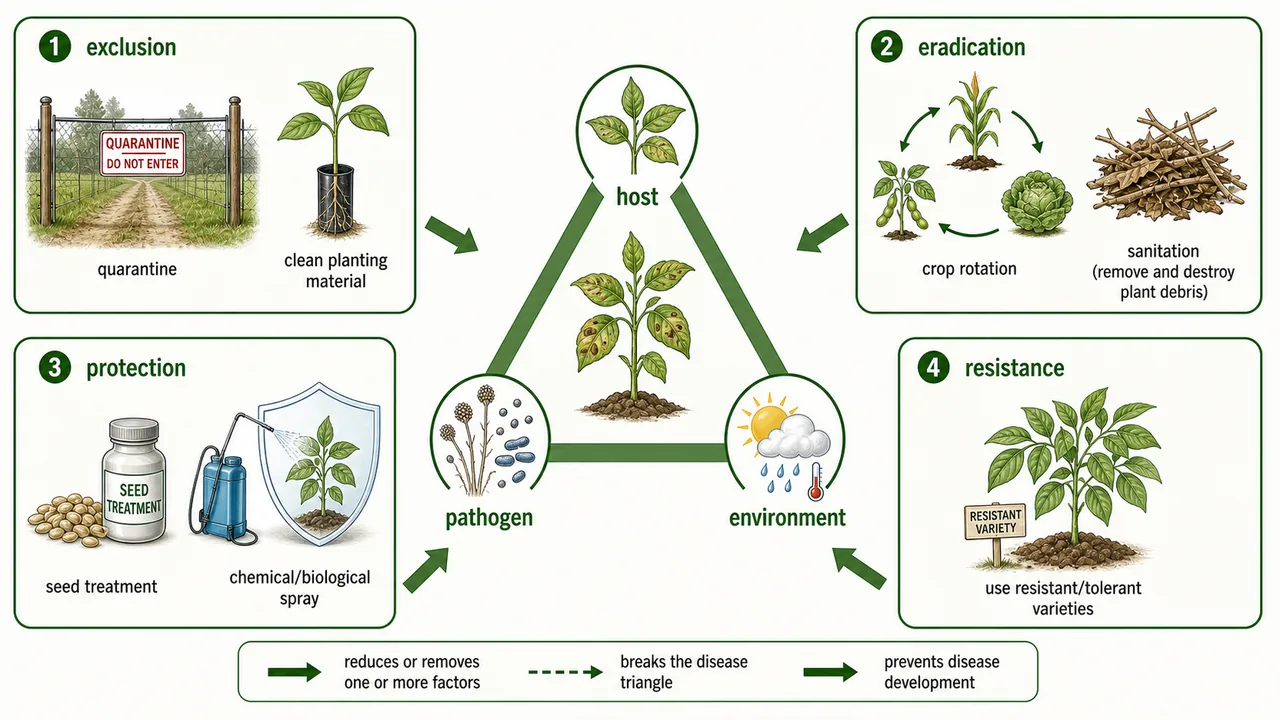
(A) Prophylaxis
- Prophylaxis includes methods which protect the plant from the attack and infection by the pathogen or from the environmental factors which favour disease development. The term prophylaxis comes from Greek, meaning “to guard or prevent beforehand”.
- These methods have further been divided into three sub-categories:
Exclusion
- Method which prevents a disease from entering into a new area. This is the first line of defense — if a pathogen is kept out of a region entirely, there is no need for other control measures.
- For example — Quarantine and Inspection, embargo, certification etc. These are regulatory measures enforced by government agencies.
Eradication
- This measure is taken for the elimination of the pathogen after its establishment on the host. Unlike exclusion (which keeps the pathogen out), eradication removes a pathogen that is already present.
- It includes
crop rotation, sanitation, elimination of alternate and overwintering hosts, elimination of pathogen from the seeds, tubers etc. Each of these practices targets a different aspect of the pathogen’s survival strategy.
Direct protection
- The principle behind this measure is that noncompliance with it can result into infection. Direct protection involves creating a physical or chemical barrier between the pathogen and the host.
- Fungicidal seed treatment methods are either eradicant or protective in nature. Eradicant treatments kill pathogens already present, while protective treatments form a shield against future infection.
- Spraying and dusting of fungicide on plant comes under direct protection.
- Other examples are controlling environmental factors in green houses and warehouses, altering the time of sowing & harvesting in order to make it favorable for the host and unfavorable for the pathogen, protecting plants from cold, frost, heat etc. and maintaining nutrient elements.
Immunization
- Immunization deals with development of disease resistance in plants. This approach strengthens the plant’s own defenses rather than attacking the pathogen directly.
- The host thus becomes capable of defending itself from the pathogen.
- Such characters are developed through selection and hybridization — the traditional methods of plant breeding that identify and combine resistance genes.
- Temporary immunization of plants can also be brought about by Chemotherapy. Chemotherapeutants are absorbed into the plant system and provide short-term resistance to specific pathogens.
- The host plant absorbs the chemotherapeutant and homogeneously circulates it in their body, providing protection throughout the plant.
👉🏻 On studying the different methods of plant disease control three conclusions are derived:
- Direct action against the pathogen or the attack on the pathogen or exclusion.
- Genetic modification of the host to resist disease or strengthening of the host.
- The alteration in the environment to make it unfavourable for disease development or to modify the environment.
These three approaches form the “disease triangle” concept — disease occurs when a susceptible host, a virulent pathogen, and a favorable environment interact simultaneously. Disrupting any one of these three factors can prevent disease.
IMPORTANT
The Disease Triangle (Host + Pathogen + Environment) is a foundational concept. Every disease management method targets at least one side of this triangle. This concept appears frequently in exams.
👉🏻 General Principles of Plant Disease Control
- Avoidance — Prevents disease by selecting a time of the year or a site where there is no inoculum or where the environment is not favorable for infection.
- Exclusion — Prevents the introduction of inoculum into a disease-free area.
- Eradication — Eliminates, destroys, or inactivates the inoculum that is already present.
- Protection — Prevents infection by means of a toxicant or some other barrier to infection.
- Resistance — Utilizes cultivars that are resistant to or tolerant of infection.
- Therapy — Cures plants that are already infected.
- Among these principles the first five are preventive measures and are adopted on the cooperative basis whereas the sixth one is curative measure. Preventive measures are always more cost-effective and reliable than curative approaches.
TIP
Memory aid: Remember the 6 principles as A-E-E-P-D-T (Avoidance, Exclusion, Eradication, Protection, Development of resistance, Therapy). First 5 = preventive, last 1 = curative.
Avoidance of the pathogen
👉🏻 It includes the following measures:
- Selection of Geographical area: A geographic area is selected on the basis of the favourable temperature and humidity requirement for a particular crop. Most of the species of fungi and bacteria develop & grow more & have more pathogenicity in humid areas in comparison to dry areas. For example — Smut and ergot disease of bajra are more in humid areas where the flowering stage prolongs in the rains for several days. Growing crops in regions where the pathogen cannot thrive is one of the simplest disease management strategies.
- Selection of field: Many soil borne diseases are controlled by proper selection of the field. It is quite possible that a particular field soil contains a pathogen species. In that case the particular crop is not sown in that field for several years. The causal organism of Red rot of sugarcane Colletotrichum falcatum survives in the soil for several months. Water drainage is also taken care of while selecting the field, as waterlogged soils promote many fungal and bacterial diseases.
- Choice of the time of sowing: The susceptible stage of plant growth and the favourable environment for pathogen should not match at the same time. By adjusting sowing dates, farmers can ensure that the crop’s vulnerable growth stages do not coincide with peak pathogen activity.
- Disease escaping varieties: Certain varieties of crop due to their growth characteristics are able to escape from disease. This disease escaping characteristic of the crop is not genetic rather it is due to growth habits and time of maturation. Early maturing variety of pea is capable of escaping powdery mildew and rust because the crop matures before the pathogen reaches its peak.
- Selection of seed: To avoid seed borne diseases, healthy and disease free seeds are essential. Using certified seed from reliable sources is one of the most effective ways to prevent disease introduction into a field.
- Modification of cultural Practices: Cultural practices such as — distance between the plants, time and frequency of irrigation, transplantation time and method, mixed cropping, amount and property of fertilizer and compost etc. can be changed to reduce losses caused by the disease. These modifications alter the microenvironment around the crop, making it less favorable for pathogen development.
Exclusion of Inoculum
👉🏻 It includes the following methods:
- Seed treatment: The pathogens present on the surface of seeds, tuber & graft etc. can be excluded by chemical treatment. This helps in avoiding entry of the pathogen in new area. Seed treatment is one of the most cost-effective disease management practices because a small amount of chemical protects the entire crop during its most vulnerable early stage.
- Physical methods:
Jensenfor the first time used heat to control internal infection of potato tubers by late blight fungus (Phytophthora infestans). It was observed that heat treatment of potato at 40°C for 4 hours results into death of the internal mycelium. The hot water treatment method of Jensen was developed in 1887 which was used to control loose smut disease of wheat, barley and Oats. Until the development of systemic fungicides, hot water treatment was the only method to control loose smut. Hot water treatment is also effective in the control of nematodes.
- Solar energy treatment to control loose smut was first developed by Luthra. In this method seeds are first rinsed or soaked in water for 4-5 hrs before drying them in scorching sun. This is a simple, cost-free method particularly useful for resource-poor farmers in tropical regions.
- Hot air treatment for the control of virus in propagating stocks was first developed by Kunkel in Peach yellow. Heat therapy works because many viruses are inactivated at temperatures that the plant can tolerate, especially in actively growing meristematic tissues.
Chemical methods
👉🏻 Seed treatment with fungicide before transplanting is done with following objectives:
- To control disease caused by seed borne infection
- To protect germinating seeds or seedlings from the attack of soil borne pathogens
Chemicals used in Seed treatment

- Chemically treated seeds are kept dry during storage. Such seeds should undergo treatment at least one week before sowing. But seeds treated with liquid chemicals are not stored and the treatment is therefore performed just before sowing — because liquid-treated seeds have higher moisture content that can promote deterioration during storage.
- Seed dressing with organomercurials is potent enough to control many diseases except loose smut disease of wheat and barley. Loose smut is internally seed-borne (the pathogen resides deep within the embryo), and surface-applied chemicals cannot reach it.
- Therefore organomercurial is called a broad spectrum seed treating fungicide — effective against a wide range of seed-borne diseases, with the notable exception of internally seed-borne pathogens.
- Systemic fungicides are suitable to control loose smut of wheat & barley because they are absorbed into the seed tissue and can reach the pathogen inside the embryo.
Types of seed treatment
👉🏻 On the basis of nature and purpose seed treatment has been divided into three categories:
- Seed Disinfection: This type of seed treatment is for the eradication of such pathogens which are
internally seed bornei.e. they are established in the seed coat or deep tissues in the seed. Examples — Loose smut of wheat & barley, stripe disease of barley, Rhizoctonia disease of tomato. Earlier only physical measures like hot water or solar energy treatment was used for the eradication of such diseases but nowadays systemic fungicides like Plantvax/oxycarboxin, Vitavax/carboxin, Benlate/Benomyl/Bavistin etc. are used for the purpose.
- Seed Disinfestation: Destruction of fungal or bacterial pathogens present on the
seed surfaceis called seed disinfestation. The fungicides used in this process are either in powder or wettable form. Many externally seed borne diseases such as — covered smut of barley or oat, Loose and grain smut of Jowar, Wheat bunt etc. can be controlled by seed disinfestation. The fungicides used in seed disinfestation are as follows: Ceresan, Panogen, Copper sulphate, copper carbonate etc. These fungicides lose their effect when the seeds are sown in soil. Due to this these are not considered good seed protectants — their action is limited to the seed surface.
- Seed Protection: Protection of seeds from soil borne pathogens during the process of seed germination is called seed protection. Pre-emergence Damping off disease in many vegetables can be controlled by seed protection. Organo-mercuric fungicides act as seed protectants. Other fungicides used as seed protectants are Captan, Thiram, Arasan, Semasan, Agrosan GN, Agallol, Aretan, Folpet etc. These chemicals create a protective zone around the seed, shielding it during the critical germination period.
- Systemic Fungicides are used for seed disinfection, seed disinfestation and seed protection — making them the most versatile class of seed treatment chemicals.
IMPORTANT
Three types of seed treatment — know the difference:
- Disinfection = kills pathogens inside the seed (internally seed-borne) → systemic fungicides
- Disinfestation = kills pathogens on the surface of the seed (externally seed-borne) → surface chemicals
- Protection = shields seed from soil-borne pathogens during germination → protectant fungicides
- Inspection and Certification: Crops grown for seed production are regularly inspected so that seed borne disease could be effectively controlled. Such disease free seeds are certified. Certified seeds carry a guarantee of genetic purity and disease-free status, giving farmers confidence in their planting material.
- Plant Quarantine: A plant quarantine can be defined as a legal restriction on the movement of agricultural commodities for the purpose of exclusion, prevention or delay in the establishment of plant pests and diseases in areas where they are not known to occur. Quarantine regulations are enforced at national borders, ports, and airports by designated plant protection officers.
IMPORTANT
Domestic quarantine in India exists for Two pests (Rooted scale and San Jose scale) and Three diseases (Bunchy top of banana, Banana mosaic, and Wart of potato).
- Eradication of Insect Vectors: Insects serve as vectors for many diseases. Eradication of such insect vectors is essential for the control of pathogens. Many viral diseases and phytoplasmal diseases are transmitted exclusively through insect vectors — controlling the vector breaks the disease transmission chain.
- Examples of some diseases and their insect vectors are as follows:
| Insect — Vector | Name of transmitting disease/pathogen |
|---|---|
| Aphids (Myzus persicae) | Potato leaf roll virus |
| Leaf hopper | Maize streak virus, Rice dwarf disease virus, Tungro virus of rice |
| White flies (Bemisia tabacci) | Yellow mosaic of beans, Vein clearning of bhindi, Tomato leaf curl |
| Thrips | Tomato spotted wilt virus |
| Mites | Wheat streak mosaic virus |
Eradication of the Pathogen
👉🏻 It includes the following principles:
- Biological control of plant pathogens: Decomposition of organic matter in the soil leads to intense microbial activity. Among them certain microorganisms have the potential to kill pathogens. In our country Root-knot nematodes and Black scurf of potato have been successfully controlled by organic soil amendments. Organic soil amendments come under biological control methods. This technique is helpful in controlling many soil borne diseases. Biological control is an eco-friendly approach that harnesses natural antagonistic relationships between microorganisms.
- Crop rotation: Crop rotation is essential for controlling soil borne diseases and pathogens. By growing non-host crops in alternate seasons, the pathogen population in the soil declines due to lack of a suitable host.
- Removal and Destruction of Diseased Plant Organs: The following methods are brought into use:
- Rogueing — removing infected plants from the field
- Eradication of Alternate and Collateral hosts — removing the secondary hosts on which pathogens survive between crop seasons
- Sanitation of Fields — removing crop debris, fallen fruits, and other material that harbors pathogens
- Heat and Chemical treatment in diseased plants: This method is used to kill the resting structures of pathogen present on the host surface. This method is very effective in controlling diseases of fruit trees, where pathogens persist on bark, branches, and pruning wounds.
- Soil treatment: The main objective of this method is to inactivate pathogens and nematodes present in the soil. For this, different chemicals, heat, flooding and fallowing etc. like physical and chemical methods are used. For controlling nematodes volatile soil fumigants are mainly used — these gaseous chemicals penetrate soil pores and kill nematodes and soil-borne fungi. Chemical treatment is performed by any one of the following methods:
- Drenching of soil with solution or suspension
- Broadcasting of dusts, powders or granules
- Furrow application
- Soil fumigation
Protective Measures
- Chemical treatment: The main objective of chemical spray, dusting and seed treatment is to form a protective poisonous layer on the host surface or to kill the parasites already present on the host surface. This layer acts as a chemical barrier that prevents pathogen spores from germinating and penetrating the plant.
- Chemical control of Insect vectors: Certain viral diseases are transmitted only through insect vectors. Therefore it becomes essential to kill these insect vectors. Insecticide sprays, systemic insecticides, and sticky traps are common methods used for vector control.
- Modification of Environments: Hot and humid conditions are favourable for disease and pathogens. Ploughing, frequency and amount of irrigation etc. change the environment up to a certain extent. Reducing plant canopy density, improving air circulation, and managing soil moisture can significantly reduce disease incidence.
- Modification of Host nutrition: Host nutrition also affects diseases. Excessive nitrogen promotes leaf diseases whereas excess of Ca (Calcium) and K (Potassium) makes the plant disease resistant. Balanced nutrient management in crops can help in reducing the intensity of many diseases. Potassium strengthens cell walls while calcium improves cell membrane integrity, both making it harder for pathogens to penetrate.
WARNING
Excess nitrogen is a common exam trap! While nitrogen boosts vegetative growth, too much N makes plants succulent and vulnerable to pathogens. In contrast, K and Ca strengthen plant defenses.
Development of Resistance in Hosts
👉🏻 Development of resistance in hosts is brought about by following methods:
- Selection and Hybridization for disease resistance — this is the most sustainable and economical method of disease control. Plant breeders identify resistance genes from wild relatives or landraces and incorporate them into high-yielding varieties through crossing and selection.
- Through chemotherapy — when systemic fungicides and antibiotics are applied to plants in form of foliar spray or through roots, their toxic effects persist on crops. This provides temporary (induced) resistance for the duration of the chemical’s activity.
- Through host nutrition — providing balanced nutrition strengthens the plant’s natural defense mechanisms.
Therapy of Diseased Plants
👉🏻 Diseased plants are cured through following methods:
- Chemotherapy — applying fungicides, bactericides, or antibiotics to cure existing infections
- Heat therapy — using controlled heat to inactivate pathogens (especially viruses) within the plant tissue
- Tree-surgery — The diseased branches of trees are removed or the diseased parts scraped and fungicidal paste is applied on the wounded areas.
- This helps in checking infection. Important diseases of apple: Black stem, Brown stem and Pink disease etc. are controlled through surgery. Tree surgery is particularly important in orchards where trees represent long-term investments that cannot simply be replaced.
Soil treating chemicals
- It is used for controlling such soil borne diseases which attack on seeds or seedlings.
- The examples of such chemicals are – Formaldehyde, Captan, Thiram, Zineb, Organo-mercurials, PCNB, Ethylene dibromide, Vapam etc. Each chemical has specific strengths — for example, PCNB is particularly effective against Rhizoctonia and Sclerotium, while Vapam is a broad-spectrum soil fumigant.
Seed treating chemicals
- It is used for controlling seed borne diseases. Seed borne diseases are of two types:
- Externally seed borne diseases: For controlling these diseases, Chemicals such as Formalin, TMTD (Thiram), Copper carbonate, Captan, Organo-mercurials (Agrosan GN and Ceresan) are used for seed treatment. These chemicals form a protective coating on the seed surface.
- Internally seed borne diseases: For controlling internally seed borne disease, hot water treatment and solar treatment are used. Systemic Organic Compounds are effective chemicals for controlling both externally and internally seed borne diseases because they can penetrate into seed tissue.
- Examples of Systemic fungicides: Oxathiin derivatives (
PlantvaxandVitavax),Benlate,Bavistin, Demosan.
- For controlling air borne diseases, foliar application of chemicals is more effective. Foliar sprays create a protective barrier on the leaf surface where airborne spores land and attempt to germinate.
- The common copper fungicides are Perenox, Perelan, Blitox, Cuprokyt, Cuprosan, Fytolan. Their use is comparatively better than that of Bordeaux mixture because they are easier to prepare, more uniform in composition, and less likely to cause phytotoxicity.
- Use of Organo-sulphur compounds such as Thiram and Dithiocarbamates (Zineb, Ziram) is a safer alternative for tender and sensitive foliage. These organic compounds are gentler on plant tissue compared to copper-based fungicides.
Bacterial Diseases
| Common Name | Particular Bacteria |
|---|---|
| Citrus Canker | Xanthomonas citri |
| Black rot of crucifers | Xanthomonas compesiris |
| Bacterial blight of Rice | Xanthomonas oryzae |
| Angular leaf spot of Cotton or Black arm disease | Xanthornonas malvacearum |
| Leaf spot of chilli | Xanthomonas vesicatoria |
| Red stripe of sugarcane | Xanthomonas rubriliniens |
| Bacterial wilt of solanacious plants/Brown rot of Potato/Ring diseases of Potato | Pseudomonas solanacearum |
| Fire blight of Apple and Pear | Erwinia amylovora |
| Soft rot of carrot | Erwinia crotovora |
| Scab disease | Streptomyces scabies |
Bacterial Diseases — Detailed Reference Table
| Disease | Causal Organism |
|---|---|
| Citrus greening | Candidatus liberibacter spp. |
| Citrus canker | Xanthomonas citri |
| Black rot of crucifers | Xanthomonas compestris |
| Bacterial blight of rice | Xanthomonas oryzae |
| Angular leaf spot of cotton / Black arm disease | Xanthomonas malvacearum |
| Leaf spot of chilli | Xanthomonas vesicatoria |
| Red stripe of sugarcane | Xanthomonas rubriliniens |
| Bacterial wilt of solanaceous plants / Brown rot of potato / Ring disease of potato | Pseudomonas solanacearum |
| Fire blight of apple and pear | Erwinia amylovora |
| Soft rot of carrot | Erwinia crotovora |
| Scab disease | Streptomyces scabies |
Mycoplasmal / Phytoplasmal Diseases
| Host Plant | Name of Mycoplasma diseases |
|---|---|
| Rice | Yellow dwarf disease |
| Safflower | Phyllody |
| Sesamum | Phyllody |
| Brinjal (Eggplant) | Little leaf |
| Citrus | Greening disease |
| Sugarcane | Grassy shoot, white leaf |
| Potato | Purple top; witches broom |
| Coconut | Lethal Yellowing |
Phytoplasmal Diseases — Detailed Reference Table with Vectors
| Host Plant | Disease | Vector |
|---|---|---|
| Rice | Yellow dwarf disease | Green leaf hopper (Nephotettix virescens) |
| Safflower | Phyllody | Leaf hopper |
| Sesamum | Phyllody | Leaf hopper (Orosius albicinctus) |
| Brinjal | Little leaf | Leaf hopper (Cestius phycitis) |
| Sugarcane | Grassy shoot, White leaf | Aphids |
| Potato | Purple top, Witches broom | Leaf hopper |
| Coconut | Lethal yellowing | — |
| Sandal | Sandalwood spike disease | Leaf hopper (Jassus indicus) |
| Coconut | Root wilt disease | Plant hoppers & Lace wing bug |
| Peach & Plum | X disease | Leaf hopper |
WARNING
Greening disease of citrus is actually a bacterial disease caused by Candidatus liberibacter spp. (gram negative bacteria). Previously it was considered as mycoplasmal disease. This reclassification is important for choosing the correct management strategy — bacterial diseases and mycoplasmal diseases respond to different treatments.
Viral Diseases
| Host plant | Name of Viral diseases |
|---|---|
| Wheat | Mosaic streak |
| Maize | Mosaic, vein enation |
| Barley | Mosaic, Yellow dwarf |
| Pearl Millet | Mosaic |
| Sorghum | Yellowing |
| Rice | Tungro diseases |
| Sugarcane | Grassy stunt, RSD (Ratoon stunting Disease) |
| Potato | Potato necrosis; Potato severe mosaic, Leaf roll; super mild mosaic |
| Tomato | Leaf curl; Mosaic; Black ring spot |
| Chilli | Leaf curl; Mosaic |
| Bhindi | Yellow vein mosaic (YVM) |
| Onion | Yellow dwarf |
| Urad | Leaf crinkle |
| Pigeon Pea | Sterility mosaic |
| Groundnut | Clump disease; mosaic; chlorosis |
| Tobacco | Leaf curl; yellow net vein (YNV); mosaic |
| Banana | Bunchy top; mosaic, Banana streak |
| Citrus | Tristeza and Quick decline |
| Papaya | Distortion ringspot, mosaic, leaf curl. |
Viral Diseases — Detailed Reference Table with Vectors
| Host Plant | Viral Disease | Vector |
|---|---|---|
| Wheat | Streak mosaic | Eriophyid mite (Aceria tulipae) |
| Maize | Mosaic, Vein enation | Sorghum bug (Peregrinus maidis) |
| Barley | Mosaic, Yellow dwarf | — |
| Bajra | Mosaic | — |
| Jowar | Yellowing | — |
| Rice | Tungro disease | GLH (Nephotettix virescens) |
| Rice | Grassy stunt | GLH (Nephotettix virescens) |
| Sugarcane | RSD (Ratoon stunting disease) | — |
| Potato | Potato necrosis, Severe mosaic | — |
| Potato | Potato leaf roll | Aphid (Myzus persicae) |
| Tomato | Leaf curl | White fly (Bemisia tabaci) |
| Chilli | Leaf curl | White fly (Bemisia tabaci) / Thrips (Scirtothrips dorsalis) |
| Chilli | Mosaic | White fly (Bemisia tabaci) |
| Okra | Yellow vein mosaic (YVM) | White fly (Bemisia tabaci) |
| Onion | Yellow dwarf | — |
| Pigeon pea | Sterility mosaic | Eriophyid mite (Aceria cajani) |
| Groundnut | Clump disease, Mosaic, Ring spot | — |
| Groundnut | Rosette virus | Aphid (Aphis craccivora) |
| Groundnut | Bud necrosis | Thrips (Frankliniella scultzei) |
| Banana | Bunchy top | Aphid (Pentalonia nigronervosa) |
| Banana | Mosaic, Banana streak | — |
| Citrus | Tristeza or Quick decline | Aphid (Toxoptera aurantii) |
| Papaya | Mosaic | Aphid (Aphis craccivora) |
| Papaya | Distortion ringspot, Leaf curl | — |
| Cotton | Leaf curl | White fly (Bemisia tabaci) |
| Cardamom | Katte / Foorkey | Aphid (Pentalonia nigronervosa) |
| Cowpea | Mosaic | Aphid (Aphis craccivora) |
Plant affected by Burrowing nematode
| Names of disease and host plants | Particular nematode |
|---|---|
| Ufra disease of Rice | Ditylenchus angustus |
| Root lesion disease of chillies, coffee, cotton, tea, rice | Pratylenchus spp. |
| Plants affected by Golden nematode / sugarbeet nematode. Host Plants — Potato, Brinjal, Sugarbeet, Beet | Heterodera rostochiensis |
| Plant affected by Burrowing nematode. Host Plants — banana, rice, citrus | Radopholus similes |
| Root knot disease/Root gall disease. Host plant — coffee | Meliodogyne exigua |
Summary Cheat Sheet
| Concept / Topic | Key Details |
|---|---|
| Disease Triangle | Disease = susceptible Host + virulent Pathogen + favourable Environment |
| Prophylaxis | Protective measures: Exclusion, Eradication, Direct Protection |
| Immunization | Developing disease resistance via selection, hybridization, or chemotherapy |
| 6 Control Principles | A-E-E-P-R-T: Avoidance, Exclusion, Eradication, Protection, Resistance, Therapy; first 5 = preventive |
| Quarantine | Legal restriction on movement of agricultural commodities to exclude pathogens |
| Domestic quarantine (India) | 2 pests (Rooted scale, San Jose scale) + 3 diseases (Bunchy top, Banana mosaic, Wart of potato) |
| Seed Disinfection | Kills internally seed-borne pathogens; systemic fungicides or hot water treatment |
| Seed Disinfestation | Kills pathogens on seed surface; Ceresan, Panogen, CuSO₄ |
| Seed Protection | Shields from soil-borne pathogens during germination; Captan, Thiram, Agrosan GN |
| Jensen (1887) | Hot water treatment for late blight (40°C, 4 hrs) and loose smut of wheat |
| Luthra | Solar energy treatment for loose smut; soak seeds 4-5 hrs then dry in sun |
| Crop rotation | Controls soil-borne diseases by breaking pathogen-host cycle |
| Biological control | Organic amendments control root-knot nematodes & black scurf of potato |
| Host nutrition effect | Excess N promotes disease; excess Ca & K makes plants resistant |
| Citrus canker | Xanthomonas citri; bacterial disease |
| Citrus greening | Candidatus liberibacter spp.; bacterial (NOT mycoplasmal) |
| Fire blight | Erwinia amylovora; first bacterial plant disease (Burrill, 1878) |
| Brinjal little leaf | Phytoplasma; vector = leafhopper Cestius phycitis |
| Sandalwood spike | Phytoplasma; vector = leafhopper Jassus indicus |
| Sesamum phyllody | Phytoplasma; vector = leafhopper Orosius albicinctus |
| Tomato leaf curl | Viral; vector = whitefly Bemisia tabaci |
| Okra YVM | Viral; vector = whitefly Bemisia tabaci |
| Potato leaf roll | Viral; vector = aphid Myzus persicae |
| Banana bunchy top | Viral; vector = aphid Pentalonia nigronervosa |
| Pigeon pea sterility mosaic | Viral; vector = eriophyid mite Aceria cajani |
Pro Content Locked
Upgrade to Pro to access this lesson and all other premium content.
₹2388 billed yearly
- All Agriculture & Banking Courses
- AI Lesson Questions (100/day)
- AI Doubt Solver (50/day)
- Glows & Grows Feedback (30/day)
- AI Section Quiz (20/day)
- 22-Language Translation (30/day)
- Recall Questions (20/day)
- AI Quiz (15/day)
- AI Quiz Paper Analysis
- AI Step-by-Step Explanations
- Spaced Repetition Recall (FSRS)
- AI Tutor
- Immersive Text Questions
- Audio Lessons — Hindi & English
- Mock Tests & Previous Year Papers
- Summary & Mind Maps
- XP, Levels, Leaderboard & Badges
- Generate New Classrooms
- Voice AI Teacher (AgriDots Live)
- AI Revision Assistant
- Knowledge Gap Analysis
- Interactive Revision (LangGraph)
🔒 Secure via Razorpay · Cancel anytime · No hidden fees
From Field to Lab — Prevention is Better Than Cure
A progressive farmer in Punjab rotates wheat with mustard every season, treats seeds with Vitavax before sowing, removes wild barberry bushes (alternate host for wheat rust) from field borders, and selects resistant varieties — all without knowing that each of these practices targets a different side of the disease triangle (host, pathogen, environment). Disease management is not about a single magic spray; it is a system of multiple defences working together.
- Till the appearance of disease symptom the pathogen has taken command over the plant. By the time symptoms become visible, the pathogen has already established itself deeply in the host tissue, making curative treatment difficult.
- In order to avoid such a situation it is essential to protect plants from disease i.e. protective and preventive measures should be undertaken well before infection occurs.
- Therefore it is said prevention is better than cure. This fundamental principle guides all modern plant disease management strategies.
Classification of Plant Disease Control Methods
- The control measures for plant diseases have been classified into two categories: (A) Prophylaxis (B) Immunization

(A) Prophylaxis
- Prophylaxis includes methods which protect the plant from the attack and infection by the pathogen or from the environmental factors which favour disease development. The term prophylaxis comes from Greek, meaning “to guard or prevent beforehand”.
- These methods have further been divided into three sub-categories:
Exclusion
- Method which prevents a disease from entering into a new area. This is the first line of defense — if a pathogen is kept out of a region entirely, there is no need for other control measures.
- For example — Quarantine and Inspection, embargo, certification etc. These are regulatory measures enforced by government agencies.
Eradication
- This measure is taken for the elimination of the pathogen after its establishment on the host. Unlike exclusion (which keeps the pathogen out), eradication removes a pathogen that is already present.
- It includes
crop rotation, sanitation, elimination of alternate and overwintering hosts, elimination of pathogen from the seeds, tubers etc. Each of these practices targets a different aspect of the pathogen’s survival strategy.
Direct protection
- The principle behind this measure is that noncompliance with it can result into infection. Direct protection involves creating a physical or chemical barrier between the pathogen and the host.
- Fungicidal seed treatment methods are either eradicant or protective in nature. Eradicant treatments kill pathogens already present, while protective treatments form a shield against future infection.
- Spraying and dusting of fungicide on plant comes under direct protection.
- Other examples are controlling environmental factors in green houses and warehouses, altering the time of sowing & harvesting in order to make it favorable for the host and unfavorable for the pathogen, protecting plants from cold, frost, heat etc. and maintaining nutrient elements.
Immunization
- Immunization deals with development of disease resistance in plants. This approach strengthens the plant’s own defenses rather than attacking the pathogen directly.
- The host thus becomes capable of defending itself from the pathogen.
- Such characters are developed through selection and hybridization — the traditional methods of plant breeding that identify and combine resistance genes.
- Temporary immunization of plants can also be brought about by Chemotherapy. Chemotherapeutants are absorbed into the plant system and provide short-term resistance to specific pathogens.
- The host plant absorbs the chemotherapeutant and homogeneously circulates it in their body, providing protection throughout the plant.
👉🏻 On studying the different methods of plant disease control three conclusions are derived:
- Direct action against the pathogen or the attack on the pathogen or exclusion.
- Genetic modification of the host to resist disease or strengthening of the host.
- The alteration in the environment to make it unfavourable for disease development or to modify the environment.
These three approaches form the “disease triangle” concept — disease occurs when a susceptible host, a virulent pathogen, and a favorable environment interact simultaneously. Disrupting any one of these three factors can prevent disease.
IMPORTANT
The Disease Triangle (Host + Pathogen + Environment) is a foundational concept. Every disease management method targets at least one side of this triangle. This concept appears frequently in exams.
👉🏻 General Principles of Plant Disease Control
- Avoidance — Prevents disease by selecting a time of the year or a site where there is no inoculum or where the environment is not favorable for infection.
- Exclusion — Prevents the introduction of inoculum into a disease-free area.
- Eradication — Eliminates, destroys, or inactivates the inoculum that is already present.
- Protection — Prevents infection by means of a toxicant or some other barrier to infection.
- Resistance — Utilizes cultivars that are resistant to or tolerant of infection.
- Therapy — Cures plants that are already infected.
- Among these principles the first five are preventive measures and are adopted on the cooperative basis whereas the sixth one is curative measure. Preventive measures are always more cost-effective and reliable than curative approaches.
TIP
Memory aid: Remember the 6 principles as A-E-E-P-D-T (Avoidance, Exclusion, Eradication, Protection, Development of resistance, Therapy). First 5 = preventive, last 1 = curative.
Avoidance of the pathogen
👉🏻 It includes the following measures:
- Selection of Geographical area: A geographic area is selected on the basis of the favourable temperature and humidity requirement for a particular crop. Most of the species of fungi and bacteria develop & grow more & have more pathogenicity in humid areas in comparison to dry areas. For example — Smut and ergot disease of bajra are more in humid areas where the flowering stage prolongs in the rains for several days. Growing crops in regions where the pathogen cannot thrive is one of the simplest disease management strategies.
- Selection of field: Many soil borne diseases are controlled by proper selection of the field. It is quite possible that a particular field soil contains a pathogen species. In that case the particular crop is not sown in that field for several years. The causal organism of Red rot of sugarcane Colletotrichum falcatum survives in the soil for several months. Water drainage is also taken care of while selecting the field, as waterlogged soils promote many fungal and bacterial diseases.
- Choice of the time of sowing: The susceptible stage of plant growth and the favourable environment for pathogen should not match at the same time. By adjusting sowing dates, farmers can ensure that the crop’s vulnerable growth stages do not coincide with peak pathogen activity.
- Disease escaping varieties: Certain varieties of crop due to their growth characteristics are able to escape from disease. This disease escaping characteristic of the crop is not genetic rather it is due to growth habits and time of maturation. Early maturing variety of pea is capable of escaping powdery mildew and rust because the crop matures before the pathogen reaches its peak.
- Selection of seed: To avoid seed borne diseases, healthy and disease free seeds are essential. Using certified seed from reliable sources is one of the most effective ways to prevent disease introduction into a field.
- Modification of cultural Practices: Cultural practices such as — distance between the plants, time and frequency of irrigation, transplantation time and method, mixed cropping, amount and property of fertilizer and compost etc. can be changed to reduce losses caused by the disease. These modifications alter the microenvironment around the crop, making it less favorable for pathogen development.
Exclusion of Inoculum
👉🏻 It includes the following methods:
- Seed treatment: The pathogens present on the surface of seeds, tuber & graft etc. can be excluded by chemical treatment. This helps in avoiding entry of the pathogen in new area. Seed treatment is one of the most cost-effective disease management practices because a small amount of chemical protects the entire crop during its most vulnerable early stage.
- Physical methods:
Jensenfor the first time used heat to control internal infection of potato tubers by late blight fungus (Phytophthora infestans). It was observed that heat treatment of potato at 40°C for 4 hours results into death of the internal mycelium. The hot water treatment method of Jensen was developed in 1887 which was used to control loose smut disease of wheat, barley and Oats. Until the development of systemic fungicides, hot water treatment was the only method to control loose smut. Hot water treatment is also effective in the control of nematodes.
- Solar energy treatment to control loose smut was first developed by Luthra. In this method seeds are first rinsed or soaked in water for 4-5 hrs before drying them in scorching sun. This is a simple, cost-free method particularly useful for resource-poor farmers in tropical regions.
- Hot air treatment for the control of virus in propagating stocks was first developed by Kunkel in Peach yellow. Heat therapy works because many viruses are inactivated at temperatures that the plant can tolerate, especially in actively growing meristematic tissues.
Chemical methods
👉🏻 Seed treatment with fungicide before transplanting is done with following objectives:
- To control disease caused by seed borne infection
- To protect germinating seeds or seedlings from the attack of soil borne pathogens
Chemicals used in Seed treatment

- Chemically treated seeds are kept dry during storage. Such seeds should undergo treatment at least one week before sowing. But seeds treated with liquid chemicals are not stored and the treatment is therefore performed just before sowing — because liquid-treated seeds have higher moisture content that can promote deterioration during storage.
- Seed dressing with organomercurials is potent enough to control many diseases except loose smut disease of wheat and barley. Loose smut is internally seed-borne (the pathogen resides deep within the embryo), and surface-applied chemicals cannot reach it.
- Therefore organomercurial is called a broad spectrum seed treating fungicide — effective against a wide range of seed-borne diseases, with the notable exception of internally seed-borne pathogens.
- Systemic fungicides are suitable to control loose smut of wheat & barley because they are absorbed into the seed tissue and can reach the pathogen inside the embryo.
Types of seed treatment
👉🏻 On the basis of nature and purpose seed treatment has been divided into three categories:
- Seed Disinfection: This type of seed treatment is for the eradication of such pathogens which are
internally seed bornei.e. they are established in the seed coat or deep tissues in the seed. Examples — Loose smut of wheat & barley, stripe disease of barley, Rhizoctonia disease of tomato. Earlier only physical measures like hot water or solar energy treatment was used for the eradication of such diseases but nowadays systemic fungicides like Plantvax/oxycarboxin, Vitavax/carboxin, Benlate/Benomyl/Bavistin etc. are used for the purpose.
- Seed Disinfestation: Destruction of fungal or bacterial pathogens present on the
seed surfaceis called seed disinfestation. The fungicides used in this process are either in powder or wettable form. Many externally seed borne diseases such as — covered smut of barley or oat, Loose and grain smut of Jowar, Wheat bunt etc. can be controlled by seed disinfestation. The fungicides used in seed disinfestation are as follows: Ceresan, Panogen, Copper sulphate, copper carbonate etc. These fungicides lose their effect when the seeds are sown in soil. Due to this these are not considered good seed protectants — their action is limited to the seed surface.
- Seed Protection: Protection of seeds from soil borne pathogens during the process of seed germination is called seed protection. Pre-emergence Damping off disease in many vegetables can be controlled by seed protection. Organo-mercuric fungicides act as seed protectants. Other fungicides used as seed protectants are Captan, Thiram, Arasan, Semasan, Agrosan GN, Agallol, Aretan, Folpet etc. These chemicals create a protective zone around the seed, shielding it during the critical germination period.
- Systemic Fungicides are used for seed disinfection, seed disinfestation and seed protection — making them the most versatile class of seed treatment chemicals.
IMPORTANT
Three types of seed treatment — know the difference:
- Disinfection = kills pathogens inside the seed (internally seed-borne) → systemic fungicides
- Disinfestation = kills pathogens on the surface of the seed (externally seed-borne) → surface chemicals
- Protection = shields seed from soil-borne pathogens during germination → protectant fungicides
- Inspection and Certification: Crops grown for seed production are regularly inspected so that seed borne disease could be effectively controlled. Such disease free seeds are certified. Certified seeds carry a guarantee of genetic purity and disease-free status, giving farmers confidence in their planting material.
- Plant Quarantine: A plant quarantine can be defined as a legal restriction on the movement of agricultural commodities for the purpose of exclusion, prevention or delay in the establishment of plant pests and diseases in areas where they are not known to occur. Quarantine regulations are enforced at national borders, ports, and airports by designated plant protection officers.
IMPORTANT
Domestic quarantine in India exists for Two pests (Rooted scale and San Jose scale) and Three diseases (Bunchy top of banana, Banana mosaic, and Wart of potato).
- Eradication of Insect Vectors: Insects serve as vectors for many diseases. Eradication of such insect vectors is essential for the control of pathogens. Many viral diseases and phytoplasmal diseases are transmitted exclusively through insect vectors — controlling the vector breaks the disease transmission chain.
- Examples of some diseases and their insect vectors are as follows:
| Insect — Vector | Name of transmitting disease/pathogen |
|---|---|
| Aphids (Myzus persicae) | Potato leaf roll virus |
| Leaf hopper | Maize streak virus, Rice dwarf disease virus, Tungro virus of rice |
| White flies (Bemisia tabacci) | Yellow mosaic of beans, Vein clearning of bhindi, Tomato leaf curl |
| Thrips | Tomato spotted wilt virus |
| Mites | Wheat streak mosaic virus |
Eradication of the Pathogen
👉🏻 It includes the following principles:
- Biological control of plant pathogens: Decomposition of organic matter in the soil leads to intense microbial activity. Among them certain microorganisms have the potential to kill pathogens. In our country Root-knot nematodes and Black scurf of potato have been successfully controlled by organic soil amendments. Organic soil amendments come under biological control methods. This technique is helpful in controlling many soil borne diseases. Biological control is an eco-friendly approach that harnesses natural antagonistic relationships between microorganisms.
- Crop rotation: Crop rotation is essential for controlling soil borne diseases and pathogens. By growing non-host crops in alternate seasons, the pathogen population in the soil declines due to lack of a suitable host.
- Removal and Destruction of Diseased Plant Organs: The following methods are brought into use:
- Rogueing — removing infected plants from the field
- Eradication of Alternate and Collateral hosts — removing the secondary hosts on which pathogens survive between crop seasons
- Sanitation of Fields — removing crop debris, fallen fruits, and other material that harbors pathogens
- Heat and Chemical treatment in diseased plants: This method is used to kill the resting structures of pathogen present on the host surface. This method is very effective in controlling diseases of fruit trees, where pathogens persist on bark, branches, and pruning wounds.
- Soil treatment: The main objective of this method is to inactivate pathogens and nematodes present in the soil. For this, different chemicals, heat, flooding and fallowing etc. like physical and chemical methods are used. For controlling nematodes volatile soil fumigants are mainly used — these gaseous chemicals penetrate soil pores and kill nematodes and soil-borne fungi. Chemical treatment is performed by any one of the following methods:
- Drenching of soil with solution or suspension
- Broadcasting of dusts, powders or granules
- Furrow application
- Soil fumigation
Protective Measures
- Chemical treatment: The main objective of chemical spray, dusting and seed treatment is to form a protective poisonous layer on the host surface or to kill the parasites already present on the host surface. This layer acts as a chemical barrier that prevents pathogen spores from germinating and penetrating the plant.
- Chemical control of Insect vectors: Certain viral diseases are transmitted only through insect vectors. Therefore it becomes essential to kill these insect vectors. Insecticide sprays, systemic insecticides, and sticky traps are common methods used for vector control.
- Modification of Environments: Hot and humid conditions are favourable for disease and pathogens. Ploughing, frequency and amount of irrigation etc. change the environment up to a certain extent. Reducing plant canopy density, improving air circulation, and managing soil moisture can significantly reduce disease incidence.
- Modification of Host nutrition: Host nutrition also affects diseases. Excessive nitrogen promotes leaf diseases whereas excess of Ca (Calcium) and K (Potassium) makes the plant disease resistant. Balanced nutrient management in crops can help in reducing the intensity of many diseases. Potassium strengthens cell walls while calcium improves cell membrane integrity, both making it harder for pathogens to penetrate.
WARNING
Excess nitrogen is a common exam trap! While nitrogen boosts vegetative growth, too much N makes plants succulent and vulnerable to pathogens. In contrast, K and Ca strengthen plant defenses.
Development of Resistance in Hosts
👉🏻 Development of resistance in hosts is brought about by following methods:
- Selection and Hybridization for disease resistance — this is the most sustainable and economical method of disease control. Plant breeders identify resistance genes from wild relatives or landraces and incorporate them into high-yielding varieties through crossing and selection.
- Through chemotherapy — when systemic fungicides and antibiotics are applied to plants in form of foliar spray or through roots, their toxic effects persist on crops. This provides temporary (induced) resistance for the duration of the chemical’s activity.
- Through host nutrition — providing balanced nutrition strengthens the plant’s natural defense mechanisms.
Therapy of Diseased Plants
👉🏻 Diseased plants are cured through following methods:
- Chemotherapy — applying fungicides, bactericides, or antibiotics to cure existing infections
- Heat therapy — using controlled heat to inactivate pathogens (especially viruses) within the plant tissue
- Tree-surgery — The diseased branches of trees are removed or the diseased parts scraped and fungicidal paste is applied on the wounded areas.
- This helps in checking infection. Important diseases of apple: Black stem, Brown stem and Pink disease etc. are controlled through surgery. Tree surgery is particularly important in orchards where trees represent long-term investments that cannot simply be replaced.
Soil treating chemicals
- It is used for controlling such soil borne diseases which attack on seeds or seedlings.
- The examples of such chemicals are – Formaldehyde, Captan, Thiram, Zineb, Organo-mercurials, PCNB, Ethylene dibromide, Vapam etc. Each chemical has specific strengths — for example, PCNB is particularly effective against Rhizoctonia and Sclerotium, while Vapam is a broad-spectrum soil fumigant.
Seed treating chemicals
- It is used for controlling seed borne diseases. Seed borne diseases are of two types:
- Externally seed borne diseases: For controlling these diseases, Chemicals such as Formalin, TMTD (Thiram), Copper carbonate, Captan, Organo-mercurials (Agrosan GN and Ceresan) are used for seed treatment. These chemicals form a protective coating on the seed surface.
- Internally seed borne diseases: For controlling internally seed borne disease, hot water treatment and solar treatment are used. Systemic Organic Compounds are effective chemicals for controlling both externally and internally seed borne diseases because they can penetrate into seed tissue.
- Examples of Systemic fungicides: Oxathiin derivatives (
PlantvaxandVitavax),Benlate,Bavistin, Demosan.
- For controlling air borne diseases, foliar application of chemicals is more effective. Foliar sprays create a protective barrier on the leaf surface where airborne spores land and attempt to germinate.
- The common copper fungicides are Perenox, Perelan, Blitox, Cuprokyt, Cuprosan, Fytolan. Their use is comparatively better than that of Bordeaux mixture because they are easier to prepare, more uniform in composition, and less likely to cause phytotoxicity.
- Use of Organo-sulphur compounds such as Thiram and Dithiocarbamates (Zineb, Ziram) is a safer alternative for tender and sensitive foliage. These organic compounds are gentler on plant tissue compared to copper-based fungicides.
Bacterial Diseases
| Common Name | Particular Bacteria |
|---|---|
| Citrus Canker | Xanthomonas citri |
| Black rot of crucifers | Xanthomonas compesiris |
| Bacterial blight of Rice | Xanthomonas oryzae |
| Angular leaf spot of Cotton or Black arm disease | Xanthornonas malvacearum |
| Leaf spot of chilli | Xanthomonas vesicatoria |
| Red stripe of sugarcane | Xanthomonas rubriliniens |
| Bacterial wilt of solanacious plants/Brown rot of Potato/Ring diseases of Potato | Pseudomonas solanacearum |
| Fire blight of Apple and Pear | Erwinia amylovora |
| Soft rot of carrot | Erwinia crotovora |
| Scab disease | Streptomyces scabies |
Bacterial Diseases — Detailed Reference Table
| Disease | Causal Organism |
|---|---|
| Citrus greening | Candidatus liberibacter spp. |
| Citrus canker | Xanthomonas citri |
| Black rot of crucifers | Xanthomonas compestris |
| Bacterial blight of rice | Xanthomonas oryzae |
| Angular leaf spot of cotton / Black arm disease | Xanthomonas malvacearum |
| Leaf spot of chilli | Xanthomonas vesicatoria |
| Red stripe of sugarcane | Xanthomonas rubriliniens |
| Bacterial wilt of solanaceous plants / Brown rot of potato / Ring disease of potato | Pseudomonas solanacearum |
| Fire blight of apple and pear | Erwinia amylovora |
| Soft rot of carrot | Erwinia crotovora |
| Scab disease | Streptomyces scabies |
Mycoplasmal / Phytoplasmal Diseases
| Host Plant | Name of Mycoplasma diseases |
|---|---|
| Rice | Yellow dwarf disease |
| Safflower | Phyllody |
| Sesamum | Phyllody |
| Brinjal (Eggplant) | Little leaf |
| Citrus | Greening disease |
| Sugarcane | Grassy shoot, white leaf |
| Potato | Purple top; witches broom |
| Coconut | Lethal Yellowing |
Phytoplasmal Diseases — Detailed Reference Table with Vectors
| Host Plant | Disease | Vector |
|---|---|---|
| Rice | Yellow dwarf disease | Green leaf hopper (Nephotettix virescens) |
| Safflower | Phyllody | Leaf hopper |
| Sesamum | Phyllody | Leaf hopper (Orosius albicinctus) |
| Brinjal | Little leaf | Leaf hopper (Cestius phycitis) |
| Sugarcane | Grassy shoot, White leaf | Aphids |
| Potato | Purple top, Witches broom | Leaf hopper |
| Coconut | Lethal yellowing | — |
| Sandal | Sandalwood spike disease | Leaf hopper (Jassus indicus) |
| Coconut | Root wilt disease | Plant hoppers & Lace wing bug |
| Peach & Plum | X disease | Leaf hopper |
WARNING
Greening disease of citrus is actually a bacterial disease caused by Candidatus liberibacter spp. (gram negative bacteria). Previously it was considered as mycoplasmal disease. This reclassification is important for choosing the correct management strategy — bacterial diseases and mycoplasmal diseases respond to different treatments.
Viral Diseases
| Host plant | Name of Viral diseases |
|---|---|
| Wheat | Mosaic streak |
| Maize | Mosaic, vein enation |
| Barley | Mosaic, Yellow dwarf |
| Pearl Millet | Mosaic |
| Sorghum | Yellowing |
| Rice | Tungro diseases |
| Sugarcane | Grassy stunt, RSD (Ratoon stunting Disease) |
| Potato | Potato necrosis; Potato severe mosaic, Leaf roll; super mild mosaic |
| Tomato | Leaf curl; Mosaic; Black ring spot |
| Chilli | Leaf curl; Mosaic |
| Bhindi | Yellow vein mosaic (YVM) |
| Onion | Yellow dwarf |
| Urad | Leaf crinkle |
| Pigeon Pea | Sterility mosaic |
| Groundnut | Clump disease; mosaic; chlorosis |
| Tobacco | Leaf curl; yellow net vein (YNV); mosaic |
| Banana | Bunchy top; mosaic, Banana streak |
| Citrus | Tristeza and Quick decline |
| Papaya | Distortion ringspot, mosaic, leaf curl. |
Viral Diseases — Detailed Reference Table with Vectors
| Host Plant | Viral Disease | Vector |
|---|---|---|
| Wheat | Streak mosaic | Eriophyid mite (Aceria tulipae) |
| Maize | Mosaic, Vein enation | Sorghum bug (Peregrinus maidis) |
| Barley | Mosaic, Yellow dwarf | — |
| Bajra | Mosaic | — |
| Jowar | Yellowing | — |
| Rice | Tungro disease | GLH (Nephotettix virescens) |
| Rice | Grassy stunt | GLH (Nephotettix virescens) |
| Sugarcane | RSD (Ratoon stunting disease) | — |
| Potato | Potato necrosis, Severe mosaic | — |
| Potato | Potato leaf roll | Aphid (Myzus persicae) |
| Tomato | Leaf curl | White fly (Bemisia tabaci) |
| Chilli | Leaf curl | White fly (Bemisia tabaci) / Thrips (Scirtothrips dorsalis) |
| Chilli | Mosaic | White fly (Bemisia tabaci) |
| Okra | Yellow vein mosaic (YVM) | White fly (Bemisia tabaci) |
| Onion | Yellow dwarf | — |
| Pigeon pea | Sterility mosaic | Eriophyid mite (Aceria cajani) |
| Groundnut | Clump disease, Mosaic, Ring spot | — |
| Groundnut | Rosette virus | Aphid (Aphis craccivora) |
| Groundnut | Bud necrosis | Thrips (Frankliniella scultzei) |
| Banana | Bunchy top | Aphid (Pentalonia nigronervosa) |
| Banana | Mosaic, Banana streak | — |
| Citrus | Tristeza or Quick decline | Aphid (Toxoptera aurantii) |
| Papaya | Mosaic | Aphid (Aphis craccivora) |
| Papaya | Distortion ringspot, Leaf curl | — |
| Cotton | Leaf curl | White fly (Bemisia tabaci) |
| Cardamom | Katte / Foorkey | Aphid (Pentalonia nigronervosa) |
| Cowpea | Mosaic | Aphid (Aphis craccivora) |
Plant affected by Burrowing nematode
| Names of disease and host plants | Particular nematode |
|---|---|
| Ufra disease of Rice | Ditylenchus angustus |
| Root lesion disease of chillies, coffee, cotton, tea, rice | Pratylenchus spp. |
| Plants affected by Golden nematode / sugarbeet nematode. Host Plants — Potato, Brinjal, Sugarbeet, Beet | Heterodera rostochiensis |
| Plant affected by Burrowing nematode. Host Plants — banana, rice, citrus | Radopholus similes |
| Root knot disease/Root gall disease. Host plant — coffee | Meliodogyne exigua |
Summary Cheat Sheet
| Concept / Topic | Key Details |
|---|---|
| Disease Triangle | Disease = susceptible Host + virulent Pathogen + favourable Environment |
| Prophylaxis | Protective measures: Exclusion, Eradication, Direct Protection |
| Immunization | Developing disease resistance via selection, hybridization, or chemotherapy |
| 6 Control Principles | A-E-E-P-R-T: Avoidance, Exclusion, Eradication, Protection, Resistance, Therapy; first 5 = preventive |
| Quarantine | Legal restriction on movement of agricultural commodities to exclude pathogens |
| Domestic quarantine (India) | 2 pests (Rooted scale, San Jose scale) + 3 diseases (Bunchy top, Banana mosaic, Wart of potato) |
| Seed Disinfection | Kills internally seed-borne pathogens; systemic fungicides or hot water treatment |
| Seed Disinfestation | Kills pathogens on seed surface; Ceresan, Panogen, CuSO₄ |
| Seed Protection | Shields from soil-borne pathogens during germination; Captan, Thiram, Agrosan GN |
| Jensen (1887) | Hot water treatment for late blight (40°C, 4 hrs) and loose smut of wheat |
| Luthra | Solar energy treatment for loose smut; soak seeds 4-5 hrs then dry in sun |
| Crop rotation | Controls soil-borne diseases by breaking pathogen-host cycle |
| Biological control | Organic amendments control root-knot nematodes & black scurf of potato |
| Host nutrition effect | Excess N promotes disease; excess Ca & K makes plants resistant |
| Citrus canker | Xanthomonas citri; bacterial disease |
| Citrus greening | Candidatus liberibacter spp.; bacterial (NOT mycoplasmal) |
| Fire blight | Erwinia amylovora; first bacterial plant disease (Burrill, 1878) |
| Brinjal little leaf | Phytoplasma; vector = leafhopper Cestius phycitis |
| Sandalwood spike | Phytoplasma; vector = leafhopper Jassus indicus |
| Sesamum phyllody | Phytoplasma; vector = leafhopper Orosius albicinctus |
| Tomato leaf curl | Viral; vector = whitefly Bemisia tabaci |
| Okra YVM | Viral; vector = whitefly Bemisia tabaci |
| Potato leaf roll | Viral; vector = aphid Myzus persicae |
| Banana bunchy top | Viral; vector = aphid Pentalonia nigronervosa |
| Pigeon pea sterility mosaic | Viral; vector = eriophyid mite Aceria cajani |
Knowledge Check
Take a dynamically generated quiz based on the material you just read to test your understanding and get personalized feedback.
Lesson Doubts
Ask questions, get expert answers