📊 Disease Classification & Transmission — How Plant Diseases Spread
Classification of plant diseases by occurrence (endemic, epidemic, pandemic), transmission mode (soil-borne, seed-borne, air-borne), and diseases introduced into India with exam-focused tables
From Field to Lab — Understanding Disease Patterns Saves Crops
In 1943, the brown spot epidemic swept through Bengal's rice fields, killing 2 million people — a pandemic triggered by a perfect storm of weather, pathogen, and host susceptibility. In contrast, wart disease of potato has remained quietly confined to the Darjeeling hills for decades — an endemic disease. Late blight of potato was introduced from Europe in 1883 and has since become India's most feared potato disease. Understanding whether a disease is endemic, epidemic, or pandemic, and whether it spreads through soil, seed, or air, is the first step toward effective management.
Classification of Diseases by Occurrence and Distribution
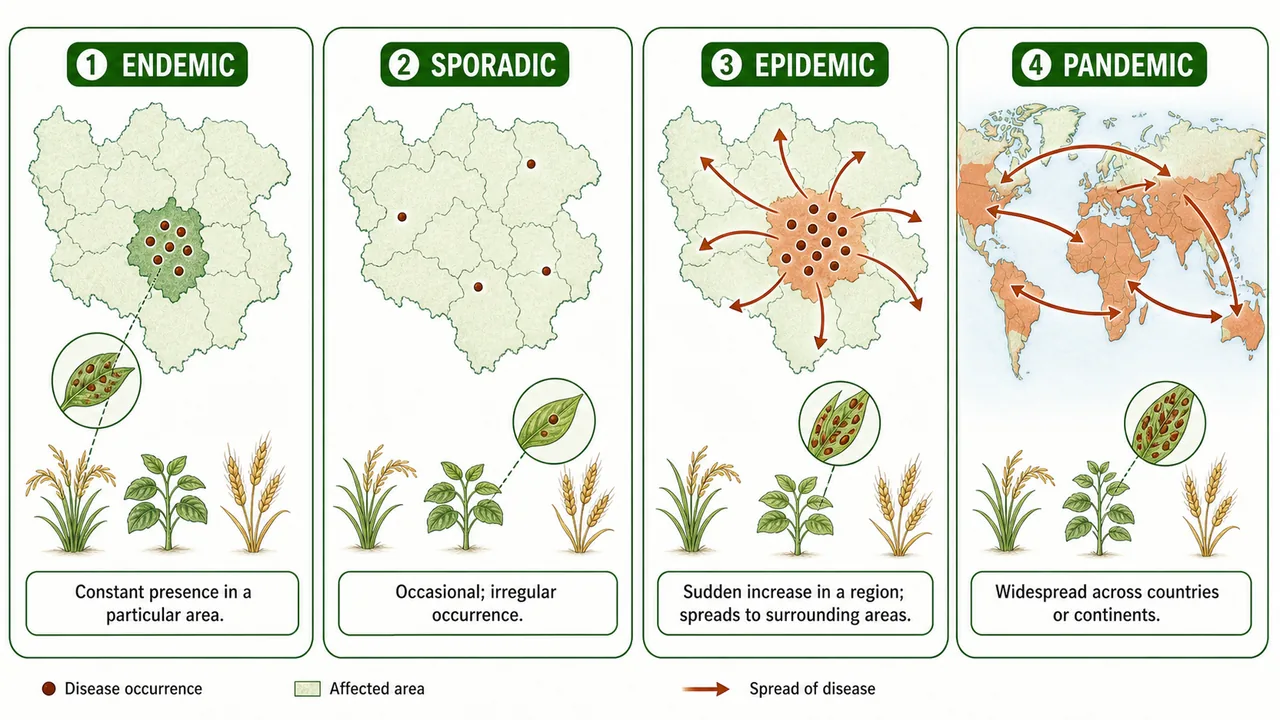
Plant diseases are classified into four categories based on their occurrence and distribution pattern.
Endemic
Endemic diseases are those that are more or less constantly prevalent from year to year in a moderate to severe form in a particular country or region.
- Example: Wart disease of potato is endemic to Darjeeling.
TIP
Think of "endemic" as "always there" — it is a disease that is native or permanently established in a specific area.
Epidemic or Epiphytotic
Epidemic (Epiphytotic) diseases are those that occur periodically but in a severe form involving a major area of the crop. The disease may be constantly present in a locality but assumes a severe form only occasionally.
- Examples: Rust, Late blight, Mildews
NOTE
In plant pathology, the term "Epiphytotic" is used instead of "Epidemic" (which is used for human diseases). Both terms mean a sudden, widespread outbreak.
Sporadic
Sporadic diseases occur at very irregular intervals and locations in a moderate to severe form.
- Examples: Leaf blights, Wilt
Pandemic
Pandemic diseases occur throughout a continent or sub-continent, resulting in mass mortality.
- Example: Late blight of potato — the most famous pandemic that caused the Irish Potato Famine (1845-1849).
IMPORTANT
For exams, remember the hierarchy of spread: Endemic (local) < Epidemic/Epiphytotic (regional) < Pandemic (continental/global).
Classification by Mode of Transmission
Plant diseases can also be classified based on how the pathogen reaches the host — through soil, seed, or air. This classification is important for designing appropriate disease management strategies.
Soil-borne Diseases
Soil-borne pathogens survive in the soil and infect plants through roots or lower stems. They are difficult to control because the pathogen persists in soil for long periods.
Soil-borne Diseases Table
| Disease | Pathogen | Host |
|---|---|---|
| Damping off | Pythium spp. | Many crops |
| Root rot | Phytophthora spp. | Tobacco, Soybean, Ornamental crops |
| Root & stem rots | Fusarium spp. | Many crops |
| Root rots, Leaf blight & Damping off | Rhizoctonia solani | Tomato, Beans, Cereal grains |
| Black rot | Cylindrocladium crotalariae | Soybean, Peanut, other legumes |
| Southern blight | Sclerotium rolfsii | Vegetable crops, Peanut, Soybean |
| Crown & stem rots, Watery soft rot | Sclerotinia spp. | Vegetable crops, Forage legumes, Soybean |
TIP
Notice that Pythium, Phytophthora, Fusarium, and Rhizoctonia are the most common soil-borne pathogens — they appear across many crops.
Seed-borne Diseases
Seed-borne pathogens are carried on or within the seed, spreading disease to new areas when infected seeds are sown.
Seed-borne Diseases Table
| Disease | Pathogen | Host |
|---|---|---|
| Loose smut | Ustilago tritici | Wheat |
| Covered smut | Ustilago hordei | Barley |
| Green ear | Sclerospora graminicola | Bajra |
| Blight | Achochyta rabiei | Gram |
| Seedling rot | Cephalosporium acremonium | Maize |
| Wart of potato | Synchytrium endobioticum | Potato |
| Red rot of sugarcane | Colletotrichum falcatum | Sugarcane |
| Angular leaf spot | Xanthomonas malvacearum | Cotton |
IMPORTANT
Loose smut of wheat (Ustilago tritici) is an internally seed-borne disease — the fungus is present inside the seed embryo, making external seed treatment ineffective. Hot water treatment is required.

Air-borne Diseases
Air-borne pathogens spread through wind-dispersed spores and can travel long distances, making them capable of causing epidemics.
Air-borne Diseases Table
| Disease | Pathogen | Host |
|---|---|---|
| Blast | Pyricularia oryzae | Rice |
| Karnal bunt | Neovossia indica | Wheat |
| Downy mildew | Plasmopara viticola | Grape |
| Powdery mildew | Erysiphe spp. | Many plants |
| Anthracnose | Colletotrichum spp. | Mango |
| Stem rust | Puccinia graminis sp. tritici | Wheat/Barley |
| Leaf rust | Puccinia recondita | Wheat |
| Late blight | Phytophthora infestans | Potato, Tomato |
WARNING
Air-borne diseases like rusts and late blight are the most dangerous because wind can carry spores across hundreds of kilometres, causing rapid epidemics.

Common Fungal Groups Used in Exam Classification
Besides classifying diseases by spread, many agriculture exams also ask for the major pathogen groups behind common disease types. A compact way to remember them is to link each group with its characteristic spores and its best-known disease examples.
| Group | Hallmark exam cue | Typical examples |
|---|---|---|
| Oomycetes | Produce zoospores in asexual stage and oospores in sexual stage | Downy mildews, Phytophthora, Pythium |
| Ascomycota | Sexual spores are ascospores | Many leaf spots, mildews, anthracnose-related fungi |
| Basidiomycota | Includes the major rust and smut fungi | Puccinia rusts, Ustilago smuts |
TIP
For quick recall: oomycetes are the water mould group, so they are commonly associated with motile zoospores and downy mildew type diseases.
IMPORTANT
In the older exam-style classification used across many agriculture books, rust fungi are commonly placed under Basidiomycota, and the classical order name Uredinales or modern Pucciniales is used for them.
Parasitic Flowering Plants as Disease Agents
Not all plant diseases are caused by microbes. Some are caused by parasitic angiosperms that directly withdraw water, minerals, and photosynthates from their host through haustorial connections. In exam-style classification, these are often grouped by whether they parasitize the stem or the root, and whether they are total or partial parasites.
| Type | Nature of parasitism | Common examples |
|---|---|---|
| Total stem parasite | Lacks effective photosynthesis and depends almost completely on the host stem | Cuscuta (dodder / amarbel) |
| Partial stem parasite | Has chlorophyll but still draws water and minerals from host branches | Loranthus |
| Total root parasite | Depends almost entirely on host roots for nourishment | Orobanche |
| Partial root parasite | Photosynthetic but parasitic on host roots for water and minerals | Striga |
TIP
A quick way to remember them is to separate the stem parasites (Cuscuta, Loranthus) from the root parasites (Orobanche, Striga), and then ask whether the parasite is total or still partly photosynthetic.
Diseases Introduced into India from Foreign Countries
Many devastating plant diseases were not originally present in India but were introduced from other countries through trade, movement of plant material, or natural dispersal. Knowing the year of introduction and country of origin is frequently asked in competitive exams.
Diseases Introduced into India
| Disease (Pathogen) | Host | Year | Introduced from |
|---|---|---|---|
| Leaf rust (Hemileia vastatrix) | Coffee | 1870 | Sri Lanka |
| Late blight (Phytophthora infestans) | Potato, Tomato | 1883 | Europe |
| Rust (Puccinia carthami) | Chrysanthemum | 1904 | Japan or Europe |
| Flag smut (Urocystis tritici) | Wheat | 1906 | Australia |
| Downy mildew (Plasmopara viticola) | Grapes | 1910 | Europe |
| Downy mildew (Pseudoperonospora cubensis) | Cucurbits | 1910 | Sri Lanka |
| Downy mildew (Sclerospora philippinensis) | Maize | 1912 | Java |
| Bacterial blight | Rice | - | Philippines |
| Rice blast | Rice | 1918 | South East Asia |
| Foot rot (Fusarium moniliforme var. majus) | Rice | 1930 | South East Asia |
| Leaf spot (Phyllachora sorghi) | Sorghum | 1934 | South Africa |
| Powdery mildew (Oidium heveae) | Rubber | 1938 | Malaya |
| Banana bunchy top (virus) | Banana | 1940 | Sri Lanka |
| Potato wart | Potato | 1953 | Netherlands |
| Onion smut | Onion | 1958 | Europe |
| Golden cyst nematode | Potato | 1961 | Europe |
| Ergot | Bajra | 1957 | Africa |
IMPORTANT
Coffee rust (Hemileia vastatrix) introduced in 1870 from Sri Lanka is very frequently asked in agricultural exams. It was the first major disease introduced into India.
TIP
Memory aid for chronology: Coffee rust (1870) came first, then Late blight of potato (1883), then the Downy mildews arrived around 1910. Post-independence introductions include Potato wart (1953) and Golden cyst nematode (1961).
Summary Cheat Sheet
| Concept / Topic | Key Details |
|---|---|
| Endemic | Disease constantly prevalent in a region; e.g. Wart of potato in Darjeeling |
| Epidemic / Epiphytotic | Periodic severe outbreak over a major area; e.g. Rust, Late blight, Mildews |
| Sporadic | Occurs at irregular intervals and locations; e.g. Leaf blights, Wilt |
| Pandemic | Spreads across continent/sub-continent; e.g. Late blight of potato (Irish Famine) |
| Soil-borne pathogens | Pythium, Phytophthora, Fusarium, Rhizoctonia; survive in soil, infect via roots |
| Seed-borne diseases | Loose smut (wheat), Green ear (bajra), Blight (gram), Red rot (sugarcane), Angular leaf spot (cotton) |
| Internally seed-borne | Pathogen inside seed embryo; e.g. Loose smut of wheat (Ustilago tritici); needs hot water treatment |
| Air-borne diseases | Wind-dispersed spores; Blast (rice), Rusts (wheat), Late blight (potato), Karnal bunt (wheat) |
| Oomycetes | Water mould group; asexual spores = zoospores, sexual spores = oospores; includes downy mildews, Phytophthora, Pythium |
| Ascomycota | Sexual spores = ascospores; covers many important foliar and fruit-infecting fungi |
| Basidiomycota | Includes the major rust and smut fungi used in exam taxonomy |
| Parasitic angiosperms | Cuscuta = total stem parasite; Loranthus = partial stem parasite; Orobanche = total root parasite; Striga = partial root parasite |
| Coffee rust introduction | Hemileia vastatrix; 1870 from Sri Lanka — first major disease introduced into India |
| Late blight introduction | Phytophthora infestans; 1883 from Europe |
| Downy mildew of grapes | Plasmopara viticola; 1910 from Europe |
| Flag smut of wheat | Urocystis tritici; 1906 from Australia |
| Banana bunchy top | Virus; 1940 from Sri Lanka |
| Bacterial blight of rice | Introduced recall often linked with the Philippines |
| Potato wart | Synchytrium endobioticum; 1953 from Netherlands |
| Golden cyst nematode | 1961 from Europe (potato) |
| Ergot of bajra | Claviceps fusiformis; 1957 from Africa |
| Powdery mildew of rubber | Oidium heveae; 1938 from Malaya |
| Spread hierarchy | Endemic (local) → Epidemic (regional) → Pandemic (continental/global) |
| Key soil-borne genera | Pythium, Phytophthora, Fusarium, Rhizoctonia, Sclerotinia, Sclerotium |
Lesson Doubts
Ask questions, get expert answers