🌾 Cereal & Fibre Crop Diseases — Pathogens, Symptoms, and Management
Comprehensive guide to major diseases of rice, wheat, pearl millet, maize, and cotton with pathogens, symptoms, favourable conditions, management strategies, and exam-focused summary tables
From Field to Lab — When Cereal Crops Fall Sick
India produces over 300 million tonnes of foodgrains annually, with rice, wheat, maize, and bajra forming the backbone of food security. Yet every season, diseases silently rob farmers of 10–30% of their potential yield. The blast in a rice nursery can burn entire fields to the ground. Brown spot of rice caused the devastating Bengal Famine of 1943. Loose smut turns wheat ears into masses of black powder. Rust can spread across hundreds of kilometres on wind currents, devastating wheat crops in days.
Knowing the pathogen, recognising the symptoms, and applying the right management strategy is what separates a successful harvest from a failed one.
Diseases of Rice
Rice Diseases — Quick Reference Table
| Disease | Causal Organism |
|---|---|
| Blast | Pyricularia oryzae (teleomorph: Magnaporthe grisea) |
| Sheath Blight | Rhizoctonia solani |
| Brown Spot | Helminthosporium oryzae (syn. Bipolaris oryzae) |
| Foot Rot / Bakanae | Fusarium moniliforme |
| Bacterial Leaf Blight | Xanthomonas oryzae pv. oryzae |
| False Smut | Ustilaginoidea virens |
| Udbatta Disease | Ephelis oryzae |
| Bunt / Kernel Smut | Tilletia barclayana |
| Khaira Disease | Zinc deficiency (not a pathogen) |
| Tungro | Rice tungro bacilliform virus (RTBV) + Rice tungro spherical virus (RTSV) |
| Grassy Stunt | Rice grassy stunt tenuivirus |
| Ufra Disease | Ditylenchus angustus (nematode) |
1. Blast — Pyricularia oryzae
Most severe disease of rice, also called "Rich men's disease". Objective books commonly pair its teleomorph with Magnaporthe oryzae; older notes may still list Magnaporthe grisea.
Symptoms:
- Leaf Blast, Nodal Blast & Neck Blast are the major symptom types
- Lesions appear as small bluish-green flecks that enlarge under moist weather to form characteristic spindle-shaped spots with grey centre and dark brown margin (Leaf blast)
- Severely infected nursery and field appear as burnt
- Neck infection blackens the neck region, producing partially filled or chaffy panicles and blanking
NOTE
Blast textbooks often attach the toxins piricularin and alpha-picolinic acid to symptom expression in rice.
IMPORTANT
Blast is favoured by excess nitrogen application and high humidity (RH > 80%). Temperature of 25-30°C is ideal. Avoid excessive nitrogenous fertilizers to reduce blast incidence.
Management:
- Seed treatment with Carbendazim or Tricyclazole
- Spray Tricyclazole 0.06% or Edifenphos 0.1%
- Use resistant varieties
- Balanced nutrition helps: avoid excess nitrogen, and adequate silicon nutrition is often linked with better blast tolerance
2. Brown Leaf Spot — Helminthosporium oryzae
This disease caused The Great Bengal Famine of 1943 — one of the most devastating plant disease epidemics in history. Older exam keys may also write the pathogen as Bipolaris oryzae / Drechslera oryzae, with teleomorph Cochliobolus miyabeanus.
Symptoms:
- Fungus attacks from seedling to milky stage
- Minute circular to oval spots on coleoptile, leaf blade, leaf sheath, and glumes
- Most prominent on leaf blade and glumes
- Disease is severe on potash-deficient soils
Favourable Conditions:
- Temperature of 25-30°C with relative humidity above 80%
- Excess nitrogen aggravates disease severity
TIP
Exam recall: Brown spot = Bengal Famine 1943 = Potash deficiency makes it worse. This is one of the most frequently asked facts in AFO/AO exams.
Management:
- Seed treatment with Thiram or Captan at 2 g/kg
- Spray Mancozeb 2 kg/ha or Edifenphos 1 ml/litre
- Apply balanced fertilization, especially potash; silicon nutrition is also commonly linked with reduced severity

3. Foot Rot or Bakanae Disease — Fusarium moniliforme
Also known as "Foolish seedling disease" because infected plants grow abnormally tall.
Symptoms:
- Infected seedlings in nursery are lean and lanky, much taller and die after some time
- In main field, affected plants have tall lanky tillers
- Plants are killed before earhead formation or produce only sterile spikelets
- When culm is split open, white mycelial growth can be seen
NOTE
Fusarium moniliforme produces gibberellic acid (GA3), which causes the abnormal elongation of infected plants. This is how gibberellins were originally discovered — from the "bakanae" (foolish seedling) disease of rice. Older objective books often connect the first isolation work with Kurasowa.
Management:
- Fungus is externally seed-borne
- Seed treatment with Thiram or Captan or Carbendazim at 2 g/kg
- Hot-water seed treatment is also a standard recall measure for seed sanitation
4. Bacterial Leaf Blight — Xanthomonas oryzae pv. oryzae
Symptoms:
- Disease usually noticed at time of heading but can occur earlier
- Textbooks often group symptoms into leaf blight, kresek, and leaf yellowing / pale-yellow phase
- Seedlings in nursery show circular yellow spots in margins that enlarge, coalesce, and cause drying of foliage
- "Kresek" symptom — seen in seedlings 1-2 weeks after transplanting; bacteria enter through cut wounds in leaf tips, become systemic, and cause death of entire seedling
- Blighting starts from tip of leaves to the base
NOTE
The bacterium forms the yellow pigment xanthomonadin. Entry is commonly through hydathodes, but stomata and wounds can also aid infection; the yellow bacterial ooze test remains a classic field clue.
Management:
- Avoid clipping of seedling tips during transplanting
- Spray Streptocycline 500 ppm
- Use resistant varieties such as IR36, IR54, and IRBB 60
5. False Smut — Ustilaginoidea virens
Symptoms:
- Fungus transforms individual ovaries/grains into greenish spore balls of velvetty appearance
- Only a few spikelets in a panicle are affected
Favourable Conditions:
- Rainfall and cloudy weather during flowering and maturity
Management:
- Spray Copper oxychloride 0.25% at boot leaf stage
- Avoid excess nitrogen
6. Udbatta Disease — Ephelis oryzae
Symptoms:
- The entire ear head is converted into a straight compact cylindrical black spike-like structure since the infected panicle is matted together by fungal mycelium
Management:
- Pathogen is internally seed-borne
- Hot water seed treatment at 45°C for 10 minutes effectively controls the disease

7. Khaira Disease — Zinc Deficiency
Khaira disease is NOT caused by a pathogen — it is a nutritional disorder due to zinc deficiency.
Symptoms:
- Chlorotic/yellow patches at leaf base on both sides of midrib
- Restricted root growth; main roots turn brown
NOTE
Khaira disease was classically described from the Tarai belt by Y. L. Nene (1966). Its name is linked with the resemblance of affected leaves to the Khair tree (Acacia catechu), and alkaline calcareous soils commonly favour the disorder.
Management:
- Apply ZnSO4 @ 25 kg/ha at the time of sowing
- Foliar spray of 0.5% ZnSO4
TIP
A standard foliar-recall mixture is 2 kg ZnSO4 + 1 kg slaked lime in water. Zinc deficiency also depresses tryptophan and auxin synthesis, which helps explain the stunting.
8. Pan Sukh / Tip Burn — Physiological Disorder
Pan sukh or tip burn in rice is another non-pathogenic disorder, usually linked with prolonged waterlogging, poor root aeration, and low nitrogen status.
Key Idea:
- Unlike infectious blights, the problem is physiological and improves with better water and nutrient management
9. Rice Viral Diseases
| Disease | Pathogen | Vector | Key Features |
|---|---|---|---|
| Tungro | RTBV + RTSV (two viruses) | Leaf hopper Nephotettix virescens | Leaves show yellow-to-orange discolouration and interveinal chlorosis; stunted plants; identified by Iodine test |
| Grassy Stunt | Rice grassy stunt tenuivirus | Brown plant hopper (Nilaparvata lugens) | Excessive tillering, erect growth habit, markedly stunted plants |
| Ragged Stunt | Rice ragged stunt virus | Brown plant hopper | Ragged and twisted leaves |
| Yellow Dwarf | Phytoplasma | Leafhopper Nephotettix sp. | General yellowing and stunting |
WARNING
Vector control is key for managing rice viral diseases. There are no chemical cures for viral infections — manage the insect vectors (leafhoppers and plant hoppers) to prevent spread.
10. Sheath Blight — Rhizoctonia solani
Symptoms:
- Oval or elliptical greenish-grey lesions on leaf sheath near water level
- Lesions have grey-white centre with brown margin
- Under severe conditions, lesions spread to upper leaf sheaths and leaf blades
Management:
- Avoid excess nitrogen and close spacing
- Spray Validamycin 3L or Hexaconazole 1 ml/litre
Diseases of Wheat
NOTE
Wheat rusts are classical exam material in plant pathology. K. C. Mehta is remembered as the Father of Indian Rust Studies, and wheat rust fungi are standard examples of obligate biotrophic, mostly macrocyclic rusts with the five-spore sequence often recalled as S A U T B (spermatia/pycniospores -> aeciospores -> urediospores -> teliospores -> basidiospores).
Wheat Rusts — Comparison Table
| Feature | Black/Stem Rust | Brown/Leaf Rust | Yellow/Stripe Rust |
|---|---|---|---|
| Pathogen | Puccinia graminis tritici | Puccinia triticina (P. recondita) | Puccinia striiformis |
| Alternate Host | Berberis vulgaris | Thalictrum spp. | None known |
| Pustule Colour | Reddish-brown → black | Orange → brown | Bright yellow |
| Pustule Location | Leaves, sheaths, culms, floral parts | Mostly on leaves | Mostly on leaves, in linear rows |
| Pustule Shape | Oblong, merging | Round, scattered | Linear stripes |
| Favourable Temp | 15-20°C | 15-20°C | < 10°C (coolest) |
| Common Name | "Killer" disease of wheat | Most common rust in India | — |
1. Black or Stem Rust — Puccinia graminis tritici
Known as the "Killer" disease of wheat. Alternate host is Berberis vulgaris (barberry).
TIP
The UG-99 race is the widely cited aggressive stem-rust lineage first tracked from Uganda in 1999. Objective books also note Mahonia along with Berberis as an alternate-host recall in some treatments.
Symptoms:
- First symptom is flecking of leaves, leaf sheaths, culms, and floral structures
- Flecks develop as oblong, reddish-brown uredo-pustules that frequently merge and burst to expose brown uredospores
Favourable Conditions:
- Low temperature (15-20°C) and high humidity during November-December
Management:
- Grow resistant varieties
- Eradicate Berberis (alternate host) near wheat fields
- Spray Mancozeb 2.5 kg/ha or Propiconazole 0.1%
2. Brown or Leaf Rust — Puccinia triticina (P. recondita)
Most common and widespread rust of wheat in India.
Symptoms:
- Minute, round, orange sori irregularly distributed on leaves
- Rarely on leaf sheath and stem
- Sori turn brown with maturity
NOTE
Brown rust is commonly keyed with Lr genes in breeding notes. Lr34 is especially famous as one of the early slow-rusting resistance genes.
3. Yellow or Stripe Rust — Puccinia striiformis
Symptoms:
- Mainly on leaves (not sheaths or stems)
- Bright yellow pustules arranged in linear rows as stripes
- Stripes are yellow to orange-yellow
NOTE
In older objective-book phrasing, yellow rust is often called the early rust of wheat because it commonly appears before stem rust in cool north-western wheat belts.
TIP
Temperature trick for rusts: Yellow rust likes it coldest (< 10°C), Black and Brown rusts prefer 15-20°C. Remember: Yellow = coldest (Year-end chills).
NOTE
In rust-disease life cycles, urediospores are the repeating spores that spread the disease rapidly during the crop season, teliospores are the thicker-walled resting spores, and basidiospores arise after teliospore germination and help continue the cycle on the alternate host.
4. Loose Smut — Ustilago nuda tritici (Ustilago tritici)
Symptoms:
- Difficult to detect until heading — infected heads emerge earlier than normal heads
- Entire inflorescence covered by olive-black spores under a thin grey membrane
- Internally seed-borne disease, with the fungus carried in the embryo
- Entire ear except rachis and awns is smutted — black powder produced in place of grains
NOTE
Primary infection is maintained internally as dikaryotic mycelium in the embryo. Loose smut is therefore treated as essentially monocyclic, with no meaningful secondary spread within the same crop season.
Management:
- Seed treatment with Vitavax (Carboxin) @ 2 g/kg
- Solar heat treatment of seeds — given by Luthara & Suttar (1934)
- Hot-water treatment is another classic recall method for embryo-borne inoculum
5. Flag Smut — Urocystis tritici
Symptoms:
- Symptoms seen on stem, culm, and leaves from late seedling stage to maturity
- Leads to twisting and drooping of leaves followed by withering
Management:
- Seed treatment with Carboxin at 2 g/kg
6. Karnal Bunt — Neovossia indica
First reported in India from Karnal (Haryana) by Mitra in 1931. This is a quarantine disease of international importance.
NOTE
Karnal bunt is also revised as new bunt, partial bunt, and even cancer of wheat in older objective books. Because it affects grain trade and export, it is treated as a trade-restricting disease of quarantine importance.
Symptoms:
- Infection occurs at flowering stage by air-borne spordia
- Symptoms most readily detected on seed after harvest
- Few grains are partially converted into black sooty powder
- Characteristic foul, fishy odour caused by production of trimethylamine by the fungus
IMPORTANT
Karnal bunt is different from common bunt — seed that is not extensively infected may germinate and produce healthy plants. The trimethylamine odour is a key diagnostic feature asked in exams.
7. Hill Bunt or Stinking Smut — Tilletia caries / T. foetida
Symptoms:
- Fungus attacks seedlings of 8-10 days old and becomes systemic
- At flowering, hyphae concentrate in inflorescence and transform the ovary into smut sorus of dark green colour with masses of chlamydospores
- Produces foul, fishy odour (similar to Karnal bunt)
8. Ear Cockle of Wheat — Anguina tritici (Nematode)
This is a nematode disease, not fungal.
Symptoms:
- Leaf blades generally twisted
- Infected ears shorter, remain green longer, with awns more spreading
- Affected grains transformed into small hard galls (cockles)
Management:
- Seed floatation in 20% salt solution — galls float and can be removed
9. Tundu Disease — Corynebacterium tritici + Anguina tritici
Tundu is a complex disease requiring both a bacterium and a nematode together.
NOTE
Tundu, Sehu, and yellow ear rot are the usual recall names for the same disease complex.
Symptoms:
- Twisting of stem, distortion of ear head, and rotting of spikelets
- Profuse oozing of yellow liquid from affected tissues — the ooze contains masses of bacterial cells
- Agglutinated inflorescence; seeds not formed; grains transformed into small hard galls
Management:
- Floatation of seeds in 20% salt solution
10. Other Wheat Diseases
| Disease | Pathogen | Key Features |
|---|---|---|
| Leaf Blight / Alternaria Blight | Alternaria triticina / Bipolaris sorokiniana | Reddish-brown oval spots on young seedlings with bright yellow margin; spray Mancozeb or Zineb 2 kg/ha |
| Powdery Mildew | Erysiphe graminis var. tritici | Greyish-white powdery growth on leaves, sheath, stem & floral parts; spray Wettable Sulphur 0.2% or Carbendazim 500 g/ha |
| Spot Blotch | Bipolaris sorokiniana | Dark brown oval lesions on leaves; spray Propiconazole 0.1% |
| Foot Rot | Pythium graminicolum & P. arrhenomanes | Seedlings become pale green, stunted; roots and rootlets brown |
| Molya Disease | Heterodera avenae (cyst nematode) | Stunting, pale yellow seedlings; roots show knots with nematode cysts |
Diseases of Pearl Millet (Bajra)
1. Downy Mildew / Green Ear Disease — Sclerospora graminicola
Most important disease of pearl millet. Infection is mainly systemic.
Symptoms:
- Leaves show patches of light green to light yellow on upper surface; corresponding lower surface bears white downy growth of sporangiophores and sporangia
- Yellow discolouration often turns to streaks along veins — young plants dry and die
- Symptoms may appear first on upper leaves
- Inflorescence gets completely or partially malformed with florets converted into leafy structures — typical symptom of "Green Ear"
Management:
- Seed treatment with Metalaxyl at 6 g/kg
- Spray Mancozeb 2 kg or Metalaxyl + Mancozeb at 1 kg/ha on 20th day after sowing
- Use resistant varieties (e.g., HHB 67 Improved)
TIP
Objective books also mention that the disease is both soil-borne and seed-borne, that oospores act as resting spores for primary infection, and that zoospores drive secondary spread. Some exam notes also include suppression cues such as PGPR seed treatment with Pseudomonas fluorescens / Bacillus subtilis and the older one-liner that chlorine can help suppress downy mildew.
2. Smut — Tolyposporium penicillariae
NOTE
Pearl-millet smut is a useful exception to the common seed-borne-smut pattern: objective books often stress that it is comparatively soil-borne, with infection initiated around flowering.
Symptoms:
- Symptoms become apparent at grain setting
- Pathogen infects few florets and transforms them into large oval-shaped sacs (sori) containing black powder (smut spores)
- Initially sori are larger and greener than normal grains; on maturity they become dark brown and release millions of black smut spore balls
3. Ergot or Sugary Disease — Claviceps fusiformis
Symptoms:
- Exudation of small droplets of light pinkish or brownish honeydew from infected spikelets
- Under severe infection, honeydew trickles along the earhead attracting insects
- Later, infected ovary turns into small dark brown sclerotium projecting out of the spikelet
NOTE
Ergot disease of pearl millet is tied with ergotism in humans and animals after consumption of contaminated grain. Older exam notes also attach ergotin / ergotoxine to the medicinal-alkaloid recall associated with the fungus.
4. Quick Barley Smut Recall
- Covered smut of barley is caused by Ustilago hordei and is classically treated as an externally seed-borne smut.
- Loose smut of barley is the contrasting internally seed-borne form, so its control logic parallels loose smut of wheat rather than covered smut.
Management:
- Adjust sowing date to avoid flowering during September (high rainfall and humidity)
- Immerse seeds in 20% common salt solution and remove floating sclerotia (ICAR & TNAU recommend 10% salt solution)
- Spray Carbendazim 500 g or Mancozeb 2 kg or Ziram 1 kg/ha at 5-10% flowering and again at 50% flowering
NOTE
Minor diseases of pearl millet: Grain mould (fungal complex), Blast (Pyricularia setariae), Zonate leaf spot (Gloeocercospora sp.), Banded leaf spot (Rhizoctonia spp.), Rust (Puccinia pennisetti)
Diseases of Maize
1. Downy Mildew / Crazy Top
Three types of downy mildew affect maize:
- Sorghum downy mildew — Peronosclerospora sorghi
- Philippine downy mildew — Peronosclerospora philippinensis
- Crazy top — Sclerophthora macrospora
Symptoms:
- Chlorotic streaks on leaves are the most characteristic symptom
- Plants exhibit a stunted and bushy appearance due to shortening of internodes
- White downy growth on lower surface of leaf
- Proliferation of auxillary buds on tassel stalk and cobs is common — giving the typical symptom of "Crazy top"
Management:
- Seed treatment with Metalaxyl at 6 g/kg
- Spray Metalaxyl + Mancozeb @ 1 kg on 20th day after sowing
2. Leaf Blight — Helminthosporium maydis
Symptoms:
- Affects crop at young stage
- Small yellowish round to oval spots on leaves
- Spots gradually increase into bigger elliptical spots — straw to grayish-brown in centre with dark brown margins
- Spots coalesce giving blighted appearance
- Surface covered with olive-green velvetty masses of conidia
Management:
- Seed treatment with Captan or Thiram at 4 g/kg
- Spray Mancozeb 2 kg or Captan 1 kg/ha
3. Rust — Puccinia sorghi
Symptoms:
- Circular to oval, elongated cinnamon-brown powdery pustules scattered over both surfaces of leaves
- As plant matures, pustules become brown to black
Management:
- Spray Mancozeb at 2 kg/ha
4. Head Smut — Sphacelotheca reiliana
Symptoms:
- Symptoms on cob and tassel
- Large smut sori replace the tassel and the ear
- Sometimes tassel is partially or wholly converted into smut sorus
- Smutted plants are stunted, produce little yield, and remain greener
Management:
- Crop rotation with pulses
- Seed treatment with Captan or Thiram at 4 g/kg
5. Charcoal Rot — Macrophomina phaseolina (Rhizoctonia bataticola)
Symptoms:
- Affected plants exhibit wilting symptoms with grayish streak on stalk
- Shredding of the interior of the stalk causes stalks to break in the crown region
- Crown region of infected plant becomes dark in colour
Management:
- Long crop rotation with crops that are not natural hosts
- Irrigate crops at earhead emergence to maturity
- Seed treatment with Carbendazim or Captan at 2 g/kg
NOTE
Minor diseases of maize: Bacterial stalk rot (Erwinia dissolvens), Mosaic (Maize mosaic potyvirus), Brown spot (Physoderma maydis)
TIP
Objective books often split maize downy mildews further into brown stripe downy mildew caused by Sclerophthora rayssiae and sugarcane downy mildew caused by Peronosclerospora sacchari. The shared idea is the same: cool, wet conditions favour downy-mildew development, and metalaxyl-based seed treatment remains the standard recall management.
NOTE
Other quick maize one-liners often asked in exams are white bud = zinc deficiency and post-flowering stalk rot = Fusarium moniliforme / F. verticillioides.
Additional Sorghum Disease Recall
- Loose smut of sorghum is commonly keyed with Sporisorium cruentum and is usually revised as an externally seed-borne smut.
- Anthracnose of sorghum is caused by Colletotrichum graminicola and is recognized by black, sunken lesions on leaves, stems, or reproductive parts.
- Sorghum anthracnose is a useful fruiting-body recall because Colletotrichum produces acervuli, the dark cushion-like conidial structures frequently asked in pathology MCQs.
Diseases of Cotton (Fibre Crop)
1. Bacterial Blight / Angular Leaf Spot / Black Arm — Xanthomonas campestris pv. malvacearum
The bacterium attacks all stages from seed to harvest. Five common symptom phases:
| Phase | Symptom |
|---|---|
| Seedling blight | Cotyledons show water-soaked spots, seedlings wilt |
| Angular leaf spot | Small angular water-soaked spots limited by veinlets, later turn brown |
| Vein blight / Black vein | Veins turn black, necrosis along veins |
| Black arm | Peripheral cracks on stem, dark discolouration |
| Square rot / Boll rot | Water-soaked lesions on bolls |
IMPORTANT
Bacterial blight of cotton shows five distinct symptom phases — a favourite question in competitive exams. Remember: S-A-V-B-S (Seedling blight, Angular leaf spot, Vein blight, Black arm, Square/Boll rot).
Management:
- Acid delinting of seeds (conc. H2SO4)
- Seed treatment with Streptocycline
- Spray Streptocycline 100 ppm + Copper oxychloride 0.25%
- Use resistant varieties
2. Wilt — Fusarium oxysporum f.sp. vasinfectum
Symptoms:
- Sudden drooping and wilting of leaves
- Brown discolouration of vascular bundles when stem is cut
- Plants die within a few days of wilting
Management:
- Long crop rotation (3-4 years)
- Seed treatment with Carbendazim 2 g/kg
- Use resistant varieties
3. Root Rot — Rhizoctonia solani
Symptoms:
- Yellowing and wilting of seedlings
- Brown lesions on roots and lower stem near soil line
Management:
- Seed treatment with Thiram or Captan 3 g/kg
- Soil application of Trichoderma viride
4. Anthracnose — Colletotrichum capsici
Symptoms:
- Small reddish-brown spots on leaves, stems, and bolls
- Lesions on bolls cause premature opening and fibre damage
Management:
- Spray Mancozeb 2.5 kg/ha or Copper oxychloride 0.25%
5. Grey Mildew / Areolate Mildew / Dahiya Disease — Ramularia areola
Symptoms:
- Pale translucent spots on leaves with angular margins defined by veinlets
- White powdery fungal growth on lower surface of leaves (visible in early morning)
- Severe infection leads to premature defoliation
Management:
- Spray Copper oxychloride 0.25% or Carbendazim 0.05%
- Avoid dense planting
6. Tirak / Bad Opening of Bolls — Physiological Disorder
Tirak is NOT a disease caused by a pathogen — it is a physiological disorder.
Symptoms:
- Premature defective opening of bolls and shedding of leaves
Causes:
- Soil with subsoil salinity
- Light sandy soil
- Nitrogen deficiency
- Low humidity, warm and dry weather during fruiting period
- Low moisture and nutrient availability during boll formation
Management:
- Late sowing and protective irrigation during flowering / fruiting in light soils are common recall measures in objective-style agronomy-pathology notes
Cluster Bean (Guar) Disease Recall
- Alternaria blight of cluster bean is keyed with Alternaria cyamopsidis and the usual target-board concentric-ring symptom.
- Bacterial blight of cluster bean is commonly paired with Xanthomonas campestris pv. cyamopsidis.
TIP
Two non-pathogenic disorders to remember: In rice, Khaira disease = Zinc deficiency. In cotton, Tirak = physiological disorder due to soil/nutrient/weather stress. Both are commonly asked as trick questions in exams.
Other Cotton Diseases
| Disease | Pathogen |
|---|---|
| Verticillium Wilt | Verticillium dahliae |
| Fusarium Wilt | Fusarium oxysporum f.sp. vasinfectum |
| Root Rot | Rhizoctonia solani |
Rice Disease Field Diagnosis: Which Disease Is It?
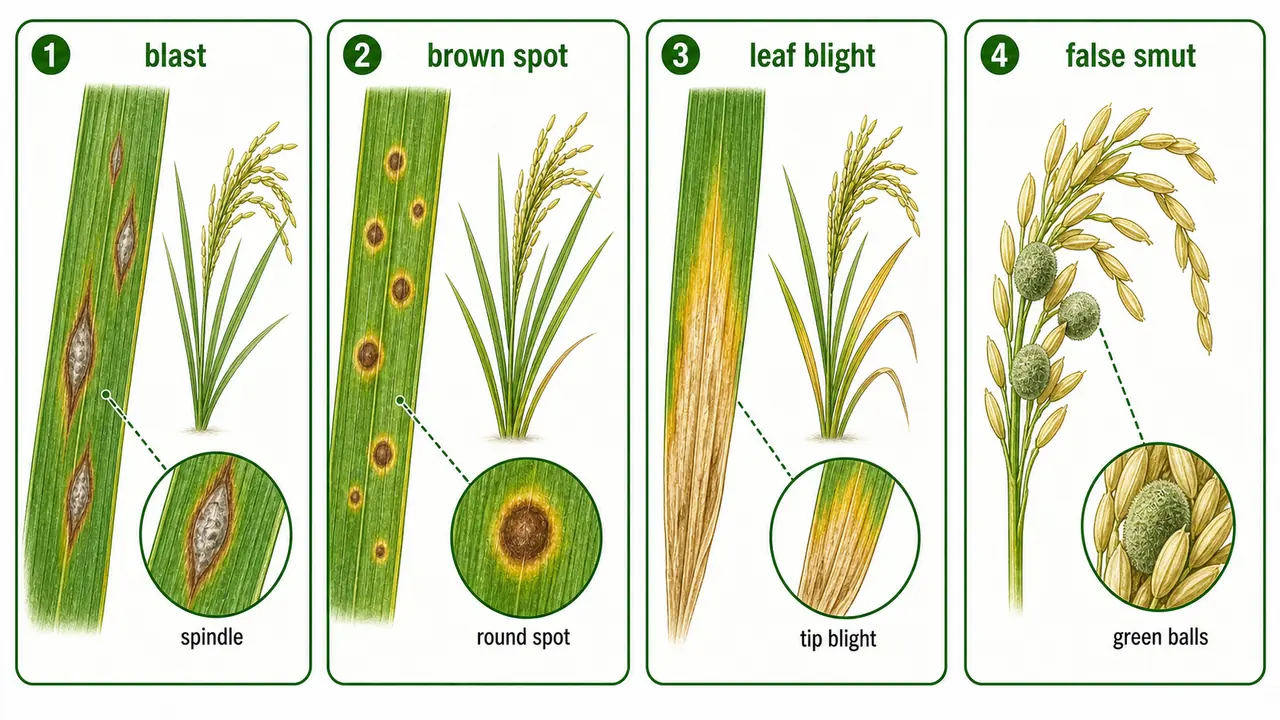
When you see leaf/plant damage in rice, follow this diagnostic flowchart:
| What You See | Likely Disease | Confirm By | Key Favouring Factor | First Action |
|---|---|---|---|---|
| Spindle-shaped spots with grey centre + brown margin on leaves | Blast (Pyricularia oryzae) | Spots enlarge and coalesce; neck node may break | Excess nitrogen + high humidity + 20-25°C | Spray Tricyclazole 0.06%; reduce N dose next season |
| Oval brown spots all over leaves, Bengal Famine disease | Brown Spot (Helminthosporium oryzae) | Spots have uniform brown colour; grain discolouration | Potash-deficient + nutrient-poor soils | Apply potash; seed treatment with Mancozeb |
| Seedlings die suddenly (kresek); water-soaked leaf margins later | Bacterial Leaf Blight (Xanthomonas oryzae) | Yellow ooze on cut leaf in water droplet test | Wounds from clipping leaf tips; rainy weather | Do NOT clip seedling tips; resistant varieties |
| Plants abnormally tall, thin, pale, falling over | Bakanae / Foolish Seedling (Fusarium moniliforme) | Fungus produces gibberellic acid causing elongation | Seed-borne; contaminated seed | Hot water seed treatment (52°C, 10 min) |
| Green velvety spore balls replacing grains | False Smut (Ustilaginoidea virens) | Unmistakable — green balls on panicle | High nitrogen + humidity at flowering | Spray Copper oxychloride at boot leaf stage |
| Rusty brown spots on lower leaves, plants stunted | Khaira disease | NOT a pathogen — it's zinc deficiency | Alkaline soils, standing water | ZnSO₄ 25 kg/ha basal; 0.5% foliar spray |
Exam trap: Khaira disease of rice is a nutritional disorder (zinc deficiency), NOT a pathogenic disease. Bakanae disease is caused by a fungus that produces GA₃ — the same plant hormone used commercially. Both are favourite trick questions.
Summary Cheat Sheet
| Concept / Topic | Key Details |
|---|---|
| Rice Blast | Pyricularia oryzae; spindle-shaped spots; favoured by excess nitrogen & high humidity; spray Tricyclazole |
| Brown Spot of Rice | Helminthosporium oryzae; caused Bengal Famine 1943; severe on potash-deficient soils |
| Bakanae / Foot Rot | Fusarium moniliforme; "Foolish seedling" disease; produces gibberellic acid (GA₃); externally seed-borne |
| Bacterial Leaf Blight (Rice) | Xanthomonas oryzae; Kresek symptom in seedlings; avoid clipping leaf tips |
| False Smut (Rice) | Ustilaginoidea virens; greenish spore balls of velvety appearance |
| Udbatta (Rice) | Ephelis oryzae; internally seed-borne; hot water treatment 45°C for 10 min |
| Khaira Disease | Zinc deficiency (NOT a pathogen); apply ZnSO₄ @ 25 kg/ha |
| Tungro Virus (Rice) | Vector: leafhopper Nephotettix virescens; identified by Iodine test |
| Black/Stem Rust (Wheat) | Puccinia graminis tritici; "Killer" disease; alternate host = Berberis vulgaris |
| Brown/Leaf Rust (Wheat) | Puccinia triticina; most common rust in India |
| Yellow/Stripe Rust (Wheat) | Puccinia striiformis; coldest temperature (<10°C); yellow linear stripes |
| Loose Smut (Wheat) | Ustilago nuda tritici; internally seed-borne; treat with Vitavax @ 2 g/kg; solar heat by Luthra & Suttar (1934) |
| Karnal Bunt (Wheat) | Neovossia indica; reported by Mitra (1931) from Karnal; fishy odour = trimethylamine |
| Ear Cockle (Wheat) | Anguina tritici (nematode); galls float in 20% salt solution |
| Tundu Disease (Wheat) | Complex = Corynebacterium tritici + Anguina tritici; yellow oozing liquid |
| Downy Mildew / Green Ear (Bajra) | Sclerospora graminicola; florets → leafy structures; seed treat with Metalaxyl 6 g/kg |
| Ergot of Bajra | Claviceps fusiformis; pinkish honeydew exudation; sclerotia removed by salt solution |
| Crazy Top (Maize) | Sclerophthora macrospora; proliferation of buds on tassel |
| Head Smut (Maize) | Sphacelotheca reiliana; large smut sori replace tassel and ear |
| Bacterial Blight of Cotton | Xanthomonas campestris pv. malvacearum; 5 phases: S-A-V-B-S; acid delinting of seeds |
| Cotton Wilt | Fusarium oxysporum f.sp. vasinfectum; brown vascular discolouration |
| Grey Mildew / Dahiya (Cotton) | Ramularia areola; pale translucent angular spots; white powdery growth on lower leaf surface |
| Tirak (Cotton) | Physiological disorder (NOT a pathogen); premature boll opening due to salinity/N deficiency |
| Molya Disease (Wheat) | Heterodera avenae (cyst nematode); stunted pale yellow seedlings |
| Powdery Mildew (Wheat) | Erysiphe graminis var. tritici; greyish-white powdery growth; spray Wettable Sulphur 0.2% |
Lesson Doubts
Ask questions, get expert answers