🍬 Sugarcane & Tobacco Diseases — Pathogens, Symptoms, and Management
Comprehensive guide to major diseases of sugarcane and tobacco including red rot, smut, sett rot, wilt, and viral diseases with pathogens, symptoms, management, and exam-focused tables
From Field to Lab — Protecting India's Sugar Bowl
India is the world's second-largest sugarcane producer, with UP, Maharashtra, and Karnataka leading production. When a farmer splits open a sugarcane stalk and finds reddened internal tissues with white cross-wise patches and a sour smell, the diagnosis is clear — Red Rot, the "cancer of sugarcane." A central shoot that converts into a long, dusty black whip signals Smut. Setts that smell like pineapple and decay before germination indicate Sett Rot. These diseases collectively cause losses worth thousands of crores annually.
Sugarcane Diseases
Sugarcane is affected by several fungal, bacterial, and phytoplasmal diseases. Understanding the key pathogens and their diagnostic symptoms is critical for competitive exams.
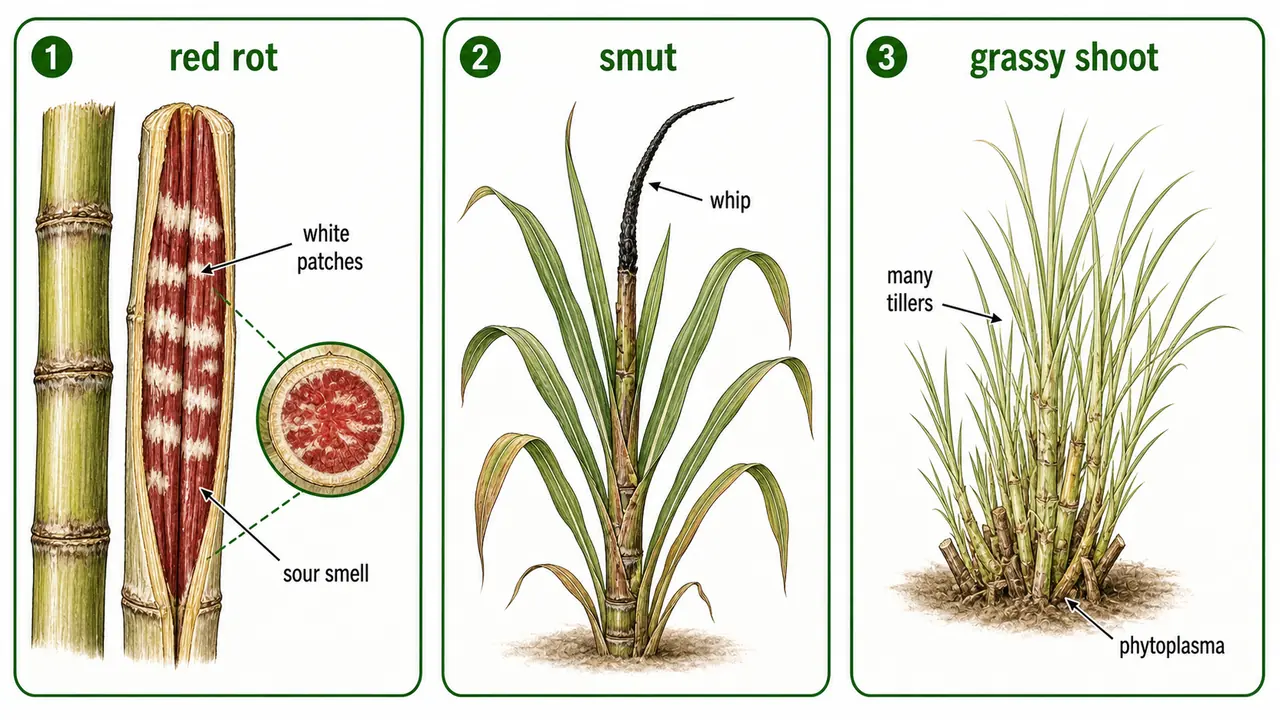
1. Red Rot — Colletotrichum falcatum
IMPORTANT
Red rot is the most destructive disease of sugarcane. It is often called the "cancer of sugarcane".
NOTE
The disease is classically linked with Barber (1901) in India, and the perfect-stage recall is often written as Glomerella tucumanensis.
Symptoms:
- First external symptom appears on the 3rd or 4th leaf — withering at tips along margins
- Splitting the stalk longitudinally reveals reddening of internal tissues elongated at right angles to the long axis
- Cross-wise white patches within the red areas are the most important diagnostic character
- Diseased cane emits an acidic-sour smell
- As disease advances, stalk becomes hollow and covered with white mycelial growth
- Acervuli may be seen near the nodes, and severely affected juice may ferment with an alcoholic off-smell
Favourable Conditions:
- Monoculturing of sugarcane
- Successive ratoon cropping
- Waterlogged conditions and insect injuries
Management:
- Soak setts in 0.25% Agallol or Aretan solution for 5 minutes
- Treat setts with aerated steam at 52°C for 4-5 hours or moist hot air at 54°C for 2 hours
- Use resistant varieties and avoid ratooning of infected fields
- Avoid waterlogging; objective notes also pair the disease with collateral hosts such as Sorghum halepense and Saccharum spontaneum
2. Smut — Ustilago scitaminea
TIP
Also known as "Whip Smut" due to the characteristic whip-like structure formed from the central shoot.
NOTE
Newer taxonomy often lists the pathogen as Sporisorium scitaminea.
Symptoms:
- It is a culmiculous smut affecting the stalk of cane
- Severe from April to July; causes ~10% loss in juice
- Affected plants are stunted; central shoot converts into a long whip-like, dusty black structure
Management:
- Discourage ratooning of diseased crops having more than 10% infection
- Grow redgram as a companion crop between 2 rows of sugarcane
- Use resistant varieties
- Kans grass / Saccharum spontaneum is a standard collateral-host recall for sugarcane smut

3. Sett Rot / Pineapple Disease — Ceratocystis paradoxa
NOTE
Named "Pineapple disease" because of the characteristic pineapple smell associated with rotting tissues.
Symptoms:
- Fungus is soil-borne; enters through cut ends and proliferates in parenchymatous tissues
- Affected tissues first develop a reddish colour turning to brownish black later
- Severely affected setts show internodal cavities covered with mycelium and abundant spores
- Setts may decay before bud germination or shoots may die after reaching 6-12 inches
- Infected shoots are stunted
Management:
- Treat setts with fungicides before planting
- Use healthy, disease-free planting material
- Avoid planting in waterlogged soils
4. Wilt — Cephalosporium sacchari
Symptoms:
- Gradual yellowing and drying of leaves
- Internal tissues of the stalk show discolouration
- Plants wilt and eventually die
Management:
- Use resistant varieties
- Remove and destroy infected plants
- Practice crop rotation
5. Red Stripe — Pseudomonas rubrilineans
Symptoms:
- Disease first appears on the basal part of young leaves
- Stripes appear as water-soaked, long, narrow chlorotic streaks that become reddish brown in a few days, running parallel to the midrib
- Rotting may commence from the tip of the shoot and spread downwards
- In badly affected fields, a foul and nauseating smell appears
Management:
- Use disease-free planting material
- Rogue out infected plants
- Grow resistant varieties
6. Grassy Shoot Disease — Phytoplasma
WARNING
Grassy shoot disease can cause complete crop failure if infected setts are used for planting.
Symptoms:
- Disease appears nearly two months after planting
- Characterised by production of numerous lanky tillers from the base of affected shoots
- Leaves become pale yellow to completely chlorotic, thin and narrow
- Plants appear bushy and "grass-like" due to reduction in internode length, premature and continuous tillering
- Buds on infected canes are usually papery and abnormally elongated
NOTE
Older exam notes also call grassy shoot albino disease or bunchy disease of sugarcane. The vector recall often includes Aphis sacchari, and Cuscuta is remembered as a dodder bridge for transmission.
Management:
- Use disease-free seed material
- Hot water treatment of setts at 50°C for 2 hours
- Rogue out diseased clumps
- Some objective notes also attach tetracycline sprays to phytoplasma suppression
7. Ratoon Stunting Disease — Clavibacter xyli sub sp. xyli
IMPORTANT
The pathogen is a Rickettsia-Like Organism (RLO). This is an important exam fact.
NOTE
Current nomenclature often writes the pathogen as Leifsonia xyli subsp. xyli.
Symptoms:
- Diseased clumps display stunted growth, reduced tillering, thin stalks with shortened internodes
- Yellowish foliage
- Pink vascular bundles in shades of yellow at the nodes are seen in infected canes
Management:
- Hot water treatment of setts at 50°C for 2 hours
- Use disease-free planting material
- Avoid ratooning of infected crops
Minor Diseases of Sugarcane
Other Sugarcane Diseases — Quick Reference
| Disease | Pathogen |
|---|---|
| Damping-off | Pythium aphanidermatum, P. debaryanum, P. graminicola, P. ultimum |
| Downy mildew | Peronosclerospora sacchari |
| Rust | Puccinia erianthi |
| Gummosis | Xanthomonas axonopodis pv. Vasculorum (fibro-vascular becomes red) |
| Sugarcane Mosaic | Sugarcane mosaic potyvirus |
| Ring spot | Leptosphaeria sacchari |
Tobacco Diseases
1. Damping Off — Pythium aphanidermatum
Symptoms:
- Pre-emergence damping off: Seeds rot before emergence
- Post-emergence damping off: Water-soaked minute lesions appear on stems near soil surface, girdling the stem; within 1-2 days stem may rot, causing toppling of seedlings
- Young seedlings in the nursery are killed in patches; infection spreads quickly
- Under favourable conditions, entire seedlings in the nursery are killed within 3-4 days
Management:
- Seed treatment with Thiram or Captan @ 2-3 g/kg
- Drench nursery beds with Copper oxychloride (0.25%)
- Ensure proper drainage in nursery
2. Tobacco Mosaic — Tobacco mosaic virus (TMV)
IMPORTANT
TMV was the first virus to be discovered by Ivanowsky in 1892 and later crystallized by W.M. Stanley in 1935 (Nobel Prize 1946). This is one of the most frequently asked exam facts in plant pathology.
Symptoms:
- In severe infections, leaves are narrowed, puckered, thin, and malformed beyond recognition
- Under hot weather, dark brown necrotic spots develop — called "Mosaic burn" or "Mosaic scorching"
Management:
- Remove and destroy infected plants
- Wash hands with soap/milk before handling healthy plants
- Use resistant varieties
- Control of insect vectors

3. Leaf Curl — Tobacco leaf curl virus (TLCV)
Symptoms:
- Infections may occur at any stage; young infected plants remain very much dwarfed
- Curling of leaves with clearing and thickening of veins; twisting of petioles
- Puckering of leaves; rugose and brittle texture
- Development of enations is an important symptom
Management:
- Control whitefly vector (Bemisia tabaci)
- Remove infected plants early
- Use resistant varieties
Minor Diseases of Tobacco
Other Tobacco Diseases — Quick Reference
| Disease | Pathogen |
|---|---|
| Powdery mildew | Erysiphe cichoracearum var. nicotianae |
| Anthracnose | Colletotrichum tabacum |
| Black shank | Phytophthora parasitica var. nicotianae |
| Frog eye spot | Cercospora nicotianae |
Summary Cheat Sheet
| Fact | Answer |
|---|---|
| Most destructive disease of sugarcane | Red Rot (Colletotrichum falcatum) |
| "Cancer of sugarcane" | Red Rot |
| Diagnostic character of Red Rot | Cross-wise white patches within red internal tissue + acidic-sour smell |
| Sugarcane Smut pathogen | Ustilago scitaminea — "Whip Smut" |
| Smut symptom | Long whip-like dusty black structure from central shoot |
| Sett Rot / Pineapple Disease pathogen | Ceratocystis paradoxa |
| Sett Rot key symptom | Pineapple smell + internodal cavities |
| Sugarcane Wilt pathogen | Cephalosporium sacchari |
| Red Stripe pathogen | Pseudomonas rubrilineans |
| Grassy Shoot Disease cause | Phytoplasma — numerous lanky tillers, grass-like bushy plants |
| Ratoon Stunting Disease pathogen | Clavibacter xyli subsp. xyli (RLO — Rickettsia-Like Organism) |
| Ratoon Stunting key symptom | Pink vascular bundles at nodes |
| Sugarcane Sett treatment | 0.25% Agallol/Aretan for 5 min OR steam at 52°C for 4–5 hrs |
| Tobacco Damping Off pathogen | Pythium aphanidermatum |
| First virus discovered | Tobacco Mosaic Virus (TMV) — Ivanowsky (1892), crystallized by Stanley (1935) |
| TMV symptom in hot weather | Mosaic burn / Mosaic scorching — dark brown necrotic spots |
| Tobacco Leaf Curl vector | Whitefly (Bemisia tabaci) |
| Leaf Curl key symptom | Vein clearing + thickening, curling of leaves, enations |
| Sugarcane Rust pathogen | Puccinia erianthi |
| Sugarcane Downy Mildew pathogen | Peronosclerospora sacchari |
Quick Revision Table
| Crop | Disease | Pathogen | Key Diagnostic Feature |
|---|---|---|---|
| Sugarcane | Red Rot | Colletotrichum falcatum | Red patches with white centre, acidic-sour smell |
| Sugarcane | Smut | Ustilago scitaminea | Whip-like black structure from central shoot |
| Sugarcane | Sett Rot | Ceratocystis paradoxa | Pineapple smell, internodal cavities |
| Sugarcane | Wilt | Cephalosporium sacchari | Yellowing, internal discolouration |
| Sugarcane | Red Stripe | Pseudomonas rubrilineans | Water-soaked streaks parallel to midrib |
| Sugarcane | Grassy Shoot | Phytoplasma | Grass-like bushy appearance, lanky tillers |
| Sugarcane | Ratoon Stunting | Clavibacter xyli subsp. xyli (RLO) | Pink vascular bundles at nodes |
| Tobacco | Damping Off | Pythium aphanidermatum | Water-soaked lesions, seedling collapse |
| Tobacco | TMV | Tobacco mosaic virus | Mosaic burn/scorching, first virus discovered |
| Tobacco | Leaf Curl | TLCV | Vein clearing, leaf curling, enations |
Lesson Doubts
Ask questions, get expert answers