🥜 Oilseed & Pulse Crop Diseases — Pathogens, Symptoms, and Management
Comprehensive guide to major diseases of groundnut, mustard, sunflower, pigeon pea, soybean, and chickpea with pathogens, symptoms, management, and exam-focused tables
From Field to Lab — When Oilseeds and Pulses Fall Sick
India is the world's largest producer of pulses and a major oilseed grower. Groundnut fields in Gujarat ravaged by Tikka leaf spot can lose 50% of their leaf area. Mustard crops in Rajasthan showing swollen, sterile "stag head" formations are suffering from white rust (Albugo candida). Chickpea plants that wilt and die in patches indicate Fusarium wilt — a soil-borne menace that can persist for years. Understanding these diseases is critical for both farm management and competitive exams.
Groundnut Diseases
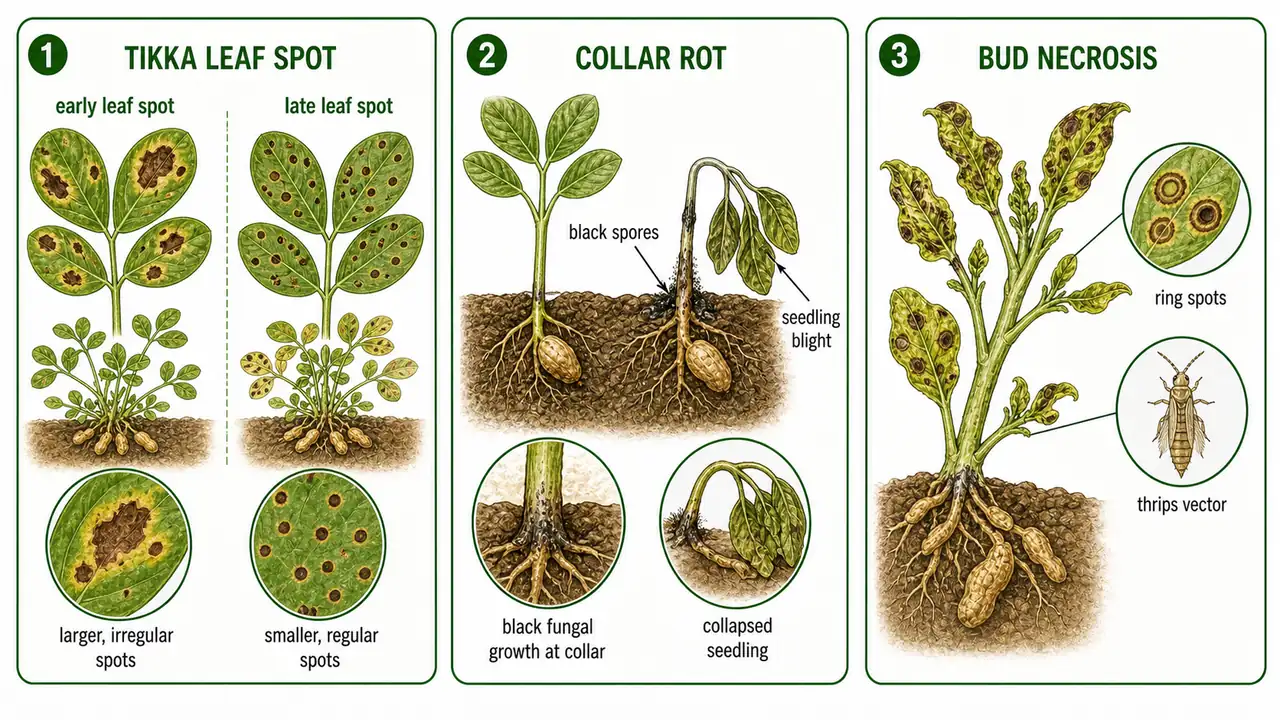
1. Tikka Leaf Spot (Early + Late Leaf Spot)
IMPORTANT
Tikka disease involves two pathogens — this is a frequently tested distinction in exams.
| Type | Pathogen | Spot Character |
|---|---|---|
| Early leaf spot | Cercospora arachidicola | Irregular spots of larger diameter |
| Late leaf spot | Cercosporidium personata | Regular spots, not more than 0.6 cm in diameter |
Symptoms:
- Small dark brown spots and premature leaf shedding
- Both pathogens can co-infect the same plant
Management:
- Seed treatment with Carbendazim or Thiram @ 2 g/kg
- Spray Carbendazim 500 g or Mancozeb 2 kg or Chlorothalonil 2 kg/ha; repeat after 15 days if necessary
2. Collar Rot / Seedling Blight / Crown Rot — Aspergillus niger and A. pulverulentum
NOTE
The disease appears in three distinct phases depending on the stage of the crop.
Phase 1 — Pre-emergence rot:
- Seeds attacked by soil-borne conidia causing rotting of seeds
- Seeds covered with black masses of spores; internal tissues become soft and watery
Phase 2 — Post-emergence rot:
- Pathogen attacks emerging seedlings causing circular brown spots on cotyledons
- Affected portion becomes soft and rotten, resulting in collapse of the seedling
Phase 3 — Crown rot (in adult plants):
- Large lesions develop on stem below soil and spread upwards along branches
- Causes drooping of leaves and wilting of plant
Management:
- Crop rotation
- Destruction of plant debris
- Remove and destroy previous season's infested crop debris
- Seed treatment with Trichoderma viride / T. harzianum @ 4 g/kg
- Soil application of Trichoderma viride / T. harzianum at 2.5 kg/ha with organic amendments (castor cake or neem cake or mustard cake @ 500 kg/ha)

3. Bud Necrosis Disease — Groundnut bud necrosis virus (GBNV — Tospo virus)
IMPORTANT
GBNV is transmitted by thrips (Tospo virus group). This is an important vector-disease association for exams.
Symptoms:
- First symptoms visible 2-6 weeks after infection as ring spots on leaves
- Newly emerging leaves are small, rounded or pinched inwards and rugose with varying patterns of mottling and minute ring spots
- Necrotic spots and irregularly shaped lesions develop on leaves and petioles
- Stem also exhibits necrotic streaks
Management:
- Control thrips vector with systemic insecticides
- Remove infected plants early
- Use resistant varieties
Minor Groundnut Disease
| Disease | Pathogen |
|---|---|
| Root rot | Macrophomina phaseolina |
Rapeseed & Mustard Diseases
1. White Rust / White Blister — Albugo candida
TIP
Albugo candida causes "Stag head" formation — the entire inflorescence is replaced by a swollen sterile structure. This is a classic exam question.
NOTE
White rust is also remembered as white blisters of crucifers. Many objective notes further distinguish local infection as the white blister stage and systemic infection as the hypertrophy-hyperplasia stage producing stag head.
Symptoms:
- White or yellow pustules with variable sizes and shapes on the lower surface of leaves
- Infection covers all parts except roots
- Entire inflorescence replaced by swollen sterile structure called "Stag head"
Management:
- Seed treatment with Metalaxyl (Apron 35 SD) @ 6 g/kg
- Spray Mancozeb (0.2%) or Ridomil MZ (0.25%)
- Use resistant varieties
2. Alternaria Blight — Alternaria brassicae
Symptoms:
- Concentric black spots on leaves, stem, and pods
- Spots have characteristic target-board appearance
Management:
- Spray Mancozeb (0.2%) or Iprodione (0.2%)
- Use resistant/tolerant varieties
- Crop rotation
3. Downy Mildew — Peronospora brassicae
Symptoms:
- Yellow and irregular spots on upper surface with white growth on under surface of leaves
- Malformed inflorescence
Management:
- Seed treatment with Metalaxyl
- Spray Ridomil MZ (0.25%)
- Ensure proper plant spacing for air circulation
4. Clubroot — Plasmodiophora brassicae
IMPORTANT
Plasmodiophora brassicae is an obligate parasite belonging to Myxomycetes. It causes swelling (clubs) on roots and is favoured by acidic soils.
Symptoms:
- Roots develop abnormal swellings or "clubs"
- Plants show wilting, stunting, and yellowing
Management:
- Liming of acidic soils to raise pH above 7.2
- Long crop rotation (5-7 years)
- Use resistant varieties
Sunflower Diseases
1. Root Rot / Charcoal Rot — Rhizoctonia bataticola
Symptoms:
- Pathogen is seed-borne; causes seedling blight and collar rot in initial stages
- Infected plants show drooping of leaves and death occurs in patches
- Bark of lower stem and roots shreds; associated with large number of sclerotia
Management:
- Seed treatment with Carbendazim or Thiram
- Crop rotation with non-host crops
- Deep summer ploughing
2. Alternaria Blight
Symptoms:
- Dark brown to black spots with concentric rings on leaves
- Severe defoliation in humid conditions
3. Rust and Downy Mildew
- Rust and downy mildew also affect sunflower
- Manage with appropriate fungicide sprays and resistant varieties
Red Gram / Pigeon Pea Diseases
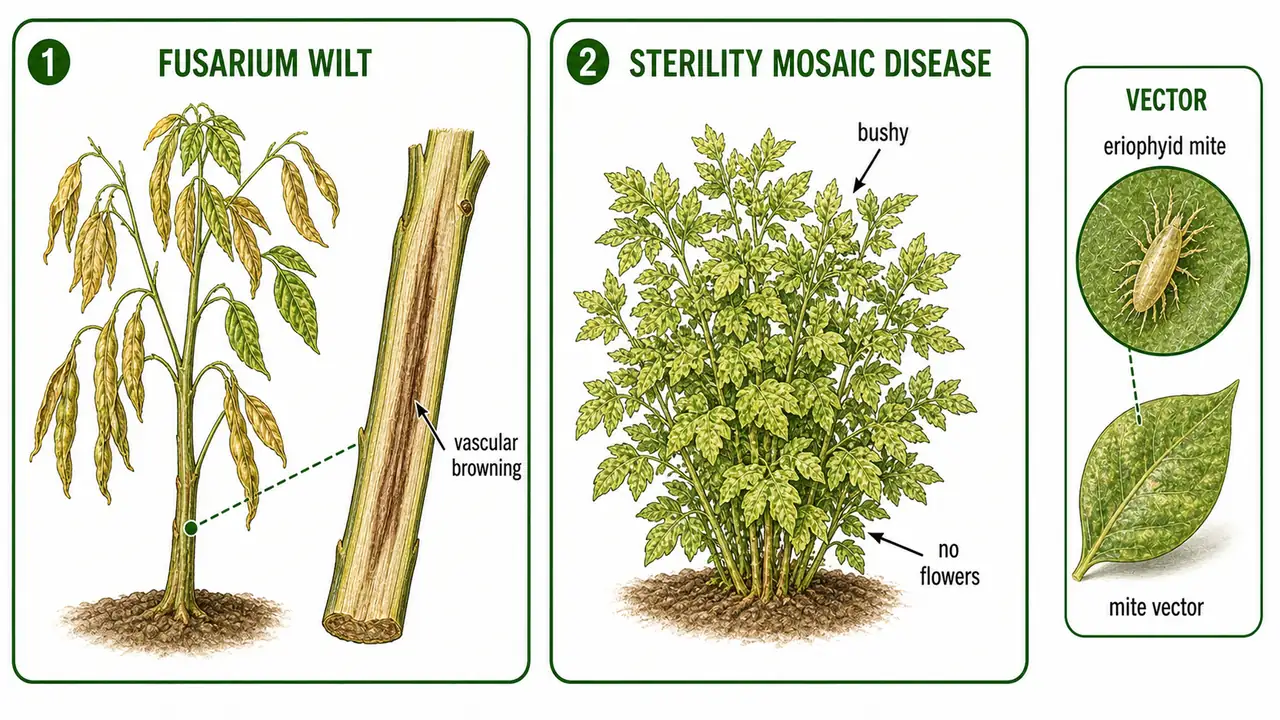
1. Wilt — Fusarium udum
NOTE
Fusarium udum is specific to pigeon pea — do not confuse with F. oxysporum which causes wilt in many other crops.
Symptoms:
- Plants show wilting, yellowing, and drying of leaves
- Browning of vascular tissues visible when stem is split open
- Can occur at any growth stage
Management:
- Use resistant varieties (e.g., Maruti, Asha-ICPL 87119)
- Seed treatment with Trichoderma viride @ 4 g/kg
- Crop rotation with cereals
2. Sterility Mosaic Disease (SMD) — Pigeonpea sterility mosaic virus (PPSMV)
IMPORTANT
Vector: Eriophyid mite (Aceria cajani). This mite-virus association is very frequently asked in exams.
Symptoms:
- Characterised by bushy and pale green appearance of plants
- Excessive vegetative growth, stunting, prominent mosaic on leaves, and reduction in leaf size
- Complete or partial cessation of flowering leads to sterility
NOTE
Because affected plants remain lush green but fail to flower normally, sterility mosaic is also remembered as the green plague of pigeon pea.
Management:
- Control eriophyid mite vector with wettable sulphur or Dicofol sprays
- Use resistant varieties
- Remove and destroy infected plants

Soybean Diseases
1. Yellow Mosaic — Yellow mosaic virus
TIP
Vector: Bemisia tabaci (whitefly). The same vector transmits yellow mosaic in green gram and black gram too.
Symptoms:
- Conspicuous systemic bright yellow mottling of leaves
- Infected plants show reduced pod formation
Management:
- Control whitefly with systemic insecticides (Imidacloprid, Thiamethoxam)
- Use resistant varieties
- Early sowing to escape peak whitefly population
2. Charcoal Rot — Rhizoctonia bataticola
Symptoms:
- Reddish black to brown necrotic lesion at crown portion
NOTE
Soybean charcoal rot is commonly associated with hot, dry weather and is often revised as a monocyclic disease.
Management:
- Seed treatment with Carbendazim
- Summer ploughing and crop rotation
3. Bacterial Pustule — Xanthomonas axonopodis pv. glycines
Symptoms:
- Small raised pustule-like lesions on leaves that later turn brown
Management:
- Spray Copper oxychloride or Streptocycline-based bactericidal combinations
4. Rust and Purple Seed Stain
- Soybean rust is an important foliar disease; the usual recall pathogen is Phakopsora pachyrhizi
- Purple seed stain affects seed quality and marketability
Green Gram Diseases
1. Yellow Mosaic — Yellow mosaic virus
Symptoms:
- Bright yellow mottling on leaves, transmitted by whitefly (Bemisia tabaci)
- Severe yield loss when infection occurs early
Management:
- Spray systemic insecticides to control whitefly
- Use resistant varieties (e.g., Pusa Vishal, SML 668)
2. Cercospora Leaf Spot
Symptoms:
- Circular to irregular brown spots on leaves
- Premature defoliation in severe cases
Minor Green Gram Diseases
| Disease | Pathogen |
|---|---|
| Powdery mildew | Erysiphe polygoni |
| Anthracnose | Colletotrichum lindemuthianum |
| Dry root rot | Rhizoctonia bataticola |
Bengal Gram / Chickpea Diseases
1. Wilt — Fusarium oxysporum f.sp. ciceri
IMPORTANT
Chickpea wilt is caused by Fusarium oxysporum f.sp. ciceri — note the forma specialis name, which is specific to chickpea. This is different from pigeon pea wilt (F. udum).
NOTE
Chickpea wilt is classically treated as a soil-borne, monocyclic vascular wilt. Fusarium survival is commonly linked with chlamydospores, and seed/soil biocontrol with Trichoderma fits this disease well.
Symptoms:
- Plants show drooping and yellowing of leaves
- Browning of vascular tissues
- Can cause total crop failure in susceptible varieties
Management:
- Use resistant varieties
- Seed treatment with Carbendazim + Thiram (1:1) @ 2 g/kg or Trichoderma viride @ 4 g/kg
- Crop rotation with non-host crops
2. Ascochyta Blight — Ascochyta rabiei
NOTE
The perfect-stage recall is often written as Didymella rabiei or Mycosphaerella rabiei. Objective notes also pair resistance with varieties such as Gaurav, Vardan, and Samrat, and mention that resistant stems tend to be hairier and richer in maleic acid.
Symptoms:
- Circular brown lesions on leaves, stems, and pods
- Concentric rings visible on pods
- Severe in cool, wet weather
Management:
- Seed treatment with Thiram or Captan
- Spray Mancozeb (0.2%) or Chlorothalonil
- Use resistant varieties
3. Botrytis Grey Mould — Botrytis cinerea
Symptoms:
- Grey mouldy growth on flowers, pods, and stems
- Favoured by dense canopy and high humidity
Management:
- Avoid dense planting
- Spray Carbendazim (0.1%) or Iprodione
- Use tolerant varieties
Other Bengal Gram Diseases
| Disease | Pathogen |
|---|---|
| Rust | Uromyces ciceris-arietini |
| Powdery mildew | Erysiphe polygoni |
Sesame Diseases
1. Phyllody — Phytoplasma (MLO)
IMPORTANT
Vector: Leafhopper (Orosius albicinctus). Phyllody literally means "leaf-like" — floral parts transform into green leaf-like structures.
Symptoms:
- Affected plants are stunted
- Entire inflorescence is replaced by a growth consisting of green, short, twisted leaves closely arranged on the stem with very short internodes
- Floral parts converted into leaf-like structures (phyllody)
- Excessive tillering and bunchy appearance may accompany the leafy floral transformation
Management:
- Control leafhopper vector with systemic insecticides
- Remove and destroy infected plants
- Early sowing to avoid peak leafhopper activity
2. Leaf Spot
Symptoms:
- Circular to irregular spots on leaves
- Premature defoliation
Management:
- Spray Mancozeb (0.2%) or Carbendazim (0.1%)
- Use clean, disease-free seed
Castor Disease Recall
- Fusarium wilt of castor is classically keyed with Fusarium oxysporum f. sp. ricini.
- Bacterial blight / bacterial leaf spot of castor is linked with Xanthomonas ricinicola and is commonly managed with copper-based sprays plus Streptocycline.
- Seedling blight of castor is a standard minor-disease recall under Phytophthora parasitica.
Summary Cheat Sheet
| Fact | Answer |
|---|---|
| Tikka Early leaf spot pathogen | Cercospora arachidicola — irregular, larger spots |
| Tikka Late leaf spot pathogen | Cercosporidium personata — regular spots, ≤0.6 cm |
| Groundnut Collar Rot pathogen | Aspergillus niger — three phases: pre-emergence, post-emergence, crown rot |
| Groundnut Bud Necrosis virus | GBNV (Tospo virus) — vector: Thrips |
| White Rust of mustard pathogen | Albugo candida |
| "Stag head" formation | White Rust (Albugo candida) — entire inflorescence replaced by sterile swollen structure |
| Mustard Alternaria Blight pathogen | Alternaria brassicae — concentric black spots |
| Mustard Clubroot pathogen | Plasmodiophora brassicae — obligate parasite (Myxomycetes); acidic soils favourable |
| Sunflower Charcoal Rot / Root Rot | Rhizoctonia bataticola — seedling blight, sclerotia in stem |
| Pigeon Pea Wilt pathogen | Fusarium udum — specific to pigeon pea |
| Pigeon Pea Sterility Mosaic vector | Eriophyid mite (Aceria cajani) |
| Soybean Yellow Mosaic vector | Whitefly (Bemisia tabaci) |
| Chickpea Wilt pathogen | Fusarium oxysporum f.sp. ciceri |
| Chickpea Ascochyta Blight pathogen | Ascochyta rabiei — concentric rings on pods |
| Chickpea Grey Mould pathogen | Botrytis cinerea — favoured by dense canopy + humidity |
| Sesame Phyllody cause | Phytoplasma (MLO) — vector: leafhopper (Orosius albicinctus) |
| Sesame Phyllody symptom | Floral parts converted into green leaf-like structures |
| Mustard Downy Mildew pathogen | Peronospora brassicae |
| Clubroot management | Lime soil to pH > 7.2 + long rotation (5–7 years) |
| Biocontrol for groundnut Collar Rot | Trichoderma viride / T. harzianum @ 4 g/kg seed treatment |
Quick Revision Table
Complete Oilseed & Pulse Disease Summary
| Crop | Disease | Pathogen | Key Exam Fact |
|---|---|---|---|
| Groundnut | Tikka (Early leaf spot) | Cercospora arachidicola | Irregular, larger spots |
| Groundnut | Tikka (Late leaf spot) | Cercosporidium personata | Regular spots, less than 0.6 cm |
| Groundnut | Collar rot | Aspergillus niger | Three phases: pre-emergence, post-emergence, crown rot |
| Groundnut | Bud necrosis | GBNV (Tospo virus) | Vector: Thrips |
| Mustard | White rust | Albugo candida | Stag head formation |
| Mustard | Alternaria blight | Alternaria brassicae | Concentric black spots |
| Mustard | Downy mildew | Peronospora brassicae | White growth on lower leaf surface |
| Mustard | Clubroot | Plasmodiophora brassicae | Root swelling, favoured by acidic soil |
| Sunflower | Charcoal rot | Rhizoctonia bataticola | Seedling blight, sclerotia in stem |
| Pigeon pea | Wilt | Fusarium udum | Specific to pigeon pea |
| Pigeon pea | Sterility mosaic | PPSMV | Vector: Eriophyid mite |
| Soybean | Yellow mosaic | YMV | Vector: Whitefly (Bemisia tabaci) |
| Green gram | Yellow mosaic | YMV | Vector: Whitefly |
| Chickpea | Wilt | F. oxysporum f.sp. ciceri | Forma specialis specific to chickpea |
| Chickpea | Ascochyta blight | Ascochyta rabiei | Concentric rings on pods |
| Chickpea | Grey mould | Botrytis cinerea | Dense canopy + humidity |
| Sesame | Phyllody | Phytoplasma (MLO) | Vector: Leafhopper (Orosius albicinctus) |
Lesson Doubts
Ask questions, get expert answers