🥭 Fruit & Plantation Crop Diseases — Pathogens, Symptoms, and Management
Comprehensive guide to major diseases of mango, citrus, banana, papaya, apple, grape, guava, pomegranate, and coffee with pathogens, symptoms, management, and exam-focused tables
From Field to Lab — Protecting India's Orchards and Plantations
Walk through a mango orchard in April and you might see white powdery patches covering the panicles — that is powdery mildew, caused by Oidium mangiferae, which can wipe out an entire season's fruit if left unchecked. In a citrus grove, trees with yellowing leaves and gum oozing from the trunk are suffering from Phytophthora gummosis. A banana plantation where plants topple over in mild wind is likely battling the burrowing nematode (Radopholus similis). And the famous coffee rust — introduced from Sri Lanka in 1870 — continues to threaten coffee production across southern India.
Fruit and plantation crops represent long-term investments, often taking years to reach bearing age. A single disease outbreak can destroy decades of effort. Understanding the pathogens, recognising symptoms early, and applying the right management is critical.
Mango Diseases
0. Black Tip — Physiological Disorder
Cause:
- Black tip is classically linked with boron deficiency aggravated by brick-kiln fumes and gaseous injury near orchards
Symptoms:
- The distal end of the fruit develops a small necrotic area that enlarges and turns black while remaining firm
Management:
- Spray borax 0.6%
- Maintain orchards away from brick kilns and reduce fume exposure during flowering-to-fruiting
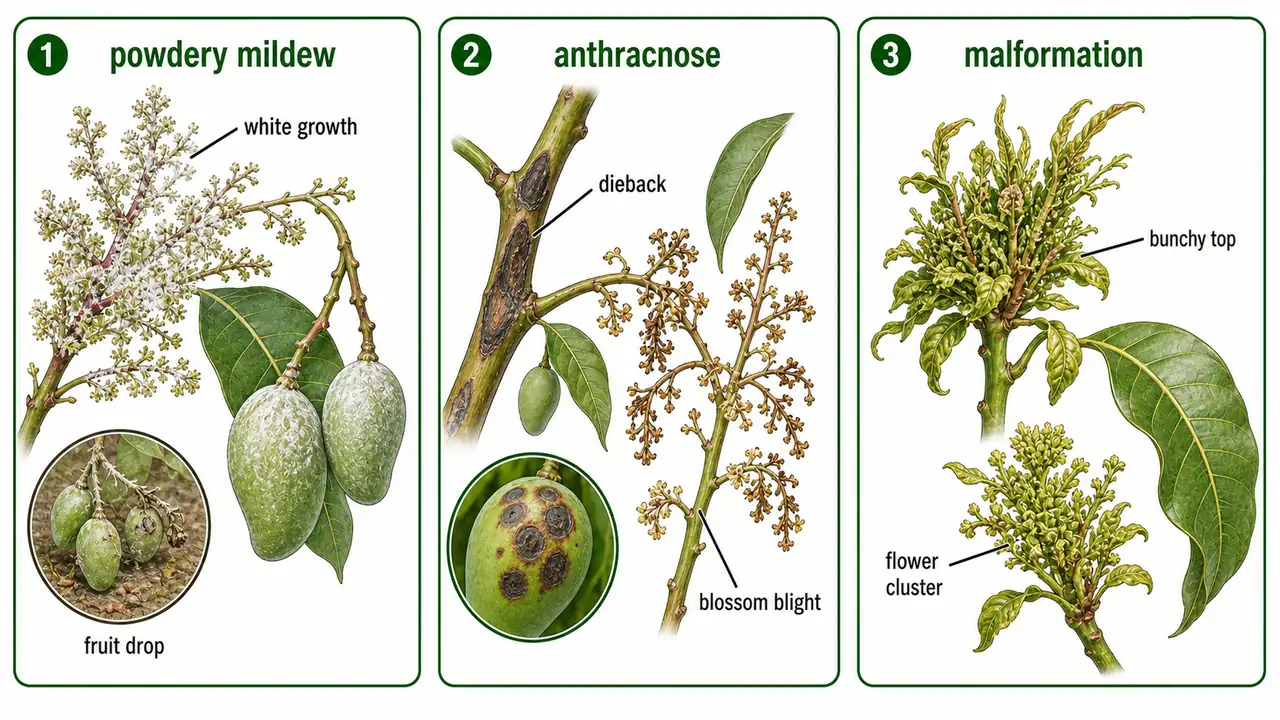
1. Anthracnose — Colletotrichum gloeosporioides
Symptoms:
- Disease appears on young leaves, stems, inflorescence and fruits
- Black necrotic areas develop on twigs from the tip downwards, causing dieback
- In humid weather, minute black dots develop on floral organs
- Infected flower-parts shed, resulting in partial or complete deblossoming
Management:
- Prune and destroy infected twigs
- Spray Carbendazim (0.1%) or Copper oxychloride (0.25%) at flowering
IMPORTANT
Anthracnose is also called blossom blight when it affects mango inflorescence. The same pathogen (C. gloeosporioides) causes anthracnose in guava and papaya as well.
2. Powdery Mildew — Oidium mangiferae (Acrosporum mangiferae)
Symptoms:
- One of the most serious diseases of mango affecting almost all varieties
- Characteristic white superficial powdery fungal growth on leaves, panicle stalks, flowers and young fruits
- Affected flowers and fruits drop pre-maturely, reducing crop load significantly
- Rains or mists with cooler nights during flowering favour disease spread
Management:
- Dusting with fine sulphur (250-300 mesh) at 0.5 kg/tree soon after flowering
- Second application 15 days later OR spray with Wettable sulphur (0.2%), Carbendazim (0.1%), Tridemorph (0.1%), or Karathane (0.1%)

3. Mango Malformation — Fusarium moliliforme var. subglutinans
Vector: Bud mite (Aceria mangiferae)
NOTE
Mango malformation is also remembered through malformin, low-temperature pre-flowering conditions, and the orchard practice of de-blossoming to reduce malformed early panicles.
Symptoms:
- Three types: bunchy top phase, floral malformation, and vegetative malformation
- Bunchy top (BT) appears on young plants in nursery beds at 4-5 months old
- Vegetative malformation: Short internodes forming bunches of various sizes at the top of seedling — gives a bunchy top appearance
- Floral malformation (MF): Variation in panicle formation; malformed heads dry up as black masses and persist on the tree
Management:
- Spray 100-200 ppm NAA during October to reduce incidence
- Remove and destroy malformed panicles and vegetative shoots
4. Sooty Mould — Capnodium mangiferae
Symptoms:
- Black encrustation forms on leaf surface, affecting photosynthesis
- The fungus grows on sugary substances (honeydew) secreted by jassids, aphids and scale insects
Management:
- Control insects and sooty moulds simultaneously
- Spray systemic insecticides like Monocrotophos or Methyl dematon
NOTE
Sooty mould is not a direct parasite — it is a saprophytic fungus that grows on insect honeydew. Controlling the insect vector automatically controls the disease.
5. Dieback — Lasiodiplodia theobromae (Botryodiplodia theobromae)
Symptoms:
- Drying of twigs from tip downwards
- Discolouration of bark, gum exudation
- Internal browning of vascular tissues
Management:
- Prune diseased branches 15 cm below the infection point
- Apply Bordeaux paste on cut ends
- Spray Copper oxychloride (0.3%)
Citrus Diseases
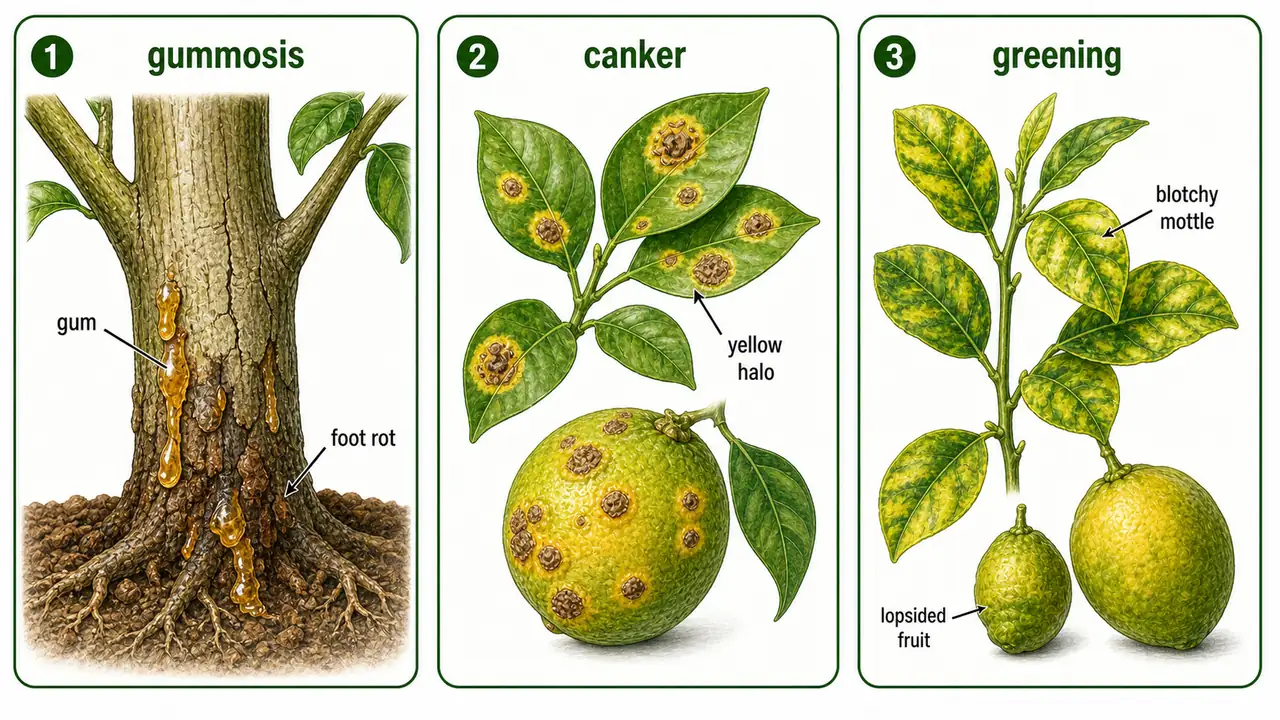
1. Gummosis — Phytophthora parasitica, P. palmivora, P. citrophthora
Symptoms:
- Yellowing of leaves, followed by cracking of bark and profuse gumming on the surface
- Infected bark becomes completely rotten; tree dries owing to girdling effect
- Also called foot rot or collar rot when plant dies before fruits mature
Management:
- Scrape diseased portions with a sharp knife; disinfect cut surface with Mercuric chloride (0.1%) or Potassium permanganate (1%)
- Paint 1 m of stem above ground level with Bordeaux paste
- Drench with Ridomil MZ 72 @ 2.75 g/l or Aliette (2.5 g/l)
- Avoid injuries to crown roots during cultural operations
2. Citrus Canker — Xanthomonas campestris pv. citri
Symptoms:
- Acid lime, lemon and grapefruit are most affected; rare on sweet oranges and mandarins
- Lesions are typically circular with yellow halo; appear on both sides of leaf
- Severe in acid lime (difference from scab)
- Twig lesions cause girdling and death; fruit lesions reduce market value
Management:
- Spray Streptomycin sulphate 500-1000 ppm or Phytomycin 2500 ppm or Copper oxychloride 0.2% at fortnightly intervals
- Control leaf miner when young flush is produced
- Prune badly infected twigs before monsoon onset
NOTE
Citrus leaf miner (Phyllocnistis citrella) is a standard canker-aggravation recall because its feeding injury helps lesions establish and spread on young flush.

TIP
Canker vs Scab: Canker lesions appear on BOTH leaf surfaces and have a yellow halo. Scab lesions are raised and corky, mainly on one side.
3. Tristeza (Quick Decline) — Citrus Tristeza Virus (CTV)
Symptoms:
- Lime is susceptible both as seedling or buddling on any root stock
- Rangpur lime root stock is tolerant to CTV
- Rapid wilting on sour orange rootstocks; honeycombing below bud union
- Bark eruption and pittings on stem, chlorosis of leaves, phloem necrosis
- Vector: Toxoptera citricida (aphid); also spread through infected bud wood
Management:
- Use CTV-free budwood for propagation
- Cross-protect with mild strains; in older plant-virology recall this approach is also described as pre-immunization because a mild strain is deliberately used to protect the plant against a more severe strain.
- Older objective-style virology notes also associate this cross-protection / pre-immunization concept with the classical observation of McKinney, and citrus tristeza remains one of the standard agricultural examples.
- Use tolerant rootstocks (Rangpur lime, trifoliate orange)
4. Citrus Greening (HLB) — Candidatus Liberibacter asiaticum
Symptoms:
- Affects almost all citrus varieties irrespective of rootstock
- Stunting, sparse foliation, twig dieback, predominantly greened worthless fruits
- Leaves become leathery with prominent veins and dull olive green colour
- Green circular dots on leaves; fruits small, lopsided with curved columella
- Vector: Citrus psyllid (Diaphorina citri)
Management:
- Control psyllids with insecticides
- Use pathogen-free bud wood for propagation
- Spray Tetracycline 500 ppm at fortnightly intervals
WARNING
Citrus Greening (HLB) is one of the most destructive citrus diseases worldwide. There is no cure — management focuses on vector control and using disease-free planting material.
NOTE
Older objective notes often call HLB yellow dragon disease and frequently mention that the disease has been especially important in North India.
5. Blastomenia — Phytoplasmal Disease
Symptoms:
- Reduced leaf size
- Leaves forming cluster-like bouquet
- Chlorotic clustering of leaves
Banana Diseases
1. Panama Wilt — Fusarium oxysporum f.sp. cubense
Economic Importance:
- First major disease of banana; named "Panama disease" after the area where it first became serious
- Soil-borne fungal disease; enters through roots and wounds caused by nematodes
Symptoms:
- Yellowing of lower leaves from margin to midrib
- Hanging of leaves around pseudostem
- Withering of leaves; fruits turning bottle-shaped
Management:
- Avoid susceptible cultivars: Rasthali, Monthan, Red banana, Virupakshi
- Grow resistant cultivar Poovan
- Tissue-culture-derived clean planting material is another standard recall tool for reducing inoculum entry into new fields
IMPORTANT
Tropical Race 4 (TR4) of Fusarium oxysporum f.sp. cubense is a major global threat to banana cultivation, affecting even Cavendish varieties that were resistant to Race 1.
2. Moko Disease — Pseudomonas solanacearum / Burkholderia solanacearum
Symptoms:
- Leaves become yellow and progress upwards; petiole breaks and leaves hang
- Vascular discolouration: pale yellow to dark brown
- Internal rot of fruits with dark brown discoloration
- Pseudostem cut transversely shows bacterial ooze
3. Bunchy Top — Banana Bunchy Top Virus (BBTV)
Symptoms:
- Plants extremely stunted; leaves reduced in size with marginal chlorosis and curling
- Leaves become upright, brittle, and crowded at the top
- If infected early, no bunch is produced
- Transmitted primarily by infected suckers; vector: Aphid (Pentalonia nigronervosa)
4. Sigatoka Leaf Spot — Cercospora musicola (Fungus)
Symptoms:
- Light yellow oval spots on leaves; centre of spot dies, turning light grey surrounded by brown ring
- Spots coalesce, killing large portions of leaves
NOTE
Objective books often separate Yellow Sigatoka from the more destructive Black Sigatoka, the latter usually keyed with Mycosphaerella fijiensis / Pseudocercospora fijiensis.
5. Kokkan Disease — Banana Bract Mosaic Virus
- Transmitted by aphid Pentalonia nigronervosa
- Pinkish streaks on pseudostem of 2-3 month old plants
- Late or failure of bunch appearance
Papaya Diseases
1. Foot Rot / Stem Rot — Pythium aphanidermatum
Symptoms:
- Water-soaked spot on stem at ground level which enlarges and girdles the stem
- Diseased area turns brown or black and rots
- Terminal leaves turn yellow and droop; entire plant topples and dies
- Common in 2-3 year old trees; favoured by rain
- When outer tissues are removed, internal tissue may show a characteristic honey-comb appearance
Management:
- Seed treatment with Thiram or Captan 4 g/kg or Chlorothalonil
- Drench with Copper oxychloride 0.25% or Bordeaux mixture 1% or Metalaxyl 0.1%
- Avoid direct contact of water with stem
NOTE
The disease is soil-borne through oospores, while secondary spread is classically tied with zoospores.
2. Papaya Ring Spot — Viral
- Upper leaves of papaya are mottled
- Transmitted by aphids (Aphis gossypii)
NOTE
Objective-style recall often expands the aphid list to include Myzus persicae and Aphis craccivora, and ties the disease to dark green ring spots on fruits, shoe-string leaves, and occasional apocarpy (double-fruit tendency).
3. Papaya Leaf Curl — Viral
- Transmitted by whiteflies
- Curling and crinkling of leaves
4. Powdery Mildew — Oidium caricae
- White powdery growth on leaf surfaces
5. Anthracnose — Colletotrichum gloeosporioides
- Same pathogen as mango anthracnose
Pomegranate Diseases
1. Bacterial Blight — Xanthomonas axonopodis pv. punicae
- Also known as nodal blight, black spot, or "oily spot/Telya" in Maharashtra
- Water-soaked lesions on leaves, stems and fruits
- One of the most devastating diseases of pomegranate in India
NOTE
Tailya rog wording is also a common regional-exam recall for this disease.
2. Wilt — Ceratocystis fimbriata
- Sudden wilting and drying of branches
- Internal discolouration of wood
Apple Diseases
1. Scab — Venturia inaequalis
Symptoms:
- Appears on leaves and fruits as olivaceous spots which turn dark brown to black and become velvety
- On young foliage, spots have radiating appearance with feathery edge
- Severe infection: leaf blade curved, dwarfed and distorted
- On mature fruits, centre of spots becomes corky with yellow halo around lesions
Other Apple Diseases/Disorders:
| Disease/Disorder | Causal Agent |
|---|---|
| Crown gall | Agrobacterium tumefaciens |
| Fire blight | Erwinia amylovora |
| Water core | Boron deficiency |
| Bitter pit and cracking | Calcium deficiency |
NOTE
Fire blight caused by Erwinia amylovora is one of the most destructive diseases of apple and pear worldwide. It causes rapid necrosis giving a "burnt" appearance to blossoms, shoots and branches.
Guava Diseases
1. Anthracnose — Colletotrichum gloeosporioides
- Symptoms observed on mature fruits on the tree
- Sunken, dark-coloured, necrotic lesions on fruits
2. Guava Rust — Puccinia psidii
- Affects foliage, young shoots, inflorescences and fruit
- Symptoms: distortion, defoliation, reduced growth
- On fully expanded leaves: dark bordered, roughly circular brown lesions with yellow halos
3. Wilt — Fusarium oxysporum f.sp. psidii
- Wilting and drying of entire tree
- Yellowing of leaves followed by desiccation
NOTE
Guava wilt is often described as more severe under alkaline soil conditions. Objective notes also pair resistance with cultivars such as Lucknow-49, Allahabad Safeda, and Banarsi.
4. Little Leaf — Zinc Deficiency
- A physiological disorder caused by zinc deficiency
- Standard correction recall: zinc sulphate spray with lime, or soil application of zinc sulphate
Ber Diseases
1. Powdery Mildew — Oidium erysiphoides f.sp. zizyphi
Symptoms:
- White powdery mass on developing young leaves causing them to shrink and defoliate
- Small white powdery growth on young fruits which enlarge, coalesce and turn brown to dark brown
- In severe cases, entire fruit surface covered with powdery mass
Management:
- Karathane or sulphur dust / spray are the standard controls
- Resistant cultivars often paired with this disease are Chhuhara and Sanaur-2
2. Alternaria Leaf Spot — Alternaria chartarum
- Small irregular brown spots on upper leaf surface
- Dark brown to black spots on lower surface; spots coalesce into big patches
- Diseased leaves drop; plant debris serves as source of primary infection
Grape Diseases
1. Downy Mildew — Plasmopara viticola
Symptoms:
- Irregular, yellowish, translucent spots on upper surface of leaves
- Correspondingly on lower surface: white powdery growth
Management:
- Spray Bordeaux mixture 1% or Metalaxyl + Mancozeb 0.4%
NOTE
Grape downy mildew is classically tied to the Bordeaux mixture story after the late-19th-century French vineyard epidemic. Resistant-variety recalls often include Black Champa, Amber Queen, and Champion Regina.
2. Powdery Mildew — Uncinula necator
Symptoms:
- Powdery growth mostly on upper surface of leaves
- Malformation and discolouration of affected leaves
Management:
- Spray Inorganic sulphur 0.25% or Chinomethionate 0.1% or Dinocap 0.05%
3. Anthracnose — Elsinoe ampelina
- Also called bird's eye rot
- Dark spots with grey centres on berries resembling a bird's eye
Coffee Rust — Hemileia vastatrix
Symptoms:
- Mostly affects leaves and sometimes tender shoots
- In earlier stage, 2-3 mm yellow spots develop on lower surface of leaves
- Rust lesions develop as orange-yellow spots on lower surface; thousands of small rust pustules appear
- Upper surface of leaves turns yellow to brown
Management:
- Spray Bordeaux mixture 0.5% or Copper oxychloride
- Plant resistant varieties
- Maintain proper shade and spacing
IMPORTANT
Coffee rust caused by Hemileia vastatrix is called "coffee leaf rust" and has historically devastated coffee plantations. It was responsible for the collapse of the Sri Lankan coffee industry in the 1870s, leading to the shift to tea cultivation.
Quick Reference: Fruit Crop Diseases
Complete Disease-Pathogen Summary Table
| Crop | Disease | Pathogen | Type | Key Diagnostic Feature |
|---|---|---|---|---|
| Mango | Anthracnose | C. gloeosporioides | Fungal | Black necrotic areas, dieback, deblossoming |
| Mango | Powdery mildew | Oidium mangiferae | Fungal | White powdery growth on panicles/flowers |
| Mango | Malformation | Fusarium moliliforme | Fungal | Bunchy top, floral malformation; bud mite vector |
| Mango | Sooty mould | Capnodium mangiferae | Fungal | Black encrustation on leaves (honeydew) |
| Citrus | Gummosis | Phytophthora spp. | Oomycete | Bark cracking, profuse gumming, foot rot |
| Citrus | Canker | X. campestris pv. citri | Bacterial | Circular lesions with yellow halo on both leaf sides |
| Citrus | Tristeza | CTV | Viral | Quick decline, honeycombing; aphid vector |
| Citrus | Greening/HLB | Ca. Liberibacter | Bacterial | Greened fruits, blotchy mottle; psyllid vector |
| Banana | Panama wilt | F. oxysporum f.sp. cubense | Fungal | Yellowing from margin, bottle-shaped fruits |
| Banana | Moko | Burkholderia | Bacterial | Bacterial ooze, internal fruit rot |
| Banana | Bunchy top | BBTV | Viral | Stunting, crowded upright leaves; aphid vector |
| Banana | Sigatoka | Cercospora musicola | Fungal | Yellow oval spots, grey centre, brown ring |
| Papaya | Foot rot | Pythium aphanidermatum | Oomycete | Water-soaked stem base, toppling |
| Papaya | Ring spot | Viral | Viral | Mottled leaves; aphid vector |
| Papaya | Leaf curl | Viral | Viral | Curling leaves; whitefly vector |
| Pomegranate | Bacterial blight | X. axonopodis pv. punicae | Bacterial | Oily spots (Telya), nodal blight |
| Apple | Scab | Venturia inaequalis | Fungal | Olivaceous velvety spots, feathery edge |
| Apple | Fire blight | Erwinia amylovora | Bacterial | Burnt appearance of blossoms/shoots |
| Guava | Anthracnose | C. gloeosporioides | Fungal | Sunken necrotic lesions on fruits |
| Guava | Rust | Puccinia psidii | Fungal | Brown lesions with yellow halo |
| Ber | Powdery mildew | Oidium erysiphoides | Fungal | White powdery mass on leaves/fruits |
| Grape | Downy mildew | Plasmopara viticola | Oomycete | Yellow spots above, white growth below |
| Grape | Powdery mildew | Uncinula necator | Fungal | Powdery growth on upper leaf surface |
| Coffee | Rust | Hemileia vastatrix | Fungal | Orange-yellow spots on lower leaf surface |
Key Exam Points to Remember
TIP
Frequently asked pathogen-disease pairs:
- Mango Anthracnose = Colletotrichum gloeosporioides
- Mango Malformation vector = Bud mite (Aceria mangiferae)
- Citrus Canker = Xanthomonas campestris pv. citri
- Citrus Greening vector = Psyllid (Diaphorina citri)
- Tristeza vector = Aphid (Toxoptera citricida)
- Panama Wilt = Fusarium oxysporum f.sp. cubense
- Banana Bunchy Top vector = Aphid (Pentalonia nigronervosa)
- Apple Scab = Venturia inaequalis
- Fire Blight = Erwinia amylovora
- Coffee Rust = Hemileia vastatrix
Summary Cheat Sheet
| Concept / Topic | Key Details |
|---|---|
| Mango Anthracnose | Colletotrichum gloeosporioides; black necrotic areas, dieback, deblossoming; spray Carbendazim 0.1% |
| Mango Powdery Mildew | Oidium mangiferae; white powdery growth on panicles/flowers; dust with fine sulphur |
| Mango Malformation | Fusarium moliliforme var. subglutinans; vector = bud mite (Aceria mangiferae); spray NAA 100-200 ppm in Oct |
| Sooty Mould (Mango) | Capnodium mangiferae; saprophytic fungus on insect honeydew; control insects to control disease |
| Citrus Gummosis | Phytophthora spp.; bark cracking, profuse gumming; paint stem with Bordeaux paste |
| Citrus Canker | Xanthomonas campestris pv. citri; circular lesions with yellow halo on both leaf sides; acid lime most affected |
| Citrus Tristeza | CTV (virus); vector = aphid Toxoptera citricida; honeycombing below bud union; Rangpur lime tolerant |
| Citrus Greening / HLB | Candidatus Liberibacter; vector = psyllid Diaphorina citri; no cure; greened worthless fruits |
| Panama Wilt (Banana) | Fusarium oxysporum f.sp. cubense; first major banana disease; TR4 threatens Cavendish; resistant cv. Poovan |
| Moko Disease (Banana) | Burkholderia solanacearum; bacterial ooze from pseudostem; internal fruit rot |
| Bunchy Top (Banana) | BBTV; vector = aphid Pentalonia nigronervosa; stunted, crowded upright leaves |
| Sigatoka (Banana) | Cercospora musicola; yellow oval spots, grey centre, brown ring; oil-mist spray |
| Papaya Foot Rot | Pythium aphanidermatum; water-soaked stem base → toppling; drench Bordeaux mixture 1% |
| Papaya Ring Spot | Viral; transmitted by aphids (Aphis gossypii); mottled upper leaves |
| Pomegranate Bacterial Blight | X. axonopodis pv. punicae; oily spot / Telya in Maharashtra |
| Apple Scab | Venturia inaequalis; olivaceous velvety spots with feathery edge |
| Fire Blight (Apple) | Erwinia amylovora; burnt appearance of blossoms/shoots |
| Apple Water Core | Boron deficiency; Bitter pit = Calcium deficiency |
| Grape Downy Mildew | Plasmopara viticola; yellow spots above, white growth below; spray Bordeaux mixture 1% |
| Grape Anthracnose | Elsinoe ampelina; also called bird's eye rot |
| Coffee Rust | Hemileia vastatrix; orange-yellow spots on lower leaf surface; introduced 1870 from Sri Lanka |
| Guava Wilt | Fusarium oxysporum f.sp. psidii; yellowing and desiccation of entire tree |
| Ber Powdery Mildew | Oidium erysiphoides; white powdery mass on developing leaves and fruits |
Lesson Doubts
Ask questions, get expert answers