🍅 Vegetable Crop Diseases — Pathogens, Symptoms, and Management
Comprehensive guide to major diseases of tomato, potato, brinjal, chilli, onion, pea, and other vegetable crops with pathogens, symptoms, management strategies, and exam tables
From Field to Lab — Defending India's Vegetable Basket
A tomato farmer in Karnataka spots leaves with dark spots and concentric rings forming a "bull's eye" pattern — that is Early Blight (Alternaria solani). In a nursery in UP, entire trays of seedlings topple over at the soil line overnight — Damping Off has struck. Potato fields in West Bengal showing water-soaked lesions that spread rapidly during cool, wet weather face the dreaded Late Blight — the same disease that caused the Irish Potato Famine. And curled, stunted tomato plants with leathery leaves signal Leaf Curl Virus, transmitted by whiteflies.
Vegetable crops are attacked by a wide range of pathogens including fungi, bacteria, viruses, and phytoplasmas. Understanding the causal organisms, symptoms, and management strategies is essential for competitive exams like IBPS AFO, NABARD Grade A, and FCI.
Tomato Diseases
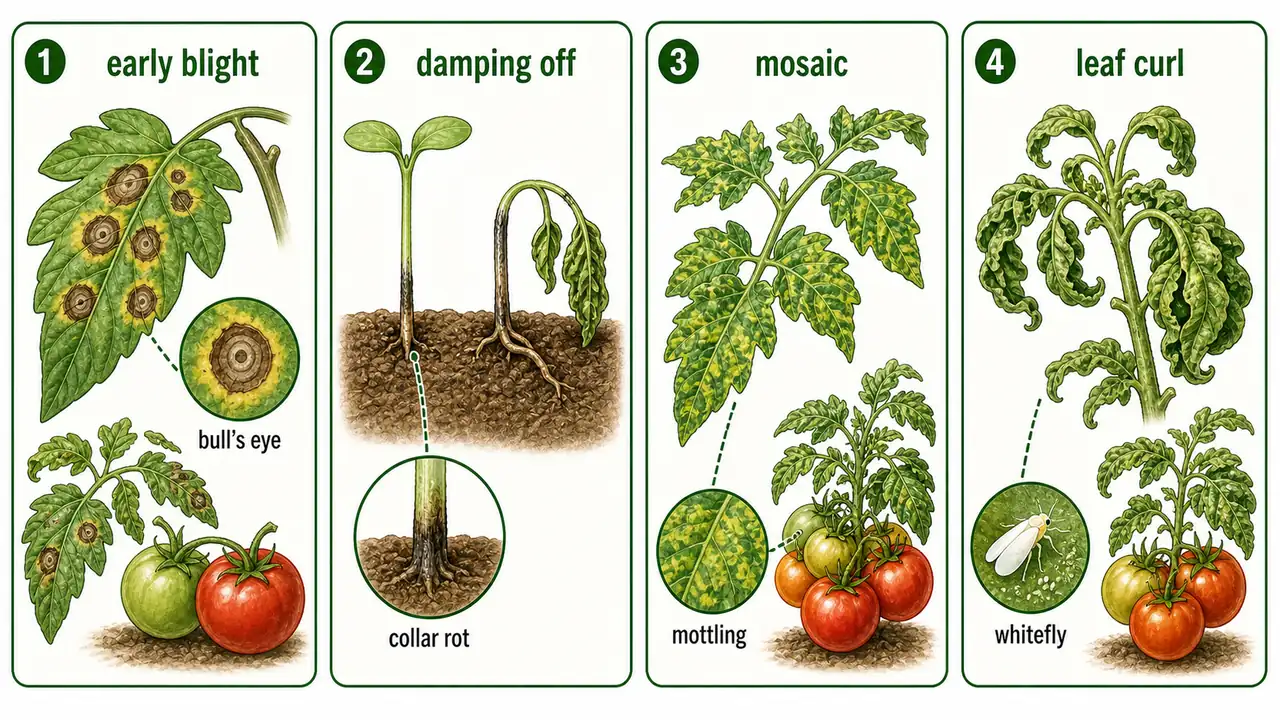
1. Early Blight — Alternaria solani
Symptoms:
- Attacks foliage causing characteristic leaf spots and blight
- Small, black lesions mostly on older foliage that enlarge to 6-7 mm diameter
- Concentric rings form a bull's eye pattern in the centre of the diseased area
- Tissue surrounding the spots may turn yellow
Management:
- Spray Mancozeb 0.2% for effective disease control
- Remove and destroy infected plant debris
- Use resistant varieties

IMPORTANT
The bull's eye pattern (concentric rings) is the hallmark diagnostic feature of Alternaria infections. This pattern is seen in early blight of both tomato and potato.
2. Damping Off — Pythium aphanidermatum
Symptoms:
- Occurs in two stages: pre-emergence and post-emergence
- Pre-emergence: Seedlings killed before reaching soil surface; complete rotting of radical and plumule
- Post-emergence: Infection of young, juvenile tissues at the collar region (ground level); tissues become soft and water-soaked; seedlings topple over
Management:
- Drench with Copper oxychloride 0.2% or Bordeaux mixture 1%
- Seed treatment with Trichoderma viride (4 g/kg) or Thiram (3 g/kg)
- Spray Metalaxyl 0.2% in cloudy weather
NOTE
Seed treatment is the only preventive measure to control pre-emergence damping off. Post-emergence can be managed with drenching.
3. Fusarium Wilt — Fusarium oxysporum f.sp. lycopersici
Symptoms:
- First symptom is clearing of veinlets and chlorosis of leaves
- Younger leaves may die in succession; entire plant wilts and dies in few days
- Petiole droops and wilts
- In young plants: vein clearing and drooping of petioles
Management:
- Spot drench with Carbendazim (0.1%)
- Use resistant varieties
- Crop rotation with non-solanaceous crops
4. Tomato Mosaic — Tomato Mosaic Virus (TMV)
Symptoms:
- Light and dark green mottling on leaves
- Often accompanied by wilting of young leaves on sunny days when plants first become infected
- Leaflets of affected leaves are usually distorted, puckered and smaller than normal
Management:
- Remove and destroy infected plants
- Control aphid vectors
- Use TMV-resistant varieties
- Wash hands with soap before handling plants (TMV is highly stable and mechanically transmitted)

WARNING
TMV is one of the most stable plant viruses — it can survive in dried plant debris for years and is easily transmitted through contaminated hands, tools, and even cigarettes (tobacco also harbours TMV).
5. Tomato Leaf Curl — Tomato Leaf Curl Virus (ToLCV)
Vector: Whitefly (Bemisia tabaci) + Begomovirus
Symptoms:
- Severe stunting with downward rolling and crinkling of leaves
- Newly emerging leaves show slight yellow colouration, later show curling
- Older leaves become leathery and brittle
Management:
- Yellow sticky traps @ 12/ha to monitor whitefly
- Raise barrier crops (cereals) around the field
- Spray Imidacloprid 0.05% or Dimethoate 0.05% at 15, 25, 45 days after transplanting to control vector
Potato Diseases
1. Late Blight — Phytophthora infestans
IMPORTANT
Late blight of potato caused the Irish Potato Famine of 1845, one of the most devastating plant disease epidemics in human history. It led to the death of over 1 million people and mass emigration from Ireland.
Symptoms:
- Affects leaves, stems and tubers
- Water-soaked spots on leaves that increase in size, turn purple-brown and finally black
- White growth develops on under surface of leaves — spreads to petioles, rachis and stems
- Frequently develops at nodes
Management:
- Protective spraying with Mancozeb or Zineb 0.2% to prevent tuber infection
- Avoid injuries at harvest; do not store visibly infected tubers
- Resistant varieties: Kufri Naveen, Kufri Jeevan, Kufri Alenkar, Kufri Khasi Garo, Kufri Moti
NOTE
Older objective-book recalls often add that P. infestans is heterothallic, has coenocytic mycelium, and survives in plains mainly through infected tubers that carry dormant mycelium between seasons.
2. Early Blight — Alternaria solani
Symptoms:
- Present in both hills and plains
- Brown-black necrotic spots — angular, oval shape with concentric rings (bull's eye pattern)
- Spots coalesce and spread all over the leaf; shot holes on fruits
Management:
- Use disease-free seed tubers
- Remove and destroy infected plant debris (spores in soil are primary infection source)
- Early spraying with Zineb or Captan 0.2% every 15-20 days
- Resistant variety: Kufri Sindhuri
3. Black Scurf — Rhizoctonia solani
Symptoms:
- At sprouting, dark brown colour appears on the eyes of tubers
- Affected xylem tissue causes wilting; infected tuber shows russeting of skin
- Hard dry rot with browning on internal tissue; spongy mass on infected tuber
- Seed tubers are source of spread
- Favourable conditions: moderately cool, wet weather at 23°C
Management:
- Treat soil with Pentachloronitrobenzene (PCNB) @ 70 kg/ha
- Plant well-sprouted tubers at shallow depth
- Leave land fallow for 2 years to reduce disease severity
4. Common Scab (Corky Scab) — Streptomyces scabies
Symptoms:
- Corkiness of tuber periderm is the characteristic symptom
- Approximately 1/4 inch into the tuber surface showing russette appearance
- Slightly pitted on infected tuber
- Light brown to dark brown lesions; affected tissue attracts insects
TIP
Streptomyces scabies is an actinomycete (not a true bacterium or fungus). Common scab is favoured by alkaline soil pH (>5.5) and dry conditions. Maintaining acidic soil pH helps control this disease.
5. Black Heart — Physiological Disorder
Cause:
- Usually linked with low oxygen and high temperature, especially under poor storage ventilation
Symptoms:
- Internal tissue develops dark grey to purplish-black discoloration
6. Wart Disease — Synchytrium endobioticum
Key Recall:
- In India, wart disease is classically revised as being restricted to the Darjeeling hills
Brinjal (Eggplant) Diseases
1. Phomopsis Blight — Phomopsis vexans
Symptoms:
- Damping off of seedlings in nursery beds
- Leaf spots: large, irregular, grey-brown patches
- Fruit rot: sunken, discoloured lesions on fruits; fruits shrivel and mummify
Management:
- Seed treatment with Thiram 3 g/kg
- Spray Copper oxychloride 0.25% or Mancozeb 0.2%
NOTE
The perfect stage is commonly written as Diaporthe vexans. Pycnidia are the flask-shaped asexual fruiting bodies, and filiform conidia are the classic morphology recall.
2. Little Leaf of Brinjal — Phytoplasma
Vector: Leafhopper (Cestius phycitis and Amrasca biguttula biguttula)
Symptoms:
- Characteristic smallness of leaves; petioles very short, leaves appear to stick to stem
- Leaves are narrow, soft, smooth and yellow; newly formed leaves much shorter
- Internodes shortened; axillary buds get enlarged giving plant a bushy appearance
- Mostly no flowering; if flowers form, they remain green. This green coloration of normally non-green floral parts is described as virescence.
- Fruiting is rare
Management:
- Spray insecticides to control leafhopper vector
- Remove and destroy infected plants
- Use resistant varieties such as Pusa Bhairav and Pant Rituraj
IMPORTANT
Little leaf of brinjal is caused by a phytoplasma (formerly mycoplasma-like organism/MLO), not a virus. Phytoplasmas are obligate parasites that inhabit phloem tissue and are transmitted by leafhoppers.
Chilli Diseases
1. Damping Off — Pythium aphanidermatum
- Same pathogen and symptoms as tomato damping off
- Pre-emergence and post-emergence phases
2. Anthracnose / Die-back — Colletotrichum capsici
Symptoms:
- Ripe fruits turning red are most affected
- Small, black, circular spots appear on fruit skin
- Badly diseased fruits turn straw colour or pale white, lose their pungency
Management:
- Seed treatment with Thiram or Captan 3 g/kg
- Spray Mancozeb 0.25% or Copper oxychloride 0.3%
- Use disease-free seeds
NOTE
In chilli, anthracnose and die-back are often caused by the same pathogen (C. capsici). Die-back refers to the drying of shoot tips from above downward, while anthracnose refers to the fruit rot phase.
3. Chilli Leaf Curl — Leaf Curl Virus
Vector: Whitefly (Bemisia tabaci)
- Upward curling and puckering of leaves
- Stunting of plants; reduced fruit set
Okra Diseases
1. Yellow Vein Mosaic — Bhendi Yellow Vein Mosaic Virus (BYVMV)
Vector: Whitefly (Bemisia tabaci)
Key Recall:
- BYVMV is commonly treated as an ss-DNA virus in the Geminiviridae group, usually revised under Begomovirus
- Vein clearing followed by vein chlorosis is the hallmark field clue
Cole Crop Disease Recall
1. Black Rot of Cabbage — Xanthomonas campestris pv. campestris
Symptoms:
- Characteristic V-shaped chlorotic lesions start from the leaf margin and progress inward
Key Recall:
- The pathogen commonly enters through leaf hydathodes/stomatal openings, and the disease is important across crucifers
4. Chilli Mosaic — Viral
- Mottling and distortion of leaves
- Stunted growth and reduced yield
Onion Diseases
1. Purple Blotch — Alternaria porri
Symptoms:
- Disease occurs mainly at the top/tip portion of leaves
- Infection starts with whitish minute dots on leaves with irregular chlorotic areas
- Circular to oblong concentric black velvety rings appear in the chlorotic area
- Lesions develop towards the base of the leaf
- Spots join together and spread quickly to the entire leaf area
- Leaves gradually die from the tip downwards
Management:
- Spray Mancozeb 0.25% or Copper oxychloride 0.3%
- Proper spacing for air circulation
- Avoid overhead irrigation
2. Onion Smut — Urocystis cepulae
- Black powdery mass of spores in leaves
- Seedlings are most susceptible
- Soil-borne; seed treatment with Thiram recommended
3. Downy Mildew — Peronospora destructor
- Pale green or yellowish patches on leaves
- Grey-violet fuzzy growth on leaf surface
- Leaves bend and fall; tips die back
Pea Diseases
1. Fusarium Wilt — Fusarium oxysporum f.sp. pisi
Symptoms:
- First symptom is drooping of plants followed by sudden death
- Leaves turn yellow and drop off prematurely
Management:
- Seed treatment with Carbendazim or Thiram
- Crop rotation (3-4 years)
- Use resistant varieties
2. Powdery Mildew — Erysiphe polygoni
Symptoms:
- Disease appears on foliage and pods
- First apparent as small, slightly darkened areas which later become white powdery spots
- Spots enlarge and cover entire leaf area
- Severely infected leaves become chlorotic and distorted before falling
- Affected pods are small in size and malformed
IMPORTANT
Pea powdery mildew (Erysiphe polygoni) was asked in exams. Remember the pathogen name.
Management:
- Spray Wettable sulphur 0.2% or Karathane 0.1%
- Use resistant varieties
- Early sowing to escape disease
3. Pea Rust — Uromyces fabae
Symptoms:
- Serious in humid regions
- Plants dry up quickly; yield considerably reduced
- Initial symptoms: flecking of leaves
- Flecks develop into reddish-brown pustules, frequently merging, finally bursting to expose brown spores
- Entire leaf blade and affected parts give brownish appearance from a distance
Management:
- Spray Mancozeb 0.2% or Zineb 0.2%
- Remove and destroy crop debris
- Use resistant varieties
Quick Reference: Vegetable Crop Diseases
Complete Disease-Pathogen Summary Table
| Crop | Disease | Pathogen | Type | Key Diagnostic Feature |
|---|---|---|---|---|
| Tomato | Early blight | Alternaria solani | Fungal | Bull's eye concentric rings on older foliage |
| Tomato | Damping off | Pythium aphanidermatum | Oomycete | Pre- and post-emergence seedling death |
| Tomato | Fusarium wilt | F. oxysporum f.sp. lycopersici | Fungal | Vein clearing, chlorosis, wilting |
| Tomato | Mosaic | TMV | Viral | Light-dark green mottling, puckered leaves |
| Tomato | Leaf curl | ToLCV | Viral | Downward rolling, crinkling; whitefly vector |
| Potato | Late blight | Phytophthora infestans | Oomycete | Water-soaked spots, white growth below leaf |
| Potato | Early blight | Alternaria solani | Fungal | Concentric rings, angular-oval spots |
| Potato | Black scurf | Rhizoctonia solani | Fungal | Dark brown on eyes, russeting of skin |
| Potato | Common scab | Streptomyces scabies | Actinomycete | Corky periderm, russette appearance |
| Brinjal | Phomopsis blight | Phomopsis vexans | Fungal | Fruit rot, mummification |
| Brinjal | Little leaf | Phytoplasma | Phytoplasma | Tiny leaves, bushy habit; leafhopper vector |
| Chilli | Anthracnose/Die-back | Colletotrichum capsici | Fungal | Black spots on ripe fruits, loss of pungency |
| Chilli | Leaf curl | Leaf curl virus | Viral | Upward curling; whitefly vector |
| Onion | Purple blotch | Alternaria porri | Fungal | Concentric black rings at leaf tips |
| Onion | Smut | Urocystis cepulae | Fungal | Black powdery spore mass in leaves |
| Onion | Downy mildew | Peronospora destructor | Oomycete | Grey-violet fuzzy growth |
| Pea | Fusarium wilt | F. oxysporum f.sp. pisi | Fungal | Drooping, sudden death |
| Pea | Powdery mildew | Erysiphe polygoni | Fungal | White powdery spots on foliage and pods |
| Pea | Rust | Uromyces fabae | Fungal | Reddish-brown pustules, merging |
Vectors and Their Associated Diseases
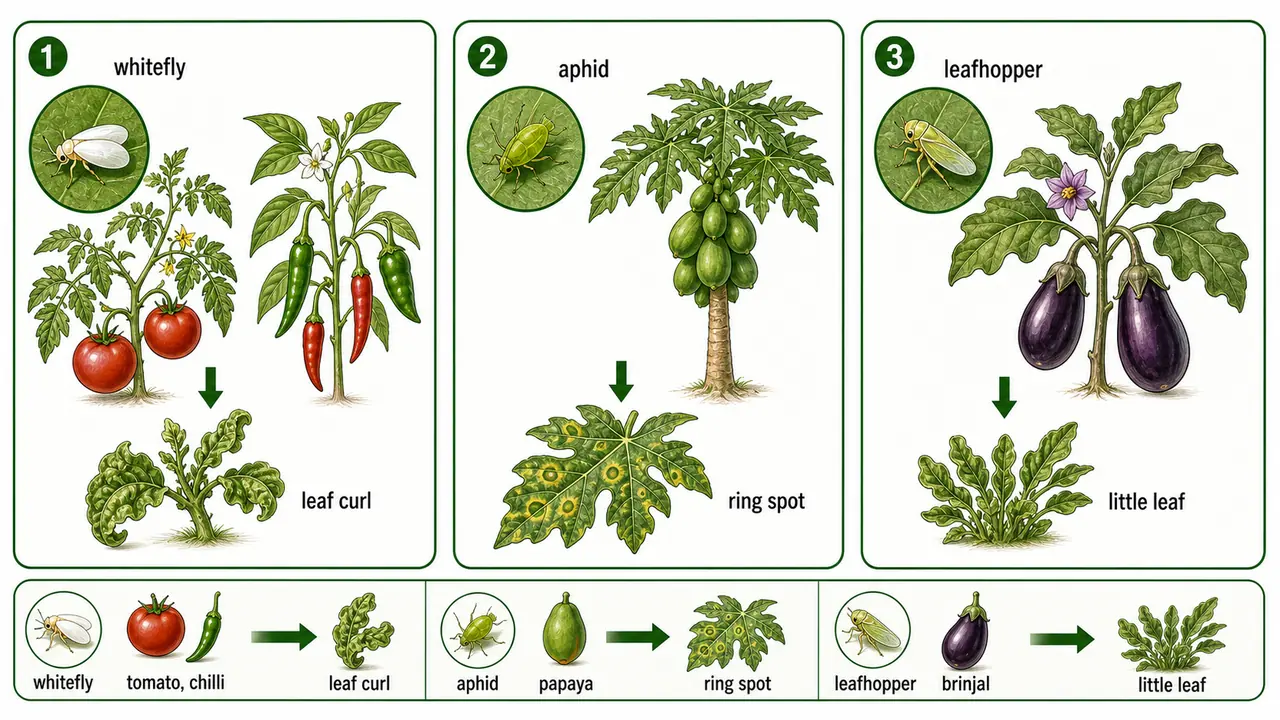
| Vector | Disease | Crop |
|---|---|---|
| Whitefly (Bemisia tabaci) | Leaf curl | Tomato, Chilli, Papaya |
| Aphids (Aphis gossypii) | Ring spot | Papaya |
| Leafhopper (Cestius phycitis) | Little leaf | Brinjal |
| Aphid (Pentalonia nigronervosa) | Bunchy top | Banana |
| Psyllid (Diaphorina citri) | Greening/HLB | Citrus |
| Aphid (Toxoptera citricida) | Tristeza | Citrus |
Key Exam Points to Remember
TIP
High-frequency exam questions:
- Irish Potato Famine (1845) = Phytophthora infestans (Late blight)
- Bull's eye pattern = Alternaria solani (Early blight of tomato/potato)
- Pea powdery mildew = Erysiphe polygoni (exams 2021)
- Little leaf of brinjal = Phytoplasma (NOT virus), vector = leafhopper
- Common scab of potato = Streptomyces scabies (actinomycete)
- Damping off = Pythium aphanidermatum (pre- and post-emergence)
- Chilli anthracnose = Colletotrichum capsici (fruits lose pungency)
- Tomato leaf curl vector = Whitefly (Bemisia tabaci)
- Fusarium wilt pathogens are host-specific: different forma specialis for each crop
Summary Cheat Sheet
| Concept / Topic | Key Details |
|---|---|
| Early Blight (Tomato/Potato) | Alternaria solani; bull's eye pattern (concentric rings); older foliage first; spray Mancozeb 0.2% |
| Damping Off | Pythium aphanidermatum; pre-emergence (complete rot) & post-emergence (collar region); drench CuOCl 0.2% |
| Fusarium Wilt (Tomato) | F. oxysporum f.sp. lycopersici; vein clearing, chlorosis; spot drench Carbendazim 0.1% |
| TMV (Tomato Mosaic) | Light-dark green mottling; highly stable virus; mechanically transmitted |
| Tomato Leaf Curl | ToLCV + Begomovirus; vector = whitefly Bemisia tabaci; downward rolling & crinkling; spray Imidacloprid 0.05% |
| Late Blight (Potato) | Phytophthora infestans; Irish Famine 1845; water-soaked spots, white growth below leaf; spray Mancozeb 0.2% |
| Black Scurf (Potato) | Rhizoctonia solani; dark brown on eyes of tubers; russeting of skin; treat soil with PCNB 70 kg/ha |
| Common Scab (Potato) | Streptomyces scabies (actinomycete); corky periderm; favoured by alkaline pH >5.5 |
| Late Blight resistant varieties | Kufri Naveen, Kufri Jeevan, Kufri Alenkar, Kufri Khasi Garo, Kufri Moti |
| Early Blight resistant variety | Kufri Sindhuri |
| Phomopsis Blight (Brinjal) | Phomopsis vexans; fruit rot → mummification; seed treat Thiram 3 g/kg |
| Little Leaf (Brinjal) | Phytoplasma (NOT virus); vector = leafhopper; tiny leaves, bushy habit, no flowering |
| Chilli Anthracnose / Die-back | Colletotrichum capsici; ripe fruits most affected; fruits lose pungency |
| Chilli Leaf Curl | Viral; vector = whitefly Bemisia tabaci; upward curling |
| Purple Blotch (Onion) | Alternaria porri; concentric black velvety rings at leaf tips |
| Onion Smut | Urocystis cepulae; black powdery spore mass; seedlings most susceptible |
| Onion Downy Mildew | Peronospora destructor; grey-violet fuzzy growth |
| Fusarium Wilt (Pea) | F. oxysporum f.sp. pisi; drooping → sudden death |
| Powdery Mildew (Pea) | Erysiphe polygoni; white powdery spots on foliage & pods; exams 2021 |
| Pea Rust | Uromyces fabae; reddish-brown pustules merging on leaves |
| Key vectors | Whitefly → Leaf curl (tomato, chilli, papaya); Leafhopper → Little leaf (brinjal); Aphid → Bunchy top (banana) |
| Fusarium wilt specificity | Different forma specialis for each crop: lycopersici, pisi, cubense, vasinfectum |
Lesson Doubts
Ask questions, get expert answers