Finding the Original — Reverse Percentage Calculations
Given the final value after a percentage change, learn to find the original value using the ratio method
Finding the Original — Reverse Percentage Calculations
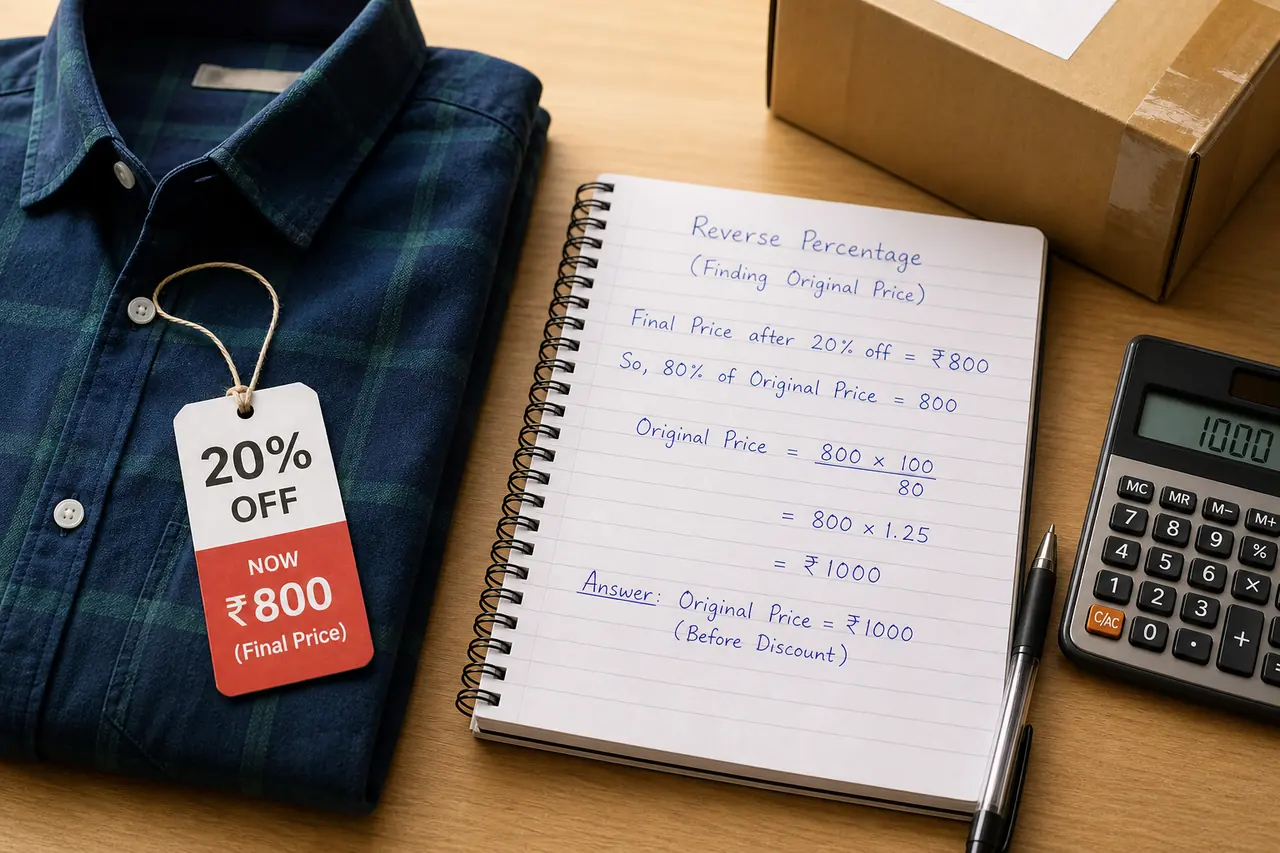
In exams, you're often given the final value after a percentage change and asked to find the original. This lesson teaches you three methods — and why the ratio method is the fastest.
The Three Methods
For any "find the original" problem, you can use:
| Method | Approach | Speed |
|---|---|---|
| 1. Formula | F = I × multiplier → I = F ÷ multiplier | Medium |
| 2. Ratio | Use I:F ratio, find the multiplier | Fastest |
| 3. Direct | Calculate the percentage amount, add/subtract | Slowest |
Method Comparison: Increase 480 by 25%
Method 1 (Formula):
- +25% multiplier = 5/4
- F = 480 × 5/4 = 600
Method 2 (Ratio):
- I : F = 4 : 5
- 480 corresponds to 4 parts, so 1 part = 120
- F = 5 × 120 = 600
Method 3 (Direct):
- 25% of 480 = 480/4 = 120
- 480 + 120 = 600
Finding Original from Final
Example 1: After 16.67% increase, marks become 105. Find original.
- 16.67% = 1/6
- +16.67% → I : F = 6 : 7
- F = 105 corresponds to 7 parts → 1 part = 15
- I = 6 × 15 = 90
Verify: 90 × 7/6 = 105 ✓
Example 2: After 25% increase, salary becomes Rs. 58,750. Find original.
- 25% = 1/4
- +25% → I : F = 4 : 5
- 58,750 corresponds to 5 parts → 1 part = 11,750
- I = 4 × 11,750 = Rs. 47,000
Example 3: After 16.67% decrease, weight becomes 2,345 kg. Find original.
- 16.67% = 1/6
- −16.67% → I : F = 6 : 5
- 2,345 corresponds to 5 parts → 1 part = 469
- I = 6 × 469 = 2,814 kg
Example 4: After 37.50% increase, money becomes Rs. 7,843. Find original.
- 37.5% = 3/8
- +37.5% → I : F = 8 : 11
- 7,843 corresponds to 11 parts → 1 part = 713
- I = 8 × 713 = Rs. 5,704
Example 5: After 87.50% increase, salary becomes Rs. 23,625. Find original.
- 87.5% = 7/8
- +87.5% → I : F = 8 : 15
- 23,625 corresponds to 15 parts → 1 part = 1,575
- I = 8 × 1,575 = Rs. 12,600
Tricky Cases: Large Decrease Percentages
Example 6: After 93.33% decrease, toys become 372. Find original.
- 93.33% = 14/15 (since 100% − 93.33% = 6.67% = 1/15)
- −93.33% → remaining = 1/15 of original
- I : F = 15 : 1
- 372 corresponds to 1 part
- I = 15 × 372 = 5,580
Example 7: After 93.75% decrease, balls become 468. Find original.
- 100% − 93.75% = 6.25% = 1/16
- I : F = 16 : 1
- I = 16 × 468 = 7,488
Finding the New Value After a Change
Example 8: Decrease 2,730 by 28.57%.
- 28.57% = 2/7
- −28.57% → I : F = 7 : 5
- 2,730 corresponds to 7 parts → 1 part = 390
- F = 5 × 390 = 1,950
Example 9: Increase 1,365 by 20%.
- 20% = 1/5
- +20% → I : F = 5 : 6
- 1,365 corresponds to 5 parts → 1 part = 273
- F = 6 × 273 = 1,638
Example 10: Decrease 4,158 by 16.67%.
- 16.67% = 1/6
- −16.67% → I : F = 6 : 5
- 4,158 corresponds to 6 parts → 1 part = 693
- F = 5 × 693 = 3,465
Finding Original: Formula Method
When the ratio doesn't divide cleanly, use the formula:
I = F × (d / (d ± n)) for percentage = n/d
Example: After 15.38% increase, result = 3,225. Find original.
- 15.38% = 2/13
- +15.38% multiplier = 15/13
- I = 3,225 × 13/15 = 2,795
Example: After 28.57% decrease, result = 1,950. Find original.
- 28.57% = 2/7
- −28.57% multiplier = 5/7
- I = 1,950 × 7/5 = 2,730
Practice Problems
| # | Given | Change | Find | Answer |
|---|---|---|---|---|
| 1 | Final = 18,375 | +25% | Original | 14,700 |
| 2 | Final = 3,225 | +15.38% | Original | 2,795 |
| 3 | Final = 3,465 | −16.67% | Original | 4,158 |
| 4 | Final = 1,950 | −28.57% | Original | 2,730 |
| 5 | Initial = 1,365 | +20% | Final | 1,638 |
| 6 | Final = 58,750 | +25% | Original | 47,000 |
| 7 | Final = 23,625 | +87.5% | Original | 12,600 |
| 8 | Final = 7,843 | +37.5% | Original | 5,704 |
| 9 | Final = 2,345 | −16.67% | Original | 2,814 |
| 10 | Final = 372 | −93.33% | Original | 5,580 |
Lesson Doubts
Ask questions, get expert answers