Successive Percentage Change — The Fraction Chain Method
Handle multiple percentage changes correctly using fraction multiplication instead of the wrong way of simply adding percentages
Successive Percentage Change — The Fraction Chain Method
When a value changes by one percentage and then by another, you cannot simply add the percentages. The base changes after each step. This lesson teaches the fraction chain method — the fastest way to handle successive changes.
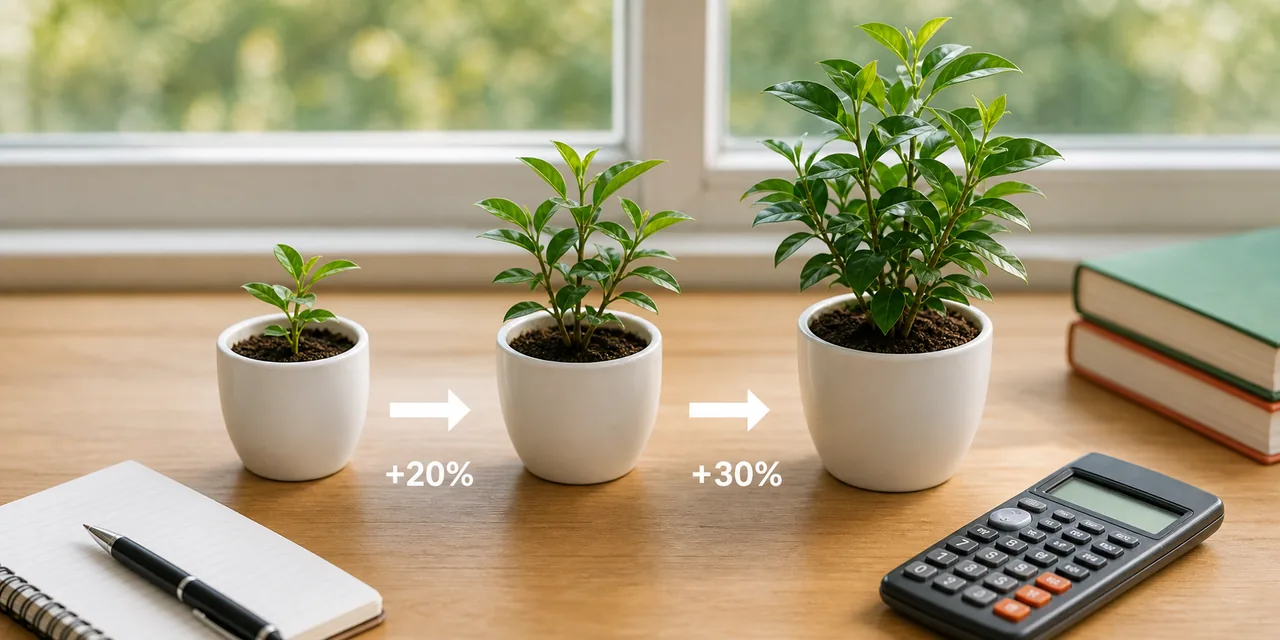
Why You Can't Simply Add Percentages
Consider: A value increases by 10% in 2012, then by 20% in 2013.
Wrong: 10% + 20% = 30% total increase ✗
Right:
- Start: 1000
- After +10%: 1000 × 11/10 = 1100
- After +20%: 1100 × 6/5 = 1320
- Actual change = (1320 − 1000)/1000 × 100 = 32% (not 30%)
Why the difference? The 20% increase is applied to 1100 (not 1000), so you get an extra 20% of the first increase.
The Fraction Chain Method
Convert each percentage change to a fraction multiplier and multiply them all together in a chain.
Steps:
- Convert each percentage to a fraction (use the table from Lesson 2)
- For increase: multiplier = 1 + fraction = (d+n)/d
- For decrease: multiplier = 1 − fraction = (d−n)/d
- Multiply all multipliers together
- Apply to the initial value
Two Successive Changes
Example 1: Price increases by 9.09% then by 25%. Overall change?
| Change | Fraction | Multiplier |
|---|---|---|
| +9.09% | 1/11 | 12/11 |
| +25% | 1/4 | 5/4 |
Chain: I × 12/11 × 5/4 = I × 15/11
Overall ratio I : F = 11 : 15. Change = 4/11 × 100 = 36.36% increase
Example 2: Mobile price Rs. 8,640. Increased by 12.50% then by 20%.
| Change | Fraction | Multiplier |
|---|---|---|
| +12.5% | 1/8 | 9/8 |
| +20% | 1/5 | 6/5 |
F = 8640 × 9/8 × 6/5 = 8640 × 54/40 = 11,664
Example 3: Share value Rs. 6,300. Reduced by 16.67% then by 14.29%.
| Change | Fraction | Multiplier |
|---|---|---|
| −16.67% | 1/6 | 5/6 |
| −14.29% | 1/7 | 6/7 |
F = 6300 × 5/6 × 6/7 = 6300 × 5/7 = 4,500
Notice how 6 cancels out — this simplification is the power of the fraction chain!
Example 4: 2,700 coins increase by 33.33%, then decrease by 11.11%.
| Change | Fraction | Multiplier |
|---|---|---|
| +33.33% | 1/3 | 4/3 |
| −11.11% | 1/9 | 8/9 |
F = 2700 × 4/3 × 8/9 = 2700 × 32/27 = 3,200
Three Successive Changes
Example 5: 23,125 increased by 14.29%, 16.67%, and 20%.
| Change | Fraction | Multiplier |
|---|---|---|
| +14.29% | 1/7 | 8/7 |
| +16.67% | 1/6 | 7/6 |
| +20% | 1/5 | 6/5 |
F = 23,125 × 8/7 × 7/6 × 6/5
Look at the cancellations: 7 cancels, 6 cancels!
F = 23,125 × 8/5 = 23,125 × 8/5 = 37,000
Example 6: Salary Rs. 17,920. Increased by 12.50%, 11.11%, and 25%.
| Change | Multiplier |
|---|---|
| +12.5% | 9/8 |
| +11.11% | 10/9 |
| +25% | 5/4 |
F = 17,920 × 9/8 × 10/9 × 5/4
Cancellations: 9 cancels!
F = 17,920 × 10/8 × 5/4 = 17,920 × 50/32 = 28,000
Example 7: 37,800 decreased by 33.33%, 8.33%, and 9.09%.
| Change | Multiplier |
|---|---|
| −33.33% | 2/3 |
| −8.33% | 11/12 |
| −9.09% | 10/11 |
F = 37,800 × 2/3 × 11/12 × 10/11
Cancellations: 11 cancels!
F = 37,800 × 2/3 × 10/12 = 37,800 × 20/36 = 21,000
Example 8: Factory output 46,800. Decreased by 37.50%, 7.69%, and 5.56%.
| Change | Multiplier |
|---|---|
| −37.5% | 5/8 |
| −7.69% | 12/13 |
| −5.56% | 17/18 |
F = 46,800 × 5/8 × 12/13 × 17/18 = 25,500
Finding Original from Final After Successive Changes
Reverse the chain — multiply by the inverse of each multiplier.
Example 9: After −22.22% and +10%, value becomes Rs. 16,170. Find original.
| Change | Multiplier | Inverse |
|---|---|---|
| −22.22% | 7/9 | 9/7 |
| +10% | 11/10 | 10/11 |
Original = 16,170 × 10/11 × 9/7 = 18,900
Example 10: After −55.56% and +18.18%, value becomes Rs. 13,000. Find original.
| Change | Multiplier | Inverse |
|---|---|---|
| −55.56% (= 5/9) | 4/9 | 9/4 |
| +18.18% (= 2/11) | 13/11 | 11/13 |
Original = 13,000 × 11/13 × 9/4 = 24,750
Example 11: After +87.50% and −28%, final = Rs. 12,960. Find original.
| Change | Multiplier | Inverse |
|---|---|---|
| +87.5% (= 7/8) | 15/8 | 8/15 |
| −28% (= 7/25) | 18/25 | 25/18 |
Original = 12,960 × 25/18 × 8/15 = 9,600
The Key Insight: Cancellations
The fraction chain method is powerful because fractions cancel beautifully. When one change has a numerator that matches another's denominator, they simplify instantly.
This is especially true for percentages like:
- 14.28% (1/7) and 16.67% (1/6) → multipliers 8/7 and 7/6 → 7s cancel
- 11.11% (1/9) and 12.5% (1/8) → multipliers 10/9 and 9/8 → 9s cancel
- 33.33% (1/3) and 25% (1/4) → multipliers 4/3 and 5/4 → could simplify
Exam strategy: Always convert to fractions first. Look for cancellations before multiplying. This can turn a complex 3-step calculation into a single simple multiplication.
Exam Speed Tricks for Successive Changes
Instant Formulas (no calculation needed)
| Question Pattern | Instant Answer |
|---|---|
| +x% then −x% (same %) | Net loss = x²/100 % (always a loss). E.g., +20% then −20% = −4% |
| +10% then +10% | Net = +21% (not 20%) |
| +10% three times | Net = +33.1% |
| −10% then −10% | Net = −19% (not −20%) |
| Price ↑ x%, consumption ↓ to keep expenditure same | Consumption must decrease by x/(100+x) × 100 % |
| Price ↑ 25%, keep expenditure same | Consumption ↓ by 25/125 × 100 = 20% (use fraction: 1/4 up → 1/5 down) |
The "Fraction Shortcut" for Expenditure-Constant Problems
If price rises by 1/n, reduce consumption by 1/(n+1) to keep spending same.
| Price ↑ by | = fraction | Consumption ↓ by | = fraction |
|---|---|---|---|
| 10% | 1/10 | 9.09% | 1/11 |
| 20% | 1/5 | 16.67% | 1/6 |
| 25% | 1/4 | 20% | 1/5 |
| 33.33% | 1/3 | 25% | 1/4 |
| 50% | 1/2 | 33.33% | 1/3 |
This table alone can solve 80% of price-consumption questions in under 10 seconds.
Lesson Doubts
Ask questions, get expert answers