Percentage Algebra & Chain Percentages — Merging Ratios
Solve 'X% of N = Y more than Z% of N' problems and chain percentage comparisons like 'A is X% of B, B is Y% of C, find A as % of C'
Percentage Algebra & Chain Percentages
Two powerful question types that appear frequently in exams: algebraic percentage equations (find the unknown number) and chain percentage comparisons (merge ratios to connect three or more quantities).
Part 1: Percentage Algebra — Finding the Unknown Number
Type 1: Difference of Two Percentages = Given Value
Example 1: 40% of a number is 60 more than 25% of the same number. Find the number.
- 40% of N − 25% of N = 60
- 15% of N = 60
- N = 60 × 100/15 = 400
Example 2: 12% of N exceeds 18% of N by 96. Wait — 12% < 18%, so:
- 18% of N − 12% of N = 96
- 6% of N = 96
- N = 96 × 100/6 = 1,600
Type 2: Sum/Average of Percentages = Given Value
Example 3: The average of 30% and 50% of a number is 144. Find the number.
- Average = (30% + 50%) / 2 = 40% of N
- 40% of N = 144
- N = 144 × 100/40 = 360
Type 3: Percentage of a Percentage
Example 4: 35% of 40% of a number is 1,050. Find the number.
- 35/100 × 40/100 × N = 1,050
- 14/100 × N = 1,050
- N = 1,050 × 100/14 = 7,500
The General Strategy
- Convert all percentages to fractions
- Set up the equation
- Solve for the unknown
- Always verify your answer by plugging back in
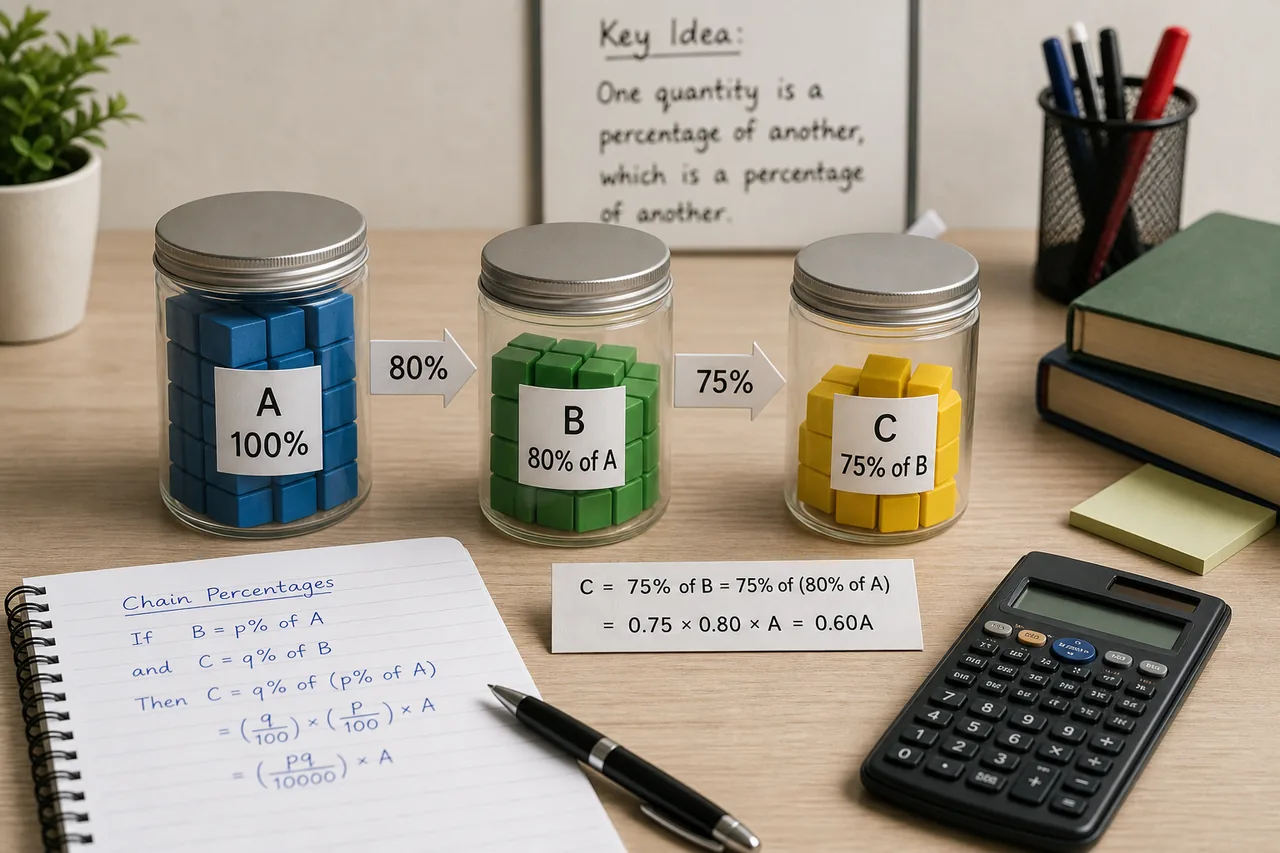
Part 2: Chain Percentages — Merging Ratios
When you're told "A is X% of B" and "B is Y% of C", you can find "A as % of C" by merging the ratios.
The Core Method
Convert each percentage to a ratio, then multiply the ratios.
Example 5: A is 75% of B, B is 80% of C. A is what % of C?
| Statement | Ratio |
|---|---|
| A = 75% of B | A/B = 3/4 → A : B = 3 : 4 |
| B = 80% of C | B/C = 4/5 → B : C = 4 : 5 |
Since B = 4 in both ratios (already equal), merge directly:
A : B : C = 3 : 4 : 5
A as % of C = (3/5) × 100 = 60%
Example 6: A is 60% of B, B is 40% of C. A is what % of C?
| Statement | Ratio |
|---|---|
| A = 60% of B | A : B = 3 : 5 |
| B = 40% of C | B : C = 2 : 5 |
B is 5 in the first ratio and 2 in the second. Make B equal:
- A : B = 3 : 5 → multiply by 2 → 6 : 10
- B : C = 2 : 5 → multiply by 5 → 10 : 25
Merged: A : B : C = 6 : 10 : 25
A as % of C = (6/25) × 100 = 24%
Example 7: A is 120% of B, B is 150% of C. A is what % of C?
| Statement | Ratio |
|---|---|
| A = 120% of B | A : B = 6 : 5 |
| B = 150% of C | B : C = 3 : 2 |
Make B equal: A : B = 6 : 5, multiply by 3 → 18 : 15. B : C = 3 : 2, multiply by 5 → 15 : 10.
Merged: A : B : C = 18 : 15 : 10
A as % of C = (18/10) × 100 = 180%
4-Variable Chains
Example 8: A is 50% of B, B is 60% of C, C is 80% of D. Find A as % of D.
| Statement | Ratio |
|---|---|
| A : B | 1 : 2 |
| B : C | 3 : 5 |
| C : D | 4 : 5 |
Make B common in first two: A : B = 3 : 6, B : C = 6 : 10 → A : B : C = 3 : 6 : 10
Make C common: A : B : C = 3 : 6 : 10, multiply by 2 → 6 : 12 : 20. C : D = 4 : 5, multiply by 5 → 20 : 25.
Merged: A : B : C : D = 6 : 12 : 20 : 25
A as % of D = (6/25) × 100 = 24%
Shortcut: Just multiply the fractions directly:
A/D = (A/B) × (B/C) × (C/D) = 1/2 × 3/5 × 4/5 = 12/50 = 24%
"Difference as % of New Value"
A tricky variant: "If salary increases by 16.67%, the difference is what % of the NEW salary?"
- 16.67% = 1/6. I : F = 6 : 7
- Difference = 1, but now base = new value (F) = 7
- (1/7) × 100 = 14.29%
Always check whether the question asks "% of original" or "% of new value" — the base changes the answer completely.
Practice Problems
| # | Problem | Answer |
|---|---|---|
| 1 | 35% of N − 20% of N = 225. Find N. | 1,500 |
| 2 | Average of 25% and 45% of N is 280. Find N. | 800 |
| 3 | 20% of 30% of N = 1,200. Find N. | 20,000 |
| 4 | A = 80% of B, B = 75% of C. A is what % of C? | 60% |
| 5 | A = 66.67% of B, B = 60% of C, C = 50% of D. A as % of D? | 20% |
| 6 | Salary increases by 25%. Increase is what % of new salary? | 20% |
Lesson Doubts
Ask questions, get expert answers