Product Constancy — Price, Consumption & Expenditure
Master the Price x Consumption = Expenditure framework using ratio multiplication for questions about price changes, budget changes, and finding original quantities
Product Constancy — Price, Consumption & Expenditure
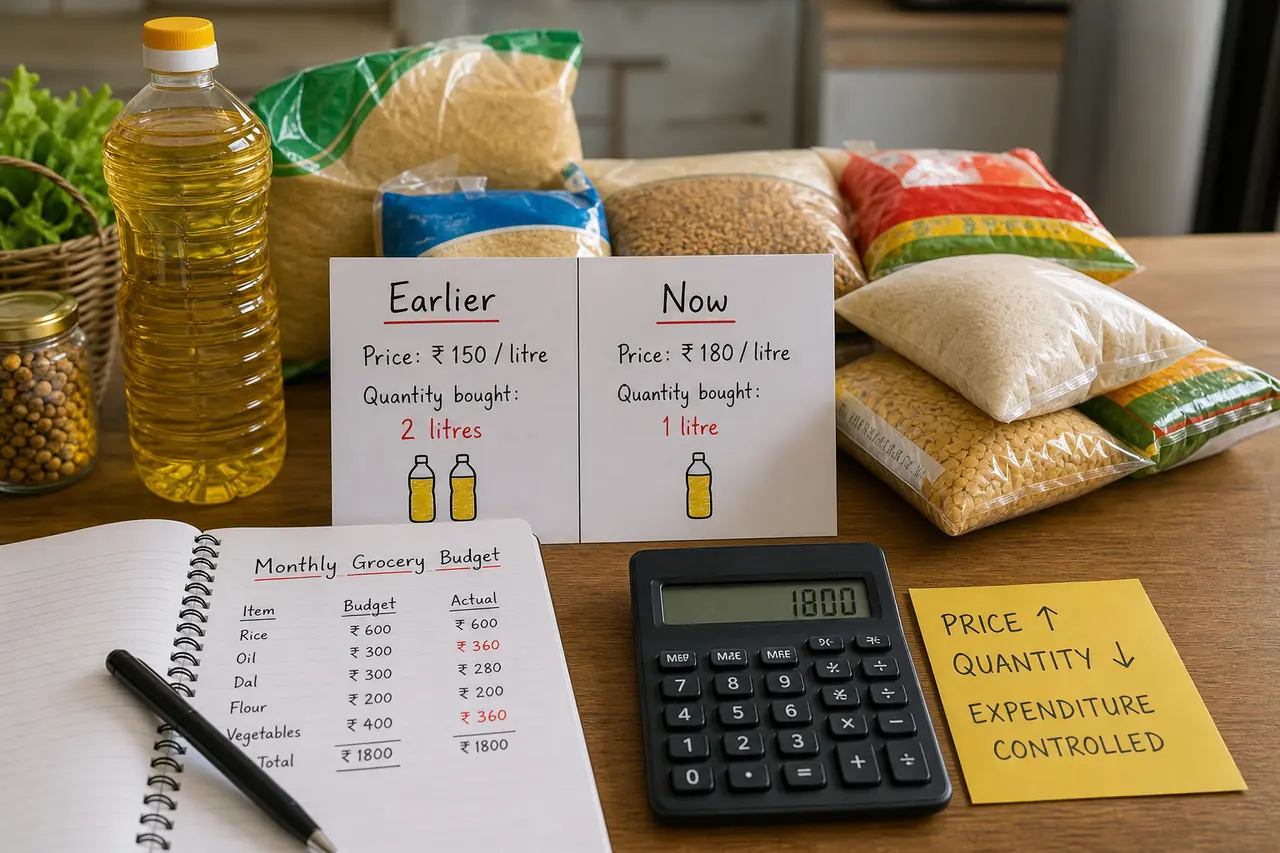
The single most important formula in percentage word problems:
Price x Consumption = Expenditure
When any two of these three change, the ratio method gives you the answer instantly.
The Core Concept: Ratio Multiplication
If Price has ratio P₁ : P₂ and Consumption has ratio C₁ : C₂, then:
Expenditure ratio = (P₁ × C₁) : (P₂ × C₂)
This works because Expenditure = Price × Consumption.
Example 1: Price rises by 15%, but Anil buys 20% fewer units. Overall spending change?
| Initial | Final | |
|---|---|---|
| Price | 20 | 23 (+15%) |
| × Consumption | 5 | 4 (−20%) |
| = Expenditure | 100 | 92 |
Change = (100 − 92)/100 × 100 = 8% decrease
Example 2: Cooking oil becomes 16.67% costlier. Priya reduces consumption by 28.57%. Expenditure change?
| Initial | Final | |
|---|---|---|
| Price | 6 | 7 (+16.67% = 1/6) |
| × Consumption | 7 | 5 (−28.57% = 2/7) |
| = Expenditure | 42 | 35 → simplified 6 : 5 |
Change = 1/6 × 100 = 16.67% decrease
Example 3: Product becomes 33.33% costlier, customer buys 10% fewer units.
| Initial | Final | |
|---|---|---|
| Price | 3 | 4 (+33.33%) |
| × Consumption | 10 | 9 (−10%) |
| = Expenditure | 30 | 36 → 5 : 6 |
Change = 1/5 × 100 = 20% increase
Example 4: Shop raises price by 30%. Riya can only buy 80% of planned quantity.
| Initial | Final | |
|---|---|---|
| Price | 10 | 13 (+30%) |
| × Consumption | 5 | 4 (−20%) |
| = Expenditure | 50 | 52 → 25 : 26 |
Change = 1/25 × 100 = 4% increase
The Reciprocal Rule (Expenditure Constant)
When expenditure stays the same (same budget):
Price ratio and Consumption ratio are reciprocals of each other.
If price goes up in ratio 4 : 5, consumption must come down in ratio 5 : 4.
Why?
P₁ × C₁ = P₂ × C₂ (expenditure constant)
So: P₁/P₂ = C₂/C₁ → ratios are reciprocal.
Finding Quantity Change (Budget Constant)
Example 5: Salary decreased by 40%. By what % must it increase to restore?
- Decrease 40% = 2/5. I : F = 5 : 3
- To go from 3 back to 5: increase = 2/3 × 100 = 66.67%
Example 6: Price decreases 20%, budget increases 10%. Quantity increase?
- Price: P₁ : P₂ = 5 : 4 (−20%)
- Expenditure: E₁ : E₂ = 10 : 11 (+10%)
- Consumption = Expenditure / Price
- C₁/C₂ = (E₁/P₁) / (E₂/P₂) = (10/5) / (11/4) = (10 × 4)/(5 × 11) = 40/55 = 8 : 11
Change = 3/8 × 100 = 37.5% increase
Finding New Price Per Kg (Budget Constant)
Example 7: After 5.88% price cut in wheat, Neha buys 5 kg more with Rs. 6,800.
- 5.88% = 1/17. Price ratio = 17 : 16
- Budget constant → Consumption ratio (reciprocal) = 16 : 17
- Difference = 1 part = 5 kg → each part = 5 kg
- New consumption = 17 × 5 = 85 kg
- New price = 6800/85 = Rs. 80 per kg
Example 8: After 12.5% price cut in sugar, Priya buys 6 kg more with Rs. 2,400.
- 12.5% = 1/8. Price = 8 : 7
- Consumption (reciprocal) = 7 : 8. Difference = 1 part = 6 kg
- New consumption = 8 × 6 = 48 kg
- Reduced price = 2400/48 = Rs. 50 per kg
Example 9: After 9.09% price increase, Meena buys 4 kg less with Rs. 2,640.
- 9.09% = 1/11. Price = 11 : 12
- Consumption (reciprocal) = 12 : 11. Difference = 1 part = 4 kg
- New consumption = 11 × 4 = 44 kg
- Increased price = 2640/44 = Rs. 60 per kg
Example 10: After 25% price increase, with Rs. 2,400, quantity purchased is 8 litres less.
- 25% = 1/4. Price = 4 : 5
- Consumption = 5 : 4. Difference = 1 part = 8 litres
- Old consumption = 5 × 8 = 40 litres, New = 32 litres
- Increased price = 2400/32 = Rs. 75 per litre
Successive Price Changes + Constant Budget
Example 11: Rice price reduced by 20% then again by 10%. With Rs. 1,800, quantity bought is 7 kg more. Original price per kg?
- Successive price change: I : F = 5/4 × 10/9 → Price I : F = 25 : 18
- Consumption (reciprocal) = 18 : 25. Difference = 7 parts = 7 kg → 1 part = 1 kg
- New consumption = 25 kg
- Original price = 1800/18 = Rs. 100 per kg
Example 12: Rice price increases 25%. Person buys same 40 kg, pays Rs. 500 more.
- Price = 4 : 5, Consumption = 1 : 1 (same)
- Expenditure = 4 : 5. Difference = 1 part = Rs. 500
- Old expenditure = 4 × 500 = Rs. 2,000
- Original price = 2000/40 = Rs. 50 per kg
Revenue Problems (Price × Quantity = Revenue)
The same framework applies to ticket pricing, product pricing, etc.
Example 13: Cinema increases ticket price by 6.67%. Viewers decrease by 12.50%. Revenue change?
| Initial | Final | |
|---|---|---|
| Price | 15 | 16 |
| × Viewers | 8 | 7 |
| = Revenue | 120 | 112 → 15 : 14 |
Change = 1/15 × 100 = 6.67% decrease
Example 14: Museum raises ticket price by 22.22%. Visitors fall by 25%. Revenue change?
| Initial | Final | |
|---|---|---|
| Price | 9 | 11 |
| × Visitors | 4 | 3 |
| = Revenue | 36 | 33 → 12 : 11 |
Change = 1/12 × 100 = 8.33% decrease
Quick Reference
| Scenario | Method |
|---|---|
| Both price & consumption change | Multiply ratios → find expenditure ratio |
| Expenditure constant | Price and consumption ratios are reciprocal |
| Find quantity from "X kg more/less" | Get consumption ratio → difference = given kg |
| Find new price per kg | New price = Budget / New consumption |
| Revenue problems | Same as Price × Consumption = Expenditure |
Exam tip: Always write the Initial : Final ratio table for Price and Consumption. Multiply across. Simplify. The answer appears instantly.
Lesson Doubts
Ask questions, get expert answers