🧩 Introduction to Puzzles
Learn the fundamental approach to solving puzzles in banking exams - Part A, Part B methodology, tabulation, and base method
Introduction to Puzzles
Puzzles are the backbone of the Reasoning section in banking exams like IBPS PO/Clerk, SBI PO/Clerk, RRB PO/Clerk, and NABARD. They carry the highest weightage and require a systematic approach to solve quickly and accurately.
Exam Pattern
| Exam | Number of Puzzle Sets | Questions per Set | Total Questions |
|---|---|---|---|
| Prelims | 3 sets | 5 questions each | 15 questions |
| Mains | 4 sets | 5 questions each | 20 questions |
- In Prelims, puzzles account for nearly half of the reasoning section
- In Mains, puzzles dominate with even more complex multi-variable sets
- Time management is critical: aim for 5-7 minutes per set in Prelims and 8-10 minutes per set in Mains
The Two-Part Solving Methodology
Every puzzle should be approached in two distinct phases. This systematic method prevents confusion and reduces errors.
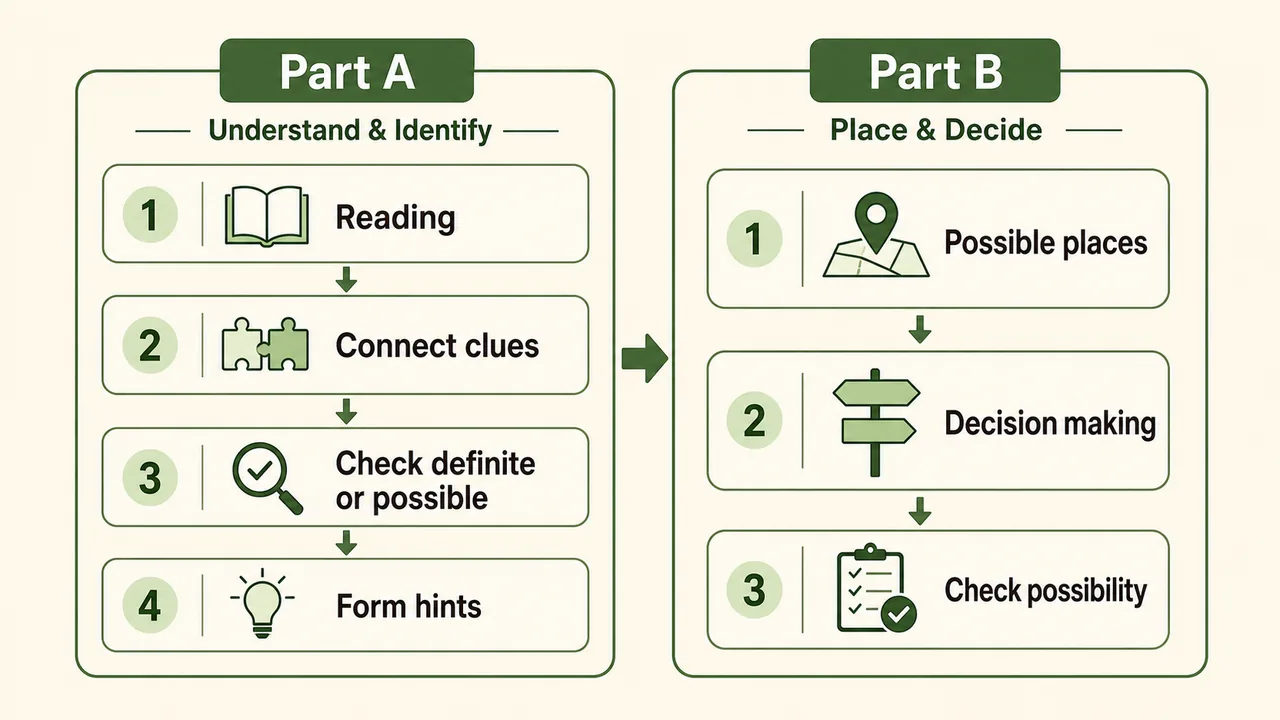
Part A: Reading and Analysis
Part A is about understanding the puzzle before you start solving. Follow these steps in order:
Pro Content Locked
Upgrade to Pro to access this lesson and all other premium content.
Charged once for one year · ₹1188 total
Save ₹100/month vs ₹2388/year launch price
- All Agriculture & Banking Courses
- AI Lesson Questions (100/day)
- AI Doubt Solver (50/day)
- Glows & Grows Feedback (30/day)
- AI Section Quiz (20/day)
- 22-Language Translation (100/day)
- Recall Questions (20/day)
- AI Quiz (15/day)
- AI Quiz Paper Analysis (100/day)
- AI Step-by-Step Explanations (100/day)
- Spaced Repetition Recall (FSRS)
- AI Tutor
- Immersive Text Questions
- Audio Lessons — Hindi & English
- Mock Tests & Previous Year Papers
- Summary & Mind Maps
- XP, Levels, Leaderboard & Badges
- Generate New Classrooms
- Voice AI Teacher (AgriDots Live)
- AI Revision Assistant
- Knowledge Gap Analysis
- Interactive Revision (LangGraph)
🔒 Secure one-time yearly payment via Razorpay · No hidden fees
Introduction to Puzzles
Puzzles are the backbone of the Reasoning section in banking exams like IBPS PO/Clerk, SBI PO/Clerk, RRB PO/Clerk, and NABARD. They carry the highest weightage and require a systematic approach to solve quickly and accurately.
Exam Pattern
| Exam | Number of Puzzle Sets | Questions per Set | Total Questions |
|---|---|---|---|
| Prelims | 3 sets | 5 questions each | 15 questions |
| Mains | 4 sets | 5 questions each | 20 questions |
- In Prelims, puzzles account for nearly half of the reasoning section
- In Mains, puzzles dominate with even more complex multi-variable sets
- Time management is critical: aim for 5-7 minutes per set in Prelims and 8-10 minutes per set in Mains
The Two-Part Solving Methodology
Every puzzle should be approached in two distinct phases. This systematic method prevents confusion and reduces errors.
Part A: Reading and Analysis
Part A is about understanding the puzzle before you start solving. Follow these steps in order:
Step 1 - Reading: Read the entire puzzle once completely without making any marks. Understand what is being asked — how many persons, how many variables, what is the base arrangement.
Step 2 - Connecting Sentences: On the second read, identify which statements connect to each other. Statements about the same person or same position should be mentally linked.
Step 3 - Cross-check (Definite vs Indefinite):
- Definite conditions give you a fixed placement: "A sits on Monday" or "B is on the 3rd floor"
- Indefinite/Possible conditions give multiple options: "A sits on either Monday or Tuesday"
- Mark definite conditions with a tick and indefinite ones with a question mark
Step 4 - Hints Formation (+w / -w):
- Positive working (+w): What the statement directly tells you (e.g., "A is above B" means A's position > B's position)
- Negative working (-w): What the statement implies by elimination (e.g., if "A is above B" and there are 5 floors, A cannot be on floor 1 and B cannot be on the top floor)
Part B: Solving and Decision Making
Part B is where you actually fill in the arrangement. Follow these steps:
Step 1 - Possible Places: For each person/element, identify all the positions they could occupy based on the conditions from Part A.
Step 2 - Decision Making: Use two key strategies:
- Least Possible Places (LPP): Start with the person who has the fewest possible positions. If someone can only go in 1 or 2 places, place them first.
- Relation Info: Use relational conditions (gaps, adjacency, above/below) to narrow down possibilities.
Step 3 - Possibility: After placing elements using LPP, check if the remaining placements are consistent with all conditions. If you hit a contradiction, backtrack to the last decision point and try the other possibility.
Base Method
The base is the primary arrangement framework around which everything is organized.
Single Base: Only one variable forms the arrangement structure.
- Example: 8 persons sitting on 8 floors (floors 1-8 is the single base)
Multiple Base: Two or more variables are linked to the base.
- Example: 8 persons on 8 floors, each liking a different color (floors = base, persons + colors = variables)
Tip: Always identify the base first. Draw your table/grid with the base as rows or columns, then add variable columns.
Tabulation Technique
Tabulation is the most important skill for puzzle solving. It means organizing all information into a grid or matrix.
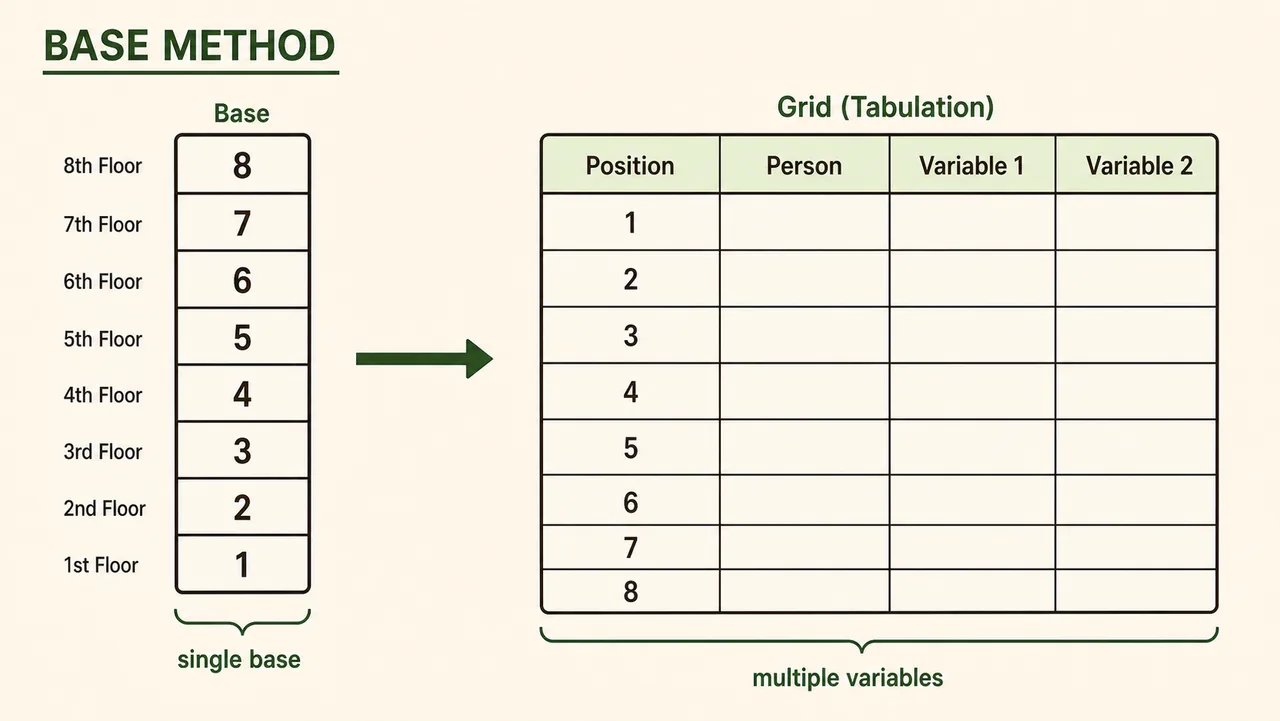
How to draw a tabulation grid:
| Position (Base) | Person | Variable 1 | Variable 2 |
|---|---|---|---|
| 8 (Top) | |||
| 7 | |||
| 6 | |||
| 5 | |||
| 4 | |||
| 3 | |||
| 2 | |||
| 1 (Bottom) |
Rules for tabulation:
- The base always goes in the first column (floors, days, boxes, months, etc.)
- Add one column for each variable (person names, colors, items, cities, etc.)
- Fill in definite information first, then work through indefinite conditions
- Use pencil in exams so you can erase and retry if needed
Types of Conditions
Understanding the language of conditions is crucial. Here are the two main types:
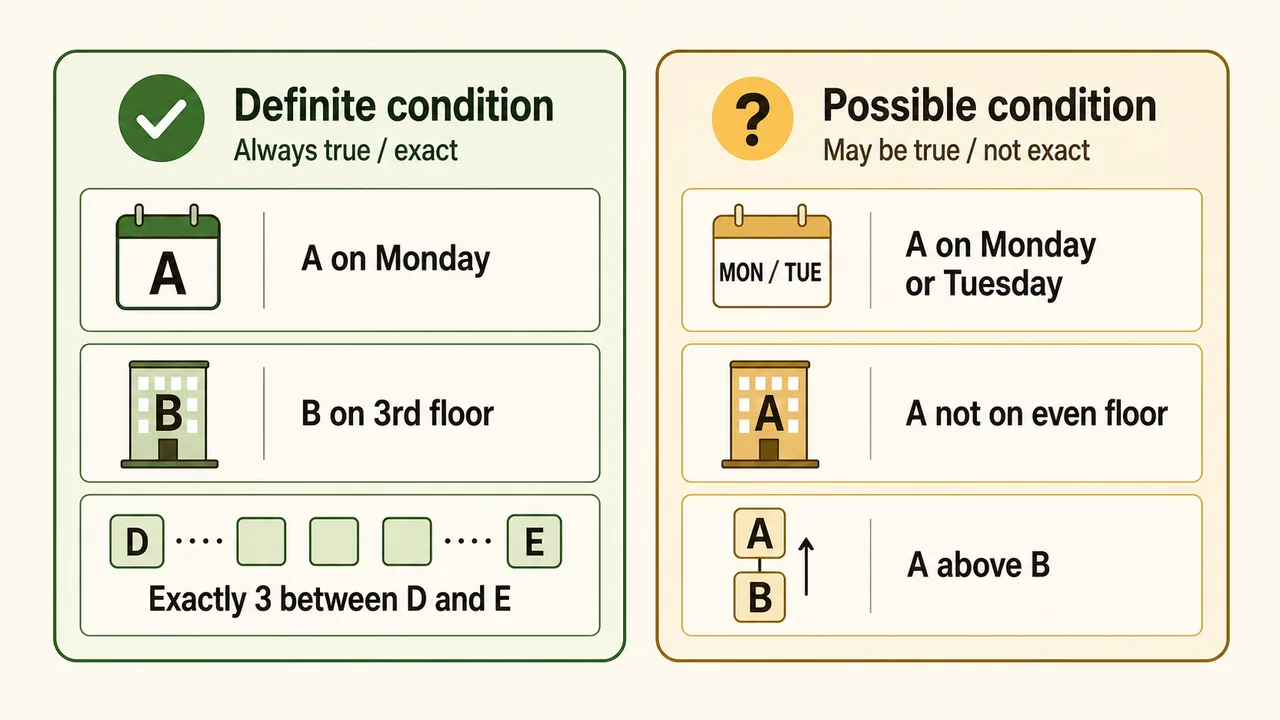
Definite Conditions (give exact information):
- "A lives on the 5th floor" — direct placement
- "B lives immediately above C" — relative but fixed once one is placed
- "There are 3 floors between D and E" — fixed gap
Possible/Indefinite Conditions (give multiple options):
- "A lives on either the 3rd or 5th floor" — two options, need more info to decide
- "A does not live on an even-numbered floor" — eliminates some positions
- "A lives above B" — relative but doesn't fix exact positions
Overview of Puzzle Types
Here is a preview of all the puzzle types you will master in this course:
| Type | Base | Difficulty | Common In |
|---|---|---|---|
| Categorized | Groups/Categories | Moderate | Prelims + Mains |
| Box/Stack | Numbered positions | Easy-Moderate | Prelims |
| Order & Comparison | Ranking/Hierarchy | Moderate | Prelims + Mains |
| Floor | Building floors | Moderate-Hard | Prelims + Mains |
| Floor + Flat | Floor + Direction | Hard | Mains |
| Floor + Stairs | Staircase/Escalator | Very Hard | Mains |
| Days Based | Days of week | Moderate | Prelims + Mains |
| Month Based | Months of year | Moderate-Hard | Mains |
| Year Based | Years/Age | Hard | Mains |
Speed Tips for Exam
- Read twice, solve once: Spend 1-2 minutes on Part A (reading). It saves time in Part B
- Start with definite conditions: Always place the certain information first
- Use LPP (Least Possible Places): The element with fewest options should be placed first
- Don't hesitate to backtrack: If you hit a contradiction after 2-3 minutes, erase and try the other possibility — this is normal and expected
- Practice tabulation daily: The faster you can draw and fill grids, the faster you solve puzzles
- Shorthand notation: Use initials (A, B, C) not full names. Use arrows for above/below