Reasoning Ability
Reasoning Ability for IBPS AFO, NABARD Grade A and RRB SO — puzzles and seating arrangement, syllogism, coding-decoding, input-output, blood relations and direction sense with practice MCQs.
Course Structure
What's Inside


Puzzles & Seating Arrangement
Linear seating, circular arrangement, box and floor puzzles, blood relations, scheduling puzzles — high-weightage topics for IBPS AFO prelims, NABARD Grade A and RRB SO reasoning sections.
Syllogism
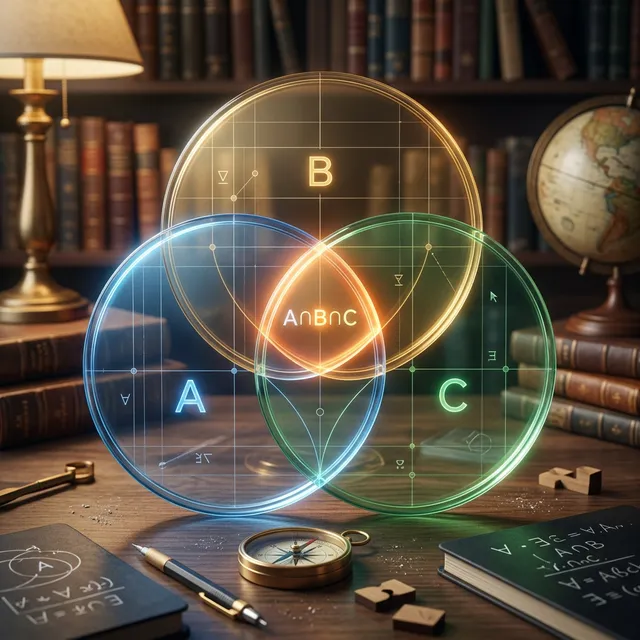
Venn diagram method, categorical propositions, definite and possibility conclusions, syllogism shortcuts — essential for IBPS AFO, NABARD Grade A and banking prelims reasoning sections.

Inequality
Master Inequality for banking exams — basic signs, chain method, same-direction rule, Either-Or combinations, coded inequality decoding with Magic Box trick, and 100 practice questions with solutions.

Input-Output
Machine input-output — word and number arrangement, step-by-step shift patterns, multi-step operations. Pattern recognition techniques for IBPS AFO, NABARD Grade A and RRB SO reasoning sections.

Coding-Decoding
Letter coding, number coding, symbol coding, mixed coding and new pattern coding-decoding — tricks and practice questions for IBPS AFO, NABARD Grade A and RRB SO banking reasoning sections.

Logical & Critical Reasoning
Master Logical and Critical Reasoning for banking exams — Statement & Arguments, Statement & Assumptions, Course of Action, Cause & Effect, and Statement & Conclusion with exam-focused frameworks and speed strategies.
Direction and Distance
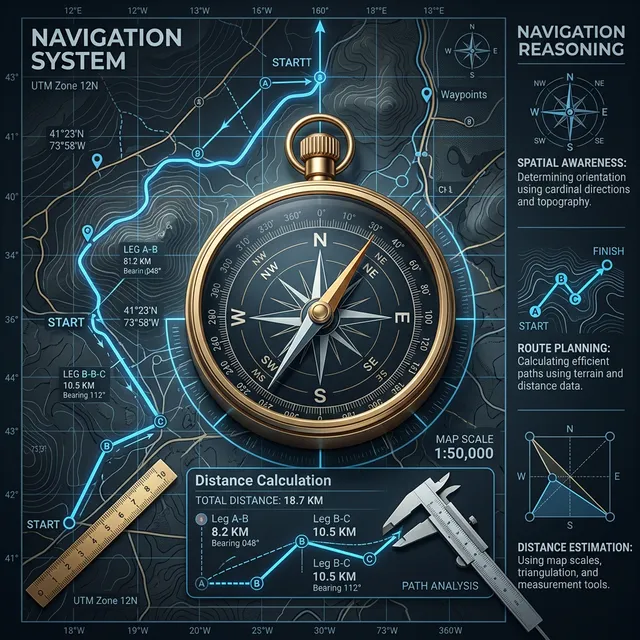
Master Direction and Distance for banking exams — compass directions, path tracing, Pythagorean distance, shadow and clock problems, coded directions, reverse direction, multi-point layouts, and complex direction-distance puzzles.
Blood Relations
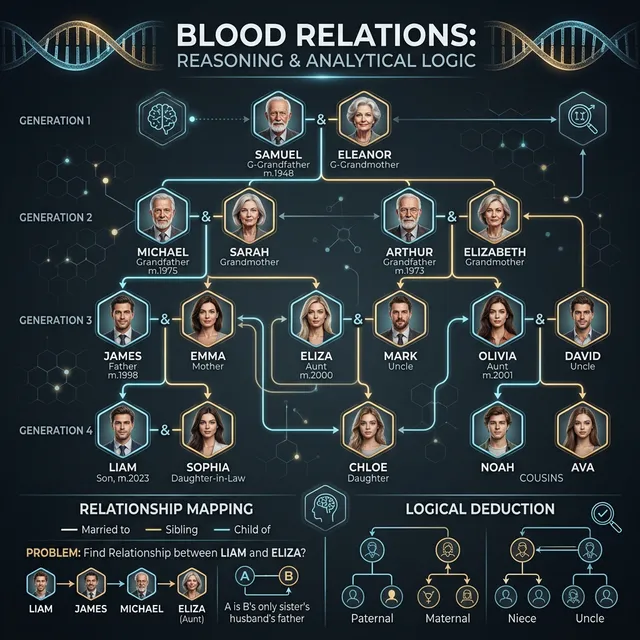
Master Blood Relations for banking exams — family tree puzzles, pointing & introduction problems, and coded blood relations with exam-focused frameworks and speed strategies.

Data Sufficiency
Master Data Sufficiency for banking exams — 2-statement, 3-statement, and 4/5-statement formats with the Definite Conclude framework, systematic combination testing, and speed strategies.

Alphabetical Series
Master Alphanumeric Series for banking exams — word-based operations, number digit manipulations, alphanumeric arrangement puzzles, position finding, and symbol-based series with exam-focused practice.

Mock Tests
20 full-length reasoning mock tests for IBPS PO Prelims and Mains — covering complex puzzles, seating arrangements, syllogism, inequality, coding-decoding, blood relations, direction sense, input-output, critical reasoning, and data sufficiency. 1750+ questions with detailed solutions.
Reasoning Ability is the most pattern-dependent section in banking and agriculture competitive exams. Unlike general knowledge or vocabulary, reasoning can be improved dramatically in a short time — but only by understanding the underlying logic of each question type, not by rote practice alone. A student who solves 500 puzzles without learning the constraint-grid method will be slower than one who solves 50 puzzles with the right technique.
This course is structured around pattern recognition. Each topic begins with the logic rules that govern it, then builds through increasing difficulty with solved examples, and ends with timed practice sets at exam difficulty. The emphasis throughout is on speed: for every major topic, you will learn both the full method and a shortcut that cuts solving time by 30–50% for common question variants.
With 196 lessons across 11 sub-courses and 50 mock test papers, this is the most comprehensive reasoning preparation available for IBPS AFO and NABARD on any platform. The mock test series alone (50 papers in the mock-test folder) provides the volume of practice needed to build exam-speed reflexes.
Course Structure
| Section | Topics | Lessons |
|---|---|---|
| 01 Puzzles & Seating Arrangement | Linear seating (1-row, 2-row), circular seating (face-in/out), floor-based puzzles, box-based puzzles, day/month scheduling puzzles, multi-variable complex puzzles | 39 |
| 02 Mock Tests | Full reasoning section mock tests at IBPS AFO / NABARD difficulty | 50 |
| 03 Logical & Critical Reasoning | Statement-assumption, statement-conclusion, statement-inference, cause and effect, course of action, argument evaluation | 16 |
| 04 Syllogism | Universal affirmative/negative, particular affirmative/negative, Venn diagram method, possibility cases, reverse syllogism | 19 |
| 05 Coding-Decoding | Letter shifting, number coding, symbol/word coding, new-pattern coding (sentence encoding) | 12 |
| 06 Inequality | Direct inequality, coded inequality, combined inequality chains | 12 |
| 07 Input-Output | Machine input with shift, arrangement, or mathematical operations; multi-step output tracing | 14 |
| 08 Blood Relations | Family tree construction, coded blood relations, mixed-condition family puzzles | 10 |
| 09 Direction & Distance | Final direction problems, total distance covered, shadow direction problems | 10 |
| 10 Data Sufficiency | Two-statement and three-statement sufficiency for reasoning problems | 9 |
| 11 Alphabetical Series | Letter pattern series, position-based coding, alphabet analogy | 4 |
| 12 Test Series | Full mock test | 1 |
Key Facts to Know
Most-tested patterns and benchmarks in Reasoning Ability:
| Topic | Key Benchmark |
|---|---|
| Puzzles & Seating — weightage in IBPS AFO Prelims | 15–20 questions (3–4 sets × 5) |
| Syllogism — questions per exam | 3–5 questions |
| Coding-Decoding — questions per exam | 3–4 questions |
| Inequality — questions per exam | 3–5 questions |
| Input-Output — questions per exam | 5 questions (1 set) |
| Blood Relations — questions per exam | 2–3 questions |
| Direction Sense — questions per exam | 1–2 questions |
| Most common puzzle type | Floor-based (8 floors, multiple attributes) |
| Circular seating — key rule | Facing centre: right = clockwise; facing outside: right = anti-clockwise |
| Syllogism — "possibility" check | Test all valid Venn diagrams — if possible in any, conclusion follows |
| New-pattern coding rule | Compare two coded sentences to derive the code by elimination |
| Venn diagram for "All A are B" | A fully inside B |
| Venn diagram for "No A is B" | A and B with zero overlap |
Who Should Study This Course?
- IBPS AFO — Agricultural Field Officer (Reasoning Ability — 35 questions in Prelims)
- NABARD Grade A — Development Assistant (Reasoning Ability — 40 questions in Prelims)
- IBPS RRB SO — Regional Rural Bank Specialist Officer
- RBI Assistant — Reasoning Ability section
- SBI PO & IBPS PO — Reasoning Ability section (Prelims + Mains)
Frequently Asked Questions
What is the best order to attempt Reasoning in IBPS AFO under time pressure?
Optimal attempt order for 35 Reasoning questions in 20 minutes (shared time with Quant and English): (1) Inequalities — 5 questions in ~2 minutes (purely mechanical, no thinking required once the rule is known). (2) Syllogism — 5 questions in ~3 minutes. (3) Coding-decoding and blood relations — 5–6 questions in ~4 minutes. (4) Input-output — 5 questions in ~4 minutes. (5) Puzzles — attempt the 1–2 easiest sets and skip the most complex one if time is short. Leaving a complex 5-question puzzle set entirely is better than spending 10 minutes and getting 2 correct.
How do Floor Puzzles differ from Box Puzzles?
Floor puzzles assign people (or objects) to floors of a building, with conditions like "A is 3 floors above B" or "C is on an even floor". The key is that "above" and "below" have absolute directional meaning. Box puzzles assign objects to stacked boxes from top to bottom, with conditions about relative positions. The critical difference: in box puzzles, "above" can mean physically above in the stack, but the numbering is often given from bottom (Box 1 = bottom, Box 7 = top) — always check the puzzle's orientation. Both types use the same constraint-grid method but floor puzzles often have 3–4 attributes per person, making them more complex.
What are the most common traps in Inequality questions?
Coded inequality questions present symbols (©, @, %, $) that stand for comparison operators (>, <, ≥, ≤, =). The three most common traps: (1) Confusing ≥ and > — "A ≥ B and B > C" gives "A > C" (the stronger conclusion), not "A ≥ C"; (2) Chaining through equality — "A = B and B < C" gives "A < C", but students often mark "A = C"; (3) Indirect chains — if A > B and C > B, you cannot determine the relationship between A and C without more information. Direct inequality questions (no coding) test the same chain logic but are faster since no symbol decoding is needed first.
How to identify the Independent Statement in Input-Output questions?
In machine input-output problems, each step rearranges words or numbers according to a hidden rule. To find the rule: compare Step 1 to the Input — which element moved, where did it go, and is the movement based on alphabetical order, numerical order, word length, or a mathematical operation? Then verify the same rule in Step 2. In IBPS-level problems, the most common rules are: (a) arranging from largest to smallest alternately from both ends, and (b) mathematical operations (add/subtract/multiply) applied to alternate numbers at each step. Once the rule is identified, solving all 5 questions from the set takes under 3 minutes.
Frequently Asked Questions
How many Reasoning questions appear in IBPS AFO Prelims?
IBPS AFO Prelims contains 35 Reasoning Ability questions out of 105 total (alongside 35 Quant and 40 English). Puzzles and Seating Arrangement alone typically account for 15–20 of these 35 questions (3–4 puzzle sets with 5 questions each). The remaining questions come from syllogism (3–5), coding-decoding (3–4), inequality (3–5), blood relations (2–3), direction sense (1–2), and input-output (5). Puzzles are the single most important topic — they can either be your highest-scoring topic or your biggest time sink depending on preparation.
Are puzzles the most important topic in Reasoning for banking exams?
Yes — Puzzles and Seating Arrangement is the highest-weightage reasoning topic in every major banking exam. In IBPS AFO and NABARD Prelims, 40–55% of all reasoning marks come from puzzles alone. Floor-based puzzles (8 people in 8 floors with attributes), box-based puzzles (ordering with conditions), and circular seating arrangements (facing centre vs. facing outside) appear in almost every exam. The critical skill is translating conditions into a constraint grid quickly. Candidates who master 3–4 puzzle types can solve any puzzle in under 7 minutes.
How to approach Seating Arrangement questions efficiently?
The systematic approach: (1) Read all conditions once without writing anything. (2) Identify the definite conditions — those that fix a person's position absolutely (e.g., 'A sits at the north end'). Place those first. (3) Apply relative conditions from the fixed positions. (4) Use elimination — if a position is claimed by one person, remove them from all other options. For circular arrangements, always mark who faces centre (inward) vs. away from centre (outward) first, as this reverses left/right. Draw the arrangement fresh for each puzzle — do not try to hold it in memory.
What is the difference between Coding-Decoding types tested in exams?
There are four main coding-decoding types in IBPS AFO and NABARD: (1) Letter shifting — each letter is shifted by a fixed number in the alphabet (A→D = +3); (2) Number coding — each letter is replaced by its position value or a transformed position (A=1, Z=26 or Z=1, A=26); (3) Symbol/word coding — words are assigned symbols or other words based on a rule in a given statement; (4) New pattern coding — a sentence is encoded and you must decode the rule by comparing two encoded sentences. The new pattern type (appearing since 2016) is the most common in current exams and cannot be solved by formula — it requires pattern comparison.
How to solve Syllogism using the Venn diagram method?
Syllogism questions give 2–3 statements and ask which conclusions follow. The fastest method is Venn diagrams: draw the minimum and maximum possible overlap between sets, then check each conclusion. For 'All A are B' — draw A as a circle fully inside B. For 'Some A are B' — draw A and B with a partial overlap. For 'No A is B' — draw A and B with zero overlap. 'Possibility' conclusions (marked with asterisk or 'may') require you to check if the conclusion can be true in any valid diagram — not whether it must be true. Possibility cases are the most common source of errors in syllogism.