Blood Relations
Master Blood Relations for banking exams — family tree puzzles, pointing & introduction problems, and coded blood relations with exam-focused frameworks and speed strategies.
Frequently Asked Questions
What are Blood Relations questions in reasoning?
Blood Relations questions test your ability to identify family relationships through statements, introductions, coded relations, family trees, and pointing problems involving generations and gender.
Why do students find blood relations confusing?
Students often get confused because one statement can imply multiple relationships at once, especially when generations shift. Clean diagrams and consistent notation remove most of that confusion.
What is the best way to solve blood relation questions?
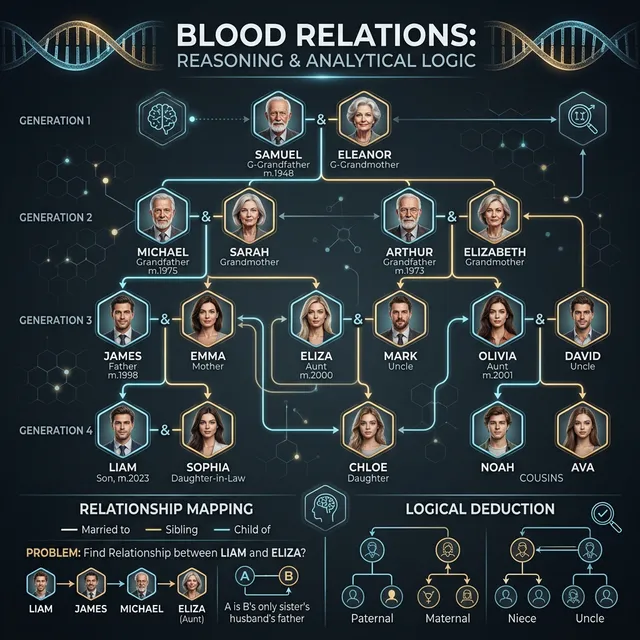
Draw a simple family tree, mark gender whenever it is known, and connect each statement before jumping to conclusions. Visual layout usually prevents avoidable mistakes.
Which blood relation question types are most common?
Pointing problems, family tree sets, coded relations, generation-based relationships, and introduction-style statements are the most common formats in competitive reasoning sections.
Why is drawing a family tree better than solving blood relation mentally?
Because mental solving becomes error-prone when generations, gender, and in-law relations mix together. A simple family tree reduces confusion and makes hidden relationships visible much faster.
What are coded blood relations?
Coded blood relations use symbols or letters to represent relationships like father, mother, son, sister, or brother. Students first decode the symbols and then convert them into a normal family tree.
How do I solve pointing and introduction blood relation questions quickly?
Break the statement into small pieces and solve from the central person outward. These questions become easier when you decode one relation at a time instead of trying to interpret the full sentence at once.
What is the biggest trap in blood relation questions?
A common trap is assuming gender or generation when the statement has not fixed it. Another is forgetting that the same person can hold more than one relation depending on whose perspective the question uses.
Can blood relation questions include marriage and in-law logic too?
Yes. Many higher-level or puzzle-style blood relation questions include in-law relations, maternal or paternal side references, and multi-generation combinations rather than only direct parent-child links.
How should I revise blood relations before an exam?
Revise relation vocabulary, basic family tree symbols, pointing questions, coded relations, and multi-generation examples. Short diagram-based revision works much better than only reading explanations.