🪜 Floor Stairs & Escalator Puzzles (Mains)
Mains-level staircase and escalator puzzles - cyclic movement, multi-building distribution, dice-based movement
Floor Stairs & Escalator Puzzles (Mains Level)
These are high-difficulty puzzles that appear in Mains exams. They involve staircases, escalators, and movement-based conditions where persons change positions according to specific rules.
Type 1: Escalator/Staircase with Standing Positions
In escalator puzzles:
- There are N stairs (e.g., 15 stairs numbered 1-15)
- Persons stand on specific stairs
- Conditions describe their relative positions and movements
Grid:
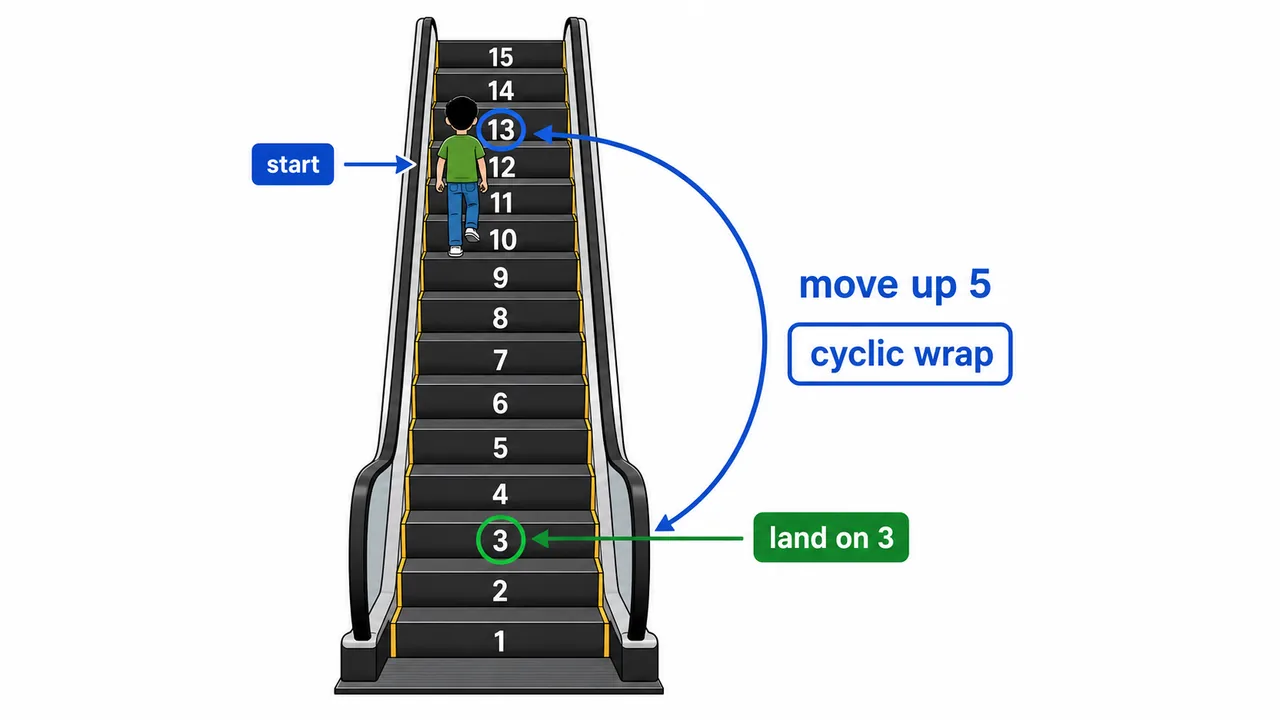
Cyclic Movement
Persons on stairs may move cyclically:
- When a person reaches the top stair and needs to go up, they wrap around to the bottom
- When a person at the bottom needs to go down, they wrap to the top
Example: On a 15-stair escalator, a person on stair 13 moves 5 stairs up:
- 13 + 5 = 18. Since max is 15, wrap: 18 - 15 = stair 3
Formula for upward cyclic movement: New position = (Current position + Steps - 1) mod Total stairs + 1
Pro Content Locked
Upgrade to Pro to access this lesson and all other premium content.
Charged once for one year · ₹1188 total
Save ₹100/month vs ₹2388/year launch price
- All Agriculture & Banking Courses
- AI Lesson Questions (100/day)
- AI Doubt Solver (50/day)
- Glows & Grows Feedback (30/day)
- AI Section Quiz (20/day)
- 22-Language Translation (100/day)
- Recall Questions (20/day)
- AI Quiz (15/day)
- AI Quiz Paper Analysis (100/day)
- AI Step-by-Step Explanations (100/day)
- Spaced Repetition Recall (FSRS)
- AI Tutor
- Immersive Text Questions
- Audio Lessons — Hindi & English
- Mock Tests & Previous Year Papers
- Summary & Mind Maps
- XP, Levels, Leaderboard & Badges
- Generate New Classrooms
- Voice AI Teacher (AgriDots Live)
- AI Revision Assistant
- Knowledge Gap Analysis
- Interactive Revision (LangGraph)
🔒 Secure one-time yearly payment via Razorpay · No hidden fees
Floor Stairs & Escalator Puzzles (Mains Level)
These are high-difficulty puzzles that appear in Mains exams. They involve staircases, escalators, and movement-based conditions where persons change positions according to specific rules.
Type 1: Escalator/Staircase with Standing Positions
In escalator puzzles:
- There are N stairs (e.g., 15 stairs numbered 1-15)
- Persons stand on specific stairs
- Conditions describe their relative positions and movements
Grid:
Cyclic Movement
Persons on stairs may move cyclically:
- When a person reaches the top stair and needs to go up, they wrap around to the bottom
- When a person at the bottom needs to go down, they wrap to the top
Example: On a 15-stair escalator, a person on stair 13 moves 5 stairs up:
- 13 + 5 = 18. Since max is 15, wrap: 18 - 15 = stair 3
Formula for upward cyclic movement: New position = (Current position + Steps - 1) mod Total stairs + 1
Formula for downward cyclic movement: New position = (Current position - Steps - 1 + Total) mod Total + 1
Type 2: Multi-Building with Direction
In this variation:
- Multiple buildings (e.g., 3 buildings X, Y, Z) each have 5 floors
- 15 persons are distributed: 5 per building
- Conditions involve direction-based placement (north, south, east, west)
Grid for 3 buildings:
| Floor | Building X | Building Y | Building Z |
|---|---|---|---|
| 5 | |||
| 4 | |||
| 3 | |||
| 2 | |||
| 1 |
Direction conditions:
- "A lives to the north of B" — A is on a higher floor than B (if in same building) or in a building positioned to the north
- Buildings may be positioned: "X is to the west of Y, Y is to the west of Z"
Type 3: Dice-Based Staircase Movement
This is the most complex variation:
- A staircase has 40 stairs
- Persons roll a dice and move based on the result
- Movement rules: odd number = move up, even number = move down
- Special rules for multiples (e.g., multiples of 6 = skip a turn)
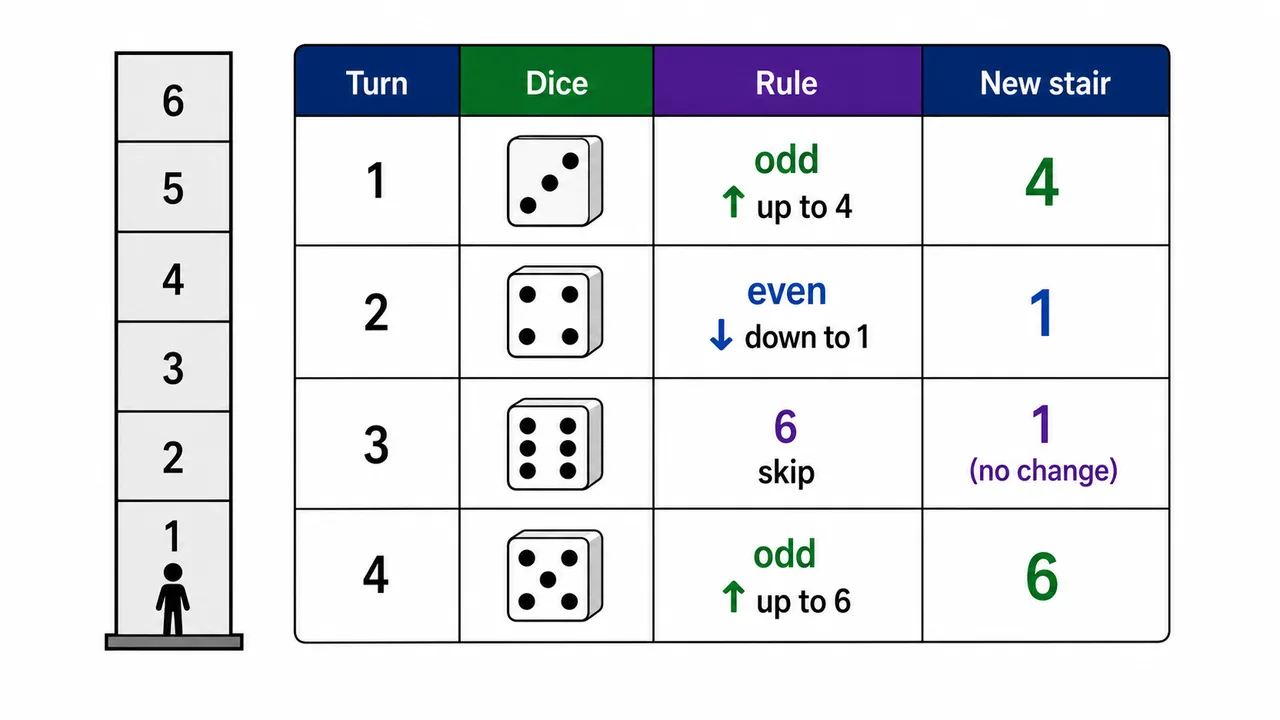
Example rules:
- Start at stair 1
- Roll dice: if odd, move up that many stairs; if even, move down that many stairs
- If on stair 1 and need to move down, stay at stair 1
- If result is a multiple of 6, skip turn (no movement)
Tracking table:
| Turn | Person | Dice Roll | Odd/Even | Movement | New Position |
|---|---|---|---|---|---|
| 1 | A | 3 | Odd | Up 3 | 4 |
| 2 | A | 4 | Even | Down 4 | 1 (can't go below 1) |
| 3 | A | 6 | Multiple of 6 | Skip | 1 |
| 4 | A | 5 | Odd | Up 5 | 6 |
Solving Multi-Building Puzzles
Step 1: Identify the number of buildings and floors per building Step 2: Determine the total number of persons and their distribution rule Step 3: Use conditions to assign persons to buildings first Step 4: Within each building, solve the floor arrangement Step 5: Apply direction-based conditions for cross-building references
Example conditions:
- "A and B are in the same building but different floors" — direct building assignment
- "C is directly above D" — same building, C's floor = D's floor + 1
- "E is to the east of F" — depends on building positions (if X is west and Z is east)
- "The person on floor 3 of Building Y likes Red" — links position to variable
Escalator Puzzles: Step-by-Step
- Draw all stairs vertically (or a subset if 40 stairs is too many — track only occupied stairs)
- Place initial positions from direct conditions
- Apply movement rules one turn at a time
- Track position after each movement in a separate table
- Answer questions about final positions after all movements are complete
Important Concepts for Mains
Relative position after movement: After all persons move, their relative order may change. Questions often ask:
- "Who is directly above person A after the movement?"
- "How many persons are between B and C after the movement?"
- "What is A's new stair number?"
Boundary conditions:
- Cannot go below stair 1 — stay at 1
- Cannot go above max stair — some puzzles allow wrapping (cyclic), others cap at max
- Read the question carefully for which rule applies
Practice Tips for Mains-Level Puzzles
- These take 8-12 minutes — don't panic if they feel slow initially
- Use a separate tracking table for movement puzzles
- For multi-building: solve building assignment before floor assignment
- For dice-based: track each person separately, don't try to track all simultaneously
- Accuracy over speed — at Mains level, getting the puzzle right matters more than finishing fast
Speed Tips
- For escalator puzzles, draw only the stairs that are mentioned (not all 40)
- Pre-identify which dice rolls are multiples of 6 to quickly spot "skip" turns
- For multi-building, use a quick notation: A-X3 means "person A in Building X, floor 3"
- Cross-building direction conditions often involve only the building identity, not the floor — simplify them mentally
- If the puzzle involves movement, track positions in a timeline format rather than rewriting the entire grid each time