ICAR JRF Agricultural Engineering Syllabus 2026 — Code 10 Unit-wise Topics
Complete ICAR JRF Agricultural Engineering and Technology syllabus 2026 — Code 10 unit-wise topics for soil and water conservation, irrigation, food engineering, farm machinery, and renewable energy.
ICAR JRF Agricultural Engineering Syllabus 2026 — Code 10
Major Subject Group: Agricultural Engineering and Technology
Sub-Subjects: 10.1 Soil & Water Conservation Engineering · 10.2 Irrigation and Drainage Engineering · 10.3 Processing and Food Engineering · 10.4 Farm Machinery and Power Engineering · 10.5 Renewable Energy Engineering
Code 10 is one of the most technical JRF papers. It combines engineering mathematics and mechanics with agricultural applications like irrigation, machinery, processing, food engineering, and renewable energy.
Exam Snapshot
| Parameter | Details |
|---|---|
| Subject Code | 10 — Agricultural Engineering and Technology |
| Total Questions | 120 MCQs |
| Duration | 2 Hours |
| Marking Scheme | +4 per correct answer |
| Negative Marking | −1/3 per wrong answer |
| Question Type | Multiple Choice (Single correct) |
| Medium | English |
Latest Official Notification Details
| Parameter | 2026-27 Official Detail |
|---|---|
| Notice Date | 08 May 2026 |
| Application Window | 08 May 2026 to 07 June 2026 (up to 5:00 PM) |
| Fee Payment Deadline | 07 June 2026 (up to 11:50 PM) |
| Correction Window | 09 June to 10 June 2026 |
| Exam Date | 04 July 2026 (Saturday) |
| Mode | Computer Based Test (CBT) |
| Pattern | Objective type MCQs |
| Medium | English only |
| Duration | 02 hours (120 minutes) |
| Source | NTA 2026 Public Notice PDF · ICAR Syllabus PDF |
What Is Officially Fixed For Code 10
- Code 10 is the official major subject group for Agricultural Engineering and Technology.
- The paper is conducted in English only, in CBT mode, for 120 minutes.
- The official syllabus is divided into seven units, not just one merged subject list.
- NTA does not publish official unit-wise weightage for Agricultural Engineering in the public notice.
- So the “high-yield” guidance below is a prep priority framework, not an official distribution chart.
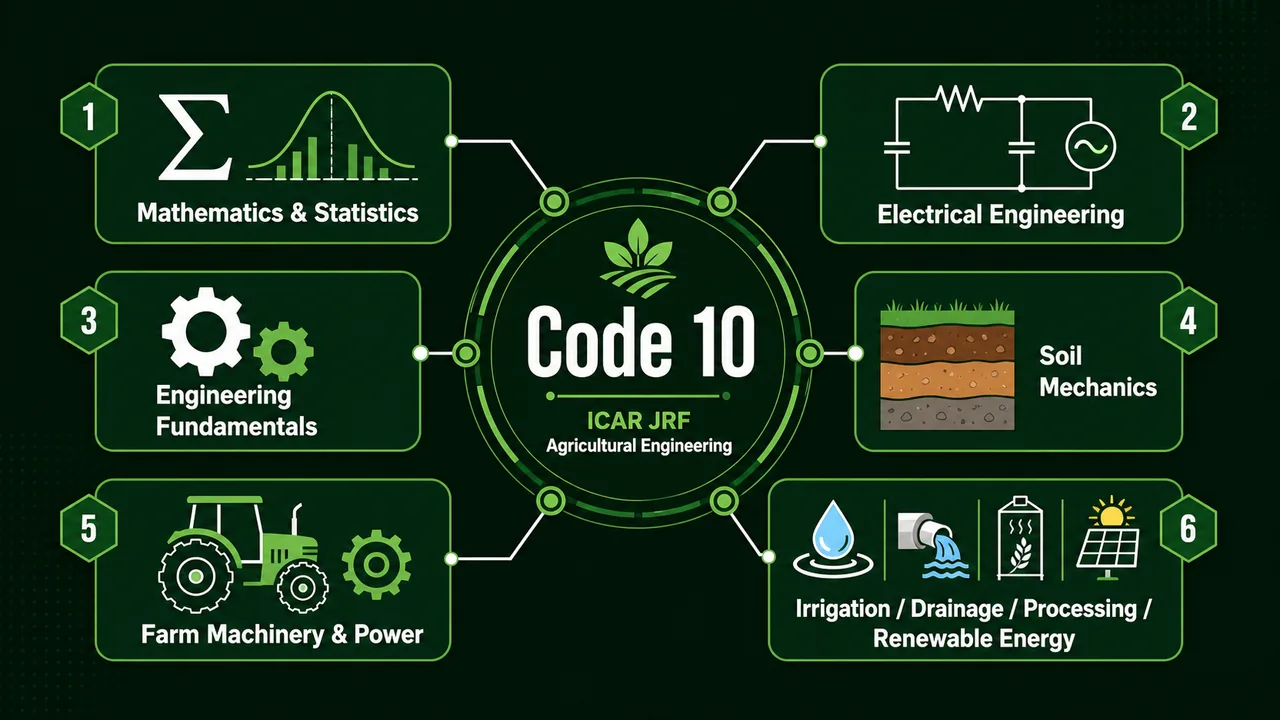
Unit-I: Mathematics and Statistics
- Elementary statistics and theory of probability
- Differential and integral calculus
- Linear algebra and Fourier series
- Differential equations
- Vector algebra and vector calculus
- Elementary numerical analysis
Unit-II: Electrical Engineering
- Electric motors: types, performance, selection, installation and maintenance
- Measuring instruments
- Fundamentals of computers
- Power distribution
Unit-III: Engineering Fundamentals
- Thermodynamic principles
- Fluid mechanics
- Theory of machines
Unit-IV: Soil Mechanics and Mechanics Base
- Soil mechanics
- Soil classification
- Compaction and shear strength of soils
- Engineering mechanics
- Strength of materials
Unit-V: Farm Machinery, Power and Renewable Energy
Farm Machinery and Power
- Importance of farm equipment in enhancing productivity and profitability
- Analysis of forces, design and production of farm machinery and power units
- Mechanics of tillage and traction operation
- Repair and maintenance of farm machines and equipment
- Farm engines
- Tractors and power tillers
- Tractor stability and operator comfort
- Field capacity and cost analysis
- Test codes and procedure
- Safety and ergonomic principles
Renewable Energy Engineering
- Role of energy in economic development
- Solar, wind and bio-energy
- Biogas plants and gasifiers
- Biofuels from biomass
- Collection, characterization and storage of biomass
- Solar cookers and solar refrigerators
Unit-VI: Processing and Food Engineering
- Biochemical and engineering properties of biological materials
- Quality control and safety of raw and finished products
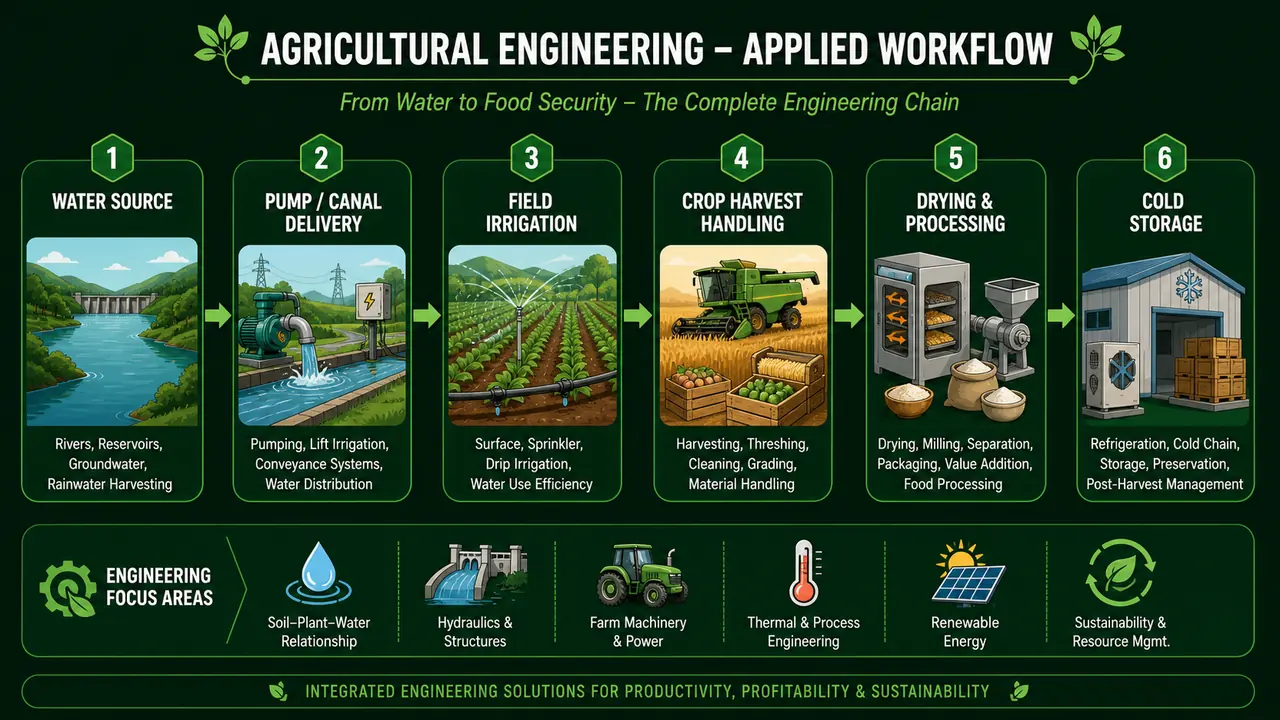
- Principles, practices and equipment for drying, milling, separation and storage of agricultural produce and by-products
- Material handling equipment and operations
- Farmstead planning
- Heating and cooling load calculation
- Seed processing practices and equipment
- Food preservation methods and product development
- Refrigeration and air conditioning
- Cold stores
- Waste management
- Cost analysis and food processing plant layout
- Feasibility reports
Unit-VII: Soil, Water, Irrigation and Drainage Engineering
- Surveying and leveling
- Hydrology
- Water resources in India
- Efficiency in water use
- Irrigation system and equipment
- Water conveyance and associated efficiency
- Soil-plant-water relationship
- Estimation of evaporation and crop water requirement
- Water harvesting and use
- Farm ponds and reservoirs
- Command area development
- Land-use capability classification
- Groundwater development, wells and pumping equipment
- Soil erosion and its control
- Land shaping and grading equipment and practices
- Hydraulic structures
- Drainage of irrigated and humid areas
- Salt balance and reclamation of saline and alkaline soils
Exam-Focused High-Yield Areas
| Area | Why it matters in JRF prep |
|---|---|
| Farm machinery and power | One of the most exam-friendly sections because definitions, components, matching, and applications convert easily into MCQs |
| Irrigation and water management | Crop water requirement, conveyance, efficiency, and irrigation methods are repeatedly testable |
| Soil and water conservation | Erosion control, water harvesting, farm ponds, and hydraulic structures are high-return topics |
| Food and process engineering | Drying, storage, preservation, refrigeration, and seed processing bridge theory and application |
| Renewable energy | Solar, biogas, gasifiers, and biomass are compact, factual, and scoring |
| Mathematics and numerical base | Strong basics here prevent avoidable losses in the more technical questions |
| Soil mechanics and strength of materials | Often weaker areas for students from less engineering-heavy preparation backgrounds |
Quick Reference: What To Revise First
| Area | What to revise first |
|---|---|
| Machinery | Tractors, tillage, traction, field capacity, cost analysis, ergonomics |
| Irrigation | Soil-plant-water relation, crop water requirement, irrigation methods, efficiency |
| Conservation | Erosion control, watershed concepts, land shaping, water harvesting |
| Processing | Drying, milling, separation, storage, refrigeration, seed processing |
| Renewable Energy | Biogas, biomass, solar devices, gasifiers |
| Math Base | Probability, calculus, matrices, differential equations, numerical methods |
| Engineering Base | Thermodynamics, fluid mechanics, theory of machines, soil compaction |
How To Prepare The General Agriculture Layer Efficiently With AgriDots
For plant- and agriculture-heavy JRF groups, the common agriculture base is explicit in the official syllabus itself. That is clear in groups such as Agronomy, Soil Science, Horticulture, Entomology, Plant Science, Plant Biotechnology, Social Sciences, and Water Science & Technology. In the animal, dairy, fisheries, food, engineering, forestry, community-science, and statistics groups, the same layer still improves scores because objective papers reward candidates who can quickly eliminate options using basic knowledge of crops, soils, schemes, extension, economics, statistics, and current agriculture.
So the practical rule is simple: do not prepare your subject in isolation. Keep one common-agriculture revision layer active throughout your JRF preparation.
Shared Books For The Common Agriculture Layer
| Book | Best use in common JRF preparation |
|---|---|
| Fundamentals of Agriculture, Vol. 1 & 2 — Arun Katyayan | Best base book for crop production, soils, nutrient deficiency, plant biology, genetics, pests, diseases, and agriculture basics |
| A Competitive Book of Agriculture — Nem Raj Sunda | Best for objective revision once the basic theory is already clear |
| Objective Agriculture for JRF Exam — S. R. Kantwa | Useful for MCQ drilling, recall speed, and mixed-agriculture practice |
| General Agriculture for ICAR Examinations — Muniraj Singh Rathore | Good backup book for one-line revision and broad competitive coverage |
Why AgriDots Is More Efficient Than Reading Books Alone
| Use AgriDots for | Why it is faster than books alone |
|---|---|
| Shared Agriculture Course | It compresses the overlapping JRF base into linked notes across agronomy, soil science, horticulture, genetics, pathology, entomology, economics, extension, animal husbandry, fisheries, ecology, and agricultural statistics instead of forcing you to extract overlap manually from multiple standard books |
| Topic-Wise Agriculture Practice Tests | You can revise chapter by chapter immediately after reading instead of waiting until one full book is complete |
| Agriculture Test Series | Mixed-subject Revision Warrior quizzes train recall across subjects, which is closer to how objective papers actually feel |
| Agriculture Current Affairs Hub | Books do not stay current on MSP, schemes, production reports, fertilizer policy, dairy/fisheries updates, or digital-agriculture changes |
Efficient JRF Workflow With AgriDots
- Read one main subject book for your core discipline and keep the rest of the books as support, not as parallel first reads.
- Use /courses/agriculture to finish the overlapping general-agriculture layer faster than building notes from multiple books.
- After each topic, solve topic-wise quizzes so weak areas become visible immediately.
- Use Revision Warrior mixed tests to train switching between crop, soil, genetics, economics, extension, and current-affairs questions.
- Use agriculture-current-affairs every week so your static preparation stays updated with schemes, policy, production, and report-based questions.
Why this works better than books alone: standard books build depth, but they are slow, repetitive across subjects, and weak on current agriculture. AgriDots is better for speed, revision order, topic linking, and exam-style recall, while books remain your depth source.
Preparation Strategy
- Finish Unit-I to Unit-IV early so the engineering base does not remain a weak spot.
- Spend the main revision time on machinery, irrigation, soil-water conservation, and processing engineering.
- Make formula sheets for field capacity, water-use efficiency, mechanics, and numerical methods.
- Revise paired topics together: machinery + traction, irrigation + crop water requirement, drying + storage, biogas + biomass.
- Use PYQs to test whether your mistakes are coming from concepts, units/formulas, or engineering vocabulary.
Syllabus-Wise Best Books
This list keeps the same book-to-syllabus mapping format used across the JRF subject pages.
| Book | Best use in the syllabus |
|---|---|
| Principles of Agricultural Engineering, Volume 2 — A. M. Michael & T. P. Ojha | Best broad reference for irrigation, drainage, soil and water engineering, and core agricultural engineering fundamentals |
| Irrigation and Drainage Engineering — R. K. Biswas | Best for irrigation, drainage, wells, and water management |
| A Textbook of Farm Machinery & Power Engineering — D. Srigiri, Basavaraj & Jayan P. R. | Best for tractors, tillage, farm power, ergonomics, and machinery topics |
| Unit Operations of Agricultural Processing — K. M. Sahay & K. K. Singh | Best for drying, milling, separation, storage, and processing-engineering basics |
| Introduction to Food Engineering — R. Paul Singh & Dennis R. Heldman | Best for heat transfer, refrigeration, drying, and food-process engineering logic |
Minimal Book Strategy for Rank-Oriented Prep
- Principles of Agricultural Engineering
- Irrigation and Drainage Engineering
- A Textbook of Farm Machinery & Power Engineering
- One short note set for formulas + PYQs
Lesson Doubts
Ask questions, get expert answers