ICAR JRF Agronomy Syllabus 2026 — Code 05 Unit-wise Topics
Complete ICAR JRF Agronomy syllabus 2026 — Code 05 unit-wise topics for crop production, agronomy principles, field crops, weeds, irrigation, nutrient management, dryland farming, and sustainable agriculture.
ICAR JRF Agronomy Syllabus 2026 — Code 05
Major Subject Group: Agronomy
Sub-Subject: 5.1 Agronomy
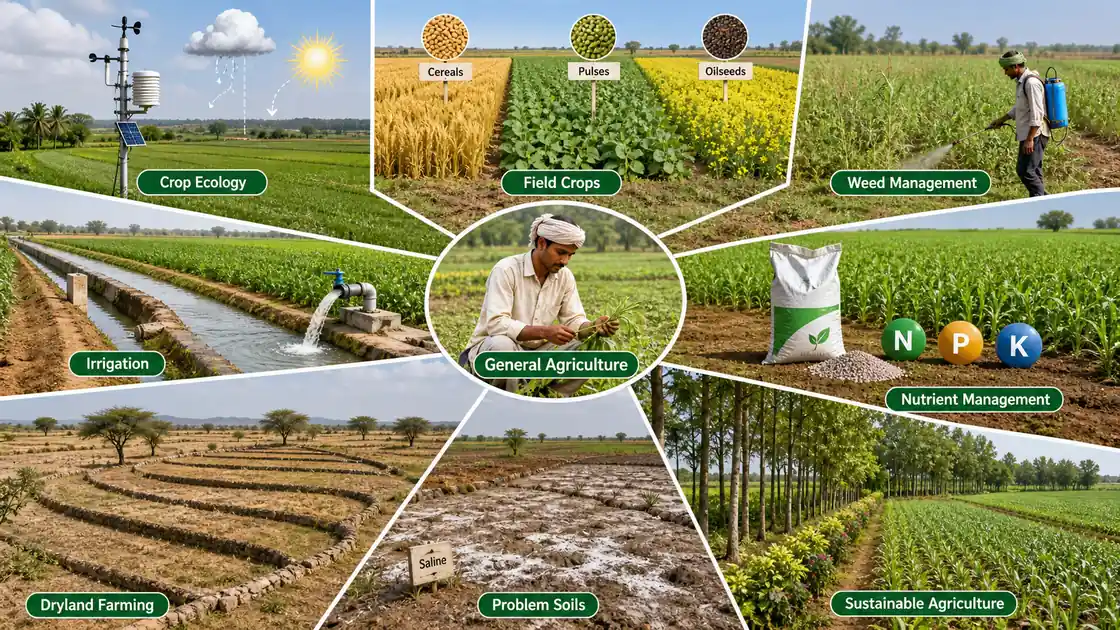
This is the complete syllabus page for ICAR JRF Agronomy (Code 05). Agronomy is one of the broadest ICAR papers because it mixes the common General Agriculture base with the main scoring areas of crop production, crop ecology, field crops, weeds, irrigation, nutrient management, dryland farming, problem soils, and sustainable systems.
Exam Snapshot
| Parameter | Details |
|---|---|
| Subject Code | 05 — Agronomy |
| Subject Group | Major Subject Group: Agronomy |
| Total Questions | 120 MCQs |
| Duration | 2 Hours |
| Marking Scheme | +4 per correct answer |
| Negative Marking | −1/3 per wrong answer |
| Question Type | Multiple Choice (Single correct) |
| Medium | English |
Latest Official Notification Details
| Parameter | 2026-27 Official Detail |
|---|---|
| Notice Date | 08 May 2026 |
| Application Window | 08 May 2026 to 07 June 2026 (up to 5:00 PM) |
| Fee Payment Deadline | 07 June 2026 (up to 11:50 PM) |
| Correction Window | 09 June to 10 June 2026 |
| Exam Date | 04 July 2026 (Saturday) |
| Mode | Computer Based Test (CBT) |
| Pattern | Objective type MCQs |
| Medium | English only |
| Duration | 02 hours (120 minutes) |
| Test Cities | Around 122 cities across India |
| Source | NTA 2026 Public Notice PDF · ICAR Syllabus PDF |
What Is Officially Fixed For Code 05
- Code 05 is the official major subject group for Agronomy in AICE JRF/SRF (Ph.D.).
- The paper is conducted in English only, in CBT mode, for 120 minutes.
- The official syllabus places Agronomy under one integrated paper with Unit-I General Agriculture and Unit-II onward subject-specific agronomy coverage.
- NTA publishes the notice, schedule, exam mode, duration, and application timeline, but it does not publish official chapter-wise or unit-wise weightage for Agronomy.
- The priority guidance below is therefore exam strategy, not an official marks blueprint.
Unit-I: General Agriculture
This common unit supports all ICAR JRF subject groups and usually creates the baseline scoring difference between prepared and underprepared candidates.
Agriculture & Crop Production
- Importance of agriculture in the national economy
- Basic principles of crop production
- Cultivation of major crops: rice, wheat, chickpea, pigeon-pea, sugarcane, groundnut, rapeseed and mustard, potato
- Major soils of India
- Role of NPK nutrients and their deficiency symptoms
Plant Biology & Biochemistry
- Structure and function of cell organelles
- Cell division: mitosis and meiosis
- Elementary Mendelian genetics
- Photosynthesis, respiration, photorespiration, and transpiration
- Structure and functions of carbohydrates, proteins, nucleic acids, enzymes, and vitamins
Plant Protection
- Major pests and diseases of rice, wheat, cotton, chickpea, and sugarcane
- Integrated management of pests and diseases
Rural Development & Statistics
- Important rural development programmes in India
- Organizational setup of agricultural research, education, and extension in India
- Elements of statistics
Unit-II: Agronomy Principles, Crop Ecology & Agricultural Meteorology
- Agronomy: meaning and scope
- National and international agricultural research institutes in India
- Agro-climatic zones of India
- Tillage, crop stand establishment, planting geometry, and their effects on crops
- Physiological limits of crop yield and variability in relation to ecological optima
- Organic farming, precision farming, and integrated farming systems
- Principles of field experimentation
- Principles of crop ecology and crop adaptation
- Climate shift and its ecological implications
- Agro-ecological regions in India
- Geographical distribution of crop plants
- Greenhouse effect
- Climatic factors and their effect on plant processes and crop productivity
- Role of GIS and GPS in agriculture
- Weather and climate
- Earth’s atmosphere
- Solar radiation
- Atmospheric temperature and global warming
- Crops and atmospheric humidity
- Weather forecasting
Unit-III: Field Crops
This unit is usually one of the biggest scoring blocks because it allows direct MCQs from crop-wise facts, package of practices, and crop group comparisons.
Cereals
- Rice
- Wheat
- Maize
- Sorghum
- Pearl millet
- Minor millets
- Barley
Pulses
- Chickpea
- Lentil
- Peas
- Pigeon pea
- Mungbean
- Urdbean
Oilseeds
- Groundnut
- Sesame
- Soybean
- Rapeseed and mustard
- Sunflower
- Safflower
- Linseed
Other Crop Groups
- Fiber crops: cotton, jute, sun hemp
- Sugar crop: sugarcane
- Fodder and forage crops: sorghum, maize, napier, berseem, lucerne, oats
- Medicinal and aromatic plants: mentha, lemon grass, isabgol
- Commercial crops: potato, tobacco
For these crop groups, the syllabus expects origin, distribution, economic importance, soil and climate requirements, varieties, cultural practices, and yield understanding.
Unit-IV: Weed Management
- Principles of weed management
- Classification, biology, and ecology of weeds
- Crop-weed competition and allelopathy
- Concepts and methods of weed control
- Integrated weed management (IWM)
- Classification, formulations, selectivity, and resistance of herbicides
- Herbicide persistence in soil and plants
- Application methods and equipment
- Weed flora shifts in cropping systems
- Special and problematic weeds and their management in cropped and non-cropped situations
- Weed management in field crops
Unit-V: Water Management
- Principles of irrigation
- Water resources and irrigation development in India
- Water and irrigation requirements of crops
- Concepts and approaches of irrigation scheduling
- Methods of irrigation
- Measurement of irrigation water
- Application, distribution, and use efficiencies
- Conjunctive use of water
- Irrigation water quality and its management
- Water management in major field crops: rice, wheat, maize, groundnut, sugarcane
- Agricultural drainage
Unit-VI: Soil Fertility & Nutrient Management
- Essential plant nutrients and their deficiency symptoms
- Concept of essentiality of plant nutrients
- Indicators of soil fertility and productivity
- Fertilizer materials and their availability to plants
- Slow-release fertilizers
- Nitrification inhibitors
- Principles and methods of fertilizer application
- Integrated nutrient management (INM)
- Site-specific nutrient management (SSNM)
Unit-VII: Dryland Agronomy & Watershed Management
- Characteristics of dryland farming and delineation of dryland tracts
- Constraints of dryland farming in India
- Types of drought and their management
- Contingency crop planning and mid-season corrections for aberrant weather
- In-situ moisture conservation and recycling
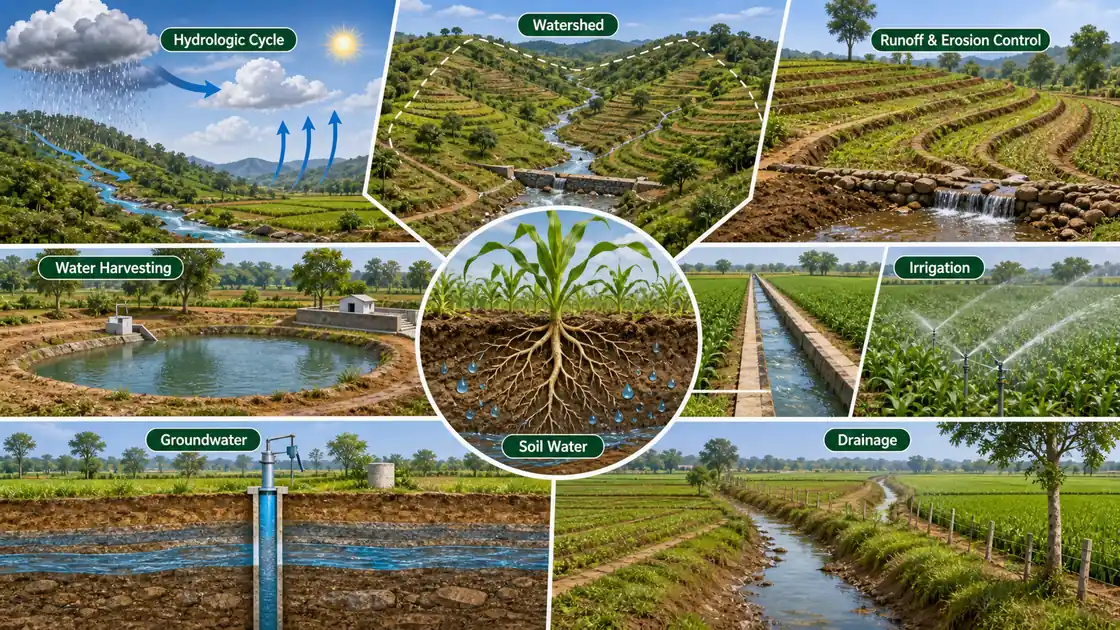
- Watershed management
Unit-VIII: Problem Soils
- Problem soils and their distribution in India
- Characteristics and reclamation of problem soils
- Crop production techniques in problem soils
- Saline, alkaline/sodic, acidic, waterlogged, and ravine soils
Unit-IX: Sustainable Agriculture
- Sustainable agriculture: parameters and indicators
- Conservation agriculture
- Safe disposal of agri-industrial waste for crop production
- Agroforestry systems
- Shifting cultivation
- Alternate land use systems
- Wastelands and their remediation for crop production
Exam-Focused High-Yield Areas
| Area | Why it is high-yield in Agronomy prep |
|---|---|
| Field crops | Very large factual and comparative zone; easy source of crop-specific MCQs |
| Irrigation and water-use efficiency | Frequently tested through concepts, method comparisons, and scheduling logic |
| Weed management and herbicides | High-return topic because classification, selectivity, persistence, and IWM are MCQ-friendly |
| Nutrient management | Deficiency symptoms, fertilizer behavior, INM, and SSNM are repeated revision zones |
| Dryland farming and drought management | Important because Agronomy papers often ask applied management questions |
| Agrometeorology and crop ecology | Connects climate, yield, adaptation, and forecasting in one block |
| Problem soils and reclamation | Short but very testable topic through soil type plus management matching |
| Sustainable agriculture concepts | Strong closing unit for theory-based and statement-type questions |
Quick Reference: What To Revise First
| Area | What to revise first |
|---|---|
| Field Crops | Cereals, pulses, oilseeds, forage crops, crop-wise packages of practices |
| Irrigation | Irrigation methods, scheduling, efficiencies, drainage, water quality |
| Weeds | Weed classification, allelopathy, herbicide formulations, IWM |
| Nutrient Management | Essentiality, deficiency symptoms, fertilizer materials, INM, SSNM |
| Dryland Agronomy | Drought types, contingency planning, moisture conservation, watershed management |
| Agrometeorology | Weather and climate, humidity, radiation, forecasting, greenhouse effect |
| Problem Soils | Saline, sodic, acidic, waterlogged soils and reclamation basics |
| General Agriculture | NPK, crop production basics, cell biology, major pests and diseases |
Best Books for ICAR JRF Agronomy
This list follows the exact books named in the topper-video recommendation set for JRF Agronomy and maps them to the syllabus blocks they help cover.
| Book | Best use in the syllabus |
|---|---|
| Principles of Agronomy — Reddy and Reddy | Best for Unit-II principles of agronomy, crop stand establishment, tillage, crop ecology, and the overall agronomy base |
| Principles of Agronomy — S. R. Reddy | Another strong base text for Unit-II, especially when you want a cleaner conceptual read of core agronomy topics |
| Field Crop Production, Vol. 1 & 2 — Rajendra Prasad | Best for Unit-III field crops: cereals, pulses, oilseeds, fibre crops, sugarcane, fodder, forage, and crop-wise practices |
| Soil Science Treatise — Etella Satyanarayana | Useful for Unit-VI soil fertility and fertilizer use and Unit-VIII problem soils |
| Agronomic Terminology — Indian Society of Agronomy | Best for quick revision of definitions, agronomy terms, and one-line concept recall across the paper |
| Modern Weed Management — O. P. Gupta | Best match for Unit-IV weed management, herbicides, selectivity, resistance, persistence, and weed-control methods |
| Agronomic Facts for Competition — R. S. Meena & Sihag | Best for fast competitive revision across Units I-IX, especially factual and objective-type recall |
| Mathematical Agriculture Concepts and Numericals — Amit Bhatnagar | Useful for agronomy numericals, calculations, and quantitative agriculture concepts that appear in objective papers |
| Objective Agronomy — Thavaprakash | Best for MCQ practice and final revision, not for first-time concept building |
| Agronomy Treatise — P. D. Choudhary | Good for broad paper revision and consolidating multiple agronomy units in one place |
| Fundamentals of Agriculture, Vol. 1 & 2 — Arun Katyayan | Best for Unit-I General Agriculture: crops, soils, NPK deficiency, cell biology, genetics, pests, diseases, and rural development basics |
| A Competitive Book of Agriculture — Nem Raj Sunda | Good backup for General Agriculture + competitive objective revision |
| Agronomy Booster | Best used as a last-stage booster/revision source once the main books are already covered |
TIP
If you do not want to study all books, the most useful stack from this video is:
- Principles of Agronomy
- Field Crop Production — Rajendra Prasad
- Modern Weed Management — O. P. Gupta
- Fundamentals of Agriculture — Arun Katyayan
- Objective Agronomy — Thavaprakash for MCQs
How To Prepare The General Agriculture Layer Efficiently With AgriDots
For plant- and agriculture-heavy JRF groups, the common agriculture base is explicit in the official syllabus itself. That is clear in groups such as Agronomy, Soil Science, Horticulture, Entomology, Plant Science, Plant Biotechnology, Social Sciences, and Water Science & Technology. In the animal, dairy, fisheries, food, engineering, forestry, community-science, and statistics groups, the same layer still improves scores because objective papers reward candidates who can quickly eliminate options using basic knowledge of crops, soils, schemes, extension, economics, statistics, and current agriculture.
So the practical rule is simple: do not prepare your subject in isolation. Keep one common-agriculture revision layer active throughout your JRF preparation.
Shared Books For The Common Agriculture Layer
| Book | Best use in common JRF preparation |
|---|---|
| Fundamentals of Agriculture, Vol. 1 & 2 — Arun Katyayan | Best base book for crop production, soils, nutrient deficiency, plant biology, genetics, pests, diseases, and agriculture basics |
| A Competitive Book of Agriculture — Nem Raj Sunda | Best for objective revision once the basic theory is already clear |
| Objective Agriculture for JRF Exam — S. R. Kantwa | Useful for MCQ drilling, recall speed, and mixed-agriculture practice |
| General Agriculture for ICAR Examinations — Muniraj Singh Rathore | Good backup book for one-line revision and broad competitive coverage |
Why AgriDots Is More Efficient Than Reading Books Alone
| Use AgriDots for | Why it is faster than books alone |
|---|---|
| Shared Agriculture Course | It compresses the overlapping JRF base into linked notes across agronomy, soil science, horticulture, genetics, pathology, entomology, economics, extension, animal husbandry, fisheries, ecology, and agricultural statistics instead of forcing you to extract overlap manually from multiple standard books |
| Topic-Wise Agriculture Practice Tests | You can revise chapter by chapter immediately after reading instead of waiting until one full book is complete |
| Agriculture Test Series | Mixed-subject Revision Warrior quizzes train recall across subjects, which is closer to how objective papers actually feel |
| Agriculture Current Affairs Hub | Books do not stay current on MSP, schemes, production reports, fertilizer policy, dairy/fisheries updates, or digital-agriculture changes |
Efficient JRF Workflow With AgriDots
- Read one main subject book for your core discipline and keep the rest of the books as support, not as parallel first reads.
- Use /courses/agriculture to finish the overlapping general-agriculture layer faster than building notes from multiple books.
- After each topic, solve topic-wise quizzes so weak areas become visible immediately.
- Use Revision Warrior mixed tests to train switching between crop, soil, genetics, economics, extension, and current-affairs questions.
- Use agriculture-current-affairs every week so your static preparation stays updated with schemes, policy, production, and report-based questions.
Why this works better than books alone: standard books build depth, but they are slow, repetitive across subjects, and weak on current agriculture. AgriDots is better for speed, revision order, topic linking, and exam-style recall, while books remain your depth source.
Preparation Strategy
- Finish Unit-I General Agriculture quickly but thoroughly because it is common, compact, and easy to score.
- Treat field crops, irrigation, weeds, and nutrient management as the main rank-deciding blocks.
- Revise crop-wise facts in groups, not one crop at a time without comparison.
- Keep dryland farming, problem soils, and sustainable agriculture for fast revision rounds because they are shorter but very testable.
- Practice PYQs with a strict habit of tagging each question as crop / water / weed / nutrient / climate / soil so weak zones become visible early.
Lesson Doubts
Ask questions, get expert answers