ICAR JRF Community Science Syllabus 2026 — Code 11 Unit-wise Topics
Complete ICAR JRF Community Science syllabus 2026 — Code 11 unit-wise topics for food and nutrition, human development, resource management, textiles, and extension education.
ICAR JRF Community Science Syllabus 2026 — Code 11
Major Subject Group: Community Science
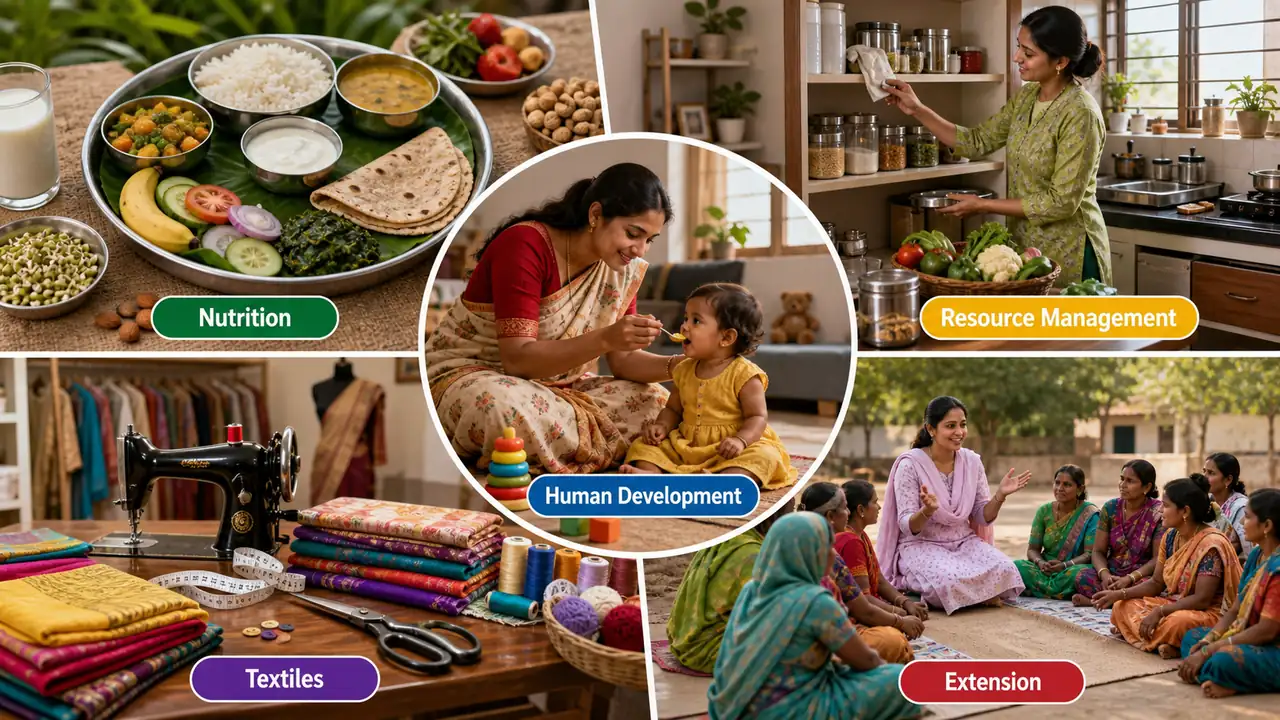
Sub-Subjects: 11.1 Food and Nutrition · 11.2 Human Development and Family Studies · 11.3 Resource Management and Consumer Science · 11.4 Apparel and Textile Science · 11.5 Extension Education and Communication Management
This is the complete syllabus page for ICAR JRF Community Science (Code 11). The paper is not only home-science memory work. It is a broad applied paper built around food and nutrition, human development, family studies, resource management, apparel and textiles, and extension education with communication management.
Exam Snapshot
| Parameter | Details |
|---|---|
| Subject Code | 11 — Community Science |
| Subject Group | Major Subject Group: Community Science |
| Total Questions | 120 MCQs |
| Duration | 2 Hours |
| Marking Scheme | +4 per correct answer |
| Negative Marking | -1/3 per wrong answer |
| Question Type | Multiple Choice (Single correct) |
| Medium | English |
Latest Official Notification Details
| Parameter | 2026-27 Official Detail |
|---|---|
| Notice Date | 08 May 2026 |
| Application Window | 08 May 2026 to 07 June 2026 (up to 5:00 PM) |
| Fee Payment Deadline | 07 June 2026 (up to 11:50 PM) |
| Correction Window | 09 June to 10 June 2026 |
| Exam Date | 04 July 2026 (Saturday) |
| Mode | Computer Based Test (CBT) |
| Pattern | Objective type MCQs |
| Medium | English only |
| Duration | 02 hours (120 minutes) |
| Test Cities | Around 122 cities across India |
| Source | NTA 2026 Public Notice PDF · ICAR Syllabus PDF |
What Is Officially Fixed For Code 11
- Code 11 is the official major subject group for Community Science in AICE JRF/SRF (Ph.D.).
- The paper is conducted in English only, in CBT mode, for 120 minutes.
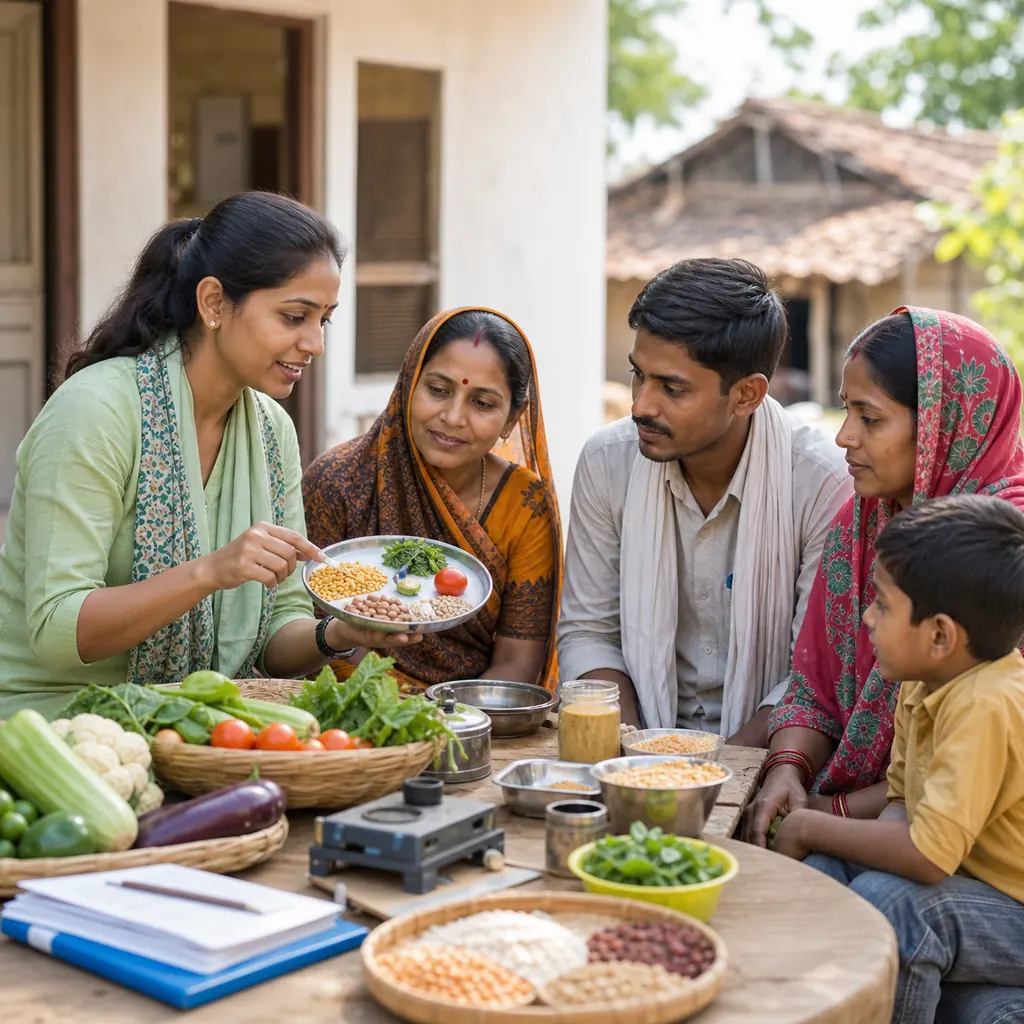
- The official syllabus publicly covers Food and Nutrition, Human Development and Family Studies, Resource Management and Consumer Science, Apparel and Textile Science, and Extension Education and Communication Management.
- NTA publishes the exam notice, schedule, mode, duration, and application timeline, but it does not publish official chapter-wise weightage for Community Science.
- The high-yield areas and revision priorities below are therefore exam guidance, not an official NTA marks-distribution sheet.
Unit-I: General Agriculture and Science Base
This common unit creates the starting base for Code 11. It is lighter than the Community Science core, but it should not be ignored.
- Importance of agriculture in the national economy
- Basic principles of crop production
- Major crops, soils, NPK, and deficiency symptoms
- Cell organelles, mitosis, meiosis, and Mendelian genetics
- Elementary plant physiology
- Basic crop protection concepts
Unit-II: Food and Nutrition
This is one of the most important scoring areas because the syllabus is direct, structured, and highly suitable for objective questions.
- Food groups and nutrients contributed by each group
- Composition and nutritive value of foods
- Food processing and preservation
- Meal planning and menu planning
- Nutrition for normal family members
- Practical diet planning
Unit-III: Human Development and Family Studies
- Meaning, concept, and principles of human development
- Prenatal development from conception to childbirth
- Care of the newborn
- Prenatal and postnatal care of the mother
- Child development in early and late childhood
- Adolescence
- Peer relations
- Family relations
- Marriage and family life
Unit-IV: Resource Management and Consumer Science
- Concept and principles of management
- Management process
- Work simplification
- Work environment
- Household organisation
- Fundamentals of housing
- Principles of design and home furnishing
- Selection, care, and maintenance of household accessories, equipment, and furniture
Unit-V: Apparel and Textile Science
- Introduction to clothing construction
- Sewing machine parts and use
- Fabric preparation for layout
- Textile fibre classification
- Processing and manufacturing methods
- Household textiles
- Weaving and hosiery
- Traditional Indian textiles and embroideries
- Care of clothing
- Textile finishes
Unit-VI: Extension Education and Communication
- Home science education
- Communication methods
- Extension methods
- Programme planning and evaluation
- Entrepreneurial education
- Projected and non-projected audio-visual aids
- Rural development programmes
- Empowerment of women
Exam-Focused High-Yield Areas
| Area | Why it matters in Community Science prep |
|---|---|
| Food groups, nutrients, and nutritive value | High-return factual area and easy for direct MCQs |
| Meal planning, menu planning, and diet planning | Frequently tested because theory can be converted into simple application questions |
| Prenatal care, child development, and adolescence | Strong conceptual block with clear stage-wise recall points |
| Management process, work simplification, and housing | Short, structured, and repeatedly useful for objective revision |
| Textile fibres, construction, and fabric basics | Good scoring zone because terms are distinct and easy to test comparatively |
| Extension methods and communication aids | Important because they connect community science with field-level outreach |
| Rural development and women empowerment | Small but meaningful area for concept-plus-programme recall |
| General agriculture base | Helps secure baseline questions that many students postpone too long |
Quick Reference: What To Revise First
| Area | What to revise first |
|---|---|
| Food and Nutrition | Food groups, nutrients, nutritive value, preservation, meal and menu planning |
| Human Development | Prenatal development, newborn care, child development, adolescence, family relations |
| Resource Management | Management principles, work simplification, housing, furnishing, household organisation |
| Textiles | Fibre classification, clothing construction, sewing machine basics, household textiles, finishes |
| Extension and Communication | Programme planning, AV aids, communication methods, entrepreneurial education, women empowerment |
| General Base | Agriculture importance, crops, soils, NPK deficiency, cell biology, genetics |
Best Books for ICAR JRF Community Science
This list keeps the same book-to-syllabus mapping format used across the JRF subject pages.
| Book | Best use in the syllabus |
|---|---|
| Textbook of Home Science — Premlata Mullick | Best starting base for Code 11, especially resource management and integrated home science orientation |
| Handbook of Food and Nutrition — M. Swaminathan | Best for food and nutrition |
| Child Development — Elizabeth B. Hurlock | Best for human development |
| Textbook of Fabric Science: Fundamentals to Finishing — Seema Sekhri | Best for textiles and fabric science |
| Objective Home Science — S. R. Sharma | Best for final integrated revision and MCQ practice |
| Minimal rank-oriented plan | Textbook of Home Science — Premlata Mullick, Handbook of Food and Nutrition — M. Swaminathan, and Child Development — Elizabeth B. Hurlock + PYQs |
How To Prepare The General Agriculture Layer Efficiently With AgriDots
For plant- and agriculture-heavy JRF groups, the common agriculture base is explicit in the official syllabus itself. That is clear in groups such as Agronomy, Soil Science, Horticulture, Entomology, Plant Science, Plant Biotechnology, Social Sciences, and Water Science & Technology. In the animal, dairy, fisheries, food, engineering, forestry, community-science, and statistics groups, the same layer still improves scores because objective papers reward candidates who can quickly eliminate options using basic knowledge of crops, soils, schemes, extension, economics, statistics, and current agriculture.
So the practical rule is simple: do not prepare your subject in isolation. Keep one common-agriculture revision layer active throughout your JRF preparation.
Shared Books For The Common Agriculture Layer
| Book | Best use in common JRF preparation |
|---|---|
| Fundamentals of Agriculture, Vol. 1 & 2 — Arun Katyayan | Best base book for crop production, soils, nutrient deficiency, plant biology, genetics, pests, diseases, and agriculture basics |
| A Competitive Book of Agriculture — Nem Raj Sunda | Best for objective revision once the basic theory is already clear |
| Objective Agriculture for JRF Exam — S. R. Kantwa | Useful for MCQ drilling, recall speed, and mixed-agriculture practice |
| General Agriculture for ICAR Examinations — Muniraj Singh Rathore | Good backup book for one-line revision and broad competitive coverage |
Why AgriDots Is More Efficient Than Reading Books Alone
| Use AgriDots for | Why it is faster than books alone |
|---|---|
| Shared Agriculture Course | It compresses the overlapping JRF base into linked notes across agronomy, soil science, horticulture, genetics, pathology, entomology, economics, extension, animal husbandry, fisheries, ecology, and agricultural statistics instead of forcing you to extract overlap manually from multiple standard books |
| Topic-Wise Agriculture Practice Tests | You can revise chapter by chapter immediately after reading instead of waiting until one full book is complete |
| Agriculture Test Series | Mixed-subject Revision Warrior quizzes train recall across subjects, which is closer to how objective papers actually feel |
| Agriculture Current Affairs Hub | Books do not stay current on MSP, schemes, production reports, fertilizer policy, dairy/fisheries updates, or digital-agriculture changes |
Efficient JRF Workflow With AgriDots
- Read one main subject book for your core discipline and keep the rest of the books as support, not as parallel first reads.
- Use /courses/agriculture to finish the overlapping general-agriculture layer faster than building notes from multiple books.
- After each topic, solve topic-wise quizzes so weak areas become visible immediately.
- Use Revision Warrior mixed tests to train switching between crop, soil, genetics, economics, extension, and current-affairs questions.
- Use agriculture-current-affairs every week so your static preparation stays updated with schemes, policy, production, and report-based questions.
Why this works better than books alone: standard books build depth, but they are slow, repetitive across subjects, and weak on current agriculture. AgriDots is better for speed, revision order, topic linking, and exam-style recall, while books remain your depth source.
Preparation Strategy
- Finish food and nutrition first because it is broad, central, and usually gives high-confidence direct questions.
- Then revise human development and family studies in stage order so concepts remain linked instead of scattered.
- Keep resource management and textiles together in one revision cycle because both are terminology-heavy.
- Reserve extension education and communication for a focused final pass because it is usually fast to revise and easy to score.
- Practice PYQs with a strict habit of grouping mistakes into nutrition, development, management, textile, and extension buckets.
Lesson Doubts
Ask questions, get expert answers