ICAR JRF Fisheries Science Syllabus 2026 — Code 15 Unit-wise Topics
Complete ICAR JRF Fisheries Science syllabus 2026 — Code 15 unit-wise topics for fishery resources, aquaculture, limnology, capture fisheries, processing, extension, economics, and fishery engineering.
ICAR JRF Fisheries Science Syllabus 2026 — Code 15
Major Subject Group: Fisheries Science
Sub-Subjects: 15.1 Fisheries Resource Management · 15.2 Aquaculture · 15.3 Fish Processing Technology · 15.4 Fish Physiology & Biochemistry · 15.5 Aquatic Animal Health Management · 15.6 Fisheries Extension · 15.7 Aquatic Environmental Management · 15.8 Fish Genetics and Breeding · 15.9 Fish Nutrition & Feed Technology · 15.10 Fisheries Economics · 15.11 Fishing Technology and Engineering · 15.12 Fish Biotechnology
This is the complete syllabus page for ICAR JRF Fisheries Science (Code 15). Code 15 is one of the broadest ICAR papers because it combines resource management, aquaculture, limnology, hatchery and seed production, fishing gear, processing, economics, extension, and biotechnology in a single integrated paper.
Exam Snapshot
| Parameter | Details |
|---|---|
| Subject Code | 15 — Fisheries Science |
| Subject Group | Major Subject Group: Fisheries Science |
| Total Questions | 120 MCQs |
| Duration | 2 Hours |
| Marking Scheme | +4 per correct answer |
| Negative Marking | −1/3 per wrong answer |
| Question Type | Multiple Choice (Single correct) |
| Medium | English |
Latest Official Notification Details
| Parameter | 2026-27 Official Detail |
|---|---|
| Notice Date | 08 May 2026 |
| Application Window | 08 May 2026 to 07 June 2026 (up to 5:00 PM) |
| Fee Payment Deadline | 07 June 2026 (up to 11:50 PM) |
| Correction Window | 09 June to 10 June 2026 |
| Exam Date | 04 July 2026 (Saturday) |
| Mode | Computer Based Test (CBT) |
| Pattern | Objective type MCQs |
| Medium | English only |
| Duration | 02 hours (120 minutes) |
| Test Cities | Around 122 cities across India |
| Source | NTA 2026 Public Notice PDF · ICAR Syllabus PDF |
What Is Officially Fixed For Code 15
- Code 15 is the official major subject group for Fisheries Science in AICE JRF/SRF (Ph.D.).
- The paper is conducted in English only, in CBT mode, for 120 minutes.
- The official ICAR syllabus publicly groups Fisheries Science into five broad units spanning resources, aquaculture, aquatic environment, fishing technology and processing, and fisheries economics with extension.
- NTA publishes the application schedule, exam mode, duration, and pattern, but it does not publish official unit-wise weightage for Fisheries Science.
- The “high-yield areas”, “quick reference”, and book strategy below are therefore exam guidance, not an official marks blueprint.
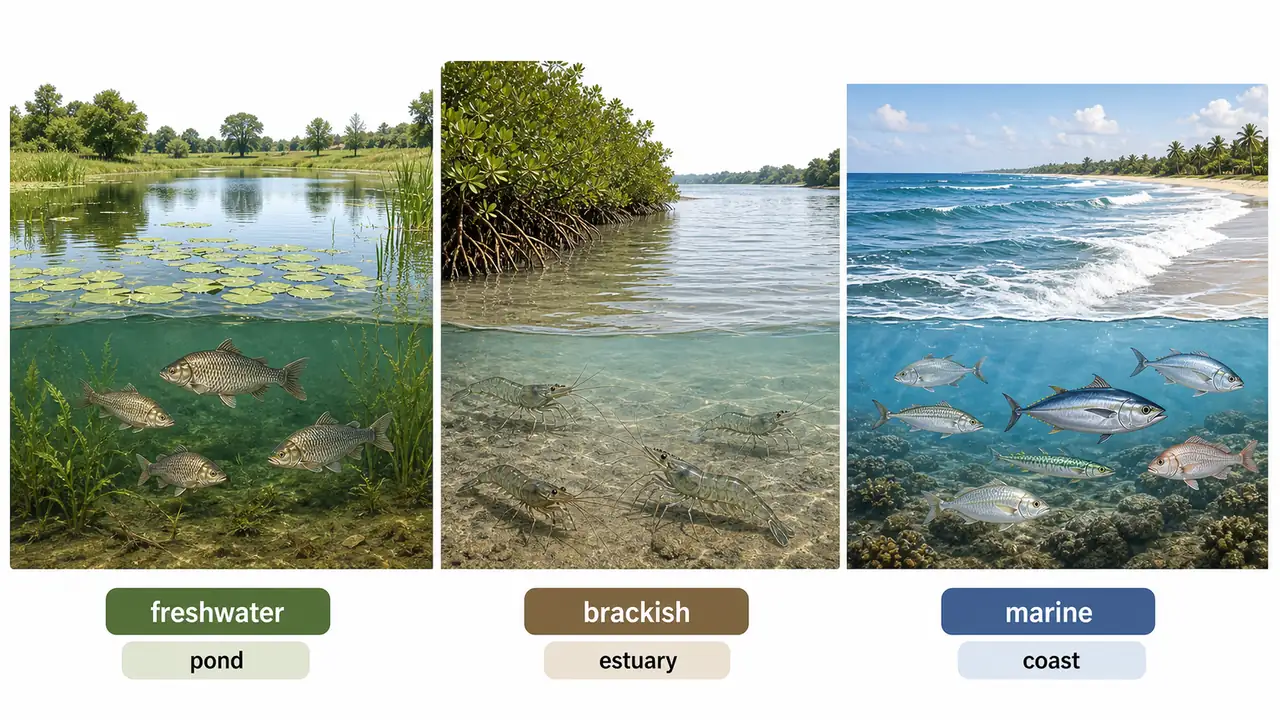
Fisheries Environments at a Glance
Official Unit-Wise Syllabus
Unit-I: Classification and Fisheries Resources
This unit builds the environment and resource base of the paper.
- Classification and taxonomical characteristics of cultivable fishes, crustaceans, and molluscs
- Freshwater, brackish water, and marine fishery resources of India
- Marine fisheries of the world
- Estuarine, lacustrine, brackish water, and pond ecosystems
- Population dynamics
- Fish stock, abundance methods, and analysis
- Conservation and management of fishery resources
- Fisheries legislations and Law of the Seas
- Impact of over-exploitation and climate change on fisheries resources
Unit-II: Reproduction, Breeding, and Aquaculture
This is one of the most scoring units because it combines fish biology with culture practice.
- Reproduction and breeding behaviour in fishes and shellfishes
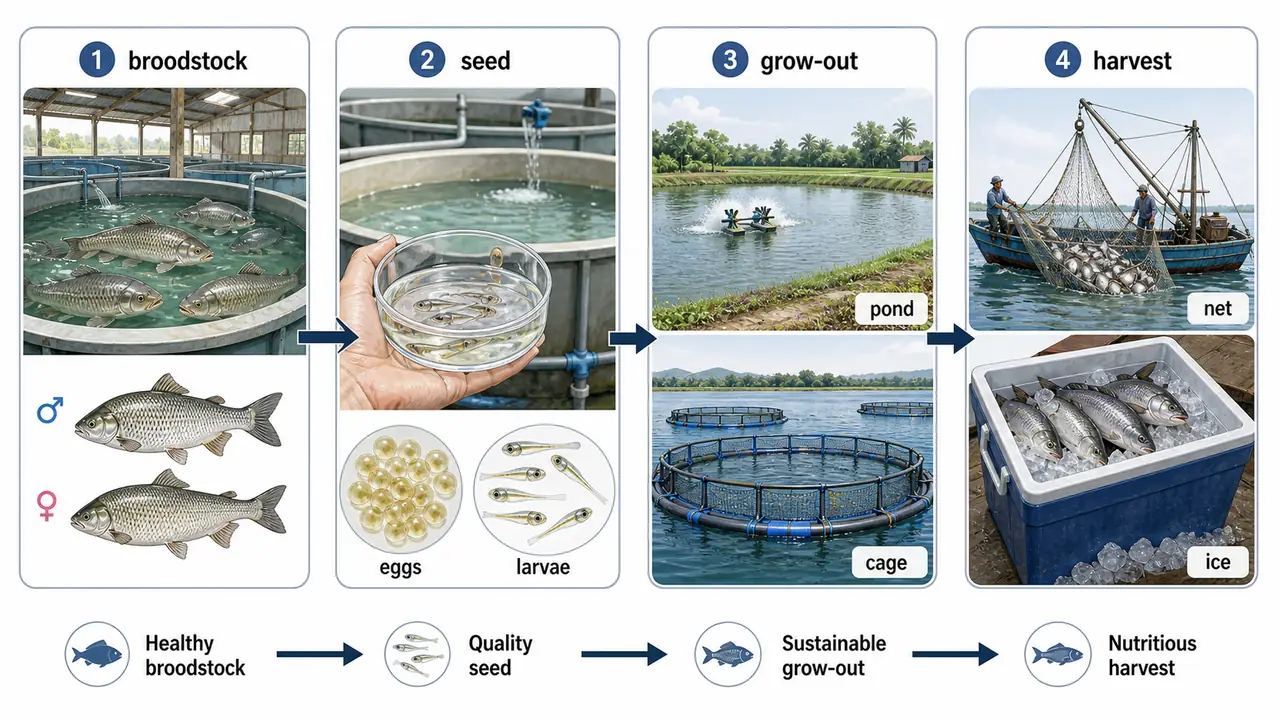
- Broodstock improvement
- Maturity and fecundity studies
- Induced spawning methods and seed production
- Natural fish seed collection and rearing methods
- Types of eggs and development of larval stages of finfishes and shellfishes
- Preparation and management of:
- freshwater fishponds
- brackish water fishponds
- Cultivable species identification
- Introduction of exotic fishes in India
- Culture methods:
- pen culture
- cage culture
- carp hatchery management
- shrimp hatchery management
- Basic aspects of biotechnology in relation to fisheries
Unit-III: Limnology and Aquatic Environmental Management
This unit supports both ecology-based and productivity-based questions.
- Important limnological, oceanographical, and biological parameters related to fisheries
- Fisheries of lotic and lentic waters
- Biological productivity and its impact on fisheries
- Environmental impact assessment on fisheries
- Biological parameters including:
- energy flow
- community ecology
- aquatic association
- Biodiversity and its conservation
- Aquatic pollution and its management
Unit-IV: Fishing Technology, Processing, and Engineering
This is the mixed applied unit where many students lose easy marks by not revising gear and processing together.
- Common crafts and gears used for fish capture
- Boat building materials and demerits of:
- wood
- steel
- aluminum
- ferro-cement
- FRP
- Different types of fibres and netting materials
- Characteristics and preservation of netting
- Parts of:
- trammel net
- purse seine
- gill net
- tuna long line
- Food chemistry fundamentals
- Fundamentals of microbiology
- General methods of fish preservation and fishery by-products
- Canning and packaging techniques
- Processing and product development techniques
Unit-V: Fisheries Economics and Extension
This unit is smaller than the biology-heavy units but can produce direct scoring questions.
- Introduction to fishery economics
- Concepts of:
- cooperative management
- marketing
- banking management
- Supply versus demand economics of:
- hatchery management
- fish culture operations
- Profit maximization
- Problems in estimating costs and returns in fisheries
- WTO agreements in the fisheries sector
- Intellectual property rights (IPR) and international fish trade
- Fisheries extension methods
- Training and education needs in fisheries
- Communication concepts
- Modern tools of fishery extension education
- Participatory rural appraisal
Aquaculture to Harvest Workflow
Exam-Focused High-Yield Areas
| Area | Why it matters in Code 15 prep |
|---|---|
| Freshwater, brackish, and marine resource classification | This is the foundation for ecology, species, and management questions |
| Broodstock, fecundity, and induced breeding | Very common aquaculture and seed-production revision areas |
| Pond preparation and hatchery management | Easy for paper setters to turn into practical MCQs |
| Lotic vs lentic productivity and limnology | Strong theory-to-application zone in fisheries papers |
| Crafts, gears, and netting materials | One of the most objective-friendly sections in the syllabus |
| Fish preservation, canning, and packaging | Short, direct, and often neglected scoring area |
| Fisheries economics and extension | Cost-return, marketing, WTO, IPR, and extension tools can add easy marks |
| Aquatic pollution and biodiversity | Good final-week revision topics because questions are usually concept based, not lengthy |
Quick Reference: What To Revise First
| Area | What to focus on first |
|---|---|
| Unit-I | Resource classification, freshwater vs brackish vs marine systems, fish stock basics, legislations |
| Unit-II | Reproduction, fecundity, induced breeding, larval stages, pond management, hatchery systems |
| Unit-III | Limnology, productivity, biodiversity, aquatic pollution, EIA |
| Unit-IV | Crafts and gears, netting materials, preservation, canning, packaging, product development |
| Unit-V | Fisheries economics, cost-return, WTO, IPR, extension methods, communication tools |
| Fast-score revision | Trammel net, purse seine, gill net, tuna long line, pen culture, cage culture, carp and shrimp hatchery |
Syllabus-Wise Best Books
This list keeps the same book-to-syllabus mapping format used across the JRF subject pages.
| Book | Best use in the syllabus |
|---|---|
| Textbook of Fish Biology and Fisheries — S. S. Khanna & H. R. Singh | Best for resource management, taxonomy, and economics support |
| Aquaculture: Principles and Practices — T. V. R. Pillay & M. N. Kutty | Best for aquaculture and breeding |
| Limnology — P. D. Sharma | Best for limnology and environment |
| Modern Fishing Gear Technology — Shahul Hameed & Boopendranath | Best for fishing technology and engineering |
| Fish Processing Technology — G. M. Hall | Best for processing and preservation |
| Minimal rank-oriented plan | Aquaculture: Principles and Practices — Pillay & Kutty, Textbook of Fish Biology and Fisheries — Khanna & Singh, and Modern Fishing Gear Technology — Shahul Hameed & Boopendranath + PYQs |
How To Prepare The General Agriculture Layer Efficiently With AgriDots
For plant- and agriculture-heavy JRF groups, the common agriculture base is explicit in the official syllabus itself. That is clear in groups such as Agronomy, Soil Science, Horticulture, Entomology, Plant Science, Plant Biotechnology, Social Sciences, and Water Science & Technology. In the animal, dairy, fisheries, food, engineering, forestry, community-science, and statistics groups, the same layer still improves scores because objective papers reward candidates who can quickly eliminate options using basic knowledge of crops, soils, schemes, extension, economics, statistics, and current agriculture.
So the practical rule is simple: do not prepare your subject in isolation. Keep one common-agriculture revision layer active throughout your JRF preparation.
Shared Books For The Common Agriculture Layer
| Book | Best use in common JRF preparation |
|---|---|
| Fundamentals of Agriculture, Vol. 1 & 2 — Arun Katyayan | Best base book for crop production, soils, nutrient deficiency, plant biology, genetics, pests, diseases, and agriculture basics |
| A Competitive Book of Agriculture — Nem Raj Sunda | Best for objective revision once the basic theory is already clear |
| Objective Agriculture for JRF Exam — S. R. Kantwa | Useful for MCQ drilling, recall speed, and mixed-agriculture practice |
| General Agriculture for ICAR Examinations — Muniraj Singh Rathore | Good backup book for one-line revision and broad competitive coverage |
Why AgriDots Is More Efficient Than Reading Books Alone
| Use AgriDots for | Why it is faster than books alone |
|---|---|
| Shared Agriculture Course | It compresses the overlapping JRF base into linked notes across agronomy, soil science, horticulture, genetics, pathology, entomology, economics, extension, animal husbandry, fisheries, ecology, and agricultural statistics instead of forcing you to extract overlap manually from multiple standard books |
| Topic-Wise Agriculture Practice Tests | You can revise chapter by chapter immediately after reading instead of waiting until one full book is complete |
| Agriculture Test Series | Mixed-subject Revision Warrior quizzes train recall across subjects, which is closer to how objective papers actually feel |
| Agriculture Current Affairs Hub | Books do not stay current on MSP, schemes, production reports, fertilizer policy, dairy/fisheries updates, or digital-agriculture changes |
Efficient JRF Workflow With AgriDots
- Read one main subject book for your core discipline and keep the rest of the books as support, not as parallel first reads.
- Use /courses/agriculture to finish the overlapping general-agriculture layer faster than building notes from multiple books.
- After each topic, solve topic-wise quizzes so weak areas become visible immediately.
- Use Revision Warrior mixed tests to train switching between crop, soil, genetics, economics, extension, and current-affairs questions.
- Use agriculture-current-affairs every week so your static preparation stays updated with schemes, policy, production, and report-based questions.
Why this works better than books alone: standard books build depth, but they are slow, repetitive across subjects, and weak on current agriculture. AgriDots is better for speed, revision order, topic linking, and exam-style recall, while books remain your depth source.
Preparation Strategy
- Start by dividing the subject into environment, production, capture, and economics. This prevents the paper from feeling too wide.
- Revise Unit-I and Unit-III together because fisheries resources, ecosystems, productivity, biodiversity, and pollution overlap heavily.
- Treat Unit-II as your rank-building unit. Broodstock, induced breeding, larval stages, pond preparation, and hatchery management give repeated returns.
- Keep a separate short notebook for crafts, gears, netting materials, preservation methods, canning, and packaging because these are factual and easy to revise fast.
- Finish every revision cycle with economics, WTO, IPR, and extension so you do not leave small but scorable topics uncovered.
Lesson Doubts
Ask questions, get expert answers