ICAR JRF Food Science Technology Syllabus 2026 — Code 18 Unit-wise Topics
Complete ICAR JRF Food Science Technology syllabus 2026 — Code 18 unit-wise topics for food chemistry, food process engineering, food processing technology, food microbiology, safety, and preservation.
ICAR JRF Food Science Technology Syllabus 2026 — Code 18
Major Subject Group: Food Science Technology
Sub-Subjects: 18.1 Food Processing Technology · 18.2 Food Process Engineering · 18.3 Food Safety & Quality
This is the complete syllabus page for ICAR JRF Food Science Technology (Code 18). The paper mixes food chemistry, unit operations, food processing lines, microbiology, preservation, packaging, safety, and engineering basics, so rank usually depends on how well you connect theory with process applications.
Exam Snapshot
| Parameter | Details |
|---|---|
| Subject Code | 18 — Food Science Technology |
| Subject Group | Major Subject Group: Food Science Technology |
| Total Questions | 120 MCQs |
| Duration | 2 Hours |
| Marking Scheme | +4 per correct answer |
| Negative Marking | −1/3 per wrong answer |
| Question Type | Multiple Choice (Single correct) |
| Medium | English |
Latest Official Notification Details
| Parameter | 2026-27 Official Detail |
|---|---|
| Notice Date | 08 May 2026 |
| Application Window | 08 May 2026 to 07 June 2026 (up to 5:00 PM) |
| Fee Payment Deadline | 07 June 2026 (up to 11:50 PM) |
| Correction Window | 09 June to 10 June 2026 |
| Exam Date | 04 July 2026 (Saturday) |
| Mode | Computer Based Test (CBT) |
| Pattern | Objective type MCQs |
| Medium | English only |
| Duration | 02 hours (120 minutes) |
| Test Cities | Around 122 cities across India |
| Source | NTA 2026 Public Notice PDF · ICAR Syllabus PDF |
What Is Officially Fixed For Code 18
- Code 18 is the official major subject group for Food Science Technology in AICE JRF/SRF (Ph.D.).
- The paper is conducted in English only, in CBT mode, for 120 minutes.
- The public syllabus groups the paper into food chemistry, food process engineering, food processing technology, and food safety/microbiology/preservation.
- NTA publishes the schedule, exam mode, and pattern, but it does not publish official chapter-wise weightage for Food Science Technology.
- The priority guidance below is therefore revision strategy, not an official NTA marks chart.
Code 18 Structure at a Glance
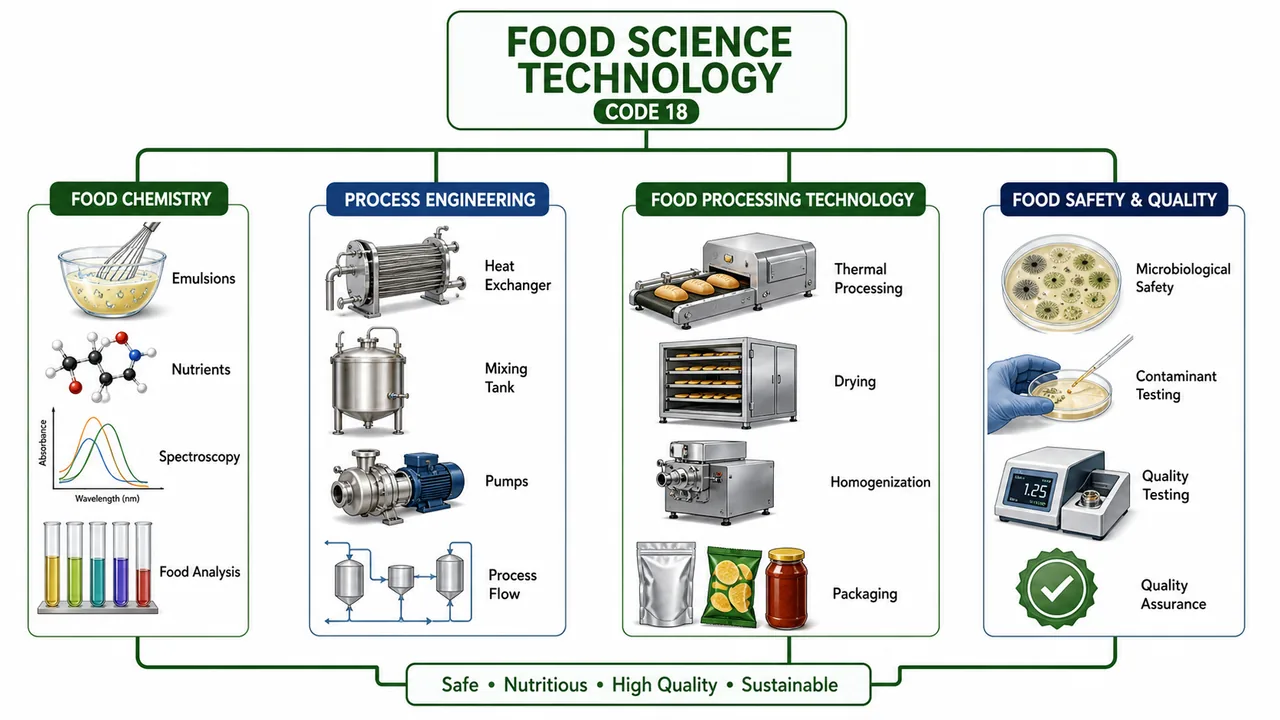
Unit-I: Food Chemistry
- General chemistry of food constituents
- Physical properties of foods
- Properties of colloidal systems, gels, and emulsions
- Minerals in foods
- Physicochemical changes in foods during processing and storage
- Functions of food nutrients
- Dietary allowances and nutritional requirements
- Metabolism of carbohydrates, lipids, and protein
- Biological value and PER
- Food additives, contaminants, and anti-nutritional factors
- Food flavours and puff-flavours
- National and international food standards
- Modern analytical techniques in food analysis
Unit-II: Food Process Engineering
- Engineering properties of food materials
- System analysis
- Mass and energy balance
- Principles, operations, and equipment for:
- food materials flow and handling
- cleaning
- de-husking
- sorting and grading
- peeling
- size reduction
- mixing and forming
- bakery foods manufacture
- extrusion
- separation
- filtration and membrane processes
- expression
- baking, roasting, frying
- extraction and leaching
- crystallization and distillation
- blanching, pasteurization, sterilization
- evaporation, drying, freezing
- packing and heat exchange
- Dairy-specific operations
- Process equipment design
- Heat and mass transfer
- Equipment for steam generation, compressed air, refrigeration, air conditioning, water and wastewater treatment
- Biochemical engineering and thermobacteriology
- Automation, online data acquisition, and process control
- Food plant layout and design
- Energy audit
Unit-III: Food Processing Technology
- Preparation and manufacturing technology of cereals and bakery products
- Beef, pork, poultry, fish and seafoods, and egg products
- Sausages and table-ready meats
- Dairy products
- Fresh fruits and fresh vegetables
- Processed fruits and processed vegetables
- Post-harvest handling and storage of fruits and vegetables
- Sugars, sweets, fats, and oils
- Fermented foods
- Alcoholic and non-alcoholic beverages
- Indigenous foods
- Fast, ready-made, and fashion foods
- Dehydration and concentration methods
- Irradiation
- Microwave and solar processing of foods
- Food by-products and downstream processing
- Flavouring and pigment technology
- Judging of food products
Unit-IV: Food Safety, Microbiology, and Preservation
- Role of intrinsic and extrinsic properties of food in relation to microbial growth
- Microbiology of fruits, fruit products, vegetables, soft drinks, bakery products, milk and milk products, fish, egg, and marine products
- Spoilage of foods
- Food pathogens and their toxins in relation to human health
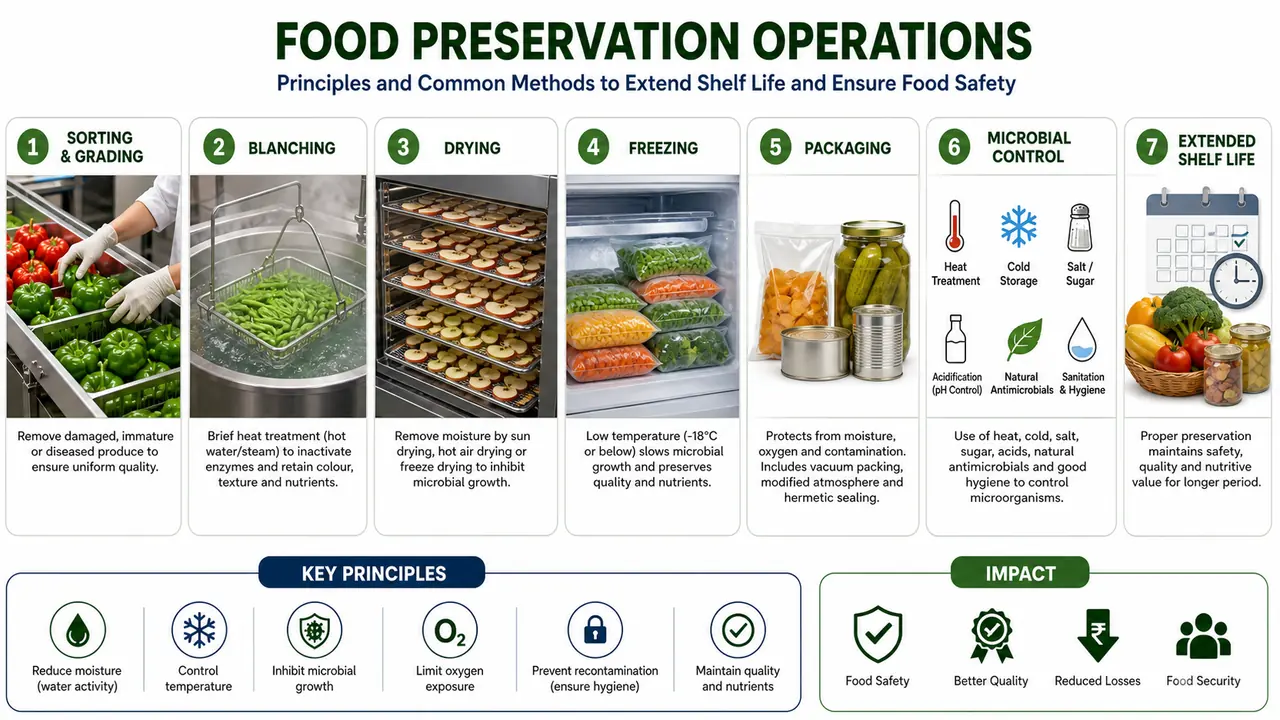
- Food preservation by sugar, salt, chemicals, heat, cold, irradiation, dehydration, and packaging
- Microbiology of fermented foods and beverages
- Factors affecting their quality
- Methods for microbiological examination of foods
- Food hygiene and safety regulations
- Water quality and waste disposal in food industry
Exam-Focused High-Yield Areas
| Area | Why it matters in Code 18 prep |
|---|---|
| Food constituents, gels, emulsions, and physicochemical changes | Common direct-theory MCQ area in food chemistry |
| Mass-energy balance and unit operations | Core engineering block that separates shallow preparation from serious preparation |
| Sorting, grading, drying, freezing, extraction, membrane processing | High-return operations because they can be tested as principle, equipment, or application |
| Cereals, bakery, dairy, fruits, vegetables, meat processing | Product-wise processing questions often come from these standard manufacturing blocks |
| Food preservation methods | One of the most predictable and repeatedly asked areas |
| Food pathogens, spoilage, and toxins | Strong scoring area because the questions are often objective and direct |
| Packaging, plant layout, utilities, and process control | Technical but compact topics that add easy marks once revised properly |
| Food standards and safety regulations | Important finishing layer for quality-oriented questions |
Quick Reference: What To Revise First
| Area | What to revise first |
|---|---|
| Food Chemistry | Constituents, colloids, gels, emulsions, additives, anti-nutritional factors, food standards |
| Process Engineering | Mass-energy balance, heat and mass transfer, drying, freezing, membrane processes, plant layout |
| Processing Technology | Cereals and bakery, dairy products, fruits and vegetables, dehydration, concentration, irradiation |
| Safety & Microbiology | Intrinsic and extrinsic factors, spoilage, pathogens, toxins, preservation, hygiene |
| Fast Final Revision | Packaging, utilities, refrigeration, wastewater treatment, automation, energy audit |
Best Books for ICAR JRF Food Science Technology
This list keeps the same book-to-syllabus mapping format used across the JRF subject pages.
| Book | Best use in the syllabus |
|---|---|
| Food Science — B. Srilakshmi | Best base coverage for Code 18 |
| Food Processing and Preservation — G. Subbulakshmi & Shobha A. Udayakumar | Best for food processing and preservation |
| Introduction to Food Engineering — R. Paul Singh & Dennis R. Heldman | Best for food process engineering and numericals |
| Food Processing Technology: Principles and Practice — P. J. Fellows | Best for unit operations and process-flow clarity |
| Engineering Properties of Foods — M. A. Rao, Syed S. H. Rizvi & Ashim K. Datta | Best for engineering properties and transfer processes |
| Minimal rank-oriented plan | Food Science — B. Srilakshmi, Introduction to Food Engineering — Singh & Heldman, and Food Processing Technology — P. J. Fellows + PYQs |
How To Prepare The General Agriculture Layer Efficiently With AgriDots
For plant- and agriculture-heavy JRF groups, the common agriculture base is explicit in the official syllabus itself. That is clear in groups such as Agronomy, Soil Science, Horticulture, Entomology, Plant Science, Plant Biotechnology, Social Sciences, and Water Science & Technology. In the animal, dairy, fisheries, food, engineering, forestry, community-science, and statistics groups, the same layer still improves scores because objective papers reward candidates who can quickly eliminate options using basic knowledge of crops, soils, schemes, extension, economics, statistics, and current agriculture.
So the practical rule is simple: do not prepare your subject in isolation. Keep one common-agriculture revision layer active throughout your JRF preparation.
Shared Books For The Common Agriculture Layer
| Book | Best use in common JRF preparation |
|---|---|
| Fundamentals of Agriculture, Vol. 1 & 2 — Arun Katyayan | Best base book for crop production, soils, nutrient deficiency, plant biology, genetics, pests, diseases, and agriculture basics |
| A Competitive Book of Agriculture — Nem Raj Sunda | Best for objective revision once the basic theory is already clear |
| Objective Agriculture for JRF Exam — S. R. Kantwa | Useful for MCQ drilling, recall speed, and mixed-agriculture practice |
| General Agriculture for ICAR Examinations — Muniraj Singh Rathore | Good backup book for one-line revision and broad competitive coverage |
Why AgriDots Is More Efficient Than Reading Books Alone
| Use AgriDots for | Why it is faster than books alone |
|---|---|
| Shared Agriculture Course | It compresses the overlapping JRF base into linked notes across agronomy, soil science, horticulture, genetics, pathology, entomology, economics, extension, animal husbandry, fisheries, ecology, and agricultural statistics instead of forcing you to extract overlap manually from multiple standard books |
| Topic-Wise Agriculture Practice Tests | You can revise chapter by chapter immediately after reading instead of waiting until one full book is complete |
| Agriculture Test Series | Mixed-subject Revision Warrior quizzes train recall across subjects, which is closer to how objective papers actually feel |
| Agriculture Current Affairs Hub | Books do not stay current on MSP, schemes, production reports, fertilizer policy, dairy/fisheries updates, or digital-agriculture changes |
Efficient JRF Workflow With AgriDots
- Read one main subject book for your core discipline and keep the rest of the books as support, not as parallel first reads.
- Use /courses/agriculture to finish the overlapping general-agriculture layer faster than building notes from multiple books.
- After each topic, solve topic-wise quizzes so weak areas become visible immediately.
- Use Revision Warrior mixed tests to train switching between crop, soil, genetics, economics, extension, and current-affairs questions.
- Use agriculture-current-affairs every week so your static preparation stays updated with schemes, policy, production, and report-based questions.
Why this works better than books alone: standard books build depth, but they are slow, repetitive across subjects, and weak on current agriculture. AgriDots is better for speed, revision order, topic linking, and exam-style recall, while books remain your depth source.
Preparation Strategy
- Start with food chemistry and preservation basics so later processing questions make sense.
- Then learn unit operations as a sequence, not as disconnected headings.
- Keep mass-energy balance, heat transfer, drying, freezing, and membrane processes in a separate revision notebook if engineering is your weak area.
- After that, revise product-wise technology: cereals, bakery, dairy, fruits, vegetables, meat, and beverages.
- End with food safety, spoilage organisms, pathogens, and standards, because these questions are usually direct and fast to score.
Lesson Doubts
Ask questions, get expert answers