ICAR JRF Horticulture Syllabus 2026 — Code 08 Unit-wise Topics
Complete ICAR JRF Horticulture syllabus 2026 — Code 08 unit-wise topics for vegetable science, fruit science, post-harvest management, floriculture, landscaping, plantation crops, spices, medicinal and aromatic crops.
ICAR JRF Horticulture Syllabus 2026 — Code 08
Major Subject Group: Horticulture
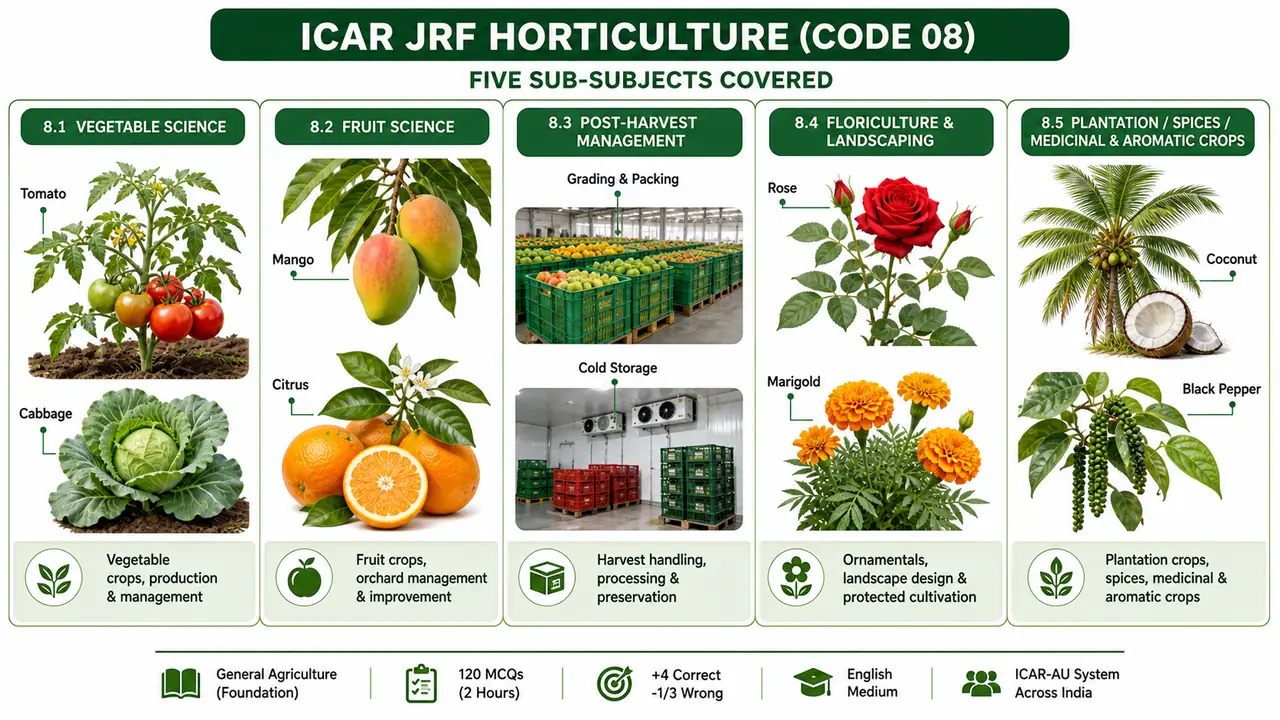
Sub-Subjects: 8.1 Vegetable Science · 8.2 Fruit Science · 8.3 Post-Harvest Management · 8.4 Floriculture & Landscaping · 8.5 Plantation, Spices, Medicinal and Aromatic Crops
This is the complete syllabus page for ICAR JRF Horticulture (Code 08). It combines the common General Agriculture foundation with the full horticulture-specific areas that usually decide rank: fruits, vegetables, floriculture, plantation crops, post-harvest management, and crop improvement.
Exam Snapshot
| Parameter | Details |
|---|---|
| Subject Code | 08 — Horticulture |
| Subject Group | Major Subject Group: Horticulture |
| Total Questions | 120 MCQs |
| Duration | 2 Hours |
| Marking Scheme | +4 per correct answer |
| Negative Marking | −1/3 per wrong answer |
| Question Type | Multiple Choice (Single correct) |
| Medium | English |
Latest Official Notification Details
| Parameter | 2026-27 Official Detail |
|---|---|
| Notice Date | 08 May 2026 |
| Application Window | 08 May 2026 to 07 June 2026 (up to 5:00 PM) |
| Fee Payment Deadline | 07 June 2026 (up to 11:50 PM) |
| Correction Window | 09 June to 10 June 2026 |
| Exam Date | 04 July 2026 (Saturday) |
| Mode | Computer Based Test (CBT) |
| Pattern | Objective type MCQs |
| Medium | English only |
| Duration | 02 hours (120 minutes) |
| Test Cities | Around 122 cities across India |
| Source | NTA 2026 Public Notice PDF · ICAR Syllabus PDF |
Sub-Subjects Covered
- 8.1 Vegetable Science
- 8.2 Fruit Science
- 8.3 Post-Harvest Management
- 8.4 Floriculture & Landscaping
- 8.5 Plantation, Spices, Medicinal and Aromatic Crops
What Is Officially Fixed For Code 08
- Code 08 is the official major subject group for Horticulture in AICE JRF/SRF (Ph.D.).
- The paper is conducted in English only, in CBT mode, for 120 minutes.
- The official syllabus is still anchored to the ICAR syllabus PDF, where Horticulture appears as one integrated group with Unit-I General Agriculture and Unit-II Horticulture.
- NTA publishes the exam notice, dates, mode, duration, and application schedule, but it does not publish official unit-wise weightage for Horticulture in the public notice.
- Preparation priorities such as “high-yield topics” are therefore revision guidance, not an official NTA distribution chart.
Unit-I: General Agriculture
This common unit supports every ICAR JRF subject group and usually contributes the baseline questions that many students ignore too lightly.
Agriculture & Crop Production
- Importance of agriculture in national economy
- Basic principles of crop production
- Cultivation of major crops: rice, wheat, chickpea, pigeon-pea, sugarcane, groundnut, tomato and mango
Soil Science
- Major soils of India
- Role of NPK nutrients and their deficiency symptoms
Plant Biology & Biochemistry
- Structure and function of cell organelles
- Cell division: mitosis and meiosis
- Mendelian genetics
- Elementary knowledge of photosynthesis, respiration and transpiration
- Structure and functions of carbohydrates, proteins, nucleic acids, enzymes and vitamins
Plant Protection
- Major pests and diseases of rice, wheat, cotton, chickpea, sugarcane
- Integrated pest and disease management strategies
Agricultural Systems & Statistics
- Important rural development programmes in India
- Organizational setup of agricultural research, education and extension in India
- Elements of statistics
Unit-II: Horticulture Core
This is the main scoring unit for Code 08 and covers all five horticulture sub-subjects in one integrated paper.
Fruit Science (8.2)
Orchard Management
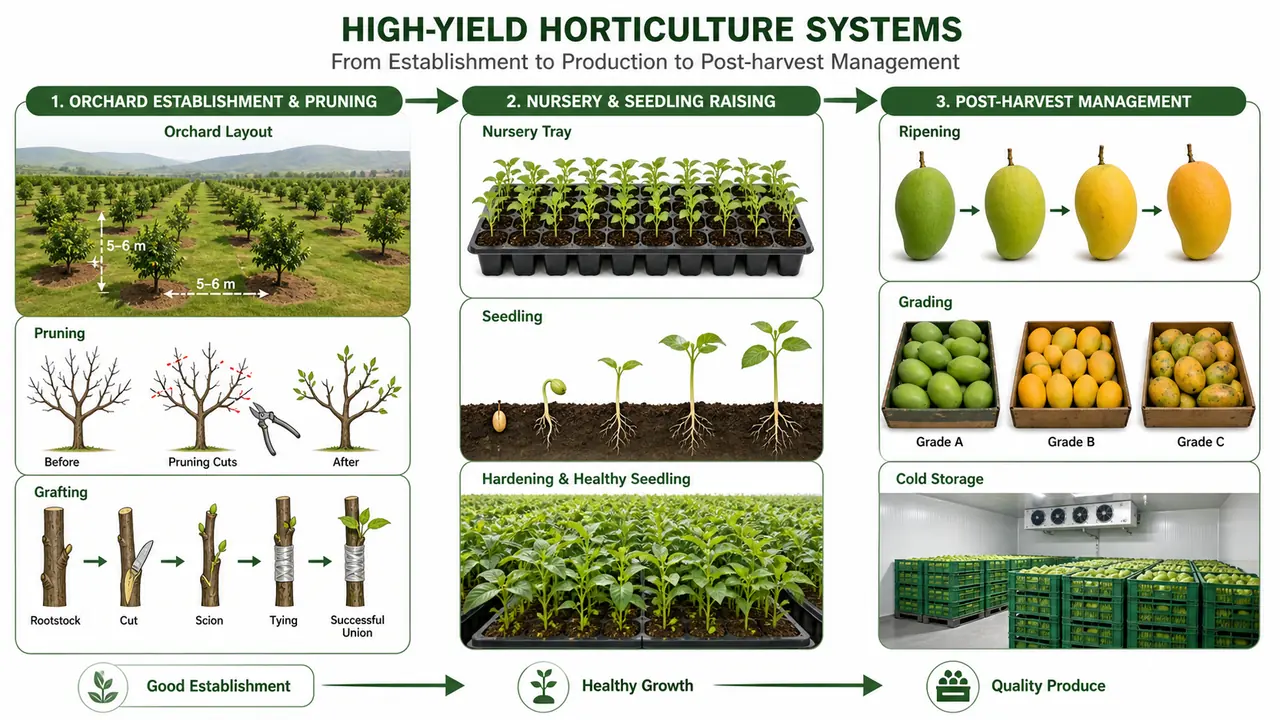
- Layout and establishment of orchards
- Pruning and training techniques
- Propagation methods for fruit crops
Tropical & Subtropical Fruits
- Mango — climatic requirements, cultivation, physiological disorders
- Banana — varieties, cultivation practices
- Citrus — species, propagation, cultivation
- Guava — cultivation, varieties
- Grape — training systems, cultivation
- Pineapple — cultivation, harvest
- Papaya — cultivation, sex forms
Temperate Fruits
- Apple — rootstocks, varieties, cultivation
- Pear — cultivation, varieties
- Peach — cultivation, chilling requirement
- Plum — cultivation, varieties
Plantation Crops & Spices (8.5)
- Coconut — cultivation, varieties, uses
- Cashew nut — cultivation, processing
- Black pepper — cultivation, propagation
- Coriander — cultivation, seed production
- Turmeric — cultivation, curcumin content
- Medicinal and aromatic crops — basic identification, uses, and cultivation importance
Vegetable Science (8.1)
Cole Crops (Brassicas)
- Cauliflower, cabbage, knol-khol — cultivation, varieties
Cucurbits
- Pumpkin, bottle gourd, bitter gourd, luffa, muskmelon, watermelon, cucumber — cultivation
Root Crops
- Radish, tapioca, sweet potato, potato — cultivation, storage
Leafy Vegetables
- Fenugreek, spinach — cultivation, nutrition
Solanaceous Crops
- Tomato, chillies, brinjal — cultivation, varieties, diseases
Nursery Techniques
- Raising vegetable nurseries, plug trays, seedling management
Nutrition
- Nutritive value of fruits and vegetables and their role in human nutrition
Post-Harvest Management (8.3)
- Basic physiology of ripening in fruits and vegetables
- Types of fruit and vegetable products (canning, freezing, drying, pickling, beverages)
- Control of fungal and bacterial diseases in post-harvest
- Processing technologies
- Storage behaviour, shelf life, and handling losses in perishables
Floriculture & Landscaping (8.4)
Commercial Floricultural Crops
- Rose — varieties, cultivation, cut flower production
- Carnation — cultivation, post-harvest
- Chrysanthemum — types, cultivation
- Marigold — varieties, cultivation
- Tuberose — cultivation, bulb management
- Gladiolus — corm production, cultivation
- Orchids — types, cultivation
Landscaping
- Establishment and maintenance of lawns
- Trees, shrubs, creepers, hedges and annuals in landscaping
- Types of gardens (formal, informal, Japanese, Mughal, etc.)
Plant Breeding & Improvement
- Methods of crop improvement in horticultural crops
- Male sterility and incompatibility
- Pure line and pedigree selection
- Backcross and mass selection
- Heterosis and hybrid seed production
Nutrition, Manures & Irrigation
- Plant nutrients and deficiency symptoms in horticultural crops
- Manures and fertilisers for fruits and vegetables
- Systems of irrigation (drip, sprinkler, flood)
Plant Protection
- Management of important pests and diseases of fruits and vegetables
Exam-Focused High-Yield Areas
| Area | Why it is repeatedly important in JRF prep |
|---|---|
| Propagation, pruning and training | These are concept-heavy fundamentals of fruit science and often tested through technique-based MCQs |
| Major fruit crops | Mango, banana, citrus, guava, grape, papaya and apple repeatedly anchor crop-specific questions |
| Vegetable crop groups | Cole crops, cucurbits, root crops and solanaceous crops are easy for paper setters to convert into classification and practice questions |
| Post-harvest management | Ripening, grading, storage, product types and disease control are direct theory-to-application areas |
| Floriculture crops | Rose, carnation, chrysanthemum, gladiolus and tuberose are short, factual, high-return revision zones |
| Plantation and spice crops | Coconut, cashew, black pepper and turmeric create many crop-identification and management questions |
| Nutrient deficiency and irrigation | These bridge general crop science with practical horticultural management |
| Pests, diseases and disorders | Horticulture papers often mix crop names with symptom, damage, or management recall |
Quick Reference: What To Revise First
| Area | What to focus on first |
|---|---|
| Fruit Science | Mango, banana, citrus, grape, guava, papaya, apple; orchard layout, pruning, propagation, physiological disorders |
| Vegetable Science | Solanaceous crops, cole crops, cucurbits, nursery raising, nutritive value, storage issues |
| Floriculture | Rose, carnation, chrysanthemum, marigold, gladiolus, tuberose, orchids |
| Plantation & Spices | Coconut, cashew, black pepper, turmeric, coriander |
| Post-Harvest | Ripening, preservation methods, product types, post-harvest disease control |
| Crop Improvement | Male sterility, incompatibility, selection methods, heterosis, hybrid seed production |
| General Agriculture | NPK deficiency, major soils, Mendelian genetics, crop production basics, pests and diseases |
How To Prepare The General Agriculture Layer Efficiently With AgriDots
For plant- and agriculture-heavy JRF groups, the common agriculture base is explicit in the official syllabus itself. That is clear in groups such as Agronomy, Soil Science, Horticulture, Entomology, Plant Science, Plant Biotechnology, Social Sciences, and Water Science & Technology. In the animal, dairy, fisheries, food, engineering, forestry, community-science, and statistics groups, the same layer still improves scores because objective papers reward candidates who can quickly eliminate options using basic knowledge of crops, soils, schemes, extension, economics, statistics, and current agriculture.
So the practical rule is simple: do not prepare your subject in isolation. Keep one common-agriculture revision layer active throughout your JRF preparation.
Shared Books For The Common Agriculture Layer
| Book | Best use in common JRF preparation |
|---|---|
| Fundamentals of Agriculture, Vol. 1 & 2 — Arun Katyayan | Best base book for crop production, soils, nutrient deficiency, plant biology, genetics, pests, diseases, and agriculture basics |
| A Competitive Book of Agriculture — Nem Raj Sunda | Best for objective revision once the basic theory is already clear |
| Objective Agriculture for JRF Exam — S. R. Kantwa | Useful for MCQ drilling, recall speed, and mixed-agriculture practice |
| General Agriculture for ICAR Examinations — Muniraj Singh Rathore | Good backup book for one-line revision and broad competitive coverage |
Why AgriDots Is More Efficient Than Reading Books Alone
| Use AgriDots for | Why it is faster than books alone |
|---|---|
| Shared Agriculture Course | It compresses the overlapping JRF base into linked notes across agronomy, soil science, horticulture, genetics, pathology, entomology, economics, extension, animal husbandry, fisheries, ecology, and agricultural statistics instead of forcing you to extract overlap manually from multiple standard books |
| Topic-Wise Agriculture Practice Tests | You can revise chapter by chapter immediately after reading instead of waiting until one full book is complete |
| Agriculture Test Series | Mixed-subject Revision Warrior quizzes train recall across subjects, which is closer to how objective papers actually feel |
| Agriculture Current Affairs Hub | Books do not stay current on MSP, schemes, production reports, fertilizer policy, dairy/fisheries updates, or digital-agriculture changes |
Efficient JRF Workflow With AgriDots
- Read one main subject book for your core discipline and keep the rest of the books as support, not as parallel first reads.
- Use /courses/agriculture to finish the overlapping general-agriculture layer faster than building notes from multiple books.
- After each topic, solve topic-wise quizzes so weak areas become visible immediately.
- Use Revision Warrior mixed tests to train switching between crop, soil, genetics, economics, extension, and current-affairs questions.
- Use agriculture-current-affairs every week so your static preparation stays updated with schemes, policy, production, and report-based questions.
Why this works better than books alone: standard books build depth, but they are slow, repetitive across subjects, and weak on current agriculture. AgriDots is better for speed, revision order, topic linking, and exam-style recall, while books remain your depth source.
Preparation Strategy
- Unit-I carries approximately 20–25% of questions — cover all topics thoroughly.
- Unit-II is the main scoring area — focus on fruit cultivation, vegetable science, and post-harvest.
- Practice previous year papers (2019–2025) available in this course.
- Deficiency symptoms, physiological disorders, and propagation methods are high-frequency topics.
- Floriculture and landscaping are relatively easy marks — don't skip them.
- Revise crop-wise facts in comparison form: fruit crop vs vegetable crop vs floriculture crop vs plantation/spice crop.
- Do not assume official weightage for each sub-subject unless NTA or ICAR explicitly publishes it; use PYQs and syllabus density to set your revision order.
Exam Pattern (ICAR JRF — Code 08)
- Total Questions: 120 MCQs
- Duration: 2 hours
- Marking: +4 for correct, −1/3 for wrong
- Maximum Marks: 480
- Medium: English only
Note: The paper mixes questions from the common General Agriculture base and horticulture-specific sections, so preparation should not be limited to fruits and vegetables alone.
Syllabus-Wise Best Books
This list follows the same-channel Horticulture topper + Horticulture booklist videos and maps the named books to the JRF Horticulture syllabus.
| Book | Best use in the syllabus |
|---|---|
| Basics of Horticulture — Jitendra Singh | Best starting book for the full Code 08 syllabus and explicitly treated as compulsory in the channel material |
| Fundamentals of Horticulture — Jitendra Singh | Good second base text for concept building across fruits, vegetables, floriculture, and plantation/spice crops |
| Handbook of Horticulture — ICAR / K. L. Chadha | Best for broad coverage and gap-filling across the entire paper |
| Instant Horticulture — S. N. Gupta | Good for fast revision and short-note style preparation |
| Glaustas Horticulture — P. Muthukumaran & R. Selvakumar | Useful for quick revision and objective-style recall |
| A to Z Horticulture at a Glance — Salaria & Salaria | Good for one-line revision and final-stage scanning |
| All in One Horticulture | Useful as a single-book revision source after main concepts are covered |
| Fruit Crops — T. Radha & L. Mathew | Best for fruit science / pomology sections |
| Fruits — Ranjit Singh | Good support for fruit crop basics and crop-wise revision |
| A Textbook on Pomology — T. K. Chattopadhyay | Useful for fruit crop detail, orchard topics, and pomology-heavy revision |
| Fruits: Tropical and Subtropical — T. K. Bose, S. K. Mitra & D. Sanyal | Best for major fruit crops, tropical and subtropical crop coverage |
| Fruit Tree Physiology — W. S. Dhillon | Useful for fruit physiology, growth, and production logic |
| Plant Propagation: Principles and Practices — Hartmann & Kester | Best for propagation methods and nursery basics |
| Breeding of Tropical and Subtropical Fruits — P. K. Ray | Useful for fruit breeding and improvement topics |
| Fruits Breeding: Approaches and Achievements — A. K. Shukla | Support for breeding questions in fruit science |
| Advances in Horticulture — K. L. Chadha & O. P. Pareek | Useful for advanced reference across horticulture branches |
| Floriculture — Desh Raj | Best for floriculture and landscaping |
| Objective Floriculture and Landscaping — Desh Raj | Best for MCQ practice in floriculture and landscaping |
| Glimpses of PHT | Best for post-harvest technology / PHT revision |
| Objective Horticulture for Competitive Examinations — Bharat Kumar, M. K. Rana, Vikram Singh, A. K. Dubey & Sanjay Sahay | Best for MCQ practice across all horticulture branches |
TIP
If you are preparing with limited time, the most efficient stack is:
- Basics of Horticulture for the first clean read
- Handbook of Horticulture for coverage gaps
- One branch-specific book only where you are weak
- Objective Horticulture and PYQs for finishing
Minimal Book Strategy For Rank-Oriented Prep
- Start with Basics of Horticulture — Jitendra Singh
- Keep Handbook of Horticulture — ICAR / K. L. Chadha for coverage gaps
- Add one weak-area book only:
- fruit science weak → Fruits: Tropical and Subtropical — Bose, Mitra & Sanyal
- floriculture weak → Floriculture — Desh Raj
- post-harvest weak → Glimpses of PHT
- Use Objective Horticulture for Competitive Examinations and PYQs only after concepts are stable
Lesson Doubts
Ask questions, get expert answers