ICAR JRF Plant Biotechnology Syllabus 2026 — Code 01 Unit-wise Topics
Complete ICAR JRF Plant Biotechnology syllabus 2026 — Code 01 unit-wise topics for biochemistry, molecular biology, genetic engineering, tissue culture, bioinformatics, and crop physiology.
ICAR JRF Plant Biotechnology Syllabus 2026 — Code 01
Major Subject Group: Plant Biotechnology
Sub-Subjects: 1.1 Plant Biochemistry/Bio. Chem. · 1.2 Plant Biotechnology & Molecular Biology/Biotechnology · 1.3 Plant/Crop Physiology
This is the complete syllabus page for ICAR JRF Plant Biotechnology (Code 01). Code 01 combines biochemistry, molecular biology, genetic engineering, plant tissue culture, bioinformatics, genomics, and crop physiology in one integrated subject group.
Exam Snapshot
| Parameter | Details |
|---|---|
| Subject Code | 01 — Plant Biotechnology |
| Subject Group | Major Subject Group: Plant Biotechnology |
| Total Questions | 120 MCQs |
| Duration | 2 Hours |
| Marking Scheme | +4 per correct answer |
| Negative Marking | −1/3 per wrong answer |
| Question Type | Multiple Choice (Single correct) |
| Medium | English |
Latest Official Notification Details
| Parameter | 2026-27 Official Detail |
|---|---|
| Notice Date | 08 May 2026 |
| Application Window | 08 May 2026 to 07 June 2026 (up to 5:00 PM) |
| Fee Payment Deadline | 07 June 2026 (up to 11:50 PM) |
| Correction Window | 09 June to 10 June 2026 |
| Exam Date | 04 July 2026 (Saturday) |
| Mode | Computer Based Test (CBT) |
| Pattern | Objective type MCQs |
| Medium | English only |
| Duration | 02 hours (120 minutes) |
| Test Cities | Around 122 cities across India |
| Source | NTA 2026 Public Notice PDF · ICAR Syllabus PDF |
What Is Officially Fixed For Code 01
- Code 01 is the official major subject group for Plant Biotechnology in AICE JRF/SRF (Ph.D.).
- The paper is conducted in English only, in CBT mode, for 120 minutes.
- The official syllabus integrates biochemistry, molecular biology and biotechnology, and plant/crop physiology in one paper.
- NTA publishes the exam notice, schedule, mode, duration, and application rules, but it does not publish official unit-wise weightage for Plant Biotechnology.
- The “high-yield areas”, “best books”, and “revise first” sections below are therefore student guidance, not an official weightage chart.
Plant Biotechnology Revision View
Unit-I: General Agriculture and Basic Biology
This common unit supports the biotechnology paper with agriculture, cell biology, and crop-protection fundamentals.
Agriculture and Crop Basics
- Importance of agriculture in national economy
- Basic principles of crop production
- Cultivation of rice, wheat, chickpea, pigeon-pea, sugarcane, groundnut, tomato, and mango
- Major soils of India
- Role of NPK and their deficiency symptoms
Cell Biology and Elementary Science
- General structure and function of cell organelles
- Mitosis and meiosis
- Mendelian genetics
- Growth and development
- Photosynthesis, respiration, and transpiration
- Elements of economic botany
- Carbohydrates, proteins, nucleic acids, enzymes, and vitamins
Crop Protection and Agricultural Biotechnology
- Major pests and diseases of rice, wheat, cotton, chickpea, sugarcane, and their management
- Organic farming
- Bio-fertilizers and bio-pesticides
- Recombinant DNA technology
- Transgenic crops
- Important rural development programmes in India
- Organizational setup of agricultural research, education and extension in India
- Elements of statistics
Unit-II: Plant Biotechnology Core
This is the main scoring unit for Code 01. The paper rewards students who can connect biochemistry pathways, molecular tools, and plant physiological responses instead of treating them as separate topics.
Biochemistry
- Acid-base concept and buffers
- pH
- Classification, structure, and metabolic functions of carbohydrates, lipids, and proteins
- Structure and function of nucleic acids
- Enzymes: structure, nomenclature, and mechanism of action
- Vitamins and minerals as coenzymes and cofactors
- Glycolysis
- TCA cycle
- Fatty acid oxidation and triglyceride biosynthesis
- Electron transport chain and ATP formation
Photosynthesis and Nitrogen Metabolism
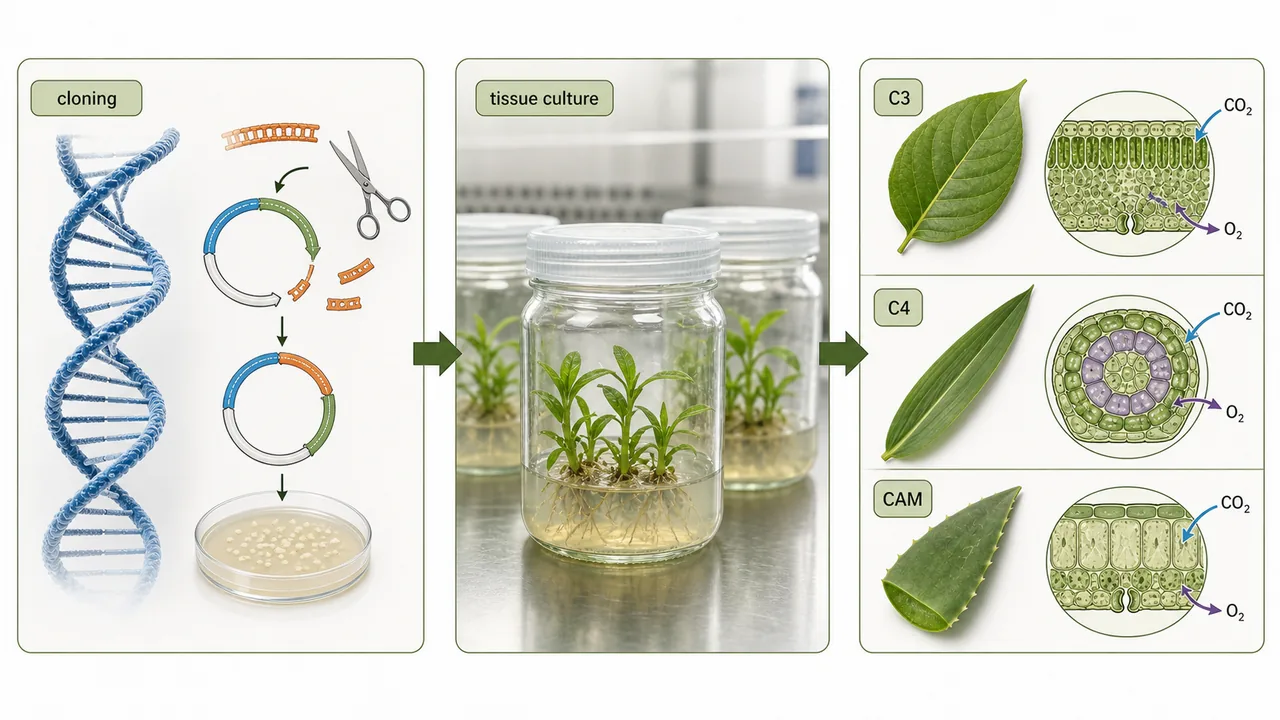
- Photosynthesis: C3, C4, and CAM pathways
- Nitrate assimilation
- Biological nitrogen fixation
Molecular Biology and Genetic Engineering
- Characteristics of prokaryotic and eukaryotic organisms
- Differences among fungi, bacteria, mycoplasmas, and viruses
- Physical and chemical basis of heredity
- Chromosome structure
- DNA replication, transcription, and translation
- Genetic code
- Operon concept
- Restriction enzymes and vectors
- Gene cloning and gene transfer
- Transformation, recombination, and heterosis
Plant Tissue Culture and Biotechnology Applications
- Plant cell and tissue culture
- Micro-propagation
- Somaclonal variation
- General applications of biotechnology
- Molecular and immunological techniques
- Concept of bioinformatics
- Genomics and proteomics
Plant/Crop Physiology
- Seed germination, viability, and vigour
- Importance of plant physiology in agriculture
- Significance of C3, C4, and CAM pathway
- Photorespiration and its implications
- Translocation of assimilates
- Dry matter partitioning
- Harvest index of crops
- Growth analysis
- Crop-water relationship
- Plant nutrients and their functions
- Phytohormones and their physiological role
- Photoperiodism and vernalization
- Pollination and fertilization in flowering plants
- Post-harvest physiology and its significance
Exam-Focused High-Yield Areas
| Area | Why it matters in Code 01 prep |
|---|---|
| Glycolysis, TCA, ETC | Repeatedly tested as core biochemistry pathways |
| DNA replication, transcription, translation | High-frequency direct theory zone |
| Restriction enzymes, vectors, gene cloning | Central biotechnology toolkit area |
| Operon concept and genetic code | Classic MCQ territory in molecular biology |
| Plant tissue culture and micro-propagation | Very scoring because definitions and applications are compact |
| C3, C4, CAM and photorespiration | One of the strongest physiology revision zones |
| Phytohormones, photoperiodism, vernalization | High-return plant physiology topics |
| Bioinformatics, genomics, proteomics | Short but easy marks if revised in final rounds |
Quick Reference: What To Revise First
| Area | What to focus on first |
|---|---|
| Biochemistry | Glycolysis, TCA cycle, ETC, enzymes, biomolecules, buffers |
| Molecular Biology | DNA replication, transcription, translation, genetic code, operon concept |
| Biotechnology Tools | Restriction enzymes, vectors, gene cloning, gene transfer, recombination |
| Tissue Culture | Micro-propagation, somaclonal variation, general applications |
| Physiology | C3/C4/CAM, photorespiration, phytohormones, seed vigour, crop-water relations |
| Bioinformatics & Omics | Genomics, proteomics, concept of bioinformatics |
| General Agriculture | NPK deficiency, crop basics, transgenic crops, biofertilizers, crop protection |
Best Books for ICAR JRF Plant Biotechnology
This list follows the same-channel Plant Biotechnology topper video and maps the named books to the JRF Plant Biotechnology syllabus.
| Book | Best use in the syllabus |
|---|---|
| Genetics — B. D. Singh | Good for genetics foundations inside the paper |
| Expanding Horizons of Genetics — B. D. Singh | Useful for extended genetics coverage and concept strengthening |
| Biochemistry — Lehninger | Best for biochemistry pathways and biomolecules |
| Plant Physiology — V. K. Jain | Good for plant physiology with an exam-friendly approach |
| Plant Physiology — Pandey & Sinha | Useful as a second source for physiology basics and revision |
| CSIR-JRF-NET Life Sciences Fundamentals and Practice, Part I & II | Good for broad life-science support and MCQ-style revision |
| Microbiology — Pelczar, Chan & Krieg | Best for microbiology support topics |
| Genetics: A Conceptual Approach — Benjamin A. Pierce | Useful for extra genetics clarity |
| Gene Cloning and DNA Analysis — T. A. Brown | Best for molecular tools, cloning, and DNA analysis |
| Life Science Fundamentals and Practice I & II — Pathfinder Academy | Used in the topper recommendation for extra coverage and revision |
| Minimal rank-oriented plan | Biochemistry — Lehninger, Plant Physiology — V. K. Jain, Genetics — B. D. Singh, and Gene Cloning and DNA Analysis — T. A. Brown + PYQs |
How To Prepare The General Agriculture Layer Efficiently With AgriDots
For plant- and agriculture-heavy JRF groups, the common agriculture base is explicit in the official syllabus itself. That is clear in groups such as Agronomy, Soil Science, Horticulture, Entomology, Plant Science, Plant Biotechnology, Social Sciences, and Water Science & Technology. In the animal, dairy, fisheries, food, engineering, forestry, community-science, and statistics groups, the same layer still improves scores because objective papers reward candidates who can quickly eliminate options using basic knowledge of crops, soils, schemes, extension, economics, statistics, and current agriculture.
So the practical rule is simple: do not prepare your subject in isolation. Keep one common-agriculture revision layer active throughout your JRF preparation.
Shared Books For The Common Agriculture Layer
| Book | Best use in common JRF preparation |
|---|---|
| Fundamentals of Agriculture, Vol. 1 & 2 — Arun Katyayan | Best base book for crop production, soils, nutrient deficiency, plant biology, genetics, pests, diseases, and agriculture basics |
| A Competitive Book of Agriculture — Nem Raj Sunda | Best for objective revision once the basic theory is already clear |
| Objective Agriculture for JRF Exam — S. R. Kantwa | Useful for MCQ drilling, recall speed, and mixed-agriculture practice |
| General Agriculture for ICAR Examinations — Muniraj Singh Rathore | Good backup book for one-line revision and broad competitive coverage |
Why AgriDots Is More Efficient Than Reading Books Alone
| Use AgriDots for | Why it is faster than books alone |
|---|---|
| Shared Agriculture Course | It compresses the overlapping JRF base into linked notes across agronomy, soil science, horticulture, genetics, pathology, entomology, economics, extension, animal husbandry, fisheries, ecology, and agricultural statistics instead of forcing you to extract overlap manually from multiple standard books |
| Topic-Wise Agriculture Practice Tests | You can revise chapter by chapter immediately after reading instead of waiting until one full book is complete |
| Agriculture Test Series | Mixed-subject Revision Warrior quizzes train recall across subjects, which is closer to how objective papers actually feel |
| Agriculture Current Affairs Hub | Books do not stay current on MSP, schemes, production reports, fertilizer policy, dairy/fisheries updates, or digital-agriculture changes |
Efficient JRF Workflow With AgriDots
- Read one main subject book for your core discipline and keep the rest of the books as support, not as parallel first reads.
- Use /courses/agriculture to finish the overlapping general-agriculture layer faster than building notes from multiple books.
- After each topic, solve topic-wise quizzes so weak areas become visible immediately.
- Use Revision Warrior mixed tests to train switching between crop, soil, genetics, economics, extension, and current-affairs questions.
- Use agriculture-current-affairs every week so your static preparation stays updated with schemes, policy, production, and report-based questions.
Why this works better than books alone: standard books build depth, but they are slow, repetitive across subjects, and weak on current agriculture. AgriDots is better for speed, revision order, topic linking, and exam-style recall, while books remain your depth source.
Preparation Strategy
- First stabilize biochemistry pathways and molecular biology flow, because they create the most direct questions.
- Revise gene cloning, vectors, and restriction enzymes as one toolkit block instead of isolated facts.
- Keep tissue culture, bioinformatics, and omics for short high-return revision rounds.
- Study plant physiology through comparisons: C3 vs C4 vs CAM, hormones vs responses, germination vs vigour.
- Use PYQs to classify each question as biochemistry, molecular biology, biotechnology application, or physiology before revision planning.
Lesson Doubts
Ask questions, get expert answers