ICAR JRF Social Sciences Syllabus 2026 — Code 06 Unit-wise Topics
Complete ICAR JRF Social Sciences syllabus 2026 — Code 06 unit-wise topics for agricultural economics, agricultural finance, extension education, communication, rural development, and statistics.
ICAR JRF Social Sciences Syllabus 2026 — Code 06
Major Subject Group: Social Sciences
Sub-Subjects: 6.1 Agricultural Economics · 6.2 Agricultural Extension Education
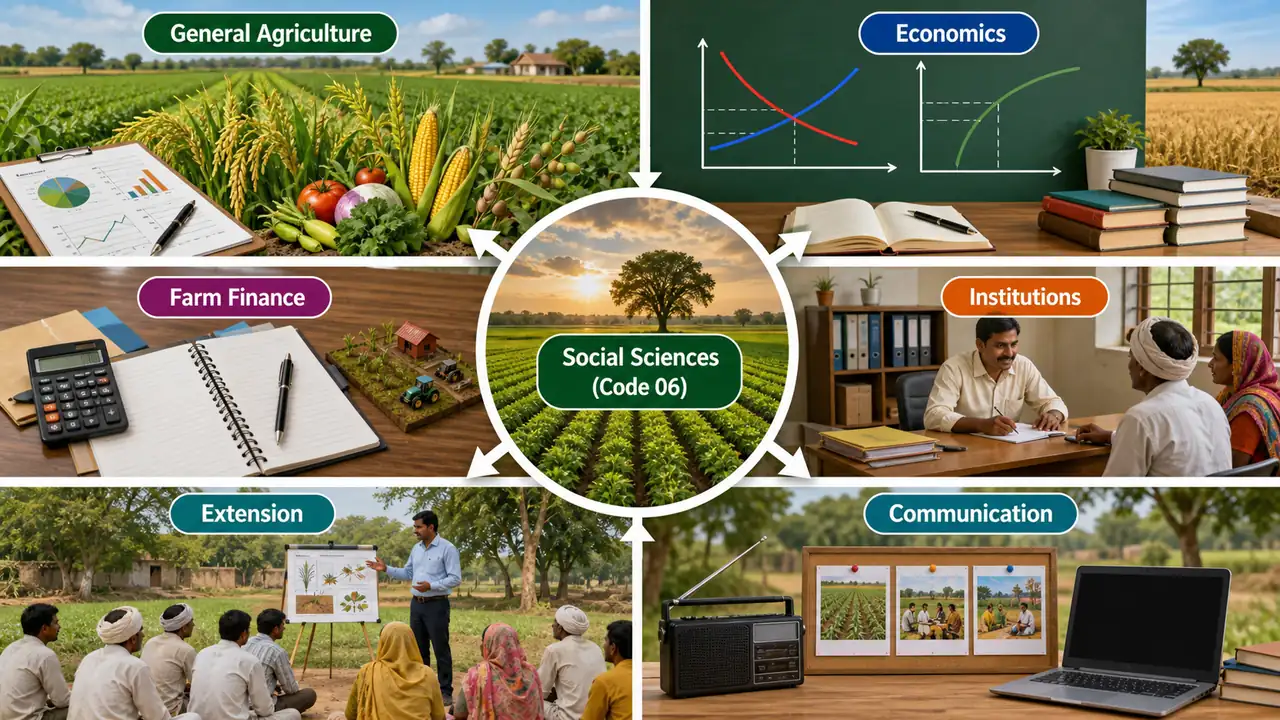
This is the complete syllabus page for ICAR JRF Social Sciences (Code 06). The paper is not only theory from agricultural economics. It is an integrated paper built around general agriculture and statistics, micro and macro economics, farm management, agricultural finance, extension education, rural development, and communication systems.
Exam Snapshot
| Parameter | Details |
|---|---|
| Subject Code | 06 — Social Sciences |
| Subject Group | Major Subject Group: Social Sciences |
| Total Questions | 120 MCQs |
| Duration | 2 Hours |
| Marking Scheme | +4 per correct answer |
| Negative Marking | -1/3 per wrong answer |
| Question Type | Multiple Choice (Single correct) |
| Medium | English |
Latest Official Notification Details
| Parameter | 2026-27 Official Detail |
|---|---|
| Notice Date | 08 May 2026 |
| Application Window | 08 May 2026 to 07 June 2026 (up to 5:00 PM) |
| Fee Payment Deadline | 07 June 2026 (up to 11:50 PM) |
| Correction Window | 09 June to 10 June 2026 |
| Exam Date | 04 July 2026 (Saturday) |
| Mode | Computer Based Test (CBT) |
| Pattern | Objective type MCQs |
| Medium | English only |
| Duration | 02 hours (120 minutes) |
| Test Cities | Around 122 cities across India |
| Source | NTA 2026 Public Notice PDF · ICAR Syllabus PDF |

What Is Officially Fixed For Code 06
- Code 06 is the official major subject group for Social Sciences in AICE JRF/SRF (Ph.D.).
- The paper is conducted in English only, in CBT mode, for 120 minutes.
- The official syllabus groups the paper around Agricultural Economics and Agricultural Extension Education, along with the common agriculture-statistics base.
- NTA publishes the exam notice, schedule, mode, duration, and application timeline, but it does not publish official chapter-wise weightage for Social Sciences.
- The high-yield areas and revision priorities below are therefore exam guidance, not an official NTA marks-distribution sheet.
Unit-I: General Agriculture and Statistics Base
This common unit creates the baseline for Code 06. Students from economics-heavy backgrounds often under-revise it, but it can still decide accuracy and rank.
Agriculture and Crop Production
- Importance of agriculture in national economy
- Basic principles of crop production
- Cultivation of rice, wheat, chickpea, pigeon-pea, sugarcane, groundnut, tomato, and mango
Soil, Nutrition, and Biology
- Major soils of India
- Role of NPK nutrients and their deficiency symptoms
- Structure and function of cell organelles
- Mitosis and meiosis
- Mendelian genetics
- Elementary knowledge of photosynthesis, respiration, and transpiration
- Structure and functions of carbohydrates, proteins, nucleic acids, enzymes, and vitamins
Crop Protection and Rural Systems
- Major pests and diseases of rice, wheat, cotton, chickpea, and sugarcane with management basics
- Important rural development programmes in India
- Organisational setup of agricultural research, education, and extension in India
Statistics
- Elements of statistics
- Measures of central tendency and dispersion
- Regression and correlation
- Concept of probability
- Sampling techniques
- Tests of significance
Unit-II: Agricultural Economics
This is one of the strongest scoring zones because paper setters can turn almost every line into direct concept-based MCQs.
Consumer, Demand, and Production Theory
- Theory of consumer behaviour
- Theory of demand
- Elasticity of demand
- Indifference curve analysis
- Theory of firm
- Cost curves
- Theory of supply
- Price determination
- Market classification
Macroeconomic Base
- Concept of macroeconomics
- Money and banking
- National income
Agricultural Marketing and Policy
- Agricultural marketing: role, practices, institutions, problems, and reforms
- Role of capital and credit in agriculture
- Crop insurance
- Credit institutions and cooperatives
- Capital formation in agriculture
- Agrarian reforms
- Globalization
- WTO and its impact on Indian agriculture
Unit-III: Farm Management and Agricultural Finance
This section usually produces applied MCQs because it mixes farm-level decision tools with finance concepts and institutional credit.
Farm Management
- Basic principles of farm management
- Concept of farming system and economics of farming systems
- Agricultural production economics: scope and analysis
- Factor-product relationship
- Marginal cost and marginal revenue
- Farm planning and budgeting
Agricultural Finance
- Nature and scope of agricultural finance
- Time value of money: compounding and discounting
- Agricultural credit: meaning, definition, need, and classification
- Credit analysis: 4R's, 5C's, and 7P's of credit
- Repayment plans
Banking and Credit Institutions
- History of financing agriculture in India
- Commercial banks
- Nationalization of commercial banks
- Lead bank scheme
- Regional rural banks
- Scale of finance
- Higher financing agencies: RBI, NABARD, AFC, Asian Development Bank, and World Bank
- Role of capital and credit in agriculture
- Credit institutions, cooperatives, and agrarian reforms in India
Unit-IV: Extension Education
This part is usually underestimated by economics-focused students, but it gives many direct recall and concept-application questions.
Concepts and Programme Planning
- Extension education: concept, meaning, principles, philosophy, scope, and importance
- Extension programme planning and evaluation: steps and principles
- Models of organizing agricultural extension
- Historical development of extension in USA, Japan, and India
Rural Development and Sociology
- Rural development: meaning, importance, and problems
- Rural development programmes in India from pre-independence era to recent ones
- Definition and concept of sociology
- Differences between rural and urban communities
- Social stratification, social groups, social organization, and social change
- Rural leadership
Educational Psychology and Community Systems
- Learning and teaching
- Role of personality in agricultural extension
- Indian rural system: characteristics, value system, caste and class
- Structure and customs
- Rural group organization
- Adult education
Unit-V: Communication
- Principles, concepts, process, elements, and barriers of communication
- Different kinds of communication methods and media
- Audio-visual aids and materials
- Media mix and campaign
- Cyber extension: internet, cybercafe, Kisan Call Centers, teleconferencing
- Agricultural journalism
- Diffusion and adoption of innovations
- Adopter categories
- Capacity building of extension personnel and farmers
- Training to farmers, women, and rural youth
Exam-Focused High-Yield Areas
| Area | Why it matters in Social Sciences prep |
|---|---|
| Demand, elasticity, and indifference curves | These are classic theory-to-MCQ areas and often appear in direct concept questions |
| Agricultural marketing, WTO, and reforms | High-return policy area because it links economics with current institutional understanding |
| Farm planning, budgeting, and production economics | Repeatedly important because they convert basic theory into applied reasoning |
| Agricultural finance and credit analysis | 4R's, 5C's, 7P's, repayment plans, and institutional finance are reliable scoring areas |
| RBI, NABARD, RRBs, and cooperative structure | Easy question-setter zone for institution-role matching and finance recall |
| Extension philosophy, programme planning, and teaching methods | Strong factual block for direct recall questions |
| Communication models, diffusion, and adopter categories | Very exam-friendly because terms are short, comparable, and easy to test |
| Statistics basics | Correlation, regression, sampling, and central tendency can create fast-scoring MCQs |
Quick Reference: What To Revise First
| Area | What to revise first |
|---|---|
| Agricultural Economics | Demand, elasticity, indifference curves, supply, price determination, market classification |
| Marketing and Policy | Agricultural marketing, reforms, crop insurance, globalization, WTO |
| Farm Management and Finance | Farming systems, budgeting, factor-product relation, time value of money, credit principles |
| Institutions | RBI, NABARD, commercial banks, RRBs, cooperatives, lead bank scheme |
| Extension Education | Principles, programme planning, evaluation, rural leadership, sociology basics |
| Communication | Communication process, barriers, AV aids, cyber extension, diffusion and adoption |
| Statistics | Measures of central tendency, dispersion, correlation, regression, sampling, significance tests |
| General Agriculture | Major crops, soils, NPK deficiency, pests and diseases, rural development programmes |
Best Books for ICAR JRF Social Sciences
This list follows the same-channel Social Science topper video and the channel’s Agricultural Economics + Agricultural Extension booklist videos.
| Book | Best use in the syllabus |
|---|---|
| Extension Education — A. A. Reddy / Adivi Reddy | Best for extension education, programme planning, and teaching methods |
| Extension Communication and Management — G. L. Ray | Best for communication, extension management, and communication-process topics |
| A Text Book of Agricultural Communication — A. S. Sandhu | Useful for communication models, barriers, media, and message design |
| MCQs in Agricultural Extension — Sunil V. G. | Best for extension MCQ practice |
| Instant Extension Education — Shruti | Good for quick extension revision |
| Agricultural Economics — S. Subba Reddy, P. Raghu Ram & T. V. Neelakanta Sastry | Best for core agricultural economics |
| Elementary Economic Theory — K. K. Dewett & J. D. Varma | Useful for economic theory basics |
| Agricultural Marketing in India — S. S. Acharya & N. L. Agarwal | Best for marketing, institutions, and market reform topics |
| Economics of Farm Production and Management — V. T. Raju | Best for farm management and production economics |
| Objective Agricultural Economics — K. N. Ravi Kumar | Best for economics MCQ practice |
| Agricultural Finance — Subba Reddy | Useful for agricultural finance and institutional credit |
| Research Methodology — C. R. Kothari | Good for research-method and methodology questions |
| Minimal rank-oriented plan | Extension Education — Adivi Reddy, Agricultural Economics — Subba Reddy et al., Agricultural Marketing in India — Acharya & Agarwal, and Economics of Farm Production and Management — V. T. Raju + PYQs |
How To Prepare The General Agriculture Layer Efficiently With AgriDots
For plant- and agriculture-heavy JRF groups, the common agriculture base is explicit in the official syllabus itself. That is clear in groups such as Agronomy, Soil Science, Horticulture, Entomology, Plant Science, Plant Biotechnology, Social Sciences, and Water Science & Technology. In the animal, dairy, fisheries, food, engineering, forestry, community-science, and statistics groups, the same layer still improves scores because objective papers reward candidates who can quickly eliminate options using basic knowledge of crops, soils, schemes, extension, economics, statistics, and current agriculture.
So the practical rule is simple: do not prepare your subject in isolation. Keep one common-agriculture revision layer active throughout your JRF preparation.
Shared Books For The Common Agriculture Layer
| Book | Best use in common JRF preparation |
|---|---|
| Fundamentals of Agriculture, Vol. 1 & 2 — Arun Katyayan | Best base book for crop production, soils, nutrient deficiency, plant biology, genetics, pests, diseases, and agriculture basics |
| A Competitive Book of Agriculture — Nem Raj Sunda | Best for objective revision once the basic theory is already clear |
| Objective Agriculture for JRF Exam — S. R. Kantwa | Useful for MCQ drilling, recall speed, and mixed-agriculture practice |
| General Agriculture for ICAR Examinations — Muniraj Singh Rathore | Good backup book for one-line revision and broad competitive coverage |
Why AgriDots Is More Efficient Than Reading Books Alone
| Use AgriDots for | Why it is faster than books alone |
|---|---|
| Shared Agriculture Course | It compresses the overlapping JRF base into linked notes across agronomy, soil science, horticulture, genetics, pathology, entomology, economics, extension, animal husbandry, fisheries, ecology, and agricultural statistics instead of forcing you to extract overlap manually from multiple standard books |
| Topic-Wise Agriculture Practice Tests | You can revise chapter by chapter immediately after reading instead of waiting until one full book is complete |
| Agriculture Test Series | Mixed-subject Revision Warrior quizzes train recall across subjects, which is closer to how objective papers actually feel |
| Agriculture Current Affairs Hub | Books do not stay current on MSP, schemes, production reports, fertilizer policy, dairy/fisheries updates, or digital-agriculture changes |
Efficient JRF Workflow With AgriDots
- Read one main subject book for your core discipline and keep the rest of the books as support, not as parallel first reads.
- Use /courses/agriculture to finish the overlapping general-agriculture layer faster than building notes from multiple books.
- After each topic, solve topic-wise quizzes so weak areas become visible immediately.
- Use Revision Warrior mixed tests to train switching between crop, soil, genetics, economics, extension, and current-affairs questions.
- Use agriculture-current-affairs every week so your static preparation stays updated with schemes, policy, production, and report-based questions.
Why this works better than books alone: standard books build depth, but they are slow, repetitive across subjects, and weak on current agriculture. AgriDots is better for speed, revision order, topic linking, and exam-style recall, while books remain your depth source.
Preparation Strategy
- Finish general agriculture plus statistics first so you do not lose easy baseline questions.
- Then do agricultural economics in one sweep: demand, supply, cost, market structure, marketing, and policy.
- Revise farm management and agricultural finance together because many topics overlap in applied questions.
- Keep extension education and communication for a separate revision cycle instead of mixing them randomly with economics.
- Practice PYQs with a strict habit of matching concept + institution + application rather than memorizing isolated definitions.
Lesson Doubts
Ask questions, get expert answers