ICAR JRF Soil Science Syllabus 2026 — Code 03 Unit-wise Topics
Complete ICAR JRF Soil Science syllabus 2026 — Code 03 unit-wise topics for analytical chemistry, soil physics, soil chemistry, clay minerals, fertility, fertilizers, soil biology, classification, pollution, and GIS basics.
ICAR JRF Soil Science Syllabus 2026 — Code 03
Major Subject Group: Physical Science
Sub-Subjects: 3.1 Agro Meteorology · 3.2 Soil Science & Agricultural Chemistry / Soil Conservation & Water Management / Irrigation and Water Management · 3.3 Agricultural Physics · 3.4 Agricultural Chemicals · 3.5 Organic Farming · 3.6 Environmental Science
This is the complete syllabus page for ICAR JRF Soil Science (Code 03). The paper is wider than pure soil science because it blends general agriculture, analytical chemistry, soil physics, soil chemistry, fertility, classification, soil biology, water quality, remote sensing, and environmental science.
Exam Snapshot
| Parameter | Details |
|---|---|
| Subject Code | 03 — Soil Science |
| Subject Group | Major Subject Group: Physical Science |
| Total Questions | 120 MCQs |
| Duration | 2 Hours |
| Marking Scheme | +4 per correct answer |
| Negative Marking | −1/3 per wrong answer |
| Question Type | Multiple Choice (Single correct) |
| Medium | English |
Latest Official Notification Details
| Parameter | 2026-27 Official Detail |
|---|---|
| Notice Date | 08 May 2026 |
| Application Window | 08 May 2026 to 07 June 2026 (up to 5:00 PM) |
| Fee Payment Deadline | 07 June 2026 (up to 11:50 PM) |
| Correction Window | 09 June to 10 June 2026 |
| Exam Date | 04 July 2026 (Saturday) |
| Mode | Computer Based Test (CBT) |
| Pattern | Objective type MCQs |
| Medium | English only |
| Duration | 02 hours (120 minutes) |
| Test Cities | Around 122 cities across India |
| Source | NTA 2026 Public Notice PDF · ICAR Syllabus PDF |

What Is Officially Fixed For Code 03
- Code 03 is the official major subject group used for the Physical Science / Soil Science stream in AICE JRF/SRF (Ph.D.).
- The paper is conducted in English only, in CBT mode, for 120 minutes.
- The official syllabus keeps the paper broad, combining General Agriculture, chemistry and analysis, soil science core, and applied soil science plus environmental coverage.
- NTA publishes the notice, dates, mode, duration, and application timeline, but it does not publish official chapter-wise weightage for Soil Science.
- The high-yield parts below are therefore preparation guidance, not an official marks-distribution table.
Unit-I: General Agriculture & National Perspective
- Importance of agriculture in national perspective
- Basic principles of crop production and diversification
- Package of practices for rice, wheat, sorghum, maize, chickpea, pigeon pea, potato, sugarcane, groundnut, and major vegetable crops
- Role of essential plant nutrients
- Deficiency symptoms and management options
- Structure and function of plant cells and cell division
- Basic plant physiology related to crop production
- Carbohydrates, proteins, enzymes, fats, vitamins, and their functions
- Developmental programmes related to rural upliftment and livelihood security
- Organizational setup of agricultural education, research, and extension
- Future strategies for up-gradation
Unit-II: Chemistry & Analysis
This unit matters because many aspirants underprepare the chemistry side and lose easy marks on direct concept questions.
Analytical Chemistry
- Volumetric and gravimetric analysis including complexometric methods
- Periodic classification of elements
- Basic principle of instrumental analysis
- Spectrophotometry: absorption and emission spectrography
- Atomic structure and elementary radioactivity
- Common ion effect
- Solubility product
- Hydrolysis of salts
- Buffer solution
- Equivalent weights and standard solutions
Organic Chemistry & Agrochemicals
- Elementary concepts of organic compounds and nomenclature
- Hydrocarbons, alcohols, aldehydes, acids, and esters
- Carbohydrates, fats, and lipids
- Amino acids and nucleic acids
- Pesticides: classification and uses
- Biopesticides and botanical pesticides
Unit-III: Soil Science Core
Soil Formation & Soil Profile
- Soil as a medium for plant growth
- Composition of earth’s crust
- Weathering of rocks and minerals
- Components of soil and their importance
- Soil profile and soil particles
- Physical, mineralogical, and chemical nature of soils
Soil Physical Properties
- Mechanical analysis
- Stokes law: assumptions, limitations, and applications
- Density, porosity, texture, and soil structure
- Rheological properties
- Calculations of porosity and bulk density
- Soil temperature: sources and losses of soil heat and factors affecting it
Soil Water
- Structure of water
- Soil-water-energy relationship
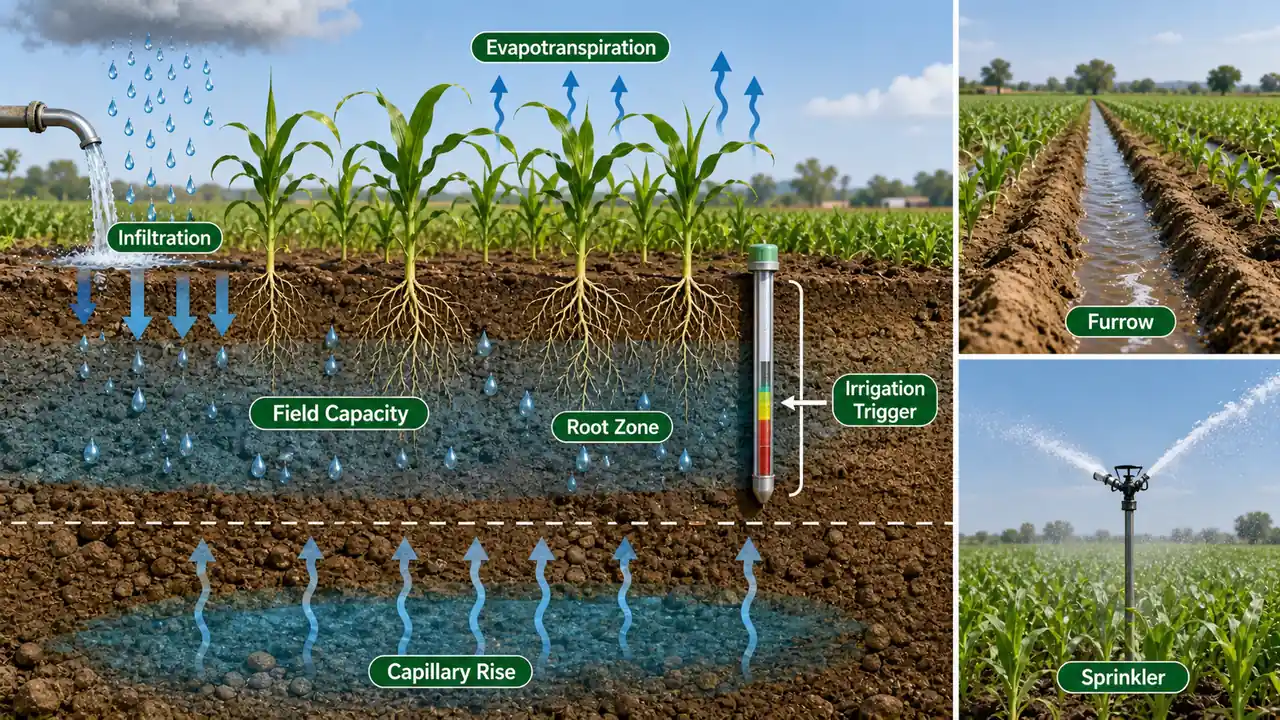
- Classification of soil water
- Surface tension and movement of water in soil
Soil Colloids & Soil Chemistry
- Properties and structure of silicate clay minerals
- Sources of negative charges
- Properties of kaolinite, illite, montmorillonite, and vermiculite
- Milli-equivalent concept
- Cation exchange capacity (CEC) and anion exchange capacity (AEC)
- Buffering of soils
Problem Soils & Irrigation Quality
- Acid, saline, sodic, and acid sulphate soils
- Their characteristics, formation, problems, and management
- Irrigation water quality and its evaluation
- Waterlogged soils and distinction from upland soils
Unit-IV: Plant Nutrients, Fertility & Applied Soil Science
- Criteria of essentiality and nutrient functions in plant growth
- Mechanisms for movement and uptake of ions in soils and plants
- Forms of nutrients in soils
- Deficiency symptoms on plants
- Luxury consumption, nutrient interactions, and chelated micronutrients
- Soil fertility evaluation and management for plant growth
- Soil testing and fertilizer recommendations
- Fertilizers and manures: classification
- NPK fertilizers and their reactions in soils
- Green manuring, recycling of organic wastes, and composting
- Slow-release fertilizers and nitrification inhibitors
- Diagnostic surface and subsurface horizons
- Soil survey: types, objectives, and uses
- Land capability classification
- Remote sensing and its application in agriculture
- GIS, GPS, and related basic uses in agriculture
- Elementary concepts of radio isotopes and uses in agriculture
- Soil microorganisms and their roles
- Organic matter decomposition, C:N ratio, mineralization, and immobilization
- Humus and the role of organic matter in soil quality
- Soil erosion: types and control measures
- Soil and water pollution: sources, pollutants, and management
Exam-Focused High-Yield Areas
| Area | Why it is high-yield in Soil Science prep |
|---|---|
| Soil physical properties | Texture, structure, porosity, density, and water relations are classic direct-question zones |
| Clay minerals, CEC, AEC, buffering | Very strong conceptual block that often appears in statement and match-type MCQs |
| Problem soils | Easy to test through soil type, characteristic, and reclamation measure matching |
| Plant nutrients and deficiency | High-return because the topic bridges soil science with plant response |
| Fertilizers and nutrient reactions | Common exam area for NPK behavior, recommendations, and inhibitors |
| Soil biology and organic matter | Short but reliable source of C:N ratio, humus, mineralization, and microbial-role questions |
| Soil survey and land capability | Repeated revision topic with definitional and applied questions |
| Remote sensing, GIS, GPS, pollution | Smaller block, but easy marks if revised once properly |
Quick Reference: What To Revise First
| Area | What to revise first |
|---|---|
| Soil Physics | Texture, structure, porosity, bulk density, soil temperature, soil water movement |
| Soil Chemistry | Clay minerals, CEC, AEC, buffering, standard solutions, common ion effect |
| Problem Soils | Acid, saline, sodic, acid sulphate, waterlogged soils and their management |
| Plant Nutrition | Essentiality, deficiency symptoms, nutrient interactions, chelated micronutrients |
| Fertility & Fertilizers | Soil testing, fertilizer recommendation, NPK reactions, nitrification inhibitors |
| Soil Biology | Microorganisms, decomposition, C:N ratio, humus, mineralization |
| Survey & Classification | Diagnostic horizons, land capability, survey objectives and uses |
| Applied Tools | Remote sensing, GIS, GPS, pollution basics, radioisotope uses |
Best Books for ICAR JRF Soil Science
This section follows the same-channel Soil Science strategy + ARS Soil Science booklist videos and maps those books to the JRF Soil Science syllabus.
| Book | Best use in the syllabus |
|---|---|
| Introductory Soil Science — D. K. Das | Best starting book for the full JRF Soil Science paper, especially Units on soil basics, properties, and overview revision |
| Text Book of Soil Science — T. D. Biswas & S. K. Mukherjee | Good second core source for soil formation, classification, and general soil science theory |
| Fundamentals of Soil Science — Indian Society of Soil Science | Useful for concept cleanup and objective-style revision across the subject |
| Text Book of Soil Physics — A. K. Saha & Anuradha Saha | Best match for soil physics, water relations, bulk density, porosity, infiltration, and soil moisture topics |
| Environmental Soil Physics — Daniel Hillel | Strong support for advanced soil-water and physical-process understanding |
| Principles of Soil Chemistry — K. H. Tan | Best for soil chemistry, exchange, colloids, CEC, buffering, and reaction concepts |
| The Nature and Properties of Soils — N. C. Brady & R. R. Weil | Broad support book for physics + chemistry + soil interpretation |
| Soil Fertility and Fertilizers — J. L. Havlin, S. L. Tisdale, W. L. Nelson & J. D. Beaton | Best for soil fertility, nutrient availability, fertilizer behavior, and nutrient interactions |
| Fertilizers: A Textbook — R. K. Basak | Useful for fertilizer materials, classification, and fertilizer-use details |
| Manual on Soil, Plant and Water Analysis — P. K. Chhonkar, D. Singh & B. S. Dwivedi | Best for analysis methods, practical chemistry, and lab-oriented questions |
| Methods of Analysis of Soils, Plants, Waters, Fertilisers and Organic Manures — H. L. S. Tandon | Good support for analytical procedures and test-oriented factual recall |
| Soil Science: An Introduction — Indian Society of Soil Science | Good supplementary revision source for introductory topics and unit consolidation |
| Introductory Pedology: Soil Genesis, Survey and Classification — J. Sehgal | Best for pedology, survey, classification, diagnostic horizons, and land capability |
| Soil Survey Manual — NBSS&LUP | Useful for soil survey and classification practice |
| Experiments in Soil Biology and Biochemistry — P. K. Chhonkar, S. Bhadraray, A. K. Patra & T. J. Purakayastha | Best for soil biology, microbes, and biochemical-process support |
| Introduction to Soil Microbiology — Martin Alexander | Good for soil microbiology basics and mineralization / decomposition topics |
| A Textbook of Agricultural Statistics — R. Rangaswamy | Useful for statistics support where the paper touches analysis and interpretation |
| Minimal rank-oriented plan | Introductory Soil Science — D. K. Das, Text Book of Soil Physics — A. K. Saha & Anuradha Saha, Principles of Soil Chemistry — K. H. Tan, and Soil Fertility and Fertilizers — Havlin et al. + PYQs |
How To Prepare The General Agriculture Layer Efficiently With AgriDots
For plant- and agriculture-heavy JRF groups, the common agriculture base is explicit in the official syllabus itself. That is clear in groups such as Agronomy, Soil Science, Horticulture, Entomology, Plant Science, Plant Biotechnology, Social Sciences, and Water Science & Technology. In the animal, dairy, fisheries, food, engineering, forestry, community-science, and statistics groups, the same layer still improves scores because objective papers reward candidates who can quickly eliminate options using basic knowledge of crops, soils, schemes, extension, economics, statistics, and current agriculture.
So the practical rule is simple: do not prepare your subject in isolation. Keep one common-agriculture revision layer active throughout your JRF preparation.
Shared Books For The Common Agriculture Layer
| Book | Best use in common JRF preparation |
|---|---|
| Fundamentals of Agriculture, Vol. 1 & 2 — Arun Katyayan | Best base book for crop production, soils, nutrient deficiency, plant biology, genetics, pests, diseases, and agriculture basics |
| A Competitive Book of Agriculture — Nem Raj Sunda | Best for objective revision once the basic theory is already clear |
| Objective Agriculture for JRF Exam — S. R. Kantwa | Useful for MCQ drilling, recall speed, and mixed-agriculture practice |
| General Agriculture for ICAR Examinations — Muniraj Singh Rathore | Good backup book for one-line revision and broad competitive coverage |
Why AgriDots Is More Efficient Than Reading Books Alone
| Use AgriDots for | Why it is faster than books alone |
|---|---|
| Shared Agriculture Course | It compresses the overlapping JRF base into linked notes across agronomy, soil science, horticulture, genetics, pathology, entomology, economics, extension, animal husbandry, fisheries, ecology, and agricultural statistics instead of forcing you to extract overlap manually from multiple standard books |
| Topic-Wise Agriculture Practice Tests | You can revise chapter by chapter immediately after reading instead of waiting until one full book is complete |
| Agriculture Test Series | Mixed-subject Revision Warrior quizzes train recall across subjects, which is closer to how objective papers actually feel |
| Agriculture Current Affairs Hub | Books do not stay current on MSP, schemes, production reports, fertilizer policy, dairy/fisheries updates, or digital-agriculture changes |
Efficient JRF Workflow With AgriDots
- Read one main subject book for your core discipline and keep the rest of the books as support, not as parallel first reads.
- Use /courses/agriculture to finish the overlapping general-agriculture layer faster than building notes from multiple books.
- After each topic, solve topic-wise quizzes so weak areas become visible immediately.
- Use Revision Warrior mixed tests to train switching between crop, soil, genetics, economics, extension, and current-affairs questions.
- Use agriculture-current-affairs every week so your static preparation stays updated with schemes, policy, production, and report-based questions.
Why this works better than books alone: standard books build depth, but they are slow, repetitive across subjects, and weak on current agriculture. AgriDots is better for speed, revision order, topic linking, and exam-style recall, while books remain your depth source.
Preparation Strategy
- Finish soil physics + soil chemistry core first because they anchor the whole paper.
- Then revise problem soils, nutrients, fertilizers, and fertility evaluation as one connected block.
- Do analytical chemistry separately in short rounds so formulas and definitions stay fresh.
- Keep soil biology, survey, GIS/GPS, and pollution for fast scoring revision rounds.
- Practice PYQs by tagging each question as physics / chemistry / nutrients / soil problem / biology / survey so weak areas become obvious.
Lesson Doubts
Ask questions, get expert answers