ICAR JRF Statistical Sciences Syllabus 2026 — Code 07 Unit-wise Topics
Complete ICAR JRF Statistical Sciences syllabus 2026 — Code 07 unit-wise topics for agricultural statistics, mathematics, computer applications, and bioinformatics.
ICAR JRF Statistical Sciences Syllabus 2026 — Code 07
Major Subject Group: Statistical Sciences
Sub-Subjects: 7.1 Agricultural Statistics · 7.2 Computer Application · 7.3 Bioinformatics
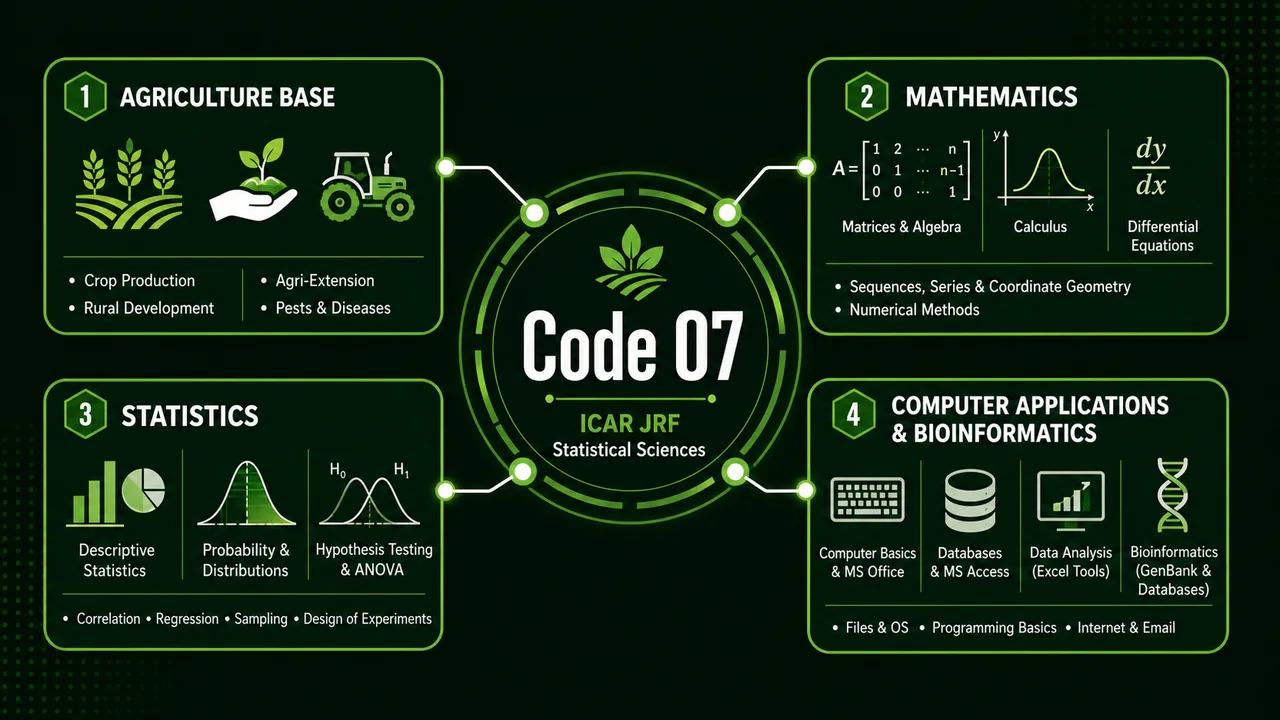
Code 07 is not a pure statistics-only paper. The official syllabus mixes agriculture base, mathematics, statistics, computer applications, and bioinformatics/database basics into one paper.
Exam Snapshot
| Parameter | Details |
|---|---|
| Subject Code | 07 — Statistical Sciences |
| Total Questions | 120 MCQs |
| Duration | 2 Hours |
| Marking Scheme | +4 per correct answer |
| Negative Marking | −1/3 per wrong answer |
| Question Type | Multiple Choice (Single correct) |
| Medium | English |
Latest Official Notification Details
| Parameter | 2026-27 Official Detail |
|---|---|
| Notice Date | 08 May 2026 |
| Application Window | 08 May 2026 to 07 June 2026 (up to 5:00 PM) |
| Fee Payment Deadline | 07 June 2026 (up to 11:50 PM) |
| Correction Window | 09 June to 10 June 2026 |
| Exam Date | 04 July 2026 (Saturday) |
| Mode | Computer Based Test (CBT) |
| Pattern | Objective type MCQs |
| Medium | English only |
| Duration | 02 hours (120 minutes) |
| Source | NTA 2026 Public Notice PDF · ICAR Syllabus PDF |
What Is Officially Fixed For Code 07
- Code 07 is the official major subject group for Statistical Sciences.
- The paper is conducted in English only, in CBT mode, for 120 minutes.
- The official syllabus is divided into four main blocks: agriculture base, mathematics, statistics, and computer application/bioinformatics.
- NTA does not publish official unit-wise weightage for Statistical Sciences.
- So the “high-yield” labels below are a revision framework, not an official NTA chapter distribution.
Unit-I: Agriculture and Research Base
- Importance of agriculture, forestry and livestock in the national economy
- Basic principles of crop production
- Major diseases and pests of crops
- Elementary principles of economics and agri-extension
- Important rural development programmes in India
- Organisational setup of agricultural research, education and extension in India
Unit-II: Mathematics
Algebra and Number Systems
- Real and complex numbers
- Polynomial and roots
- de Moivre’s theorem and applications
- Set theory and De Morgan’s laws
Linear Algebra
- Vector space
- Linear independence
- Orthogonality
- Matrices: addition, multiplication, rank, determinant, inverse
- Solution of system of linear equations
- Characteristic roots and vectors
Sequences, Series and Coordinate Geometry
- Convergence of infinite sequences and infinite series
- Tests for convergence and absolute convergence
- Two-dimensional coordinate geometry: line, circle, parabola, ellipse, hyperbola
Calculus
- Limits and differentiation
- Taylor’s and Maclaurin’s theorems
- Mean value theorem
- Maxima and minima
- Indeterminate forms
- Curvature, asymptotes, tracing of curves
- Partial differentiation
- Homogeneous functions and Euler’s theorem
- Composite functions
- Total derivatives
- Implicit differentiation
- Change of variables and Jacobians
Integral Calculus and Differential Equations
- Standard integrations and simple definite integrals
- Double integrals and change of order
- Gamma and Beta functions
- Area by double integrals
- First-order differential equations
- Exact and Bernoulli’s equations
- Integrating factor methods
- Higher-degree first-order equations
- Clairaut’s equation
- Complementary function and particular integral
Numerical Methods
- Finite differences and interpolation
- Numerical differentiation and integration
- Difference equations
- Newton-Raphson method
Unit-III: Statistics Fundamentals
- Definition, use and limitations of statistics
- Frequency distributions and curves
- Measures of central tendency: arithmetic mean, geometric mean, harmonic mean, median, mode
- Measures of dispersion: range, mean deviation, quartile deviation, variance, coefficient of variation
- Probability: addition law, multiplication law, conditional probability, Bayes’ theorem
- Binomial, multinomial, Poisson and normal distributions
- Introduction to sampling and standard error
- Tests of significance
- Types of errors, null hypothesis, level of significance
- Large-sample test for means
- Student’s t-test: single, two-sample and paired
- F-test
- Chi-square test for goodness of fit and independence of attributes
- Correlation and regression with tests of significance
- Experimental design principles
- Analysis of variance
- Completely Randomized Design (CRD)
- Randomized Block Design (RBD)
Unit-IV: Computer Application and Bioinformatics
- Input and output devices
- Memory, hardware and software
- Booting and classification basics
- Computer viruses, worms and antivirus
- Operating system basics and DOS commands
- Types of files
- Windows desktop, explorer, files and folders
- MS Word basics
- MS Excel spreadsheet creation and editing
- In-built statistical functions in Excel
- Excel data analysis tools
- Correlation, regression, t-test for two samples, one-way ANOVA in Excel
- Creating graphs
- MS PowerPoint and its features
- MS Access and database basics
- Flow charts and algorithms
- Programming languages: BASIC, FORTRAN and C
- World Wide Web, web browsing and electronic mail
- Bioinformatics: NCBI GenBank sequence database, primary and secondary database
Exam-Focused High-Yield Areas
| Area | Why it matters in JRF prep |
|---|---|
| Probability and distributions | Binomial, Poisson, normal, Bayes, and conditional probability are repeat-worthy core topics |
| Central tendency and dispersion | Short, direct, highly objective-friendly topics |
| Hypothesis testing and ANOVA | One of the most standard score-making areas in agricultural statistics |
| Correlation and regression | Frequently asked because they combine concept recall with interpretation |
| Matrices and calculus basics | A common elimination area when students over-focus only on applied statistics |
| Excel-based statistical tools | The syllabus explicitly names Excel correlation, regression, t-test, and ANOVA |
| Bioinformatics database basics | GenBank, primary vs secondary database, and basic computing terms are compact scoring areas |
Quick Reference: What To Revise First
| Area | What to revise first |
|---|---|
| Statistics | Mean, median, mode, dispersion, probability, distributions, hypothesis testing, ANOVA |
| Maths | Matrices, determinants, roots, convergence, derivatives, maxima-minima, integration |
| Numerical Methods | Interpolation, finite differences, Newton-Raphson |
| Computer Applications | Memory, files, DOS commands, MS Excel tools, MS Access basics |
| Bioinformatics | GenBank, primary vs secondary database, internet and data-handling basics |
| Agriculture Base | Crop production, rural development, agri-extension, pests and diseases |
How To Prepare The General Agriculture Layer Efficiently With AgriDots
For plant- and agriculture-heavy JRF groups, the common agriculture base is explicit in the official syllabus itself. That is clear in groups such as Agronomy, Soil Science, Horticulture, Entomology, Plant Science, Plant Biotechnology, Social Sciences, and Water Science & Technology. In the animal, dairy, fisheries, food, engineering, forestry, community-science, and statistics groups, the same layer still improves scores because objective papers reward candidates who can quickly eliminate options using basic knowledge of crops, soils, schemes, extension, economics, statistics, and current agriculture.
So the practical rule is simple: do not prepare your subject in isolation. Keep one common-agriculture revision layer active throughout your JRF preparation.
Shared Books For The Common Agriculture Layer
| Book | Best use in common JRF preparation |
|---|---|
| Fundamentals of Agriculture, Vol. 1 & 2 — Arun Katyayan | Best base book for crop production, soils, nutrient deficiency, plant biology, genetics, pests, diseases, and agriculture basics |
| A Competitive Book of Agriculture — Nem Raj Sunda | Best for objective revision once the basic theory is already clear |
| Objective Agriculture for JRF Exam — S. R. Kantwa | Useful for MCQ drilling, recall speed, and mixed-agriculture practice |
| General Agriculture for ICAR Examinations — Muniraj Singh Rathore | Good backup book for one-line revision and broad competitive coverage |
Why AgriDots Is More Efficient Than Reading Books Alone
| Use AgriDots for | Why it is faster than books alone |
|---|---|
| Shared Agriculture Course | It compresses the overlapping JRF base into linked notes across agronomy, soil science, horticulture, genetics, pathology, entomology, economics, extension, animal husbandry, fisheries, ecology, and agricultural statistics instead of forcing you to extract overlap manually from multiple standard books |
| Topic-Wise Agriculture Practice Tests | You can revise chapter by chapter immediately after reading instead of waiting until one full book is complete |
| Agriculture Test Series | Mixed-subject Revision Warrior quizzes train recall across subjects, which is closer to how objective papers actually feel |
| Agriculture Current Affairs Hub | Books do not stay current on MSP, schemes, production reports, fertilizer policy, dairy/fisheries updates, or digital-agriculture changes |
Efficient JRF Workflow With AgriDots
- Read one main subject book for your core discipline and keep the rest of the books as support, not as parallel first reads.
- Use /courses/agriculture to finish the overlapping general-agriculture layer faster than building notes from multiple books.
- After each topic, solve topic-wise quizzes so weak areas become visible immediately.
- Use Revision Warrior mixed tests to train switching between crop, soil, genetics, economics, extension, and current-affairs questions.
- Use agriculture-current-affairs every week so your static preparation stays updated with schemes, policy, production, and report-based questions.
Why this works better than books alone: standard books build depth, but they are slow, repetitive across subjects, and weak on current agriculture. AgriDots is better for speed, revision order, topic linking, and exam-style recall, while books remain your depth source.
Preparation Strategy
- Finish the agriculture base quickly so it does not keep stealing marks from a statistics candidate.
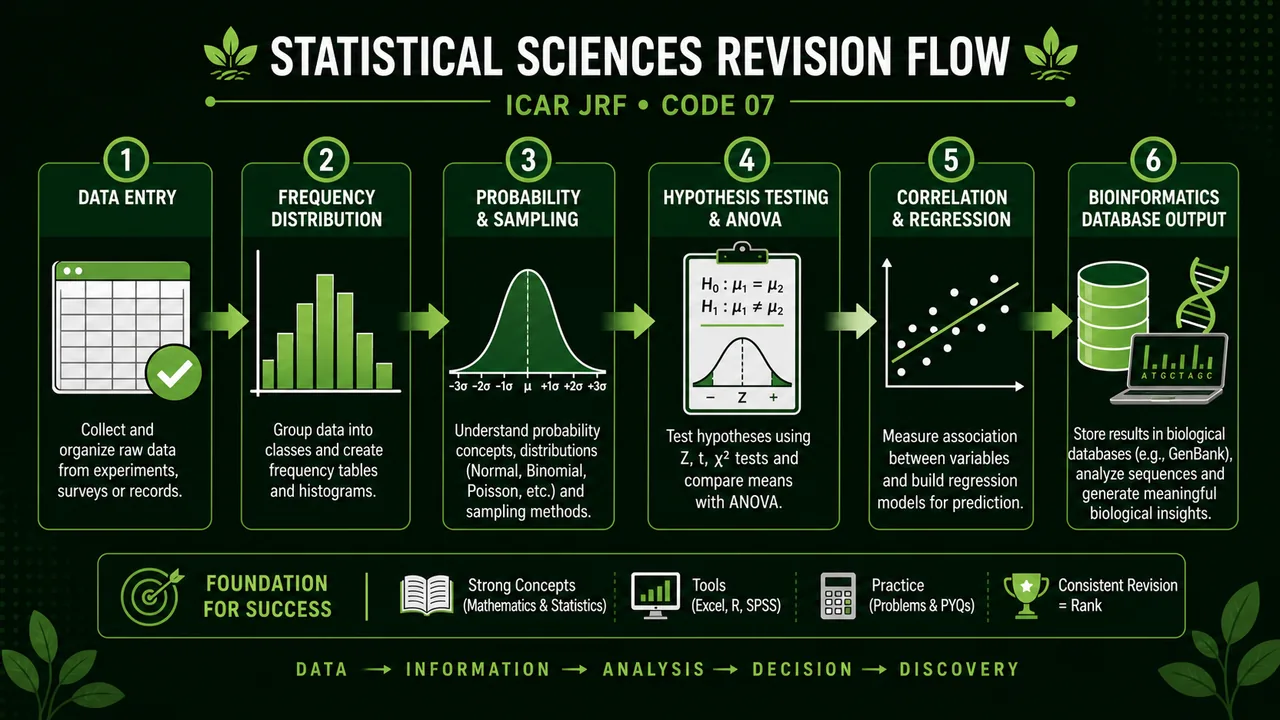
- Build the paper around probability, distributions, testing, ANOVA, and regression first.
- Revise matrices, calculus, and numerical methods in a separate short daily block.
- Do not ignore Excel and computer applications because the official syllabus names them directly.
- Keep one compact note page for GenBank, primary vs secondary database, DOS commands, and Excel tools.
Syllabus-Wise Best Books
This list is aligned to the same-channel Agricultural Statistics / Computer Applications references that appear across the channel’s ARS and JRF-oriented material.
| Book | Best use in the syllabus |
|---|---|
| A Text Book of Agricultural Statistics — R. Rangaswamy | Best starting book for agricultural statistics, sampling, hypothesis testing, and experimental design |
| Agriculture and Applied Statistics, Vol. I & II — P. K. Sahu & A. K. Das | Useful for applied agriculture-linked statistics practice |
| Fundamentals of Mathematical Statistics — S. C. Gupta & V. K. Kapoor | Best for probability, distributions, estimation, and statistical theory |
| Computer Organization and Architecture — M. Morris Mano | Useful for computer applications basics |
| Introduction to Algorithms — Thomas H. Cormen et al. | Support for algorithm and logical-computing foundations |
| Data Structures Using C — Andrew S. Tanenbaum | Useful for data-structure support topics |
| Software Engineering: A Practitioner’s Approach — Roger S. Pressman | Useful for software engineering basics |
| Data Communications and Networking — Behrouz A. Forouzan | Useful for networking and computer-application support |
| Operating System Concepts — Abraham Silberschatz, Peter B. Galvin & Greg Gagne | Useful for operating-system basics |
| Compilers: Principles, Techniques, and Tools — Aho, Lam, Sethi & Ullman | Useful for compiler concepts |
| Fundamentals of Database Systems — Elmasri & Navathe | Best for database basics |
| Introduction to Bioinformatics — Arthur M. Lesk | Useful for bioinformatics foundations, databases, and sequence-oriented basics |
| Minimal rank-oriented plan | A Text Book of Agricultural Statistics — R. Rangaswamy, Fundamentals of Mathematical Statistics — S. C. Gupta & V. K. Kapoor, Fundamentals of Database Systems — Elmasri & Navathe, and Introduction to Bioinformatics — Arthur M. Lesk + PYQs |
Lesson Doubts
Ask questions, get expert answers