🎯 MIDH & Horticulture Missions
Mission for Integrated Development of Horticulture — sub-schemes, funding patterns, CHAMAN, HORTNET, and cost norms
India is the second-largest producer of fruits and vegetables globally. To bring all horticulture-related schemes under one roof, the government launched the Mission for Integrated Development of Horticulture (MIDH).
Mission for Integrated Development of Horticulture (MIDH)
MIDH was launched on 1 April 2014 as a Centrally Sponsored Scheme under the Ministry of Agriculture & Farmers' Welfare. It subsumed several earlier horticulture schemes into a single umbrella mission.
Key objectives:
- Promote holistic growth of the horticulture sector
- Improve productivity through R&D and technology
- Strengthen post-harvest management & marketing infrastructure
- Support skill development and employment generation
Funding Pattern
| Category | Centre Share | State Share |
|---|---|---|
| General States | 60% | 40% |
| NE & Himalayan States | 90% | 10% |
| Union Territories | 100% | 0% |
TIP
The 60:40 and 90:10 funding pattern is common across most Centrally Sponsored Schemes launched after the 14th Finance Commission (2015). Remember this as the standard CSS funding ratio.
Pro Content Locked
Upgrade to Pro to access this lesson and all other premium content.
₹99 charged monthly · Cancel anytime
- All Agriculture & Banking Courses
- AI Lesson Questions (100/day)
- AI Doubt Solver (50/day)
- Glows & Grows Feedback (30/day)
- AI Section Quiz (20/day)
- 22-Language Translation (100/day)
- Recall Questions (20/day)
- AI Quiz (15/day)
- AI Quiz Paper Analysis (100/day)
- AI Step-by-Step Explanations (100/day)
- Spaced Repetition Recall (FSRS)
- AI Tutor
- Immersive Text Questions
- Audio Lessons — Hindi & English
- Mock Tests & Previous Year Papers
- Summary & Mind Maps
- XP, Levels, Leaderboard & Badges
- Generate New Classrooms
- Voice AI Teacher (AgriDots Live)
- AI Revision Assistant
- Knowledge Gap Analysis
- Interactive Revision (LangGraph)
🔒 Secure via Razorpay · Cancel anytime · No hidden fees
India is the second-largest producer of fruits and vegetables globally. To bring all horticulture-related schemes under one roof, the government launched the Mission for Integrated Development of Horticulture (MIDH).
Mission for Integrated Development of Horticulture (MIDH)
MIDH was launched on 1 April 2014 as a Centrally Sponsored Scheme under the Ministry of Agriculture & Farmers' Welfare. It subsumed several earlier horticulture schemes into a single umbrella mission.
Key objectives:
- Promote holistic growth of the horticulture sector
- Improve productivity through R&D and technology
- Strengthen post-harvest management & marketing infrastructure
- Support skill development and employment generation
Funding Pattern
| Category | Centre Share | State Share |
|---|---|---|
| General States | 60% | 40% |
| NE & Himalayan States | 90% | 10% |
| Union Territories | 100% | 0% |
TIP
The 60:40 and 90:10 funding pattern is common across most Centrally Sponsored Schemes launched after the 14th Finance Commission (2015). Remember this as the standard CSS funding ratio.
30% of the MIDH budget is earmarked for women beneficiaries — a frequently asked fact in exams.
Sub-Schemes under MIDH
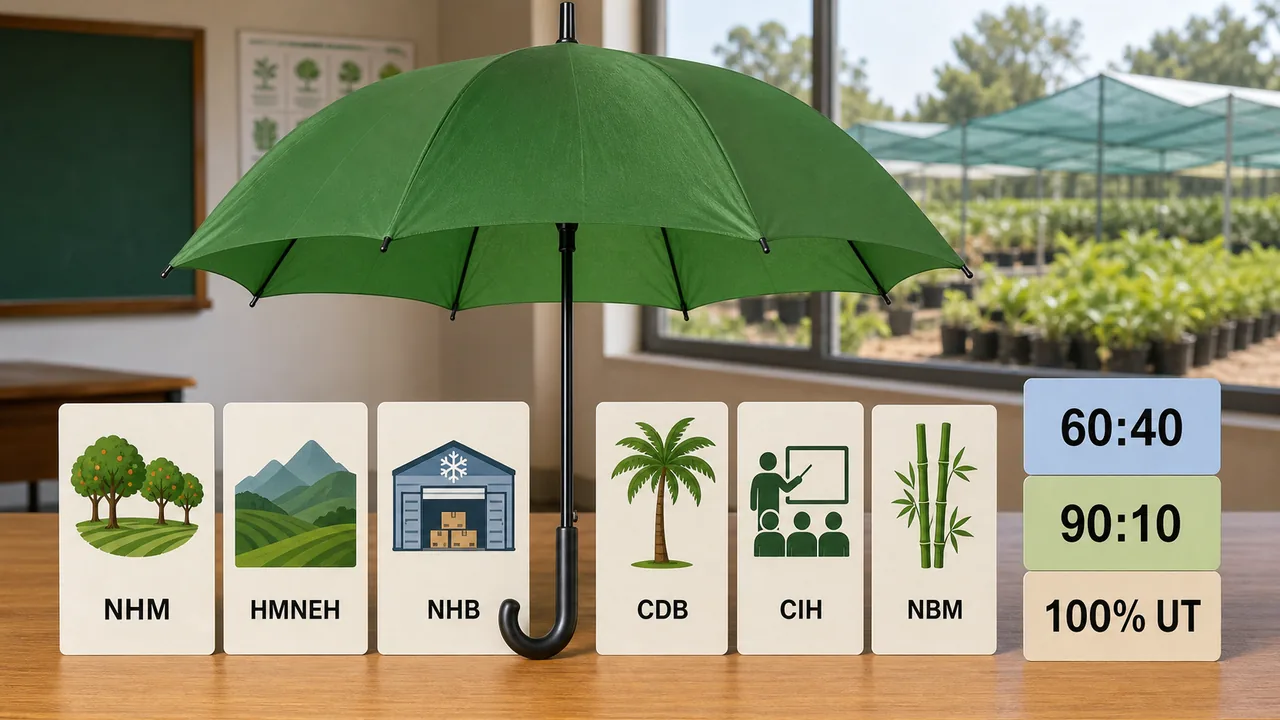
MIDH integrates 6 sub-schemes:
| Sub-Scheme | Full Name | Focus Area |
|---|---|---|
| NHM | National Horticulture Mission | Horticulture development in identified districts (all states except NE) |
| HMNEH | Horticulture Mission for NE & Himalayan States | NE states, J&K, Himachal Pradesh, Uttarakhand |
| NHB | National Horticulture Board | Commercial horticulture development, cold storage |
| CDB | Coconut Development Board | Coconut sector development & technology mission |
| CIH | Central Institute of Horticulture | Training & capacity building (Nagaland) |
| NBM | National Bamboo Mission | Bamboo plantation, value addition & marketing |
NOTE
NHM covers all states except the NE & Himalayan region. HMNEH exclusively covers the northeastern and Himalayan states — this distinction is important for exam questions.
NHM Cost Norms
NHM provides assistance at specific cost norms for various horticulture activities:
Nursery Development
| Activity | Cost Norm | Government Assistance |
|---|---|---|
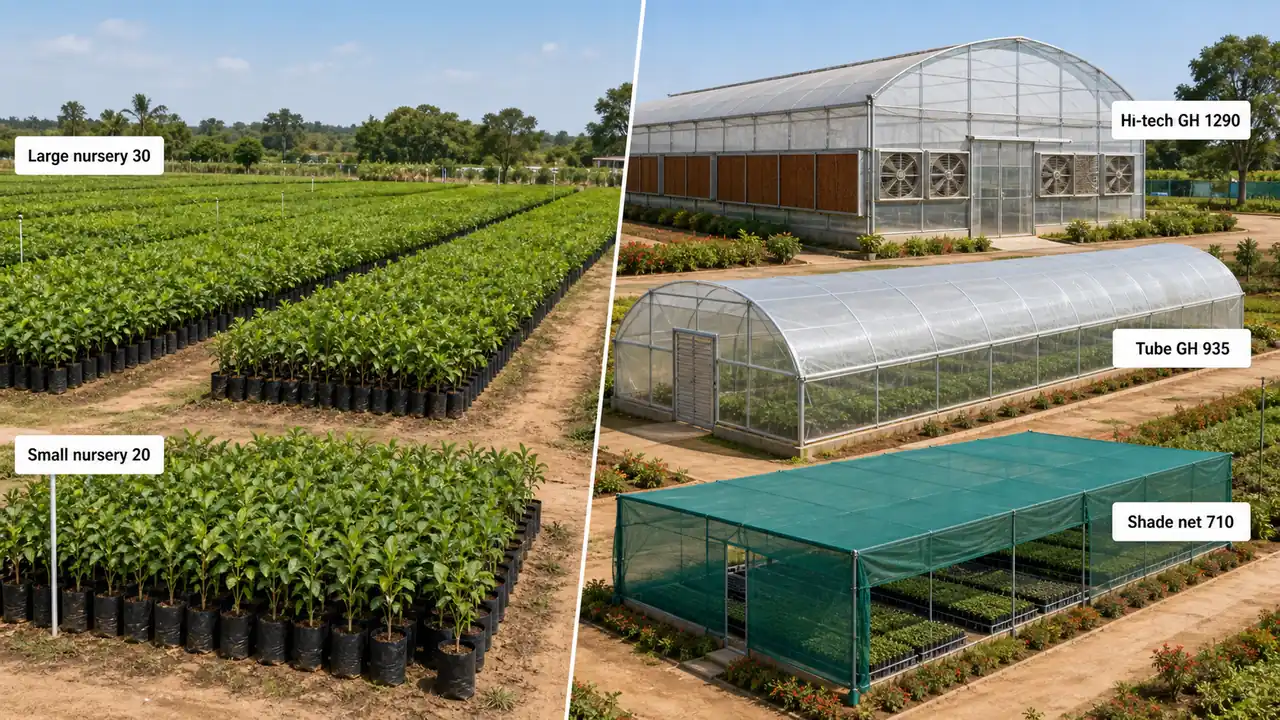
| Large Nursery (4 ha) | Rs 30 lakh/ha | 50% of cost (max Rs 15 lakh/ha) |
| Small Nursery (1 ha) | Rs 20 lakh/ha | 50% of cost (max Rs 10 lakh/ha) |
Mushroom Cultivation
| Component | Cost Norm |
|---|---|
| Mushroom Production Unit | Rs 30 lakh |
| Mushroom Spawn Unit | Rs 20 lakh |
| Compost Making Unit | Rs 30 lakh |
TIP
Quick memory trick: Mushroom norms follow a 30-20-30 pattern (Production-Spawn-Compost). Nurseries follow 30-20 (Large-Small).
Protected Cultivation
| Structure | Cost Norm | Assistance |
|---|---|---|
| Greenhouse (Tube/Wooden) | Rs 935/sq m | 50% of cost |
| Greenhouse (Hi-tech / Fan & Pad) | Rs 1,290/sq m | 50% of cost |
| Shade Net House | Rs 710/sq m | 50% of cost |
| Plastic Mulching | Rs 32,000/ha | 50% of cost |
TIP
Protected cultivation cost norms asked in exams & exams. Key sequence: Hi-tech GH (1,290) > Tube GH (935) > Shade Net (710).
Other Key Cost Norms
| Activity | Cost Norm | Assistance |
|---|---|---|
| Fruit crops (per ha) | Rs 1.50 lakh | 40% of cost in 3 installments (60:20:20) |
| Flower crops (per ha) | Rs 1.00 lakh | 40% of cost in 2 installments |
| Spice crops (per ha) | Rs 0.75 lakh | 40% of cost |
| Vermicompost units | Rs 1.50 lakh/unit | 50% of cost (max Rs 75,000) |
| Pack house | Rs 4.00 lakh/unit | 50% of cost |
CHAMAN Programme
CHAMAN (Coordination of Horticulture Assessment and MANagement) is a programme that uses geo-informatics and remote sensing for horticulture crop assessment.
Key features:
- Uses satellite imagery, GIS, and GPS for area estimation and production forecasting
- Covers major horticulture crops across India
- Implemented by MNCFC (Mahalanobis National Crop Forecast Centre)
- Provides early estimates of area and production for 7 major horticulture crops
- Helps in crop-weather monitoring and damage assessment
NOTE
CHAMAN is to horticulture what FASAL (Forecasting Agricultural output using Space, Agro-meteorology and Land-based observations) is to food grains. Both use remote sensing technology.
HORTNET — e-Governance Platform
HORTNET is the e-governance platform of MIDH for monitoring scheme implementation across all states.
Features of HORTNET:
- Online submission and tracking of beneficiary applications
- Real-time monitoring of physical and financial progress
- Geo-tagging of assets created under the scheme
- Dashboard for state-wise and component-wise progress
- Integration with DBT (Direct Benefit Transfer) for subsidy disbursal
Key Statistics & Targets
| Parameter | Value |
|---|---|
| India's rank in fruit production | 2nd (after China) |
| India's rank in vegetable production | 2nd (after China) |
| Share of horticulture in agriculture GVO | ~33% |
| Total horticulture production (2024-25) | 3,707.38 lakh MT |
| Area under horticulture (2024-25) | 301.36 lakh ha |
| MIDH Budget 2025-26 | Rs 2,500 crore |
TIP
Exam corner: India is the largest producer of bananas, mangoes, papayas, and okra globally. It is the second-largest overall in both fruits and vegetables. Horticulture production has now exceeded foodgrain production — a key structural shift to remember.
Summary Cheat Sheet
| Concept / Topic | Key Details / Explanation |
|---|---|
| Why MIDH was created | India is the second-largest producer of fruits and vegetables, and MIDH was created to bring multiple horticulture schemes under one umbrella mission for coordinated sector growth. |
| Launch and administrative status | MIDH was launched on 1 April 2014 as a Centrally Sponsored Scheme under the Ministry of Agriculture & Farmers’ Welfare. |
| Core objectives of MIDH | The mission aims to promote holistic horticulture growth, raise productivity through R&D and technology, strengthen post-harvest and marketing infrastructure, and support skill development and employment generation. |
| Funding pattern | The Centre-State sharing pattern is 60:40 for General States, 90:10 for North Eastern and Himalayan States, and 100% central support for Union Territories. |
| Women beneficiary earmark | 30% of the MIDH budget is earmarked for women beneficiaries, which is a high-frequency exam fact. |
| Number and identity of sub-schemes | MIDH integrates 6 sub-schemes: NHM, HMNEH, NHB, CDB, CIH, and NBM. |
| NHM vs HMNEH distinction | NHM covers identified horticulture districts in states outside the NE belt, while HMNEH specifically covers the North Eastern and Himalayan states, including J&K, Himachal Pradesh, and Uttarakhand. |
| Other MIDH institutions | NHB supports commercial horticulture and cold storage, CDB focuses on the coconut sector, CIH handles training and capacity building from Nagaland, and NBM supports bamboo plantation, value addition, and marketing. |
| Nursery-development norms | For nursery support, Large Nursery (4 ha) has a cost norm of Rs 30 lakh/ha with 50% assistance up to Rs 15 lakh/ha, while Small Nursery (1 ha) has Rs 20 lakh/ha with 50% assistance up to Rs 10 lakh/ha. |
Summary Continued
| Concept / Topic | Key Details / Explanation |
|---|---|
| Mushroom-cultivation norms | The mushroom pattern is 30-20-30: Mushroom Production Unit = Rs 30 lakh, Mushroom Spawn Unit = Rs 20 lakh, and Compost Making Unit = Rs 30 lakh. |
| Protected-cultivation norms | Key protected-cultivation support figures are Hi-tech greenhouse = Rs 1,290/sq m, Tube/Wooden greenhouse = Rs 935/sq m, Shade net house = Rs 710/sq m, and Plastic mulching = Rs 32,000/ha, generally with 50% assistance. |
| Other frequently tested cost norms | Fruit crops get Rs 1.50 lakh/ha with 40% assistance in 3 installments (60:20:20), flower crops get Rs 1.00 lakh/ha, spice crops get Rs 0.75 lakh/ha, vermicompost units get Rs 1.50 lakh/unit with 50% assistance up to Rs 75,000, and pack house support is Rs 4.00 lakh/unit with 50% assistance. |
| CHAMAN programme | CHAMAN stands for Coordination of Horticulture Assessment and MANagement and uses remote sensing, GIS, GPS, and satellite imagery for horticulture area estimation, production forecasting, crop-weather monitoring, and damage assessment. |
| CHAMAN implementing agency and crop coverage | CHAMAN is implemented by MNCFC (Mahalanobis National Crop Forecast Centre) and provides early estimates for 7 major horticulture crops. |
Continued
| Concept / Topic | Key Details / Explanation |
|---|---|
| CHAMAN vs FASAL | The lesson explicitly compares CHAMAN for horticulture with FASAL for food grains, with both built around remote-sensing-based crop assessment. |
| HORTNET platform | HORTNET is the e-governance platform of MIDH and supports online beneficiary applications, progress tracking, geo-tagging of assets, dashboard monitoring, and DBT-linked subsidy disbursal. |
| Key horticulture statistics used in the lesson | The lesson links MIDH to the larger sector context: India ranks 2nd in fruit production and 2nd in vegetable production, horticulture contributes about 33% of agricultural GVO, total horticulture production is 3,707.38 lakh MT, and area is 301.36 lakh ha. |
| Budget and exam-closing facts | The lesson highlights MIDH Budget 2025-26 = Rs 2,500 crore, reminds that India is the largest producer of bananas, mangoes, papayas, and okra, and stresses that horticulture production has now exceeded foodgrain production as a structural shift. |
Lesson Doubts
Ask questions, get expert answers