📚 Decision Making Syllabus
Understand the preparation scope and topic map for NABARD Grade A Decision Making.
What You Should Know
Decision Making is included in the NABARD Grade A Phase I exam pattern. The safest way to prepare it is to think of the subject as applied judgment: the exam wants to know whether you can recognise a situation, compare options, and choose a sensible response.

Scope of Preparation
The preparation scope becomes much clearer when it is grouped into the big idea-clusters below. Learn them as connected thinking tools, not as isolated textbook headings.
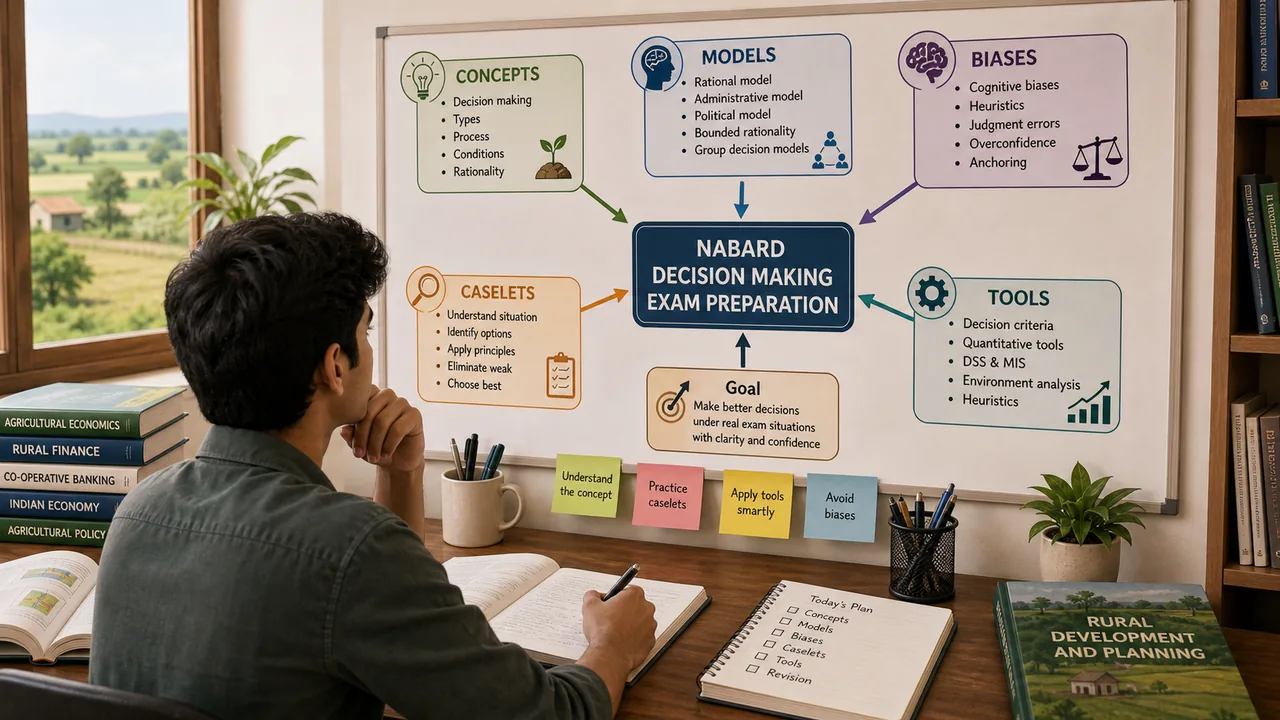
Practical Topic Map for Preparation
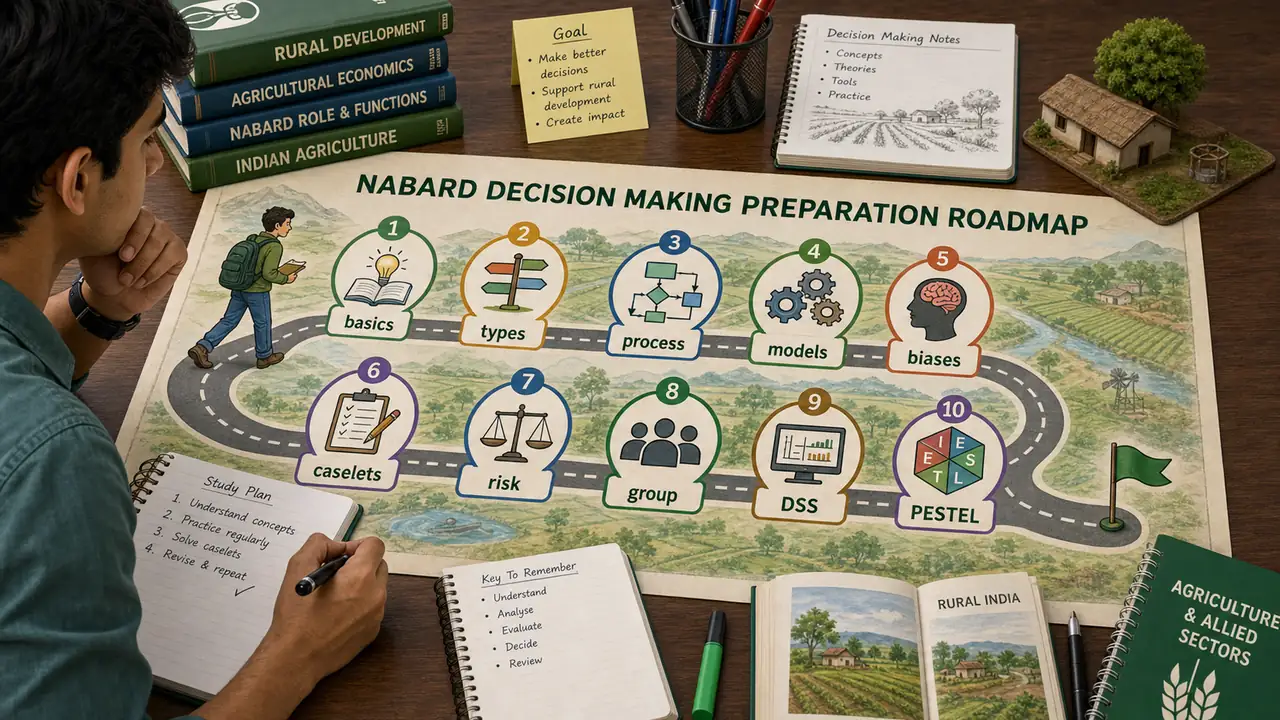
You should prepare the following clusters:
1. Basics of Decision Making
- meaning of decision making
- why decision making matters in organisations
- features of a good decision
- difference between routine choice and structured decision
2. Types of Decisions
- programmed decisions
- non-programmed decisions
- strategic, tactical, and operational decisions
- individual vs group decisions
3. Conditions of Decision Making
- decision under certainty
- decision under risk
- decision under uncertainty
- time pressure and incomplete information
4. Decision Making Process
- identifying the problem
- diagnosing causes
- generating alternatives
- evaluating alternatives
- choosing the best option
- implementation
- review and feedback
5. Decision Making Models
- rational model
- bounded rationality
- satisficing
- incremental approach
6. Approaches and Techniques
- analytical approach
- intuitive approach
- cost-benefit thinking
- elimination method
- priority and feasibility screening
7. Biases and Errors
- confirmation bias
- anchoring bias
- overconfidence
- status quo bias
- emotional decision errors
8. Caselets and Applied Judgment
- workplace scenarios
- public-service style dilemmas
- ethical but practical choices
- stakeholder-sensitive decision making
9. Decision Criteria Under Uncertainty
- maximax criterion
- maximin criterion
- minimax regret criterion
- insufficient reason criterion
10. Group vs Individual Decision Making
- individual decisions
- group decisions
- groupthink
- satisficing in group settings
11. Decision-Making Techniques
- brainstorming
- nominal group technique
- Delphi technique
- intuition, facts, experience, and considered opinions
- decision tree and basic quantitative tools
12. Rationality Models
- rational decision making
- bounded rationality
- economic man model
- administrative man model
13. Political and Advanced Models
- political model
- power types
- coalitions
- escalation of commitment
- incremental model
- mixed scanning model
- optimal model
14. Decision Styles and Support Systems
- directive, analytical, conceptual, and behavioral styles
- leadership style link to decision making
- decision support system
- management information system
15. Decision Context and Environment Tools
- internal and external environment
- micro, meso, and macro environment
- Porter's Five Forces
- PESTEL analysis
- practical good-decision vs bad-decision elimination rules
What Recent Papers Are Signalling
The recoverable 2025 paper is a useful warning against shallow preparation. It did not stay only at textbook definitions; it mixed decision-making with management-use questions and checked whether the student knew the exact tested expression.
The most visible signals were:
- Economic man was asked directly as the perfectly rational model
- non-programmed decision was tested through its features, not only its label
- status quo trap was tested as a named cognitive bias
- criteria and constraints were tested at the evaluation-and-selection stage
- creative process was tested through the final stage: verification
- decision style was asked in the classic Rowe-type pattern: low ambiguity tolerance + logic orientation = directive style
- strategic vs tactical vs operational classification was tested through a business example
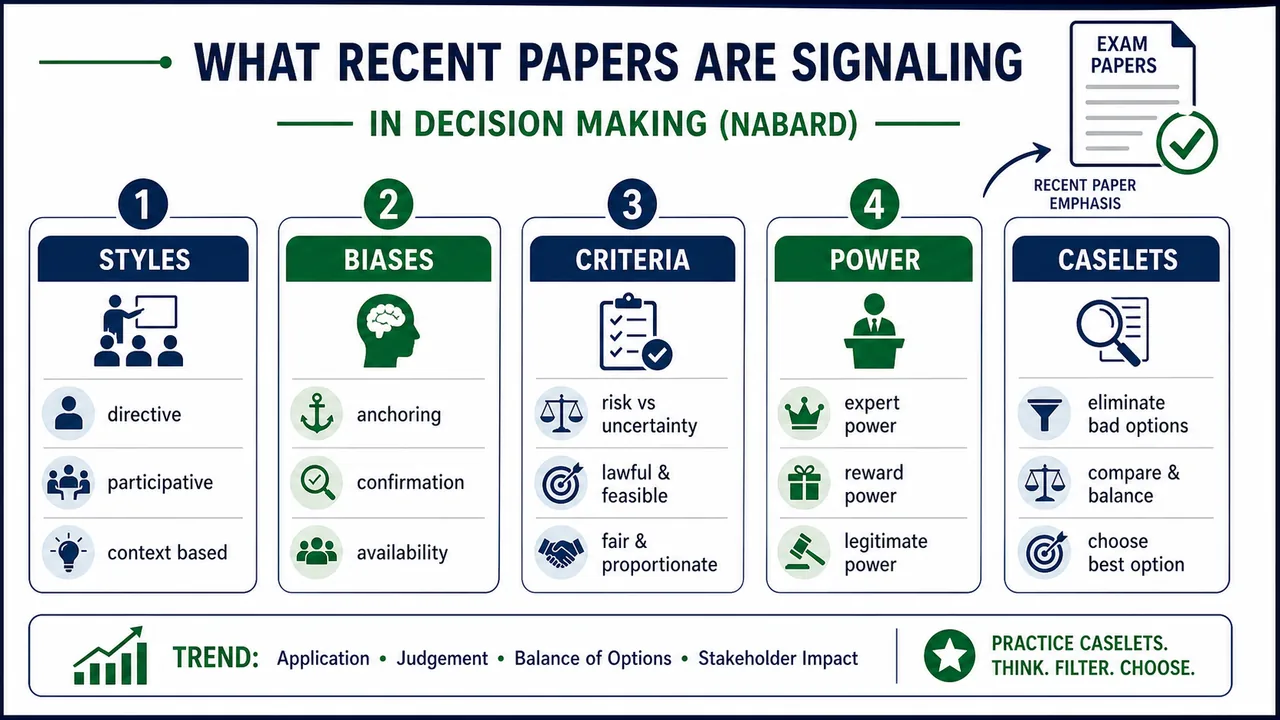
So the safe study rule is:
- learn the theory label
- learn the hidden clue words
- learn the applied example that reveals the same concept in a different form
Priority Areas for Scoring Better
If your time is limited, prioritise these first because they give the fastest improvement in actual question solving:

- decision types
- certainty, risk, and uncertainty
- decision-making process
- rational vs bounded-rational decisions
- common biases
- directive, analytical, conceptual, and behavioral styles
- case-based elimination
- groupthink and group vs individual decisions
- maximax, maximin, and minimax regret basics
- creative-process stages and criteria-vs-constraint usage
How NABARD May Ask Questions
Questions are usually not deeply mathematical. They more often test whether you can think clearly inside a short scenario:

- whether you can identify the kind of decision
- whether you can choose the best practical option
- whether you can spot a bias or flawed judgment
- whether you can select the most appropriate next step
Safe Preparation Rule
Treat this subject as a judgment + concept paper:
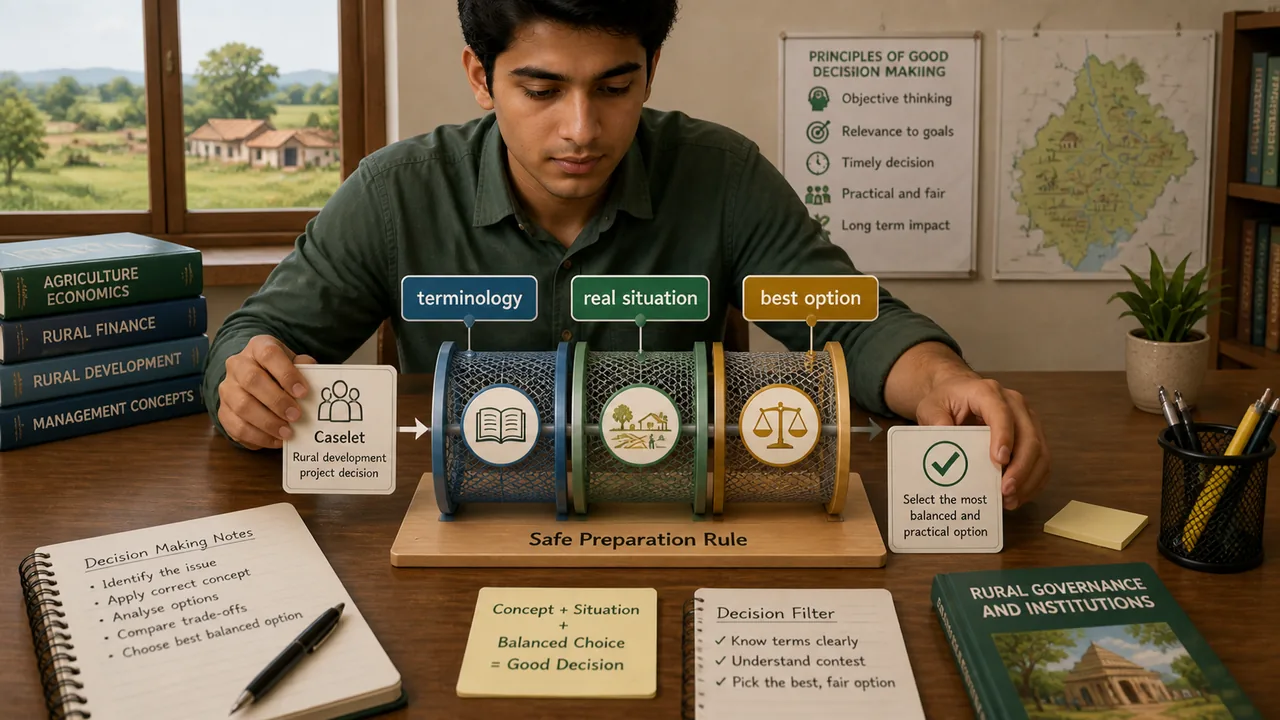
- know the terminology
- understand why the concept matters in a real situation
- practise selecting the best option, not just a technically correct one
Summary Cheat Sheet
- Core idea: Decision Making Syllabus is important because NABARD questions test both concept clarity and practical judgment.
- What You Should Know: revise this block as a separate exam-ready concept and connect it with case-based application.
- Scope of Preparation: revise this block as a separate exam-ready concept and connect it with case-based application.
- Practical Topic Map for Preparation: revise this block as a separate exam-ready concept and connect it with case-based application.
- What Recent Papers Are Signalling: revise this block as a PYQ-pattern decoder so you can recognise the same topic even when the wording changes.
- Priority Areas for Scoring Better: revise this block as a separate exam-ready concept and connect it with case-based application.
- How NABARD May Ask Questions: revise this block as a separate exam-ready concept and connect it with case-based application.
- Exam habit: identify the goal, compare feasible alternatives, remove weak or unsafe choices, and choose the most balanced option.
Lesson Doubts
Ask questions, get expert answers