🧩 Basics of Decision Making
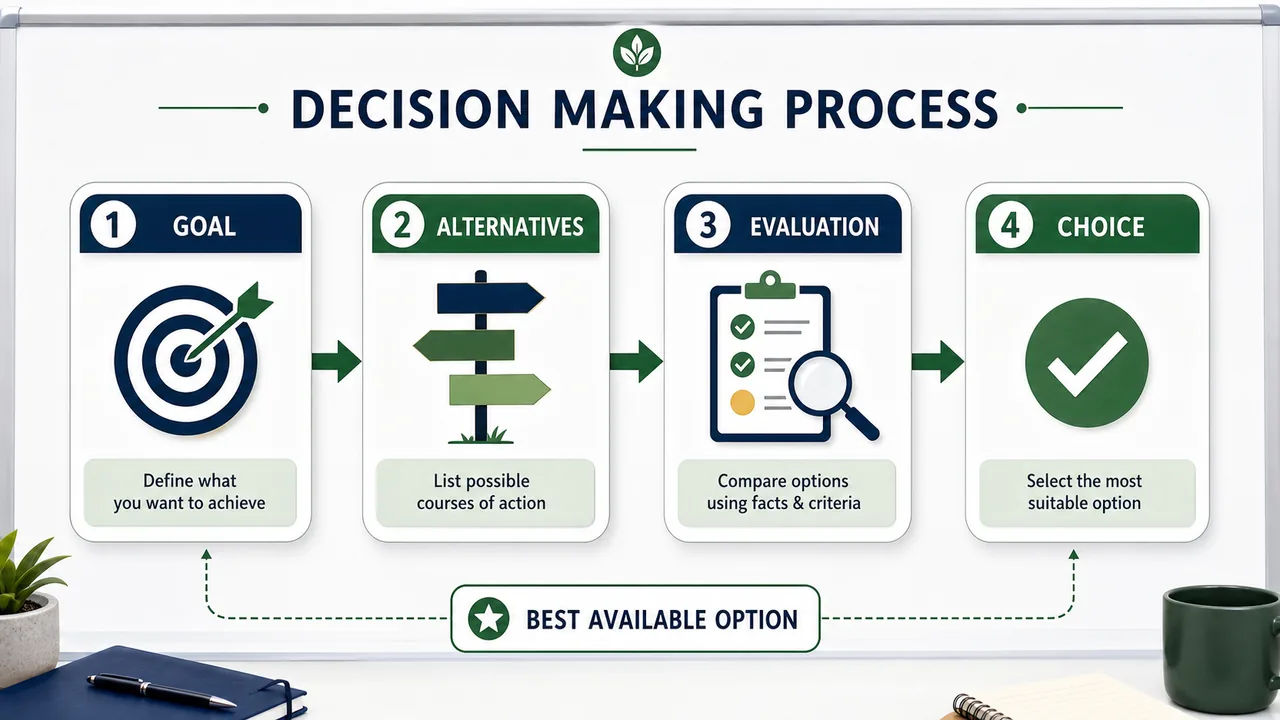
Every meaningful decision begins when a person or an organisation has a goal, faces more than one possible path, and must choose with limited time, limited information, or limited resources. That is why decision making is not just "selecting something"; it is the disciplined act of selecting a course of action that is most suitable for the situation.
What Decision Making Actually Means
Decision making is the process of choosing the best available alternative from two or more alternatives in order to achieve a desired objective. The words "best available" are important. In real life, the chooser does not always get a perfect option; instead, the chooser compares the available options and selects the one that fits the objective, constraints, and likely consequences better than the others.
To understand the definition clearly, break it into three parts:
Pro Content Locked
Upgrade to Pro to access this lesson and all other premium content.
₹99 charged monthly · Cancel anytime
- All Agriculture & Banking Courses
- AI Lesson Questions (100/day)
- AI Doubt Solver (50/day)
- Glows & Grows Feedback (30/day)
- AI Section Quiz (20/day)
- 22-Language Translation (100/day)
- Recall Questions (20/day)
- AI Quiz (15/day)
- AI Quiz Paper Analysis (100/day)
- AI Step-by-Step Explanations (100/day)
- Spaced Repetition Recall (FSRS)
- AI Tutor
- Immersive Text Questions
- Audio Lessons — Hindi & English
- Mock Tests & Previous Year Papers
- Summary & Mind Maps
- XP, Levels, Leaderboard & Badges
- Generate New Classrooms
- Voice AI Teacher (AgriDots Live)
- AI Revision Assistant
- Knowledge Gap Analysis
- Interactive Revision (LangGraph)
🔒 Secure via Razorpay · Cancel anytime · No hidden fees
Every meaningful decision begins when a person or an organisation has a goal, faces more than one possible path, and must choose with limited time, limited information, or limited resources. That is why decision making is not just "selecting something"; it is the disciplined act of selecting a course of action that is most suitable for the situation.
What Decision Making Actually Means
Decision making is the process of choosing the best available alternative from two or more alternatives in order to achieve a desired objective. The words "best available" are important. In real life, the chooser does not always get a perfect option; instead, the chooser compares the available options and selects the one that fits the objective, constraints, and likely consequences better than the others.
To understand the definition clearly, break it into three parts:
- there must be a goal or purpose
- there must be alternatives
- there must be evaluation followed by selection
If any one of these is missing, the situation is not a full decision-making exercise. For example:
- if there is only one compulsory action, there is no real choice
- if there are many options but no objective, comparison becomes directionless
- if an option is selected without evaluation, the act is impulsive rather than well-reasoned
Classic Views in Decision Making
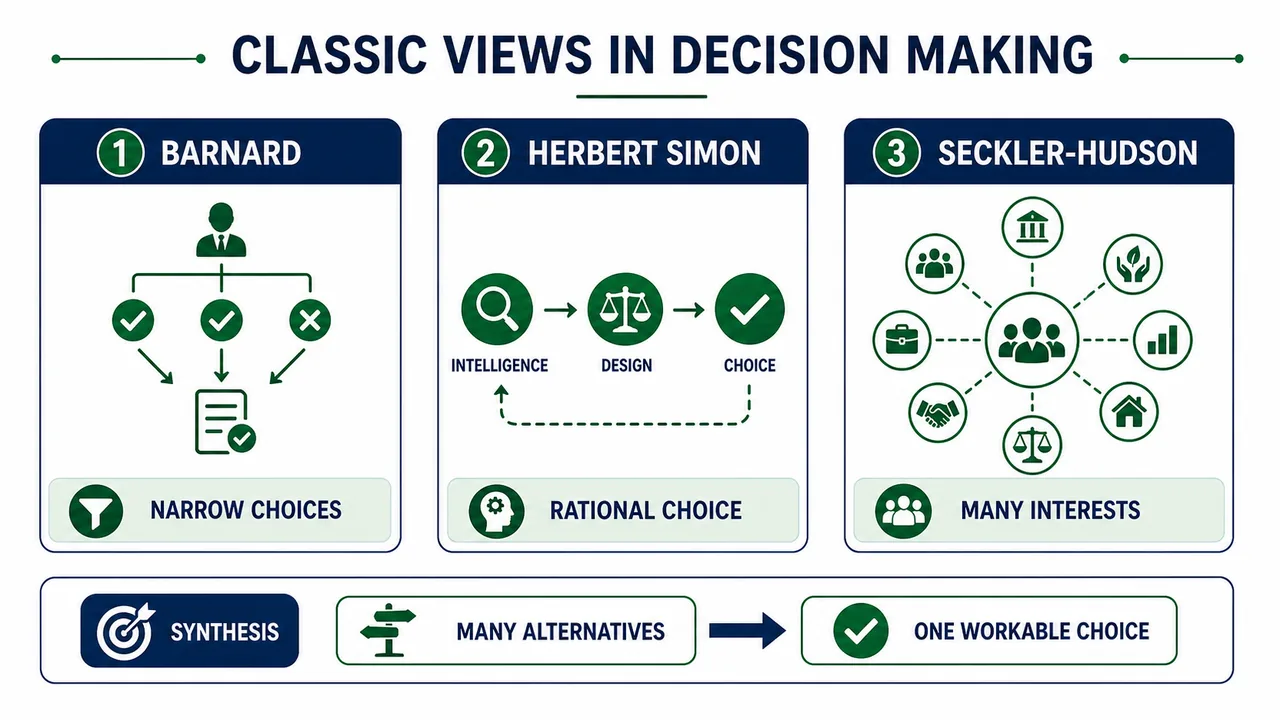
Different thinkers described decision making in different words, but their ideas point toward the same core logic.
- Chester Barnard viewed decision making as a process of narrowing down available possibilities until one workable choice remains.
- Herbert Simon described decision making as rational choice among alternatives, with emphasis on judgment and selection.
- Seckler-Hudson highlighted the plural nature of public and governmental decision making, where several interests and viewpoints may be involved.
These views help because they show that decision making is not merely a private mental event. Depending on the context, it can be:
- a logical comparison process
- an administrative act
- a public responsibility involving several stakeholders
Human Behaviour Behind Decisions
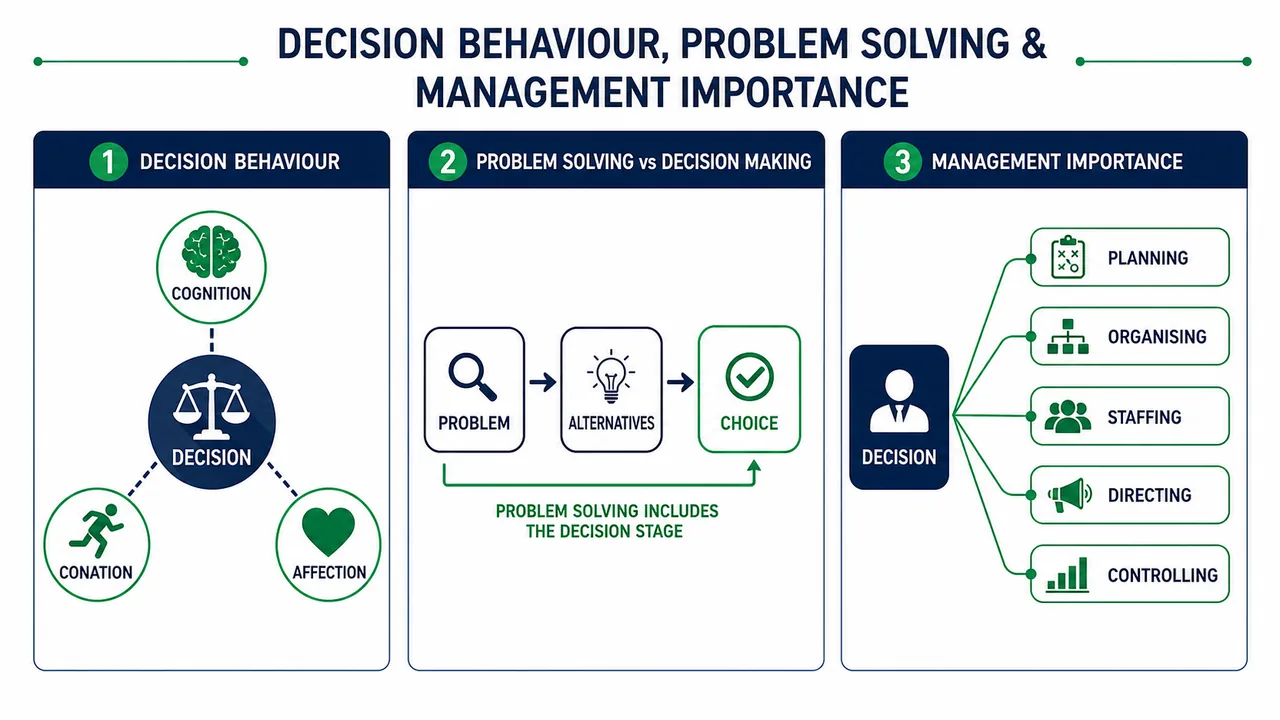
A decision may look external, but it is shaped internally by the human mind. Three broad dimensions are often mentioned:
- Cognition: what the person knows, understands, remembers, and analyses
- Conation: what the person wants to do, intends to do, or is willing to pursue
- Affection: how feelings, likes, dislikes, fears, and emotional tone influence the choice
These three dimensions explain why two people with the same facts may still choose differently. One may be guided more by evidence, another by confidence or fear, and another by habit or social pressure.
For exam understanding, this means:
- knowledge alone does not guarantee a good decision
- emotion alone does not guarantee a good decision
- balanced judgment is usually superior to blind logic or blind feeling
Decision Making and Problem Solving Are Related but Not Identical
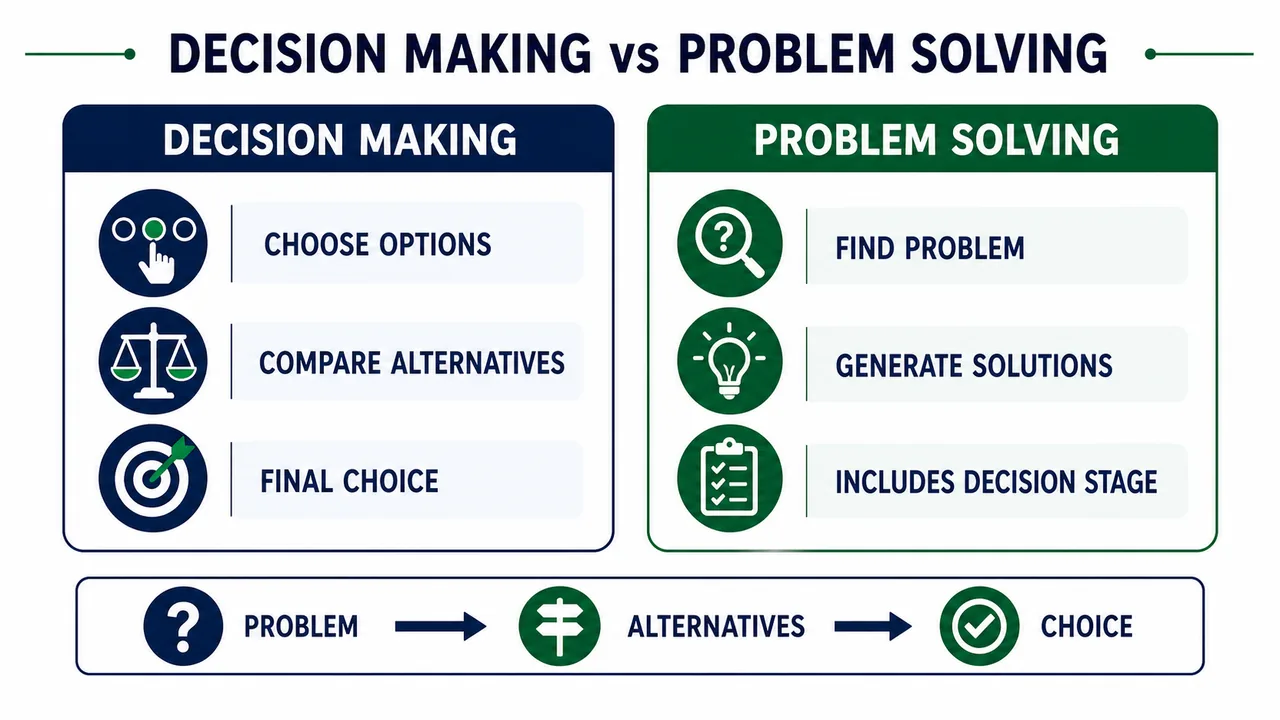
Many students mix up decision making and problem solving because the two often appear together. They are connected, but they do not mean the same thing.
| Decision Making | Problem Solving |
|---|---|
| Focuses on choosing among alternatives | Focuses on removing a gap, obstacle, or difficulty |
| Asks: which option should be selected? | Asks: what is the problem and how can it be solved? |
| May occur in routine or non-routine situations | Usually begins when something is wrong, missing, or not working |
| Ends with a choice | Often includes diagnosis, creativity, and then choice |
The usual sequence in practice is:
- understand the problem
- generate alternatives
- compare alternatives
- choose the best available course of action
Main Characteristics of Decision Making
A good conceptual answer should recognise the main features of decision making:
- it is goal-oriented
- it involves choice among alternatives
- it depends on information, judgment, or both
- it operates under constraints such as time, money, policy, or uncertainty
- it has consequences, so the quality of the choice matters
- it must often be timely, because delay itself can become harmful
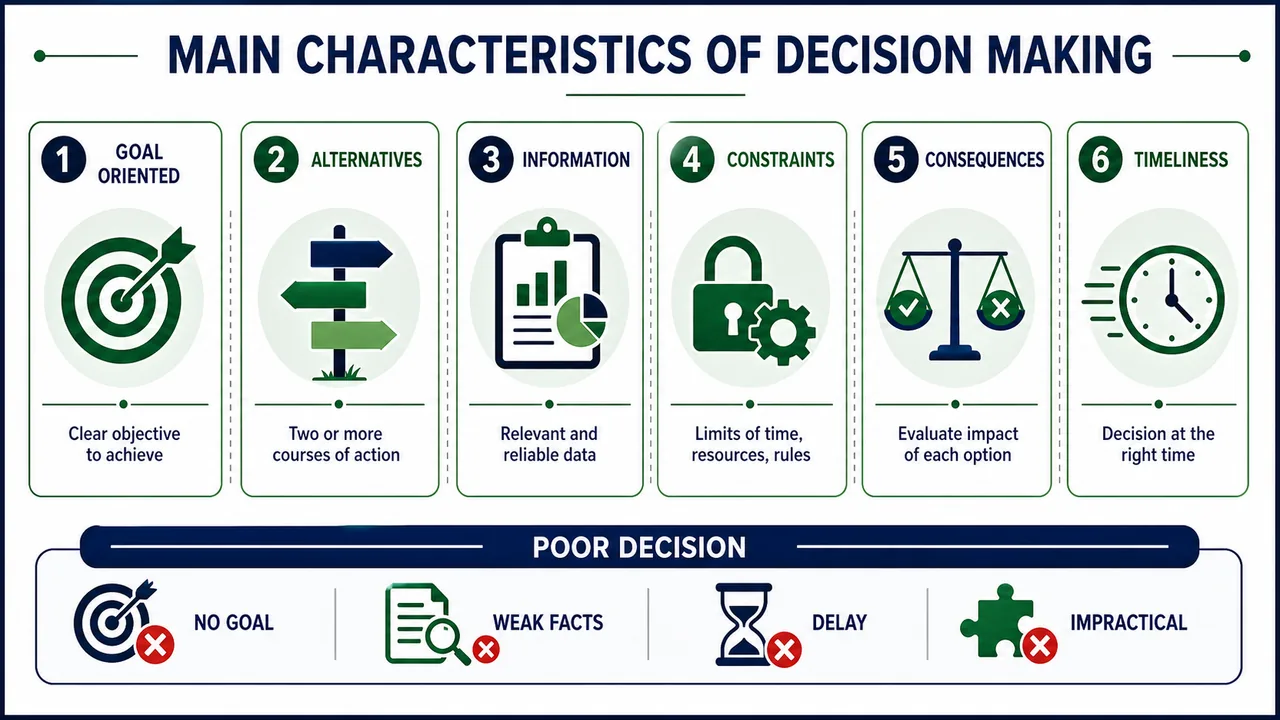
From these characteristics, we can also identify what a poor decision looks like:
- no clear objective
- weak or incomplete facts
- emotional or biased judgment
- impractical choice
- unnecessary delay
- no thought about likely outcomes
Why Decision Making Matters in Organisations
Decision making is central to management because every managerial function depends on it.
- planning requires choosing goals and methods
- organising requires deciding roles and allocation of resources
- staffing requires selecting people and responsibilities
- directing requires choosing actions in changing situations
- controlling requires deciding corrective steps when performance deviates
In NABARD-style thinking, good decisions are usually those that balance:
- objective and practicality
- rules and human sensitivity
- short-term action and long-term effect
- facts and judgment
Worked Examples
Example 1: Simple routine choice
A branch manager must choose one of three available time slots for a weekly review meeting.
- there are alternatives
- the objective is convenience and effectiveness
- the decision is routine and low-risk
This is a basic example of decision making.
Example 2: Resource allocation choice
A rural project team has limited funds and must choose whether to repair irrigation channels, train self-help groups, or improve digital reporting.
This is a richer decision because:
- all options may be useful
- resources are limited
- the choice must be based on priority, impact, and feasibility
Example 3: Delayed decision
A team continues collecting information but fails to approve the project before the seasonal window closes.
This teaches an important rule: not deciding in time is also a decision failure.
Example 4: Personal preference over evidence
An officer supports a weak proposal only because it comes from a trusted colleague.
This is a poor decision because affection has overpowered objective evaluation.
Summary Cheat Sheet
| Concept / Topic | Key Details / Explanation |
|---|---|
| Meaning of decision making | Decision making is the process of choosing the best available alternative to achieve an objective. A true decision requires goal + alternatives + evaluation + final selection. |
| Minimum conditions | If there is only one compulsory action, there is no real decision. If there is no clear purpose, comparison becomes directionless. |
| Classic views | Barnard emphasised narrowing choices, Herbert Simon stressed rational choice among alternatives, and Seckler-Hudson highlighted plural and public decision settings. |
| Human side of decisions | Decision quality is influenced by cognition (thinking/knowledge), conation (willingness/action tendency), and affection (emotion/feeling). |
| Decision making vs problem solving | Problem solving diagnoses and removes the obstacle; decision making selects the best response among alternatives. Usual flow: problem -> alternatives -> evaluation -> choice. |
| Key characteristics | Good decisions are goal-oriented, informed, feasible, timely, and consequence-aware. Delay can itself become a decision failure. |
| Management importance | Decision making supports planning, organising, staffing, directing, and controlling, so it is central to every managerial function. |
| Exam-ready rule | In concept questions and caselets, the strongest answer is usually the most balanced, workable, and practical option, not the most dramatic one. |
Mini Practice
What are the minimum conditions for decision making?
a goal, two or more alternatives, and a final choice after evaluation. Without alternatives or without a purpose, the idea of decision making remains incomplete.
Why is timeliness considered part of decision quality?
because a late decision may lose its usefulness even if it looks correct on paper. Real decisions operate in changing conditions, so delay can damage outcomes.
Which is broader in sequence: problem solving or decision making?
problem solving is usually broader, and decision making appears as one important stage within it. First the problem is diagnosed, then alternatives are created and one is selected.
Can a decision be rational and still not be perfect?
yes. In practice, decision makers often choose the best available option, not an ideal option.
Why do human emotions matter in decision making?
because feelings can influence judgment, priorities, and risk-taking. That is why balanced evaluation is more reliable than emotion alone. ---
Lesson Doubts
Ask questions, get expert answers