🗂️ Types and Conditions of Decision Making
When students struggle with decision-making questions, the real problem is often not the definition but the classification. The moment you recognise what kind of decision the question is describing and under what condition it is being taken, the answer becomes much easier to choose.
Why Decisions Are Classified
All decisions are not alike. Some are routine, some are strategic, some are personal, some are group-based, and some are taken under certainty while others are taken under uncertainty. Classification helps because it tells us:
- how much analysis is needed
- who should make the decision
- how much risk is involved
- whether rules already exist
- whether speed or creativity matters more
If you understand the classification, you automatically understand the likely method, difficulty level, and responsibility structure of the decision.
Programmed and Non-Programmed Decisions
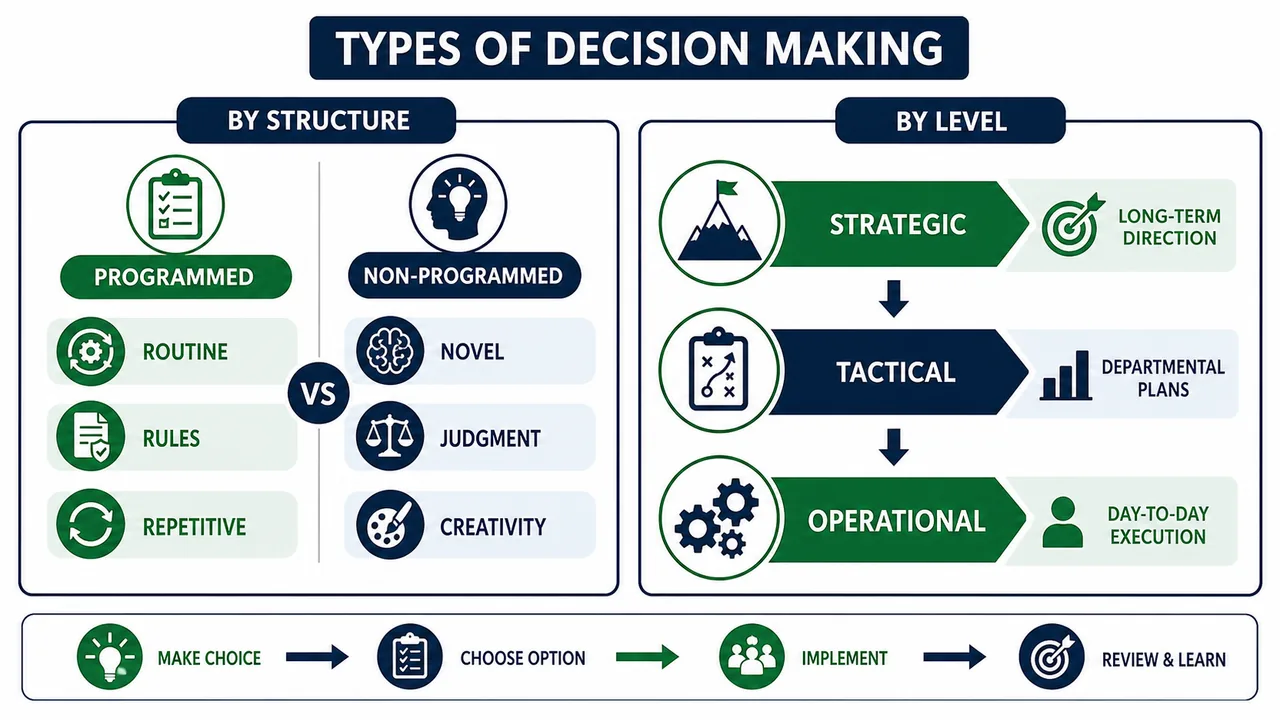
One of the most important classifications in management is based on whether the situation is repetitive or novel.
Pro Content Locked
Upgrade to Pro to access this lesson and all other premium content.
₹99 charged monthly · Cancel anytime
- All Agriculture & Banking Courses
- AI Lesson Questions (100/day)
- AI Doubt Solver (50/day)
- Glows & Grows Feedback (30/day)
- AI Section Quiz (20/day)
- 22-Language Translation (100/day)
- Recall Questions (20/day)
- AI Quiz (15/day)
- AI Quiz Paper Analysis (100/day)
- AI Step-by-Step Explanations (100/day)
- Spaced Repetition Recall (FSRS)
- AI Tutor
- Immersive Text Questions
- Audio Lessons — Hindi & English
- Mock Tests & Previous Year Papers
- Summary & Mind Maps
- XP, Levels, Leaderboard & Badges
- Generate New Classrooms
- Voice AI Teacher (AgriDots Live)
- AI Revision Assistant
- Knowledge Gap Analysis
- Interactive Revision (LangGraph)
🔒 Secure via Razorpay · Cancel anytime · No hidden fees
When students struggle with decision-making questions, the real problem is often not the definition but the classification. The moment you recognise what kind of decision the question is describing and under what condition it is being taken, the answer becomes much easier to choose.
Why Decisions Are Classified
All decisions are not alike. Some are routine, some are strategic, some are personal, some are group-based, and some are taken under certainty while others are taken under uncertainty. Classification helps because it tells us:
- how much analysis is needed
- who should make the decision
- how much risk is involved
- whether rules already exist
- whether speed or creativity matters more
If you understand the classification, you automatically understand the likely method, difficulty level, and responsibility structure of the decision.
Programmed and Non-Programmed Decisions
One of the most important classifications in management is based on whether the situation is repetitive or novel.
Programmed decisions
These are routine, repetitive, and structured decisions. They are usually taken with the help of:
- established rules
- standard operating procedures
- habitual methods
- clear precedents
Examples:
- approving routine leave according to policy
- reordering standard office supplies
- scheduling a regular review meeting
Non-programmed decisions
These arise in new, unusual, or complex situations where no ready-made rule is fully sufficient. They require:
- judgment
- creativity
- analysis
- comparison of alternatives
Examples:
- choosing a strategy for a new rural credit initiative
- responding to a sudden policy change
- deciding how to handle a serious public-relations issue
Quick clue: if the question describes a repeated and structured situation, think programmed. If it describes a new, complex, or exceptional situation, think non-programmed.
Strategic, Tactical, and Operational Decisions
Decisions can also be classified by level and time horizon.
| Type | Main Focus | Time Horizon | Typical Decision-Maker |
|---|---|---|---|
| Strategic | Overall direction and long-term goals | Long-term | Top management |
| Tactical | Converting strategy into departmental plans | Medium-term | Middle management |
| Operational | Day-to-day execution | Short-term | Lower-level management or supervisors |
Strategic decisions
These shape the future direction of the organisation. They are broad, long-term, and often difficult to reverse. For example, deciding to expand into a new region or adopt a new institutional model is strategic.
Tactical decisions
These translate strategy into practical plans. If the strategy is "expand outreach," the tactical decision may be how to distribute staff, budget, and communication support.
Operational decisions
These support day-to-day functioning, such as scheduling, task allocation, routine approvals, or handling small recurring issues.
Individual and Group Decisions
Another common classification is based on who makes the choice.
Individual decision
This is made by one person. It is often faster and more suitable when:
- responsibility is clear
- confidentiality matters
- the issue is routine
- quick action is needed
Group decision
This is made collectively through discussion, consultation, or committee process. It is often preferable when:
- several departments are affected
- diverse knowledge is needed
- acceptance by stakeholders matters
- the issue is large or sensitive
This distinction is important because many exam questions indirectly test whether the problem requires speed and accountability or participation and wider insight.
Organisational and Personal Decisions
Sometimes the basis of classification is whether the decision is taken in an official capacity or in a personal capacity.
- Organisational decisions are taken for official objectives and must align with policy, rules, and institutional goals.
- Personal decisions are taken for individual benefit or personal preference.
In management and public service situations, organisational decisions should not be distorted by personal interest. This becomes especially important in ethical caselets involving favouritism, conflict of interest, or pressure from friends and relatives.
Conditions of Decision Making
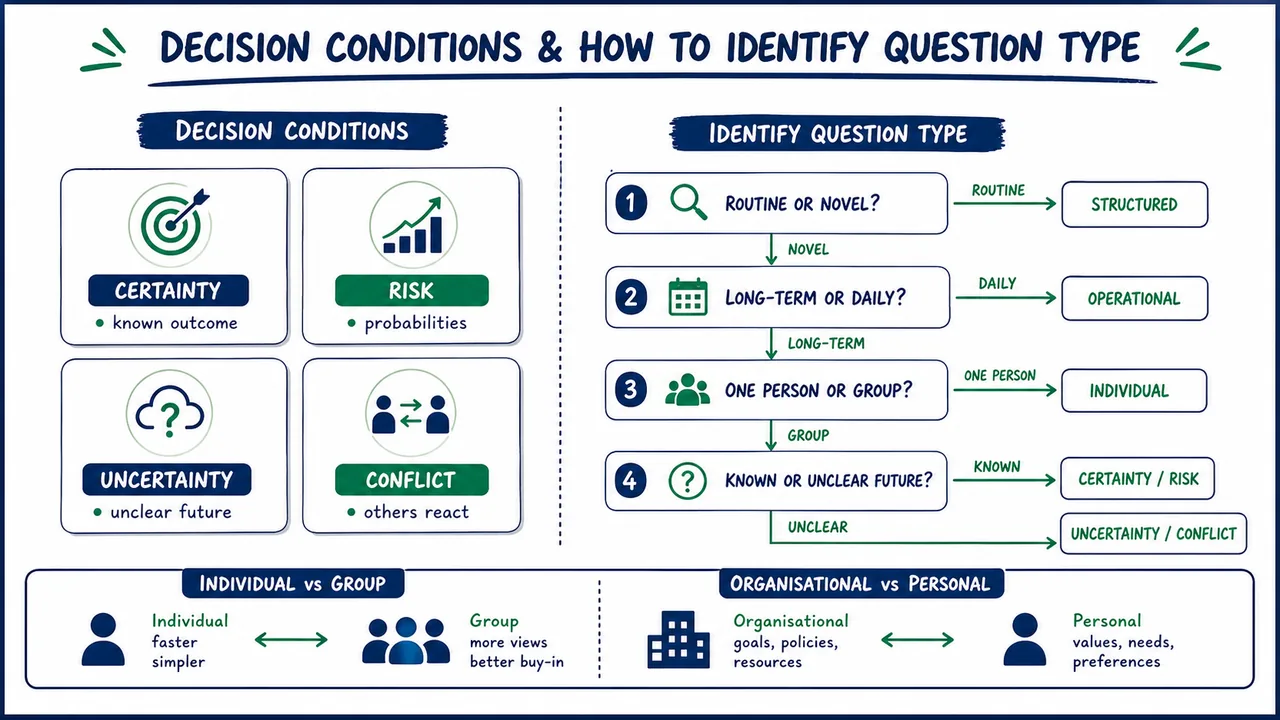
A decision is not shaped only by type; it is also shaped by the condition under which it is taken. The three classic conditions are:
- certainty
- risk
- uncertainty
Some books also mention conflict as a fourth condition when the outcome depends on the actions of another party.
Decision Making Under Certainty, Risk, Uncertainty, and Conflict
Under certainty
The decision-maker knows the alternatives, knows the outcomes, and is reasonably sure what will happen after each action. The problem is mostly one of selecting the most efficient or suitable option.
Under risk
The outcomes are not fully certain, but probabilities can be estimated. The decision-maker can compare options by likelihood, expected payoff, or probable loss.
Under uncertainty
The future is unclear and probabilities cannot be assigned with confidence. In such cases, the decision-maker may rely on judgment rules such as optimism, caution, or regret minimisation.
Under conflict
The outcome depends partly on the choices of others, such as competitors, rivals, or opposing interest groups. Here, strategy matters because the environment is interactive, not passive.
| Condition | What is Known? | Main Difficulty |
|---|---|---|
| Certainty | Outcomes are known clearly | Selecting the most suitable option |
| Risk | Probabilities can be estimated | Managing chance and expected consequences |
| Uncertainty | Probabilities are unclear | Choosing without reliable likelihood estimates |
| Conflict | Others' actions affect results | Anticipating strategic behaviour |
How to Identify the Type Quickly in Questions
Use this sequence:
- ask whether the situation is routine or novel
- ask whether the issue is long-term, medium-term, or day-to-day
- ask whether one person or a group should decide
- ask whether the future is known, probable, unclear, or strategically contested
This habit turns a vague chapter into an answer-selection framework.
Worked Examples
Example 1: Daily stock reorder
A branch office reorders standard stationery every month according to a fixed rule.
Classification:
- programmed
- operational
- usually individual or low-level administrative decision
Example 2: New district expansion
A development institution must decide whether to expand into a new region over the next five years.
Classification:
- non-programmed
- strategic
- likely group or top-level decision
Example 3: Probable weather outcomes
A farm-related decision is taken after estimating likely rainfall patterns from available data.
Classification:
- decision under risk
Example 4: No dependable probability basis
A decision-maker knows several possible outcomes but has no reliable basis for assigning probabilities.
Classification:
- decision under uncertainty
Summary Cheat Sheet
| Concept / Topic | Key Details / Explanation |
|---|---|
| Why classification matters | Decisions are classified to understand their structure, difficulty, authority level, and suitable method. |
| Programmed vs non-programmed | Programmed decisions are routine, repetitive, and rule-based. Non-programmed decisions arise in new, complex, or exceptional situations and require judgment and creativity. |
| Strategic, tactical, operational | Strategic decisions shape long-term direction; tactical decisions convert strategy into plans; operational decisions handle day-to-day execution. |
| Individual vs group | Individual decisions favour speed, accountability, and confidentiality. Group decisions favour wider knowledge, discussion, and acceptance. |
| Organisational vs personal | Organisational decisions must serve institutional goals and rules; personal preference should not distort official decision quality. |
| Conditions of decision making | Main conditions are certainty, risk, uncertainty, and sometimes conflict when outcomes depend on the actions of others. |
| Meaning of risk and uncertainty | Under risk, probabilities can be estimated. Under uncertainty, probabilities cannot be assigned confidently. |
| Fast exam classification rule | First identify: routine or novel, long-term or daily, one person or group, and whether the future is known, probable, unclear, or contested. |
Mini Practice
Which type of decision usually relies on standard procedures?
programmed decision. Programmed decisions arise in repetitive situations where rules or precedents already exist.
A decision about long-term institutional direction belongs to which class?
strategic decision. Strategic decisions shape the broad and future course of the organisation.
Which condition exists when probabilities can be estimated?
risk. Risk means the future is not fully certain, but likelihoods can still be assessed.
Which condition exists when probabilities cannot be estimated confidently?
uncertainty. Under uncertainty, the future is unclear and formal probability-based comparison becomes weak.
Why are group decisions often preferred for major policy questions?
because wider knowledge, acceptance, and stakeholder participation may be needed. Large decisions often affect many people and benefit from multiple viewpoints. ---
Lesson Doubts
Ask questions, get expert answers