⚙️ Process and Models of Decision Making
Many students remember model names but still get confused in application questions because they do not see the sequence behind good decisions. Process tells us how a decision should move, while models tell us what assumptions the decision-maker is using. Once these two ideas are separated, the chapter becomes much easier.
The Decision-Making Process Step by Step
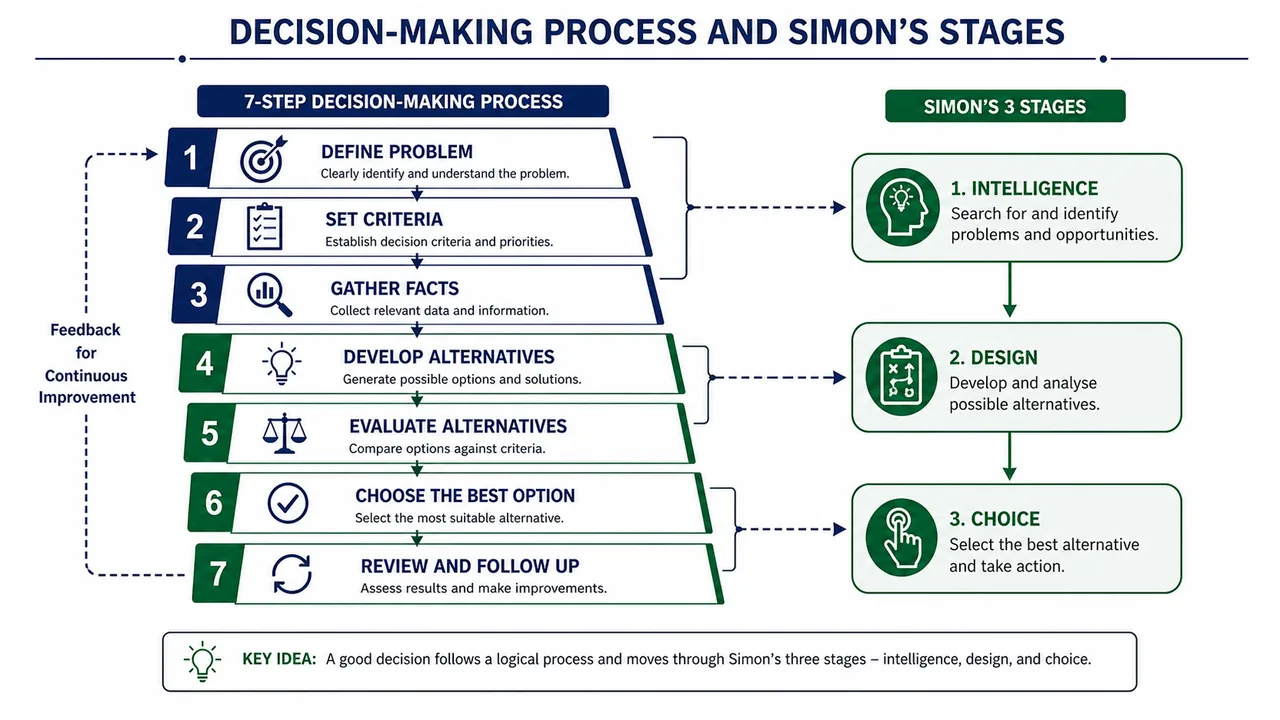
Although books use slightly different wording, the process usually includes the following stages:
- identify the problem or opportunity
- diagnose the situation and collect relevant facts
- set criteria for judgment
- generate alternatives
- evaluate alternatives
- choose the best available alternative
- implement the decision
- review the results and take corrective action if needed
This sequence matters because a weak decision is often not weak at the end; it becomes weak earlier due to wrong problem definition, poor facts, or narrow alternatives.
Pro Content Locked
Upgrade to Pro to access this lesson and all other premium content.
₹99 charged monthly · Cancel anytime
- All Agriculture & Banking Courses
- AI Lesson Questions (100/day)
- AI Doubt Solver (50/day)
- Glows & Grows Feedback (30/day)
- AI Section Quiz (20/day)
- 22-Language Translation (100/day)
- Recall Questions (20/day)
- AI Quiz (15/day)
- AI Quiz Paper Analysis (100/day)
- AI Step-by-Step Explanations (100/day)
- Spaced Repetition Recall (FSRS)
- AI Tutor
- Immersive Text Questions
- Audio Lessons — Hindi & English
- Mock Tests & Previous Year Papers
- Summary & Mind Maps
- XP, Levels, Leaderboard & Badges
- Generate New Classrooms
- Voice AI Teacher (AgriDots Live)
- AI Revision Assistant
- Knowledge Gap Analysis
- Interactive Revision (LangGraph)
🔒 Secure via Razorpay · Cancel anytime · No hidden fees
Many students remember model names but still get confused in application questions because they do not see the sequence behind good decisions. Process tells us how a decision should move, while models tell us what assumptions the decision-maker is using. Once these two ideas are separated, the chapter becomes much easier.
The Decision-Making Process Step by Step
Although books use slightly different wording, the process usually includes the following stages:
- identify the problem or opportunity
- diagnose the situation and collect relevant facts
- set criteria for judgment
- generate alternatives
- evaluate alternatives
- choose the best available alternative
- implement the decision
- review the results and take corrective action if needed
This sequence matters because a weak decision is often not weak at the end; it becomes weak earlier due to wrong problem definition, poor facts, or narrow alternatives.
Understanding Each Stage Clearly
1. Identifying the problem
The first task is not to jump into action but to ask: what exactly requires a decision? If the decision-maker misidentifies the real problem, even a logically selected option can fail.
2. Diagnosing and gathering information
At this stage, the decision-maker tries to understand causes, constraints, urgency, and stakeholders. Good decisions depend on relevant facts, not random information.
3. Setting criteria
Criteria are the standards used to compare alternatives. These may include:
- cost
- time
- legality
- impact
- feasibility
- stakeholder acceptance
At this same stage, many questions also mention constraints. Criteria and constraints are related but not identical:
- criteria tell us how alternatives will be judged
- constraints tell us what alternatives cannot violate
Examples of constraints:
- budget limit
- legal rule
- fixed deadline
- manpower shortage
- policy ceiling
So in exam language, criteria and constraints are mainly used during evaluation and selection, because they shape which alternatives are acceptable and which one is strongest among the acceptable set.
4. Generating alternatives
This is the creative stage. If only one alternative is considered, decision quality automatically becomes weak because comparison disappears.
5. Evaluating alternatives
The options are compared against the criteria. Here the decision-maker asks:
- which option best meets the objective?
- which option is feasible?
- which option carries the least unacceptable risk?
6. Choosing
At this point, the best available option is selected. The word "available" is important because the best theoretical option may not be the best practical option.
7. Implementing
A decision that stays on paper is incomplete. Implementation turns choice into action.
8. Reviewing
Follow-up is necessary because real outcomes may differ from expected outcomes. Review closes the loop between decision and learning.
The Creative Process Inside Decision Making
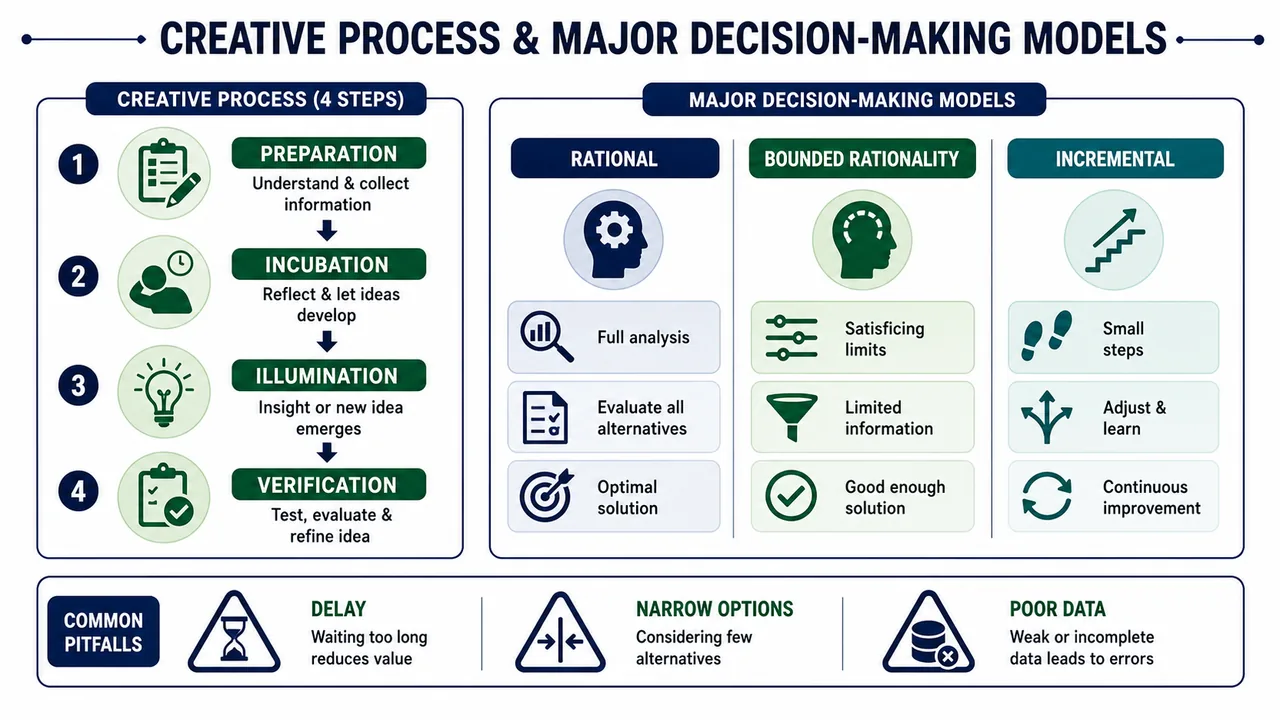
Some NABARD-style questions do not ask the general process directly. Instead, they ask about the creative process used while generating and testing alternatives. The classic sequence is:
- Preparation: gather facts, define the issue, and understand the problem clearly
- Incubation: allow the mind to process the problem, often away from direct pressure
- Illumination: the fresh idea or insight appears
- Verification: test whether the idea actually works in reality
This matters because a bright idea is not the end of decision making. Verification is the stage that checks whether the idea survives feasibility, evidence, and implementation reality.
If a question asks:
- which stage gathers material first -> preparation
- which stage gives the "aha" insight -> illumination
- which stage checks workability -> verification
Simon's Stages of Decision Making
Herbert Simon gave one of the most influential explanations of the decision process. His stages are usually presented as:
- Intelligence
- Design
- Choice
- Implementation
Intelligence
This is the stage of searching for and identifying the problem. The decision-maker scans the environment, notices a gap, and recognises that action is needed.
Design
This is the stage of creating and analysing possible alternatives. The person explores possible solutions rather than selecting immediately.
Choice
This is the stage of selecting one alternative from the available options.
Implementation
This is the stage of putting the chosen option into effect and assessing its results.
You can see that Simon's model is not different from the general process; it is simply a more compact and influential way of expressing it.
Why Models Are Needed
A model is a simplified representation of how decision making happens. Models help because:
- real situations are complex
- not all decision-makers behave in the same way
- different situations require different assumptions
Models therefore explain whether the decision-maker is expected to be perfectly logical, practically limited, intuitive, political, or gradual in approach.
Major Decision-Making Models
Rational model
This model assumes that the decision-maker:
- knows the objective clearly
- identifies all relevant alternatives
- gathers enough information
- compares alternatives systematically
- chooses the option that maximises benefit
It is a useful ideal model, but it often assumes more clarity and information than reality provides.
Bounded rationality model
This model accepts that decision-makers face limits such as:
- incomplete information
- limited time
- limited attention
- limited computational ability
So instead of finding the perfect option, they often choose a satisficing option, meaning one that is good enough and workable.
Intuitive model
This relies more on experience, pattern recognition, and judgment than on long formal analysis. It becomes important when:
- time is short
- experience is rich
- the situation is familiar but hard to quantify
Behavioural model
This model recognises that real decisions are influenced by attitudes, perceptions, habits, and psychological limitations, not just formal logic.
Incremental model
This model favours small step-by-step adjustments rather than one large comprehensive redesign. It is useful when the environment is uncertain and full redesign is risky or impractical.
Comparing the Rational and Bounded Rational Approaches
| Basis | Rational Model | Bounded Rationality |
|---|---|---|
| Information | Assumes extensive information | Accepts incomplete information |
| Alternatives | Assumes broad search | Search is limited |
| Choice goal | Best or optimal | Good enough or satisfactory |
| Time and capacity | Treated as sufficient | Treated as limited |
| Realism | Ideal and normative | More realistic and practical |
This comparison is heavily tested because many questions ask whether the decision-maker is trying to optimise or satisfice.
Common Process Failures
A decision can fail at any stage:
- wrong problem identified
- too little or irrelevant information collected
- criteria not defined clearly
- too few alternatives generated
- evaluation influenced by bias
- implementation neglected
- no review after action
Whenever a question asks why an apparently reasonable decision failed, try to locate the broken stage in the process.
Worked Examples
Example 1: Wrong diagnosis
A manager thinks sales are falling because of poor staff effort, but the real problem is delayed supply.
Lesson: The process failed at the problem-identification stage.
Example 2: Many options but no criteria
A committee discusses several alternatives but has no standards for comparison.
Lesson: The evaluation stage becomes weak when criteria are undefined.
Example 3: Good choice, poor execution
A strong alternative is selected, but no one is assigned responsibility for implementation.
Lesson: Decision quality includes implementation, not just selection.
Example 4: Good enough under constraints
A manager chooses a practical option before the deadline instead of waiting endlessly for a perfect option.
Lesson: This reflects bounded rationality or satisficing.
Summary Cheat Sheet
| Concept / Topic | Key Details / Explanation |
|---|---|
| Process vs models | Process explains the sequence of good decision making, while models explain the logic and assumptions behind how decisions are made. |
| Usual decision process | The standard flow is problem identification -> information gathering -> criteria setting -> alternatives -> evaluation -> choice -> implementation -> review. |
| Meaning of each stage | Weak decisions often fail early because of wrong problem definition, poor facts, unclear criteria, or too few alternatives. |
| Simon's stages | Simon's model includes Intelligence, Design, Choice, and Implementation. |
| Rational model | The rational model assumes clear goals, broad alternative search, enough information, and optimisation of the best option. |
| Bounded rationality | Bounded rationality accepts practical limits of time, information, and attention, so decision-makers often choose a satisficing option. |
| Other useful models | Intuitive, behavioural, and incremental models explain why real decisions often differ from ideal full rationality. |
| Creative-process stages | Preparation -> Incubation -> Illumination -> Verification is a classic creativity sequence tested inside decision-making questions. |
| Criteria vs constraints | Criteria are standards of comparison, while constraints are limits that alternatives must respect; both matter mainly during evaluation and final selection. |
| Exam solving rule | In questions, ask whether the issue is a broken stage in the process or the type of model/assumption being used. |
Mini Practice
Which stage of Simon's model is concerned with identifying the problem?
intelligence. Intelligence is the scanning and problem-recognition stage.
Why are criteria important in the decision process?
because they provide the basis for comparing alternatives. Without criteria, evaluation becomes random or subjective.
Which model assumes optimisation through full analysis?
the rational model. It assumes clear goals, enough information, and systematic comparison.
Which model accepts limited information and satisficing?
bounded rationality. It recognises practical limits in real-world decision making.
If a good option is selected but not acted upon, which stage has failed?
implementation. Decision making is incomplete until the chosen action is carried out. ---
Lesson Doubts
Ask questions, get expert answers