🎯 Approaches, Biases and Decision Errors
Not every wrong decision is caused by lack of intelligence. Many poor decisions happen because the decision-maker uses a narrow approach, relies on mental shortcuts, or commits predictable errors in judgment. This lesson matters because once you understand how decisions go wrong, you become much better at eliminating wrong options in theory questions and caselets.
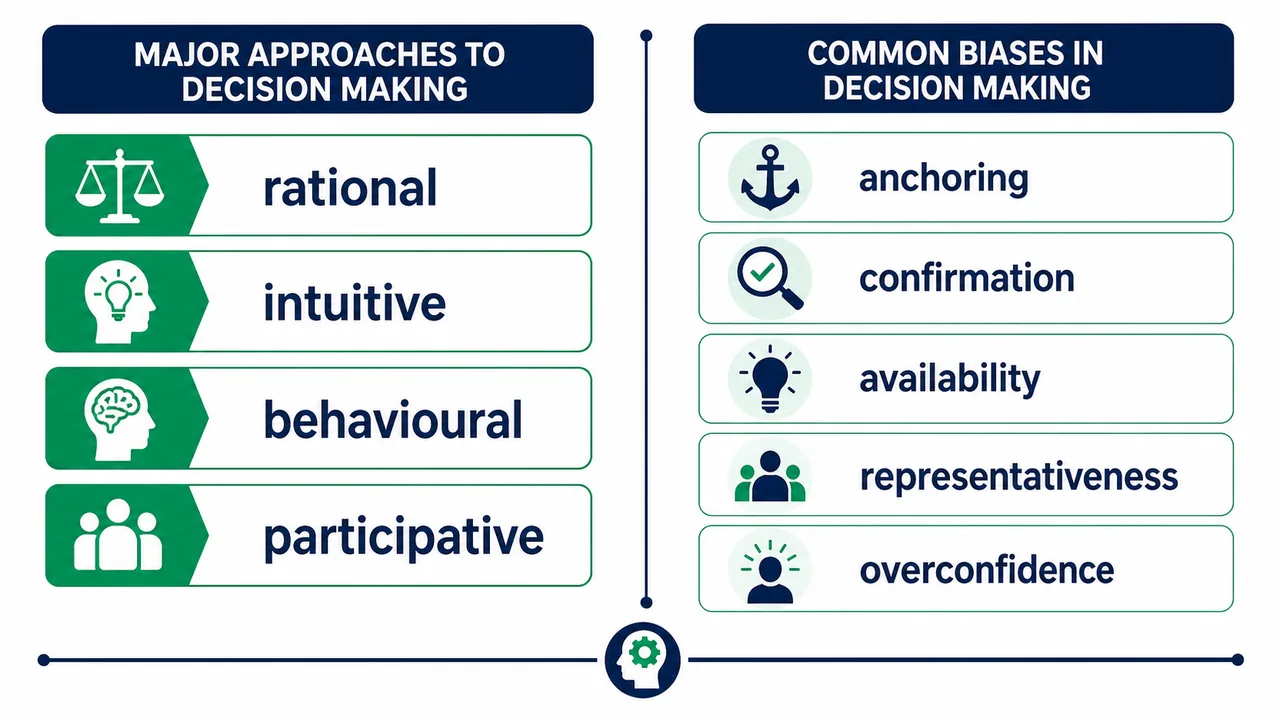
Major Approaches to Decision Making
An approach means the general way in which a person or organisation tries to decide. Different approaches become suitable in different situations.
Rational or analytical approach
This approach emphasises:
- clear objectives
- facts and evidence
- comparison of alternatives
- logical evaluation
It is strongest when information is available and the problem can be analysed systematically.
Intuitive approach
This approach depends more on experience, judgment, and pattern recognition. It becomes useful when:
Pro Content Locked
Upgrade to Pro to access this lesson and all other premium content.
₹99 charged monthly · Cancel anytime
- All Agriculture & Banking Courses
- AI Lesson Questions (100/day)
- AI Doubt Solver (50/day)
- Glows & Grows Feedback (30/day)
- AI Section Quiz (20/day)
- 22-Language Translation (100/day)
- Recall Questions (20/day)
- AI Quiz (15/day)
- AI Quiz Paper Analysis (100/day)
- AI Step-by-Step Explanations (100/day)
- Spaced Repetition Recall (FSRS)
- AI Tutor
- Immersive Text Questions
- Audio Lessons — Hindi & English
- Mock Tests & Previous Year Papers
- Summary & Mind Maps
- XP, Levels, Leaderboard & Badges
- Generate New Classrooms
- Voice AI Teacher (AgriDots Live)
- AI Revision Assistant
- Knowledge Gap Analysis
- Interactive Revision (LangGraph)
🔒 Secure via Razorpay · Cancel anytime · No hidden fees
Not every wrong decision is caused by lack of intelligence. Many poor decisions happen because the decision-maker uses a narrow approach, relies on mental shortcuts, or commits predictable errors in judgment. This lesson matters because once you understand how decisions go wrong, you become much better at eliminating wrong options in theory questions and caselets.
Major Approaches to Decision Making
An approach means the general way in which a person or organisation tries to decide. Different approaches become suitable in different situations.
Rational or analytical approach
This approach emphasises:
- clear objectives
- facts and evidence
- comparison of alternatives
- logical evaluation
It is strongest when information is available and the problem can be analysed systematically.
Intuitive approach
This approach depends more on experience, judgment, and pattern recognition. It becomes useful when:
- time is limited
- the decision-maker has rich prior experience
- the situation is hard to express fully in numbers
Behavioural approach
This approach recognises that people are not perfect calculating machines. Their decisions are affected by:
- perception
- values
- habits
- emotions
- social influence
Quantitative approach
This approach uses measurable data, numerical comparison, and formal tools. It is appropriate when the issue can be expressed in terms of cost, time, output, probability, or similar measurable criteria.
Participative approach
This approach involves consultation, group input, and broader discussion. It is useful when:
- acceptance matters
- many stakeholders are involved
- no single person has all the knowledge
What Cognitive Bias Means
A cognitive bias is a systematic tendency to think in a distorted way while believing that one is being reasonable. Bias is dangerous because it does not always look like error from inside the mind. The person often feels confident even while judging poorly.
Biases matter because they can distort:
- what information we notice
- how we interpret evidence
- which option we prefer
- how much risk we think exists
Common Biases You Must Know
Anchoring bias
The mind becomes overly influenced by the first piece of information received. Even if later information is stronger, the initial anchor keeps pulling judgment toward itself.
Confirmation bias
The person searches for or gives more weight to information that supports an existing belief while ignoring information that challenges it.
Availability bias
The person relies too heavily on information that is easy to recall, recent, dramatic, or familiar rather than on information that is more representative.
Representativeness bias
The person judges based on similarity to a known pattern, sometimes ignoring real probability or deeper evidence.
Overconfidence bias
The person believes too strongly in his or her own judgment, predictions, or ability to control outcomes.
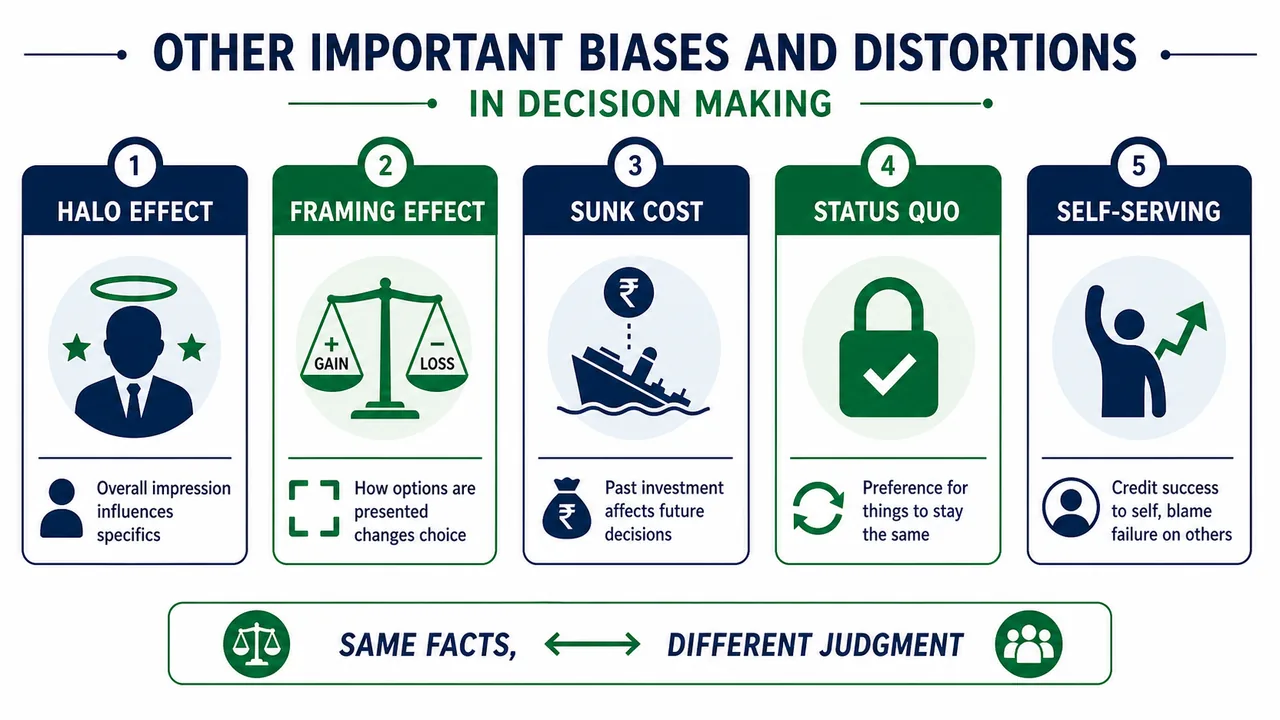
Other Important Biases and Distortions
Halo effect
One positive or negative trait influences the entire judgment. For example, a person's communication skill may cause others to assume that the person's proposal is also technically strong.
Framing effect
The same information leads to different decisions depending on how it is presented. People react differently to "90% success" and "10% failure" even though the information is logically identical.
Sunk cost bias
A person continues with a weak course of action simply because time, money, or reputation has already been invested in it.
Status quo bias
The person prefers to keep things unchanged even when change may be justified.
Self-serving bias
Success is attributed to one's own ability, while failure is blamed on external factors. This weakens honest learning.
Why the Mind Falls Into Bias
Bias is common because the human mind wants to save effort. Instead of re-analysing every decision from the beginning, it often uses shortcuts. These shortcuts are useful for speed, but they become dangerous when:
- the stakes are high
- the facts are incomplete
- emotions are active
- the situation is unfamiliar
- group pressure is present
So bias is not simply "bad character." It is often a side effect of limited attention, limited time, and simplified mental processing. The real skill is learning to detect and correct it.
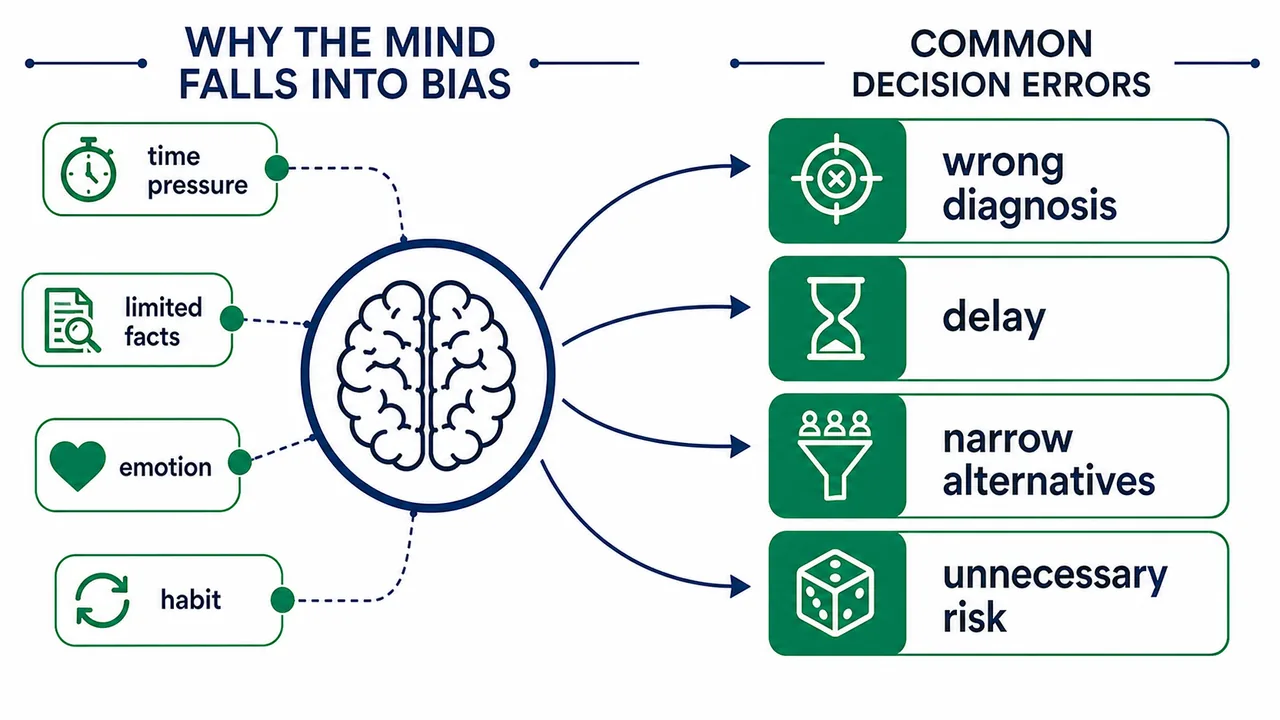
Common Decision Errors
Biases are mental tendencies; decision errors are the wrong outcomes or faulty steps that result from them. Common decision errors include:
- defining the problem wrongly
- using too little relevant information
- using too much irrelevant information
- generating too few alternatives
- evaluating options on weak criteria
- delaying the decision unnecessarily
- becoming rigid and refusing correction
- ignoring long-term consequences
A very important exam point is this: a person may commit an error without having bad intentions. The error may result from poor process, poor interpretation, or poor self-control.
Worked Examples
Example 1: Fixation on the first estimate
A manager hears the first project-cost estimate and keeps comparing everything to that number even after more realistic estimates arrive.
Best interpretation: anchoring bias.
Example 2: Only listening to supportive evidence
A decision-maker believes a scheme will work and only reads reports that support that belief.
Best interpretation: confirmation bias.
Example 3: Continuing a weak plan due to past investment
A team continues funding a poor initiative because it has already spent a lot on it.
Best interpretation: sunk cost thinking and possible escalation tendency.
Example 4: Attractive presenter, weak proposal
A speaker is impressive, so the committee assumes the proposal is technically sound without proper review.
Best interpretation: halo effect.
Summary Cheat Sheet
| Concept / Topic | Key Details / Explanation |
|---|---|
| Major approaches | Decision making may follow rational, intuitive, behavioural, quantitative, or participative approaches depending on the situation. |
| Meaning of bias | A bias is a systematic distortion in judgment, not just a random mistake. It changes what information we notice and how we interpret it. |
| Core biases | Major biases include anchoring, confirmation, availability, representativeness, and overconfidence. |
| Other important distortions | Also remember halo effect, framing effect, sunk cost bias, status quo bias, and self-serving bias. |
| Why bias happens | Biases arise because the mind uses shortcuts under time pressure, limited attention, uncertainty, and emotional influence. |
| Common decision errors | Typical errors include wrong diagnosis, weak or irrelevant facts, narrow alternatives, poor criteria, delay, and rigidity. |
| Bias vs error | Bias is the mental tendency; error is the visible faulty outcome or poor decision step that results from it. |
| Exam solving rule | First identify whether the question is testing the approach, the bias, or the decision error. |
Mini Practice
Which bias makes a person rely too much on the first piece of information?
anchoring bias. The initial reference point keeps influencing later judgment disproportionately.
Which bias makes people seek evidence that supports their existing belief?
confirmation bias. It encourages selective attention and selective interpretation.
Why is framing dangerous?
because the same fact can be judged differently depending on presentation. Good decision making should examine substance, not only wording.
Which error occurs when no real alternative search is done?
narrow-alternative error. If only one or two options are considered, the quality of comparison becomes weak.
Are biases always intentional?
no. Many biases arise automatically from limited attention, mental shortcuts, and emotional pressure. ---
Lesson Doubts
Ask questions, get expert answers