🌐 Decision Context and Environment Tools
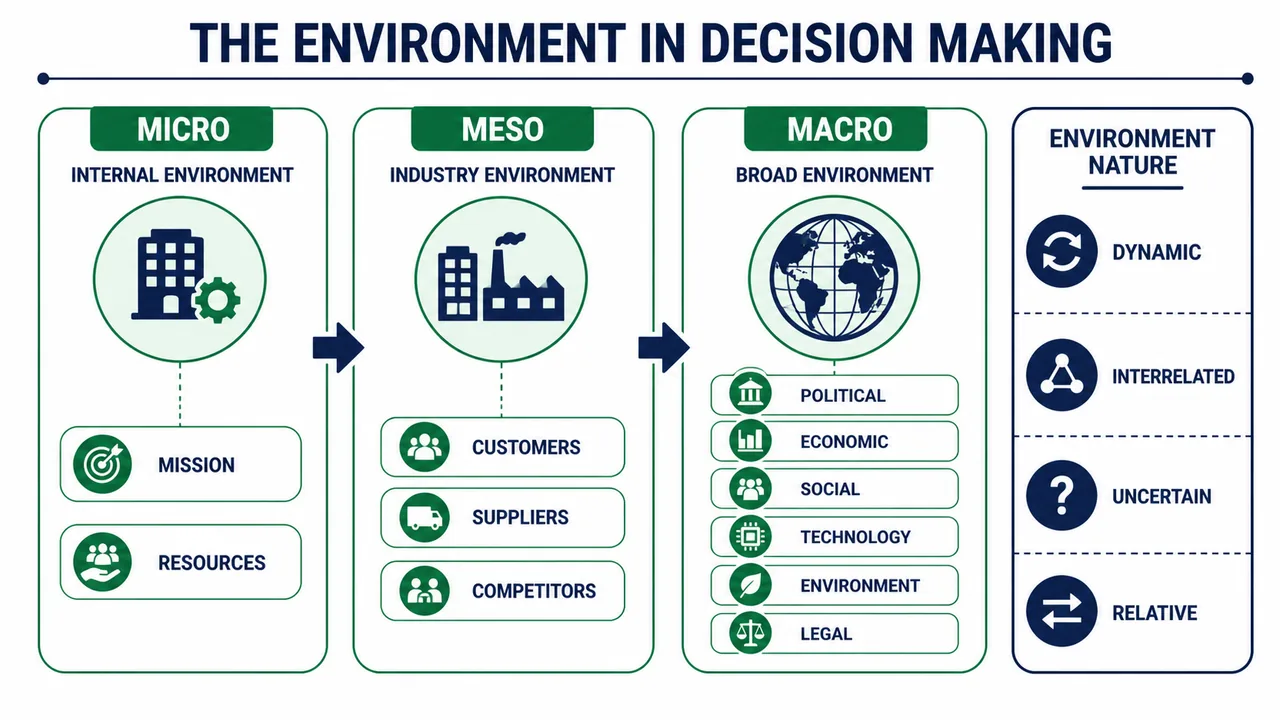
A decision is never made in a vacuum. Even a logically sound choice can fail if the decision-maker ignores the environment surrounding the organisation. That environment includes internal strengths and weaknesses, industry pressures, and broader political, economic, social, technological, environmental, and legal forces.
Business Environment and Decision Making
The business environment is the total set of forces that affect the functioning of an organisation. These forces create:
- opportunities
- threats
- constraints
- uncertainty
So decision quality depends not only on internal reasoning but also on external awareness. A decision that ignores the surrounding context may look good in theory and still fail in practice.
Internal and External Environment
Internal environment
This refers to the factors inside the organisation, such as:
Pro Content Locked
Upgrade to Pro to access this lesson and all other premium content.
₹99 charged monthly · Cancel anytime
- All Agriculture & Banking Courses
- AI Lesson Questions (100/day)
- AI Doubt Solver (50/day)
- Glows & Grows Feedback (30/day)
- AI Section Quiz (20/day)
- 22-Language Translation (100/day)
- Recall Questions (20/day)
- AI Quiz (15/day)
- AI Quiz Paper Analysis (100/day)
- AI Step-by-Step Explanations (100/day)
- Spaced Repetition Recall (FSRS)
- AI Tutor
- Immersive Text Questions
- Audio Lessons — Hindi & English
- Mock Tests & Previous Year Papers
- Summary & Mind Maps
- XP, Levels, Leaderboard & Badges
- Generate New Classrooms
- Voice AI Teacher (AgriDots Live)
- AI Revision Assistant
- Knowledge Gap Analysis
- Interactive Revision (LangGraph)
🔒 Secure via Razorpay · Cancel anytime · No hidden fees
A decision is never made in a vacuum. Even a logically sound choice can fail if the decision-maker ignores the environment surrounding the organisation. That environment includes internal strengths and weaknesses, industry pressures, and broader political, economic, social, technological, environmental, and legal forces.
Business Environment and Decision Making
The business environment is the total set of forces that affect the functioning of an organisation. These forces create:
- opportunities
- threats
- constraints
- uncertainty
So decision quality depends not only on internal reasoning but also on external awareness. A decision that ignores the surrounding context may look good in theory and still fail in practice.
Internal and External Environment
Internal environment
This refers to the factors inside the organisation, such as:
- mission
- objectives
- policies
- resources
- staff capability
- organisational culture
External environment
This refers to forces outside the organisation, such as:
- customers or beneficiaries
- competitors
- suppliers
- regulators
- technology changes
- social and economic conditions
This distinction is important because some factors can be controlled or shaped internally, while others must be understood and responded to externally.
Characteristics of the Environment
The environment is often described as having the following characteristics:
- totality of forces: many influences operate together
- specific and general forces: some affect only a given organisation, while others affect the wider system
- inter-relatedness: one factor can influence several others
- dynamic nature: the environment changes over time
- uncertainty: future conditions cannot always be predicted clearly
- relativity: the same environment may affect organisations differently
These characteristics explain why environmental scanning is an ongoing activity, not a one-time exercise.
Layers of the Environment
The environment can be understood at three useful levels.
Micro level
The internal or immediate organisational setting, including mission, policies, structure, and resources.
Meso level
The industry or sectoral environment, including customers, competitors, suppliers, and regulators.
Macro level
The broad societal environment, including economic, political, technological, social, environmental, and legal forces.
In easy language:
- micro = inside the organisation
- meso = around the organisation in its operating field
- macro = the wider world shaping the field itself
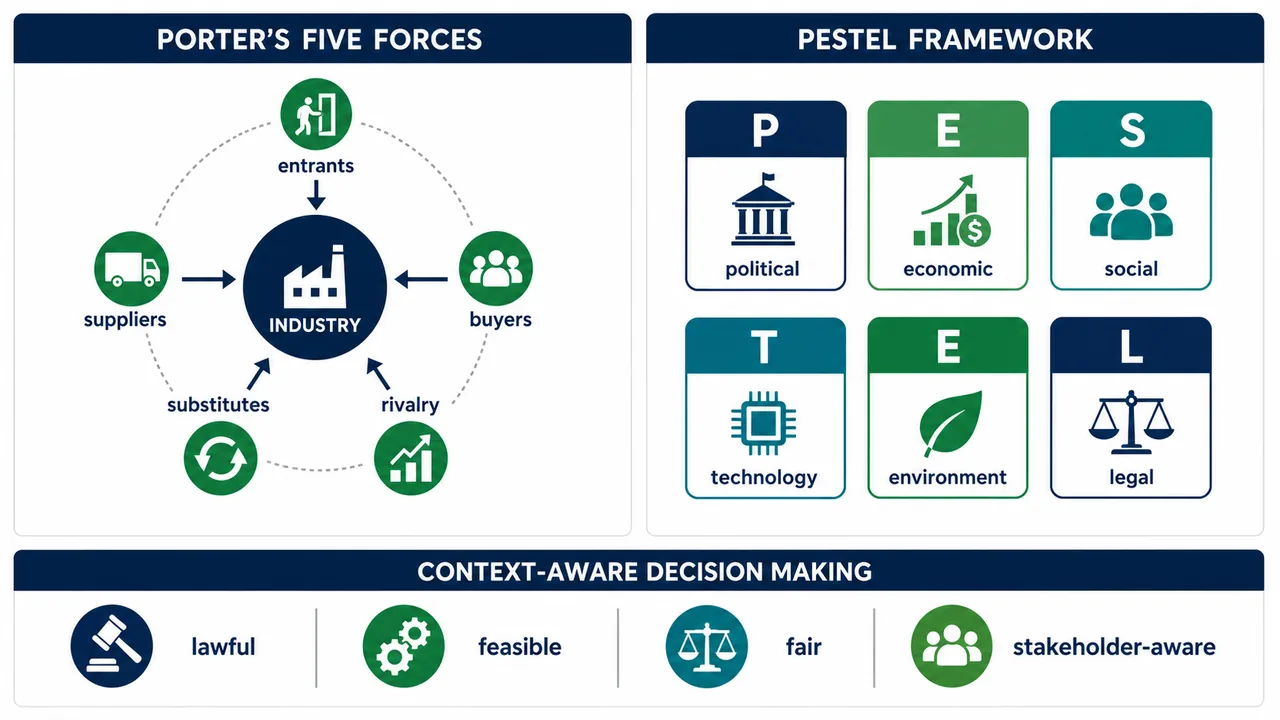
Porter's Five Forces
Porter's framework is used mainly to study the industry or meso environment. It asks how much competitive pressure exists around the organisation.
The five forces are:
- threat of new entrants
- bargaining power of suppliers
- bargaining power of buyers
- threat of substitutes
- rivalry among existing competitors
This framework helps explain why a decision that looks attractive internally may still become difficult in the industry environment.
For example:
- strong suppliers may raise costs
- powerful buyers may pressure prices
- substitutes may reduce demand
- intense rivalry may reduce profitability
PESTEL Analysis
PESTEL is used to scan the macro environment. It studies:
- political factors
- economic factors
- social factors
- technological factors
- environmental factors
- legal factors
The key idea is that broad outside forces influence decisions even when the organisation does not control them directly.
Examples:
- policy change affects regulation
- inflation affects costs and purchasing power
- social change affects demand and behaviour
- technology affects methods and competition
- environmental rules affect compliance
- legal change affects operations and accountability
Why These Tools Matter for Decision Context
Porter and PESTEL do different jobs:
- Porter analyses industry-level competitive pressure
- PESTEL analyses broad external environmental forces
Together they help a decision-maker answer two different questions:
- what pressures exist in the immediate field?
- what larger forces are shaping that field?
Decision Making as a Mental and Contextual Process
Decision making is both:
- a mental process of selecting a course of action
- a contextual process shaped by environment, rules, and stakeholders
This is especially important in exam caselets. A good option is usually not only personally sensible but also:
- lawful
- consistent with institutional rules
- aware of constraints
- fair to affected people
That is why environmental understanding and ethical decision logic often meet in the same question.
Worked Examples
Example 1: New competitor pressure
A new institution enters the same market and begins attracting the same customer segment.
Best framework: Porter's Five Forces, specifically threat of new entrants.
Example 2: Rising compliance requirements
A new government rule changes reporting and monitoring obligations.
Best framework: PESTEL, especially legal and political factors.
Example 3: Internal capacity issue
A strong plan fails because the organisation lacks trained staff and systems.
Best interpretation: internal environment weakness.
Example 4: Conflict-of-interest caselet
A person is pressured to bend rules for a known contact.
Best decision logic: choose the humane but rule-consistent option rather than personal favour.
Summary Cheat Sheet
| Concept / Topic | Key Details / Explanation |
|---|---|
| Decision context | Decision context includes internal factors, industry pressures, and broad external environmental forces. |
| Internal environment | Internal environment covers mission, objectives, policies, resources, staff capability, and organisational culture. |
| External environment | External environment includes customers, competitors, suppliers, regulators, technology, and wider social-economic conditions. |
| Characteristics of environment | The environment is dynamic, interrelated, uncertain, and relative, so it must be studied continuously. |
| Micro, meso, macro | Micro = inside the organisation, Meso = industry/sector field, Macro = political, economic, social, technological, environmental, and legal world. |
| Porter's Five Forces | Porter analyses industry competition through entrants, supplier power, buyer power, substitutes, and rivalry. |
| PESTEL analysis | PESTEL analyses Political, Economic, Social, Technological, Environmental, and Legal macro forces. |
| Exam solving rule | Good decisions are mental choices made with environmental awareness, legal consistency, and stakeholder fairness, not isolated personal judgment. |
Mini Practice
What is the basic role of the business environment in decision making?
it creates opportunities, threats, constraints, and uncertainty. Decisions succeed only when the surrounding context is understood properly.
Which framework analyses buyers, suppliers, entrants, substitutes, and rivalry?
Porter's Five Forces. It studies industry-level competitive pressure.
Which framework analyses political, economic, social, technological, environmental, and legal forces?
PESTEL analysis. It scans the broad macro environment.
Is internal environment part of decision context?
yes. Mission, resources, policies, structure, and organisational culture all affect what decisions are possible.
Why is a lawful and fair option usually stronger in a caselet?
because decision quality depends on both sound judgment and proper context-awareness. Good decisions must fit institutional rules and stakeholder reality, not just personal opinion. ---
Lesson Doubts
Ask questions, get expert answers