🖥️ Decision Styles, Leadership and Support Systems
Two people can face the same problem and still decide very differently. The reason is not always knowledge; it is often style. Decision style explains the person's natural pattern of choosing, leadership style explains how that person's decision process affects others, and support systems explain how technology assists the process.
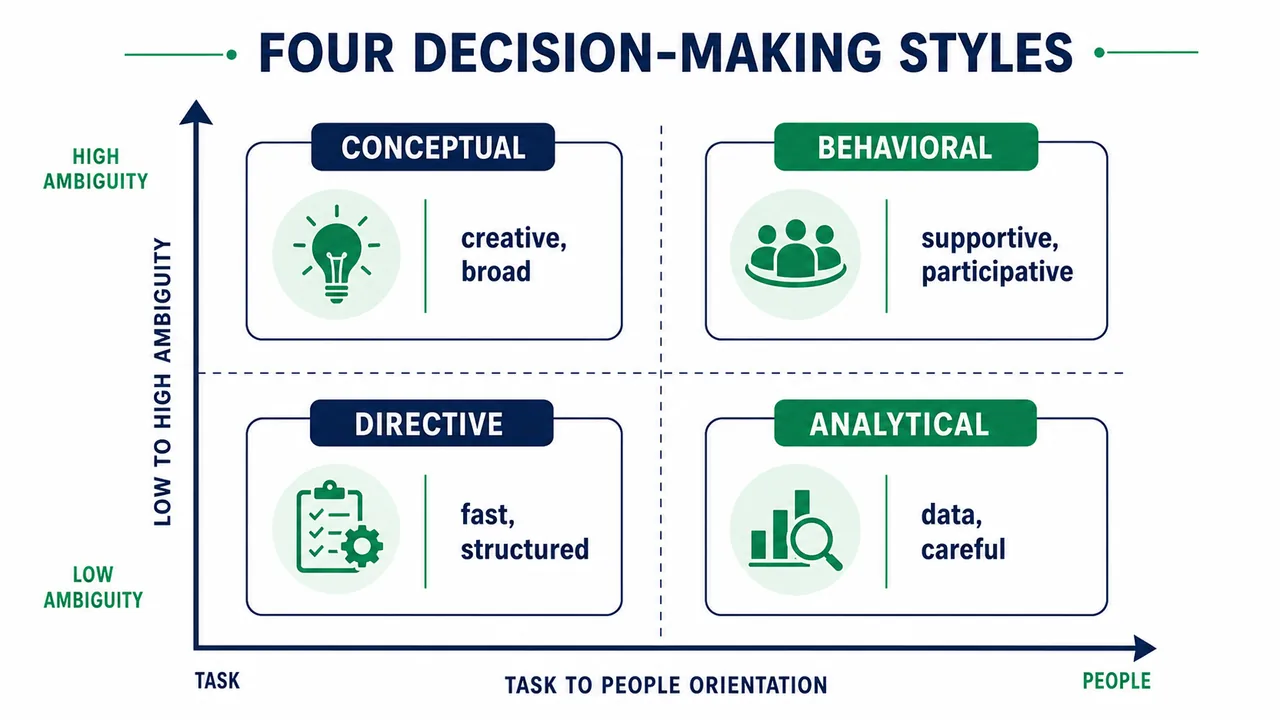
Decision-Making Styles
For NABARD, the safest framework is the classic four-style model used in recent papers:
Directive style
- low tolerance for ambiguity
- strong preference for logic, rules, and clarity
- fast decisions
- limited alternative search
- short-term and efficiency-focused
This style is useful when quick action is needed, but it may become too narrow if the situation is complex.
Analytical style
- higher tolerance for ambiguity than directive style
- strong data orientation
- careful comparison of many alternatives
- slower but more thorough
This style is useful when the problem is complex and information can be gathered, but it can suffer from over-analysis.
Pro Content Locked
Upgrade to Pro to access this lesson and all other premium content.
₹99 charged monthly · Cancel anytime
- All Agriculture & Banking Courses
- AI Lesson Questions (100/day)
- AI Doubt Solver (50/day)
- Glows & Grows Feedback (30/day)
- AI Section Quiz (20/day)
- 22-Language Translation (100/day)
- Recall Questions (20/day)
- AI Quiz (15/day)
- AI Quiz Paper Analysis (100/day)
- AI Step-by-Step Explanations (100/day)
- Spaced Repetition Recall (FSRS)
- AI Tutor
- Immersive Text Questions
- Audio Lessons — Hindi & English
- Mock Tests & Previous Year Papers
- Summary & Mind Maps
- XP, Levels, Leaderboard & Badges
- Generate New Classrooms
- Voice AI Teacher (AgriDots Live)
- AI Revision Assistant
- Knowledge Gap Analysis
- Interactive Revision (LangGraph)
🔒 Secure via Razorpay · Cancel anytime · No hidden fees
Two people can face the same problem and still decide very differently. The reason is not always knowledge; it is often style. Decision style explains the person's natural pattern of choosing, leadership style explains how that person's decision process affects others, and support systems explain how technology assists the process.
Decision-Making Styles
For NABARD, the safest framework is the classic four-style model used in recent papers:
Directive style
- low tolerance for ambiguity
- strong preference for logic, rules, and clarity
- fast decisions
- limited alternative search
- short-term and efficiency-focused
This style is useful when quick action is needed, but it may become too narrow if the situation is complex.
Analytical style
- higher tolerance for ambiguity than directive style
- strong data orientation
- careful comparison of many alternatives
- slower but more thorough
This style is useful when the problem is complex and information can be gathered, but it can suffer from over-analysis.
Conceptual style
- high tolerance for ambiguity
- broad outlook
- creative and future-oriented
- considers many possibilities and perspectives
This style is useful for innovation, planning, and uncertain strategic situations.
Behavioral style
- lower tolerance for ambiguity
- people-oriented
- supportive and relationship-sensitive
- open to suggestions and participation
This style improves acceptance and team harmony, but it may delay tough choices if conflict avoidance becomes too strong.
The Decision Style Matrix
These styles are often understood through two broad dimensions:
- tolerance for ambiguity
- task / technical orientation vs people / social orientation
The logic is simple:
- a structured person prefers order, sequence, and clarity
- an ambiguity-tolerant person is more comfortable exploring multiple possibilities
- a task-oriented person emphasises logic, efficiency, and results
- a people-oriented person gives more weight to participation, relationships, and viewpoints
This matrix helps explain why styles are not random personality labels but patterns of how people handle information and uncertainty.
| Style | Ambiguity tolerance | Orientation | Usual tendency |
|---|---|---|---|
| Directive | Low | Task / logic | quick, structured, efficient |
| Analytical | High | Task / logic | detailed, data-heavy, careful |
| Conceptual | High | People / ideas | broad, creative, long-term |
| Behavioral | Low | People / relationships | supportive, participative, acceptance-seeking |
Leadership Style and Decision Behaviour
Leadership style affects not only what decision is taken but how the decision is reached and accepted.
Common leadership styles include:
- autocratic
- democratic or participative
- laissez-faire
- transformational
- transactional
- bureaucratic
- coaching
- visionary
Different texts may list more styles, but the decision-making logic behind them is the important part.
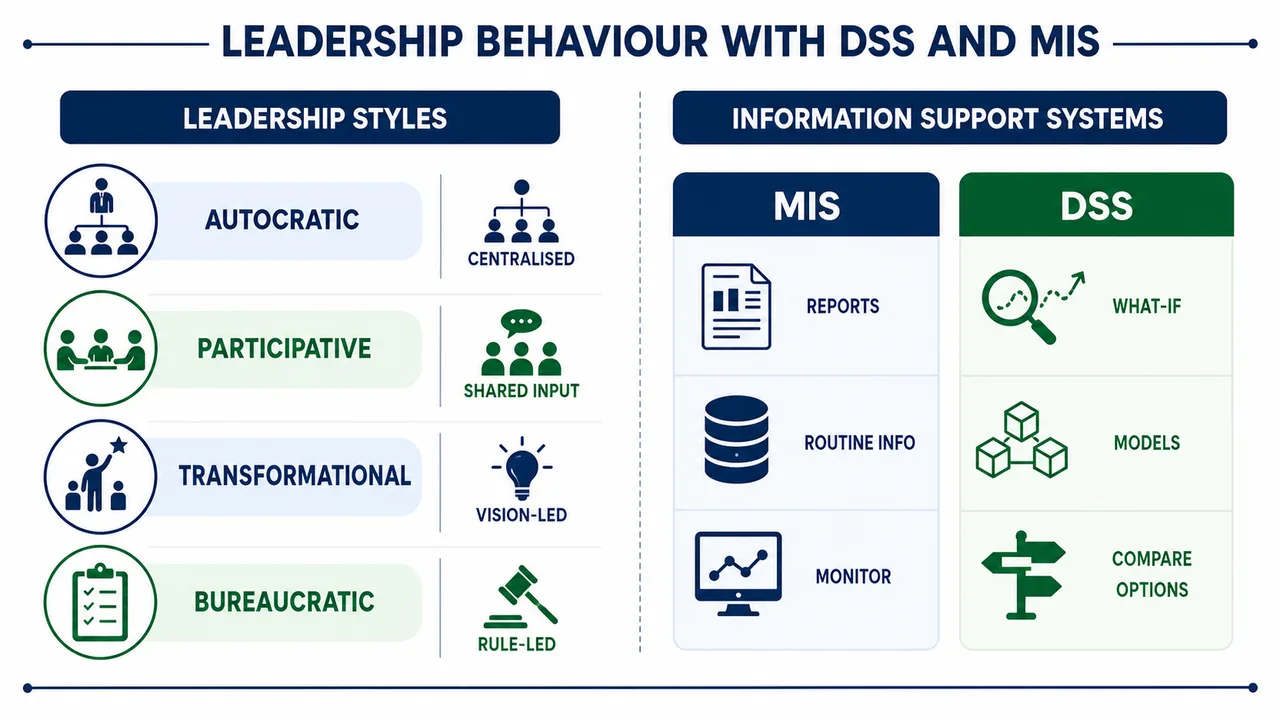
How Leadership Style Changes Decisions
Autocratic
The leader decides quickly and centrally. This is useful in urgent situations but may reduce participation.
Democratic or participative
The leader involves others and values discussion before deciding. This improves acceptance and idea diversity but may slow the process.
Laissez-faire
The leader allows broad delegation and low direct control. This can help capable teams but may create drift where clarity is needed.
Transformational
The leader connects decisions with larger vision and change. This style can energise commitment and long-term orientation.
Transactional
The leader emphasises structure, performance, reward, and correction. This style fits clear targets and control systems.
Bureaucratic
The leader relies strongly on rules, procedures, and formal authority. This helps consistency but may reduce flexibility.
Decision Support System (DSS)
A Decision Support System is a computer-based system that helps managers make semi-structured and unstructured decisions by combining:
- data
- models
- analytical tools
- user-friendly interaction
DSS does not replace the manager. It supports the manager by helping compare alternatives, test assumptions, explore scenarios, and improve judgment in complex situations.
It is most useful when:
- the problem is not fully routine
- several variables must be compared
- the decision has multiple possible outcomes
- a manager wants to test "what if" scenarios before choosing
Management Information System (MIS)
MIS is a system that collects, processes, and supplies organised information needed for planning, control, and management.
Its main purpose is to ensure that managers receive:
- timely information
- relevant information
- usable information
- reasonably accurate information
MIS is not mainly about choosing among alternatives through modelling. Its strength lies in providing organised management information for recurring managerial purposes.
In the wider system hierarchy, you can think of:
- TPS for routine transaction handling
- MIS for reports and summaries
- DSS for scenario-based decision support
- EIS for top-level strategic information
You do not need to memorise every technology detail, but this ladder helps when options are given in pair-comparison form.
DSS and MIS: The Difference
| Basis | DSS | MIS |
|---|---|---|
| Main role | Supports decision analysis | Supplies organised information |
| Problem type | Semi-structured and unstructured | Recurring management needs |
| Nature | Analytical and model-oriented | Information and reporting oriented |
| Use | Helps decide what to do | Helps understand what is happening |
| Typical cue words | what-if, compare, simulate, model | report, summary, monitor, routine information |
This is one of the most common comparison questions in this topic.
Easy memory rule:
- MIS tells the manager what is happening
- DSS helps the manager think through what to do
Worked Examples
Example 1: Quick action with limited information
A manager wants a clear answer quickly and prefers not to analyse too many alternatives.
Best interpretation: directive style.
Example 2: Creative discussion across many viewpoints
A leader wants to explore multiple possibilities and values broad participation.
Best interpretation: conceptual style with participative leadership tendency.
Example 3: Dashboard plus analytical comparison
A manager uses data, models, and scenario testing before choosing among alternatives.
Best interpretation: DSS support.
Example 4: Regular information for planning and control
An organisation wants standardised reports for routine management monitoring.
Best interpretation: MIS support.
Summary Cheat Sheet
| Concept / Topic | Key Details / Explanation |
|---|---|
| Meaning of decision style | Decision style explains how a person naturally approaches choice, uncertainty, and information use. |
| Four major styles | Directive = fast and logic-led; Analytical = data-heavy and careful; Conceptual = broad and creative; Behavioral = people-sensitive and supportive. |
| Style matrix basis | Styles are understood through ambiguity tolerance and task/technical vs people/social orientation. |
| Leadership and decisions | Leadership style affects whether decisions are centralised, participative, delegated, visionary, control-based, or rule-bound. |
| DSS | Decision Support System (DSS) helps with semi-structured and unstructured decisions by combining data, models, and analytical tools. |
| MIS | Management Information System (MIS) provides organised information for planning, monitoring, and control. |
| DSS vs MIS | Quick distinction: MIS informs management, while DSS supports management judgment and choice. |
| Exam solving rule | If the question is about how a person decides, think style. If it says low ambiguity + logic, think directive first. If it is about system support, distinguish DSS from MIS. |
Mini Practice
Which style is fast and action-oriented with limited information?
directive style. It has low tolerance for ambiguity and prefers quick, logical, structured choice.
Which style is most analytical and thorough?
analytical style. It tolerates ambiguity better and seeks more information before deciding.
Which leadership style is most participative?
democratic or participative style. It values team input before final choice.
What does DSS mainly do?
supports semi-structured and unstructured decision analysis. It combines data and models to improve judgment in complex decisions.
What is the simplest difference between MIS and DSS?
MIS provides organised information, while DSS supports analytical decision making. MIS informs; DSS assists choice. ---
Lesson Doubts
Ask questions, get expert answers