🏛️ Political and Advanced Models of Decision Making
Not all decisions are made in a calm world of pure logic. In organisations, people have different goals, different power, and different interests. That is why some decisions are shaped by negotiation, pressure, compromise, and gradual adjustment rather than by full rational calculation alone. This lesson explains that more realistic side of decision making.
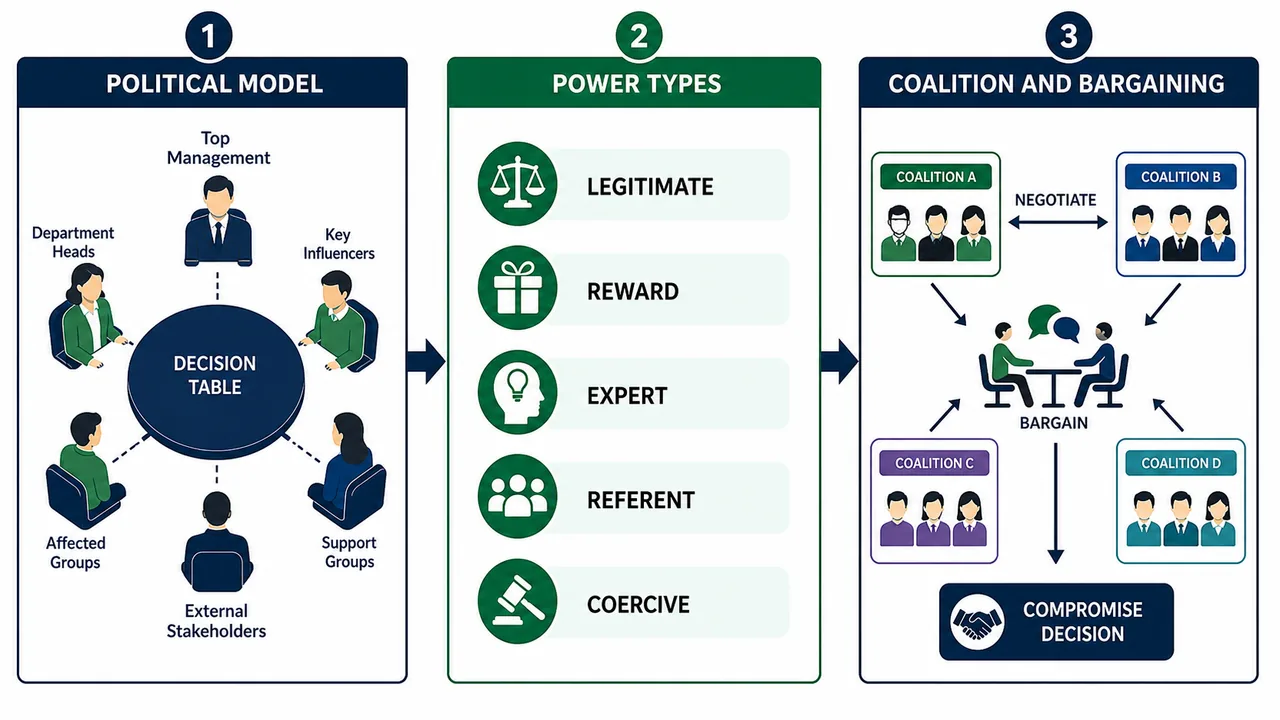
The Political Model
The political model says that decision making in organisations is often influenced by:
- power
- bargaining
- negotiation
- competing interests
- coalition building
This model becomes especially relevant when:
- the problem is complex
- information is incomplete
- departments disagree
- resources are scarce
- stakeholders want different outcomes
Under the political model, the final decision may be less about the objectively best option and more about the option that can gain enough support.
So this model is mainly descriptive rather than ideal. It explains how organisational choices often emerge in real life when preferences are divided.
Pro Content Locked
Upgrade to Pro to access this lesson and all other premium content.
₹99 charged monthly · Cancel anytime
- All Agriculture & Banking Courses
- AI Lesson Questions (100/day)
- AI Doubt Solver (50/day)
- Glows & Grows Feedback (30/day)
- AI Section Quiz (20/day)
- 22-Language Translation (100/day)
- Recall Questions (20/day)
- AI Quiz (15/day)
- AI Quiz Paper Analysis (100/day)
- AI Step-by-Step Explanations (100/day)
- Spaced Repetition Recall (FSRS)
- AI Tutor
- Immersive Text Questions
- Audio Lessons — Hindi & English
- Mock Tests & Previous Year Papers
- Summary & Mind Maps
- XP, Levels, Leaderboard & Badges
- Generate New Classrooms
- Voice AI Teacher (AgriDots Live)
- AI Revision Assistant
- Knowledge Gap Analysis
- Interactive Revision (LangGraph)
🔒 Secure via Razorpay · Cancel anytime · No hidden fees
Not all decisions are made in a calm world of pure logic. In organisations, people have different goals, different power, and different interests. That is why some decisions are shaped by negotiation, pressure, compromise, and gradual adjustment rather than by full rational calculation alone. This lesson explains that more realistic side of decision making.
The Political Model
The political model says that decision making in organisations is often influenced by:
- power
- bargaining
- negotiation
- competing interests
- coalition building
This model becomes especially relevant when:
- the problem is complex
- information is incomplete
- departments disagree
- resources are scarce
- stakeholders want different outcomes
Under the political model, the final decision may be less about the objectively best option and more about the option that can gain enough support.
So this model is mainly descriptive rather than ideal. It explains how organisational choices often emerge in real life when preferences are divided.
Types of Power in Decision Settings
Power explains why some voices influence decisions more than others. Five commonly discussed types are:
- Legitimate power: influence arising from official position or authority
- Reward power: influence arising from the ability to provide benefits or incentives
- Coercive power: influence arising from the ability to punish or threaten
- Expert power: influence arising from knowledge, skill, or technical competence
- Referent power: influence arising from personal appeal, credibility, or identification
These types help explain why the same argument may be accepted from one person and ignored from another.
Coalitions and Bargaining
Coalitions are temporary or lasting alliances formed by people or groups with similar interests. Inside organisations, coalitions may form among:
- departments
- professional groups
- senior and junior blocs
- internal and external stakeholders
Coalitions influence decisions by:
- pooling support
- negotiating trade-offs
- resisting rival proposals
- increasing bargaining power
Coalitions do not always mean wrongdoing. Sometimes they are a normal part of organisational reality. The key issue is whether the coalition helps better judgment or distorts it.
Escalation of Commitment
Escalation of commitment means continuing to support a failing course of action even after evidence turns negative.
Why it happens:
- self-justification
- ego involvement
- fear of admitting error
- hope that one more investment will reverse the situation
- political pressure to defend earlier choices
This is an important concept because many questions describe someone "throwing good money after bad."
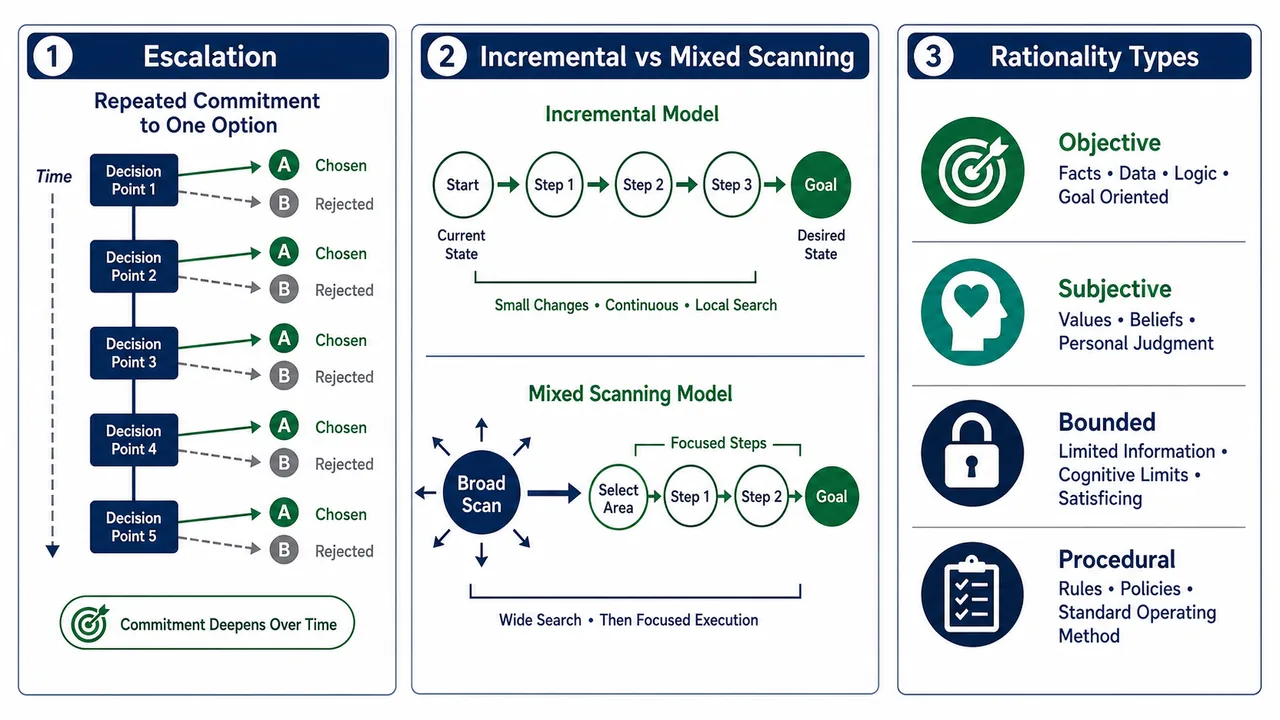
Incremental and Mixed Scanning Models
Lindblom's incremental model
This model supports small step-by-step adjustments instead of one large, fully comprehensive redesign. It is sometimes described as "muddling through."
The logic is:
- large systems are too complex for perfect redesign
- small changes are easier to test and reverse
- practical administration often advances gradually
Etzioni's mixed scanning model
This model tries to combine two strengths:
- broad overall review at a higher level
- incremental adjustment at the detailed level
In simple terms, mixed scanning says: "Look widely first, then move in smaller practical steps."
This makes it a middle path between full rationality and pure incrementalism.
So the clean contrast is:
- rational model = broad and detailed search everywhere
- incremental model = small marginal steps
- mixed scanning = broad scan first, then selective detailed action
Other Advanced Models
Dror's optimal model
This model tries to improve policy-level decision making by going beyond simplistic rational assumptions and encouraging more refined, high-quality public decision processes.
Bounded rationality link
Even though bounded rationality is studied separately, it is relevant here because it explains why political, incremental, and mixed approaches become necessary in real organisations.
Types of Rationality
Management literature sometimes uses different expressions of rationality to show that "rational" does not always mean the same thing.
- Objective rationality: choice judged by ideal correctness
- Subjective rationality: choice judged according to what the decision-maker knows
- Conscious rationality: deliberate thought is actively used
- Organisational rationality: the choice serves the organisation's formal goals
- Personal rationality: the choice serves the individual's personal goals
This distinction is valuable because one decision may be rational for a person but not for the organisation, or rational based on limited knowledge but not objectively best.
High-Yield Contrasts for Questions
Questions in this chapter are easier when you classify the clue first:
| Clue in the question | Best concept to test first |
|---|---|
| support must be negotiated | political model |
| alliance of departments or groups | coalition |
| pressure comes from authority, expertise, reward, or fear | type of power |
| project continues despite bad evidence | escalation of commitment |
| only small marginal changes are preferred | incremental model |
| broad review first, then limited detailed action | mixed scanning |
This chapter becomes difficult only when all models are memorised as abstract names. It becomes manageable once each model is tied to one visible behavioural pattern.
Worked Examples
Example 1: Competing departments
Two departments support different projects and each mobilises support to influence the final choice.
Best interpretation: political model and coalition behaviour.
Example 2: Failing project continues
A leader keeps increasing funding for a weak project because that leader approved it earlier.
Best interpretation: escalation of commitment.
Example 3: Limited policy adjustment
An institution changes a policy gradually through small modifications rather than total redesign.
Best interpretation: incremental model.
Example 4: Broad review plus small-step action
A policy team first studies the broad environment and then makes practical gradual adjustments.
Best interpretation: mixed scanning.
Summary Cheat Sheet
| Concept / Topic | Key Details / Explanation |
|---|---|
| Political model | The political model explains decisions shaped by power, bargaining, negotiation, coalitions, and competing interests. |
| Types of power | Organisational power may be legitimate, reward-based, coercive, expert, or referent. |
| Coalitions | Coalitions are alliances formed to increase influence and bargaining strength in decision settings. |
| Escalation of commitment | This means continuing a failing course of action despite negative evidence, often due to ego, past investment, or pressure. |
| Incremental model | Incrementalism supports small-step practical change instead of one large comprehensive redesign. |
| Mixed scanning | Mixed scanning combines a broad overall review with gradual practical adjustment, acting as a middle path between full rationality and pure incrementalism. |
| Types of rationality | Different forms of rationality show that a decision may be objective, subjective, organisational, personal, or otherwise rational in different senses. |
| Exam solving rule | If the clue is power, pressure, bargaining, coalition, or stubborn continuation of a weak choice, think political model or escalation side. If the clue is small-step adjustment or broad scan plus detailed limited moves, think incremental or mixed-scanning side. |
Mini Practice
When is the political model especially relevant?
when interests conflict, information is incomplete, and support must be negotiated. In such cases, decision making is shaped by power and bargaining.
Which type of power comes from special knowledge or competence?
expert power. Influence arises from recognised expertise rather than position alone.
What is escalation of commitment?
continuing a failing course of action despite adverse evidence. The decision-maker becomes trapped by ego, past investment, or pressure.
Which model is associated with step-by-step change?
Lindblom's incremental model. It favours gradual adjustment over total redesign.
What is the core idea of mixed scanning?
combine broad review with incremental practical action. It balances strategic overview with workable gradual change. ---
Lesson Doubts
Ask questions, get expert answers