🧭 Rationality, Bounded Rationality and Administrative Man
The idea of rationality sits at the heart of decision-making theory. But students often assume that rationality means "perfectly correct decision." That is too simplistic. Rationality means choosing according to reason, objective, and evidence. The real debate in management is whether human beings can ever be fully rational in practice.
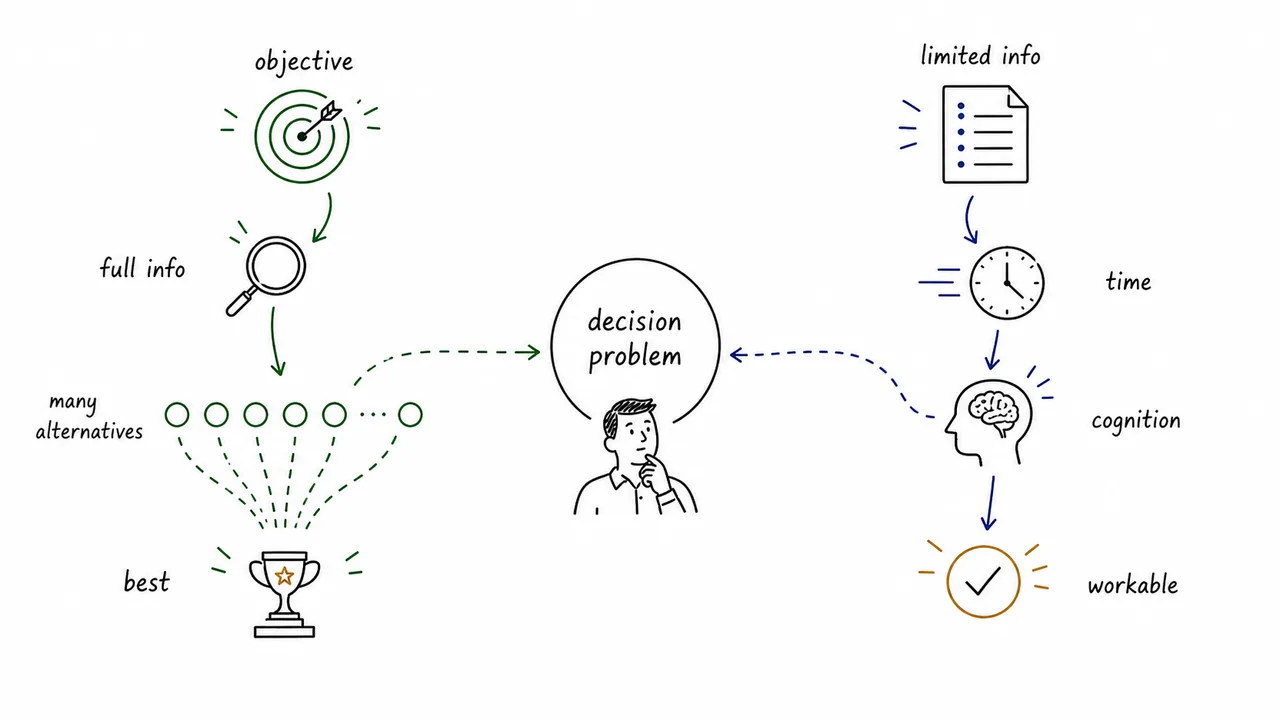
What Rationality Means in Decision Making
Rationality means using reason to choose an alternative that best serves the objective. A rational decision-maker is expected to:
- define the objective clearly
- gather relevant information
- identify alternatives
- compare alternatives logically
- choose the alternative that best meets the objective
This is an attractive ideal because it promises coherence, consistency, and efficiency.
But notice the hidden assumptions:
- all alternatives are known
- all relevant consequences are understood
- enough time is available
- the decision-maker can process all information accurately
These assumptions are powerful in theory but difficult in real life.
Pro Content Locked
Upgrade to Pro to access this lesson and all other premium content.
₹99 charged monthly · Cancel anytime
- All Agriculture & Banking Courses
- AI Lesson Questions (100/day)
- AI Doubt Solver (50/day)
- Glows & Grows Feedback (30/day)
- AI Section Quiz (20/day)
- 22-Language Translation (100/day)
- Recall Questions (20/day)
- AI Quiz (15/day)
- AI Quiz Paper Analysis (100/day)
- AI Step-by-Step Explanations (100/day)
- Spaced Repetition Recall (FSRS)
- AI Tutor
- Immersive Text Questions
- Audio Lessons — Hindi & English
- Mock Tests & Previous Year Papers
- Summary & Mind Maps
- XP, Levels, Leaderboard & Badges
- Generate New Classrooms
- Voice AI Teacher (AgriDots Live)
- AI Revision Assistant
- Knowledge Gap Analysis
- Interactive Revision (LangGraph)
🔒 Secure via Razorpay · Cancel anytime · No hidden fees
The idea of rationality sits at the heart of decision-making theory. But students often assume that rationality means "perfectly correct decision." That is too simplistic. Rationality means choosing according to reason, objective, and evidence. The real debate in management is whether human beings can ever be fully rational in practice.
What Rationality Means in Decision Making
Rationality means using reason to choose an alternative that best serves the objective. A rational decision-maker is expected to:
- define the objective clearly
- gather relevant information
- identify alternatives
- compare alternatives logically
- choose the alternative that best meets the objective
This is an attractive ideal because it promises coherence, consistency, and efficiency.
But notice the hidden assumptions:
- all alternatives are known
- all relevant consequences are understood
- enough time is available
- the decision-maker can process all information accurately
These assumptions are powerful in theory but difficult in real life.
Normative Ideal vs Descriptive Reality
One reason students get confused here is that the chapter mixes two different questions:
- Normative question: how should an ideal decision be made?
- Descriptive question: how do people actually decide in real organisations?
The economic man model is mostly normative and ideal. The administrative man model is more descriptive and realistic. NABARD-style questions often hide this contrast inside one small phrase such as:
- "best possible choice" -> ideal-rational side
- "acceptable workable option" -> realistic administrative side
The Economic Man Model
The economic man model is the classic image of the fully rational decision-maker. It assumes the person:
- has clear and stable goals
- knows all available alternatives
- can compare all consequences
- selects the option that maximises utility or benefit
This model is useful as a normative benchmark. It tells us what perfectly rational choice would look like if all important information and analytical capacity were available.
However, in practice it is often unrealistic because real organisations do not operate in perfect clarity.
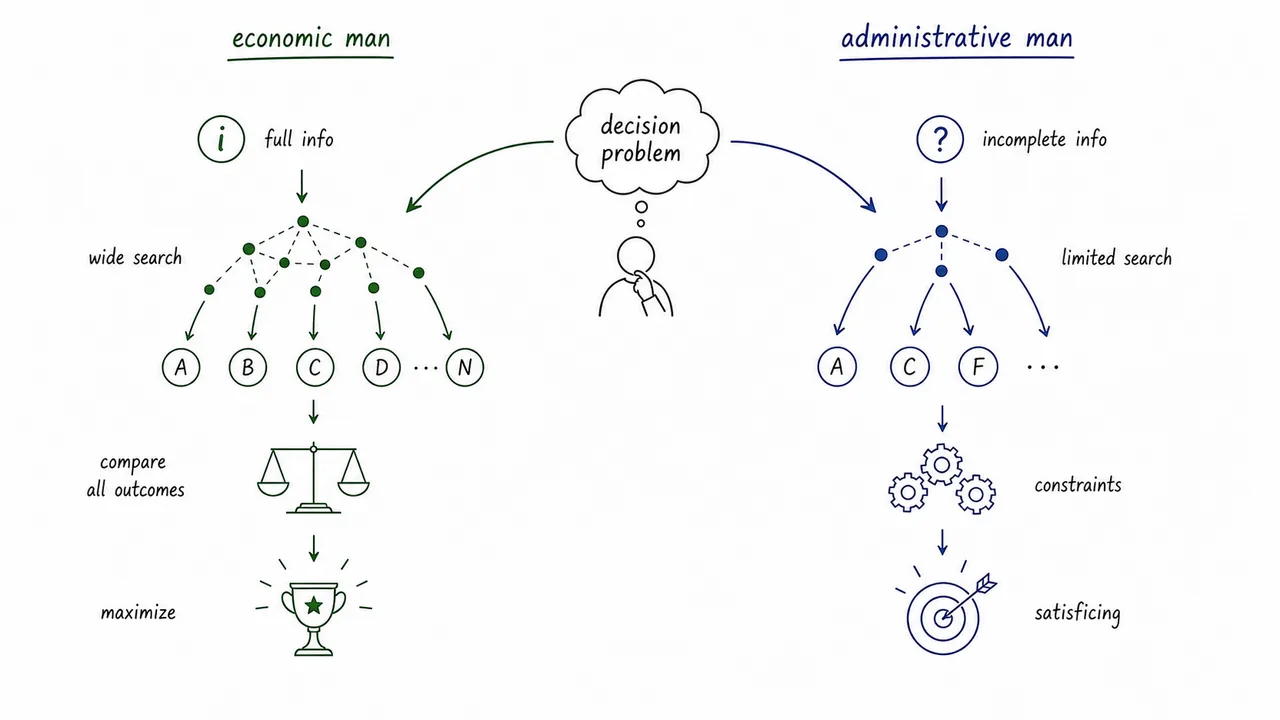
The Administrative Man Model
Herbert Simon introduced the idea of the administrative man to describe how people actually decide inside organisations. Administrative man does not assume perfect optimisation. Instead, it assumes that the decision-maker works under:
- limited information
- limited time
- limited attention
- limited computational ability
- pressure from organisational routines and environment
So instead of choosing the absolute best option, administrative man often chooses a satisficing option, meaning one that is satisfactory and workable.
This is not a sign of laziness. It is a realistic response to practical limits.
Bounded Rationality
Bounded rationality is the concept that human rationality is limited by real-world constraints. A person may want to be rational, but rationality is bounded by:
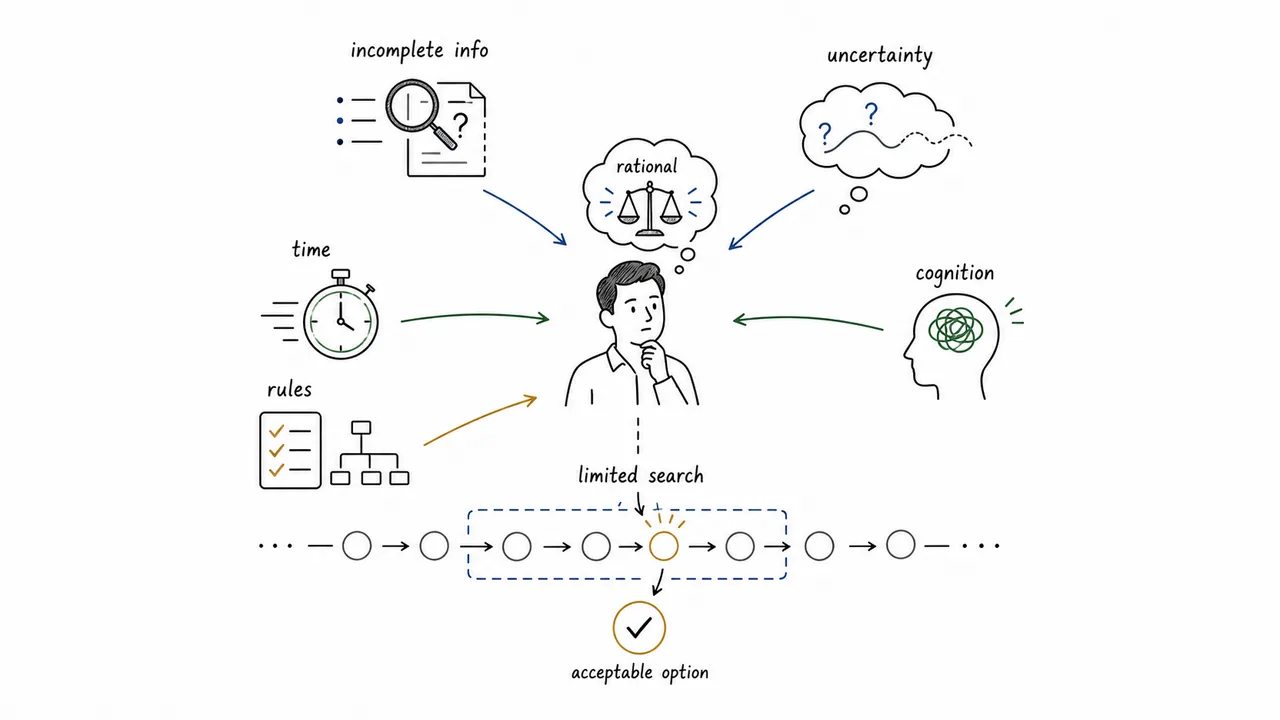
- incomplete information
- uncertainty about the future
- cognitive limitations
- time pressure
- organisational rules and habits
Under bounded rationality, the search for alternatives is usually incomplete, and the final choice is often the first acceptable option rather than the mathematically best one.
Britannica's framing is useful here: the contrast is not only between right and wrong choices, but between substantive rationality and procedural rationality. In exam language:
- substantive rationality asks whether the final choice is the best achievable outcome
- procedural rationality asks whether the decision emerged from an appropriate and sensible process under the actual constraints
This is why a decision can be boundedly rational even when it is not perfect.
Economic Man vs Administrative Man
| Basis | Economic Man | Administrative Man |
|---|---|---|
| Goal | Maximise benefit | Find a satisfactory workable option |
| Information | Assumes full or near-full information | Accepts incomplete information |
| Search | Extensive | Limited |
| Decision rule | Optimisation | Satisficing |
| Realism | Idealised | More realistic |
This comparison is central to exam questions because many statements are actually testing whether the model is ideal-rational or practical-realistic.
Optimising vs Satisficing
This is one of the most tested contrasts in the whole chapter.
- optimising means searching for the best possible option
- satisficing means selecting the first option that adequately meets the essential criteria
Satisficing happens when:
- search is expensive
- time is short
- information is incomplete
- further comparison gives little extra benefit
Satisficing does not mean careless decision making. It means "good enough under real limits," which is exactly why Herbert Simon used it to explain administrative behaviour.
Why Full Rationality Is Rare
Full rationality is rare because:
- problems are often complex
- information is costly and incomplete
- the future changes while the decision is being made
- people differ in perception and priorities
- organisations have rules, politics, and pressures
So even a sincere decision-maker cannot always optimise perfectly. Real decision making is often about reaching a good and defensible decision under constraints.
Practical Implications for Questions
If a question says the decision-maker:
- examined everything fully and chose the maximum benefit -> think economic man or rational model
- chose the first acceptable workable option under limits -> think administrative man or bounded rationality
If the question asks why perfect rationality failed, the answer usually lies in:
- limited information
- uncertainty
- limited time
- limited human processing ability
If a question asks whether a person is being irrational or merely realistic, ask one more thing:
- was the process reasonable given the real constraints?
If yes, the better answer is often bounded rationality rather than irrationality.
Worked Examples
Example 1: Full optimisation assumption
A manager is described as knowing all alternatives, all outcomes, and choosing the maximum payoff.
Best interpretation: economic man or full rationality.
Example 2: Good enough under deadline
A district officer chooses the first option that meets the essential criteria because the deadline is near and information is incomplete.
Best interpretation: bounded rationality and satisficing.
Example 3: Complex organisational environment
A committee cannot evaluate every possible option because data is scattered and time is short.
Best interpretation: administrative man operates under realistic limits.
Summary Cheat Sheet
| Concept / Topic | Key Details / Explanation |
|---|---|
| Meaning of rationality | Rationality means choosing according to reason, objective, and evidence, with logical comparison of alternatives. |
| Economic man model | Economic man represents the ideal of full information, broad comparison, and maximisation / optimisation. |
| Administrative man model | Administrative man represents real organisational decision making under limits of time, information, and attention. |
| Bounded rationality | Bounded rationality means people try to be rational, but rationality is constrained by uncertainty, incomplete information, time pressure, and cognitive limits. |
| Substantive vs procedural rationality | Substantive rationality focuses on the best achievable outcome, while procedural rationality focuses on whether the process was sensible under real constraints. |
| Optimisation vs satisficing | Optimisation belongs to the economic man idea; satisficing belongs to bounded rationality and administrative man. |
| Why full rationality is rare | Full rationality is rare because real life involves complexity, costly information, changing environments, human limits, and organisational pressures. |
| Exam clue words | Full information, best possible choice, and maximum benefit point toward economic man; acceptable option, time pressure, and limited search point toward bounded rationality. |
Mini Practice
What is the main goal of economic man?
optimisation or maximisation. The model assumes the best possible option can be identified and selected.
What is the main goal of administrative man?
satisficing. The choice is satisfactory and workable rather than perfectly optimal.
What does bounded rationality mean?
rationality is limited by information, time, cognitive, and environmental constraints. People try to be rational, but real conditions restrict perfect analysis.
Is a satisficing decision always irrational?
no. Under real limits, a good enough decision may be the most rational practical choice.
Why is full rationality uncommon in organisations?
because complete information and unlimited analysis are rarely available. Real organisations operate under uncertainty, time pressure, and human limits. ---
Lesson Doubts
Ask questions, get expert answers