🛠️ Techniques and Tools of Decision Making
Decision-making tools are not random names to memorise. Each technique exists because a certain type of decision problem keeps appearing in management. If you understand what problem a tool is designed to handle, you can solve most objective questions even when you forget the textbook wording.
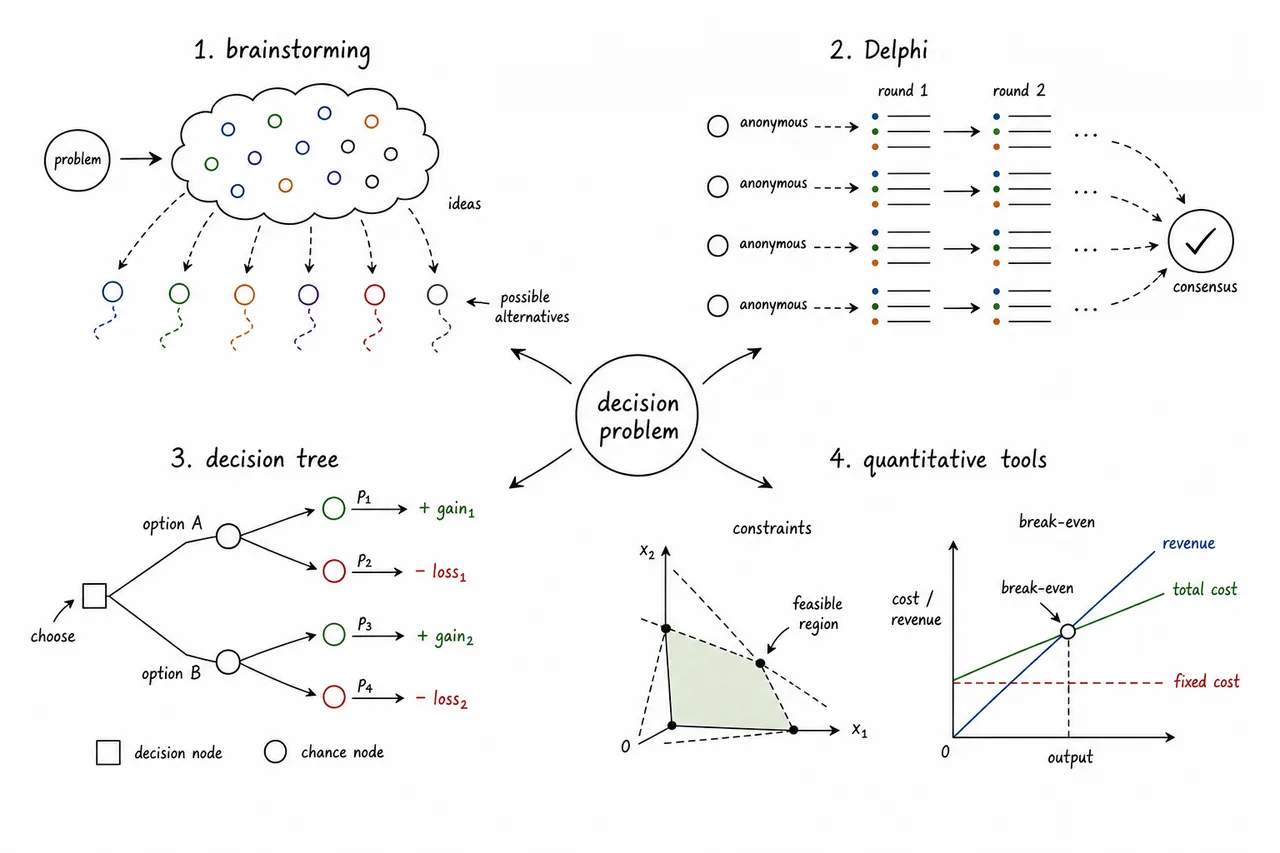
How to Choose a Technique
Before studying the names, understand the selection logic. A decision tool is chosen based on:
- whether the problem is routine or novel
- whether data is qualitative or quantitative
- whether a group must participate
- whether time is limited
- whether optimisation is needed
- whether the future is uncertain
This means the first exam question is not "What is the definition?" but "What kind of problem is being described?"
Broad Approaches Behind the Tools
Four broad approaches often sit behind the tools:
Pro Content Locked
Upgrade to Pro to access this lesson and all other premium content.
₹99 charged monthly · Cancel anytime
- All Agriculture & Banking Courses
- AI Lesson Questions (100/day)
- AI Doubt Solver (50/day)
- Glows & Grows Feedback (30/day)
- AI Section Quiz (20/day)
- 22-Language Translation (100/day)
- Recall Questions (20/day)
- AI Quiz (15/day)
- AI Quiz Paper Analysis (100/day)
- AI Step-by-Step Explanations (100/day)
- Spaced Repetition Recall (FSRS)
- AI Tutor
- Immersive Text Questions
- Audio Lessons — Hindi & English
- Mock Tests & Previous Year Papers
- Summary & Mind Maps
- XP, Levels, Leaderboard & Badges
- Generate New Classrooms
- Voice AI Teacher (AgriDots Live)
- AI Revision Assistant
- Knowledge Gap Analysis
- Interactive Revision (LangGraph)
🔒 Secure via Razorpay · Cancel anytime · No hidden fees
Decision-making tools are not random names to memorise. Each technique exists because a certain type of decision problem keeps appearing in management. If you understand what problem a tool is designed to handle, you can solve most objective questions even when you forget the textbook wording.
How to Choose a Technique
Before studying the names, understand the selection logic. A decision tool is chosen based on:
- whether the problem is routine or novel
- whether data is qualitative or quantitative
- whether a group must participate
- whether time is limited
- whether optimisation is needed
- whether the future is uncertain
This means the first exam question is not "What is the definition?" but "What kind of problem is being described?"
Broad Approaches Behind the Tools
Four broad approaches often sit behind the tools:
- routine approach for repeated, rule-based situations
- scientific approach for systematic observation and analysis
- quantitative approach for measurable comparison and optimisation
- creative approach for new, open-ended, or unconventional problems
These approaches explain why one tool cannot solve every kind of decision problem.
Non-Quantitative Techniques
Non-quantitative techniques rely more on experience, judgment, and structured discussion than on formulas.
Intuition
Fast judgment based on experience and pattern recognition. It is useful when time is limited, but it can be risky if experience is weak or bias is high.
Facts
Decision making based on verified information. Facts reduce uncertainty, but they still need interpretation.
Experience
Past learning helps decision-makers recognise patterns and likely consequences. The limitation is that old experience may not fit a new situation exactly.
Considered opinion
Advice from informed people, experts, or seniors. Its value depends on the quality and relevance of the source.
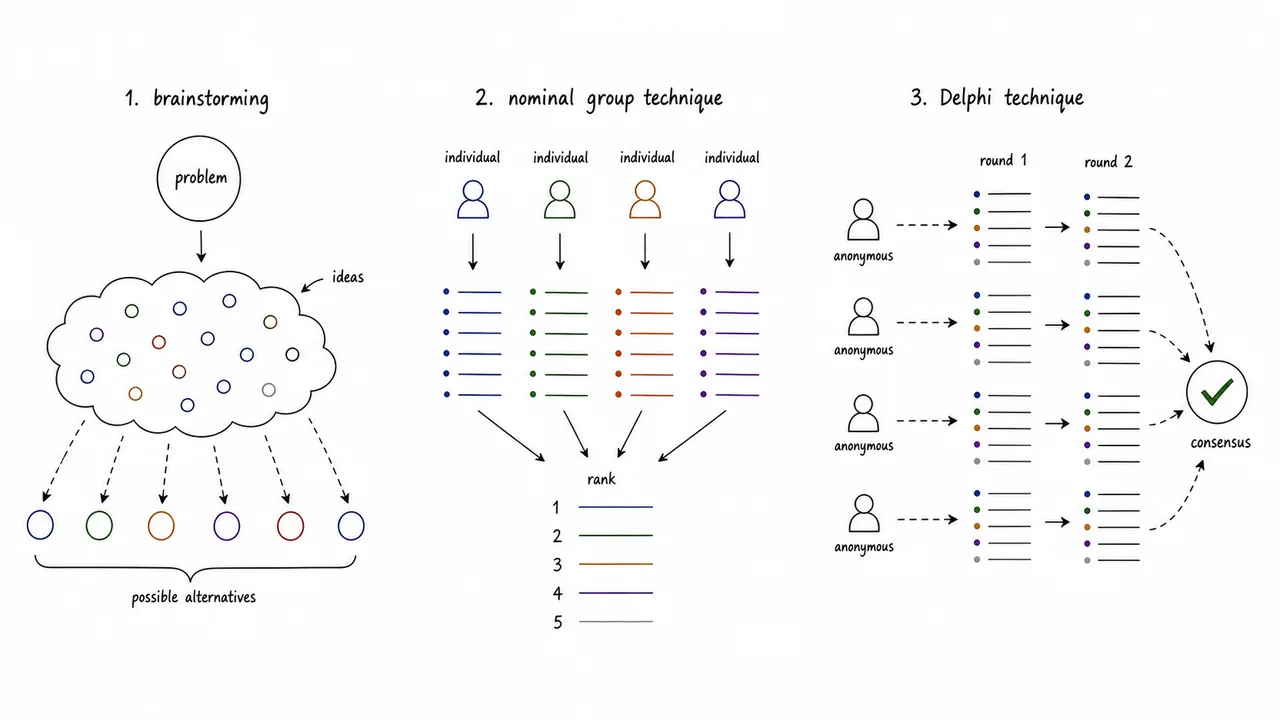
Brainstorming
A group generates many ideas first and evaluates them later. The method is useful when creativity is needed and early criticism would block idea generation.
Nominal Group Technique
Participants first think individually, then present ideas, and finally rank or vote. This reduces chaos and helps quieter members contribute.
Delphi Technique
Experts provide opinions anonymously across rounds, often from different locations. This reduces direct social pressure and helps build informed consensus.
Quantitative Techniques
These techniques become useful when the problem can be described in measurable terms.
Marginal analysis
Compares the additional benefit and additional cost of one more unit of action or input.
Financial analysis
Used to evaluate profitability, cash flows, investment feasibility, and financial soundness.
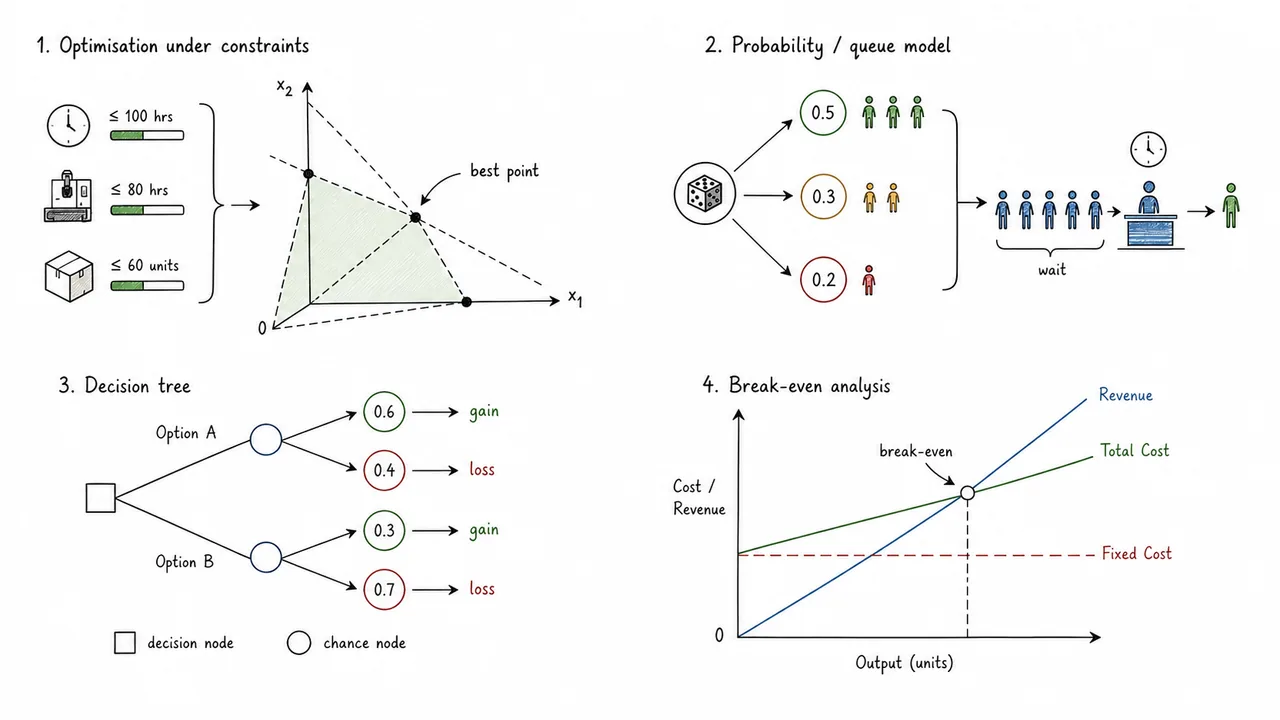
Break-even analysis
Identifies the point where total revenue equals total cost. It helps answer how much output or sales is needed to avoid loss.
Ratio analysis
Interprets accounting relationships such as liquidity, profitability, and solvency ratios to support judgment.
Linear programming
Used to optimise an objective under constraints. It is ideal when resources are scarce and a best combination must be selected.
Decision tree
A branching technique that shows decisions, uncertain events, and resulting outcomes step by step.
Probability decision theory
Used when outcomes are uncertain but probabilities can be estimated.
Game theory
Useful when outcomes depend on the choices of competitors, rivals, or opposing parties.
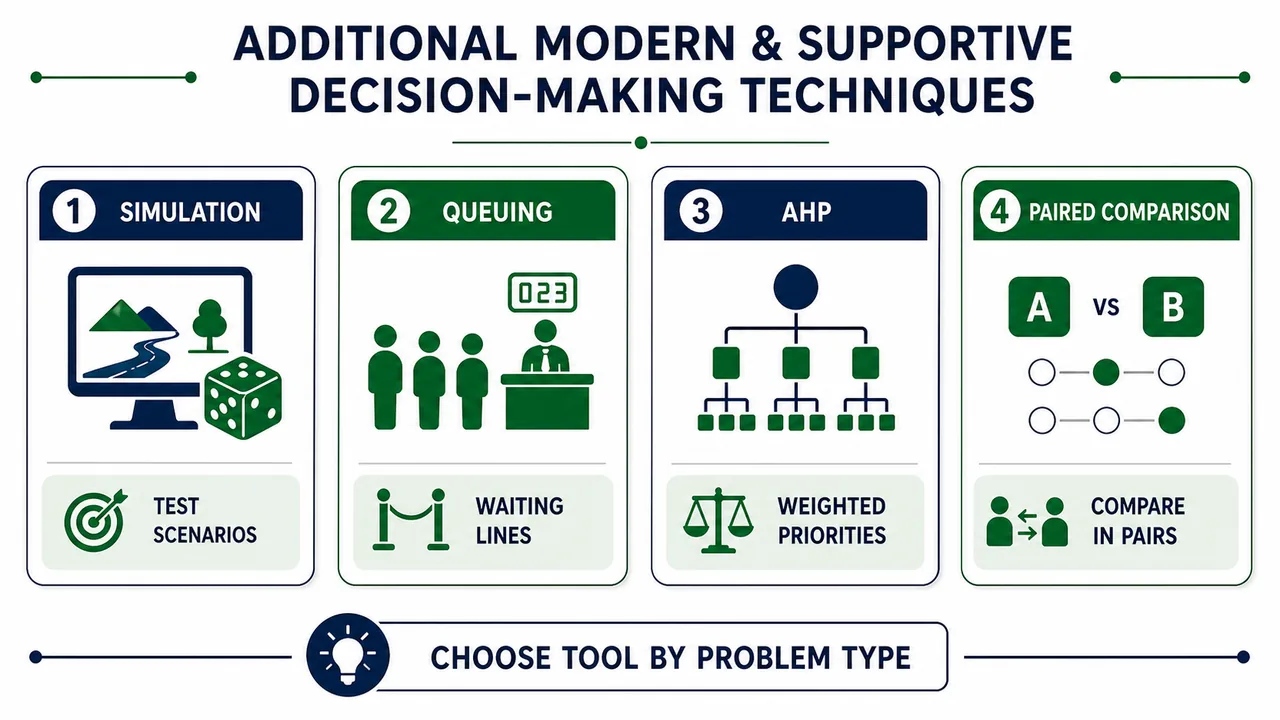
Queuing theory
Used for waiting-line problems involving service channels, congestion, or customer flow.
Simulation
Creates a model of the situation and tests likely behaviour under hypothetical conditions.
Network techniques: CPM and PERT
Used in project planning where many interdependent tasks must be coordinated in time.
Cost-benefit analysis
Compares total expected benefits and total expected costs, especially useful in public projects or policy decisions.
Additional Modern and Supportive Techniques
Affinity diagram
Groups many ideas into meaningful categories after brainstorming.
Analytic Hierarchy Process (AHP)
Breaks a complex decision into levels and pairwise comparisons, helping reduce subjectivity.
Paired comparison analysis
Useful when alternatives must be compared two at a time.
Pareto analysis
Applies the idea that a small number of causes often create most of the effect. It helps identify the vital few.
Conjoint analysis
Common in market research for understanding how people value different features or attributes.
These tools are often asked not for heavy calculation, but for their correct use-case.
Heuristics as Practical Shortcuts
Heuristics are mental shortcuts used when:
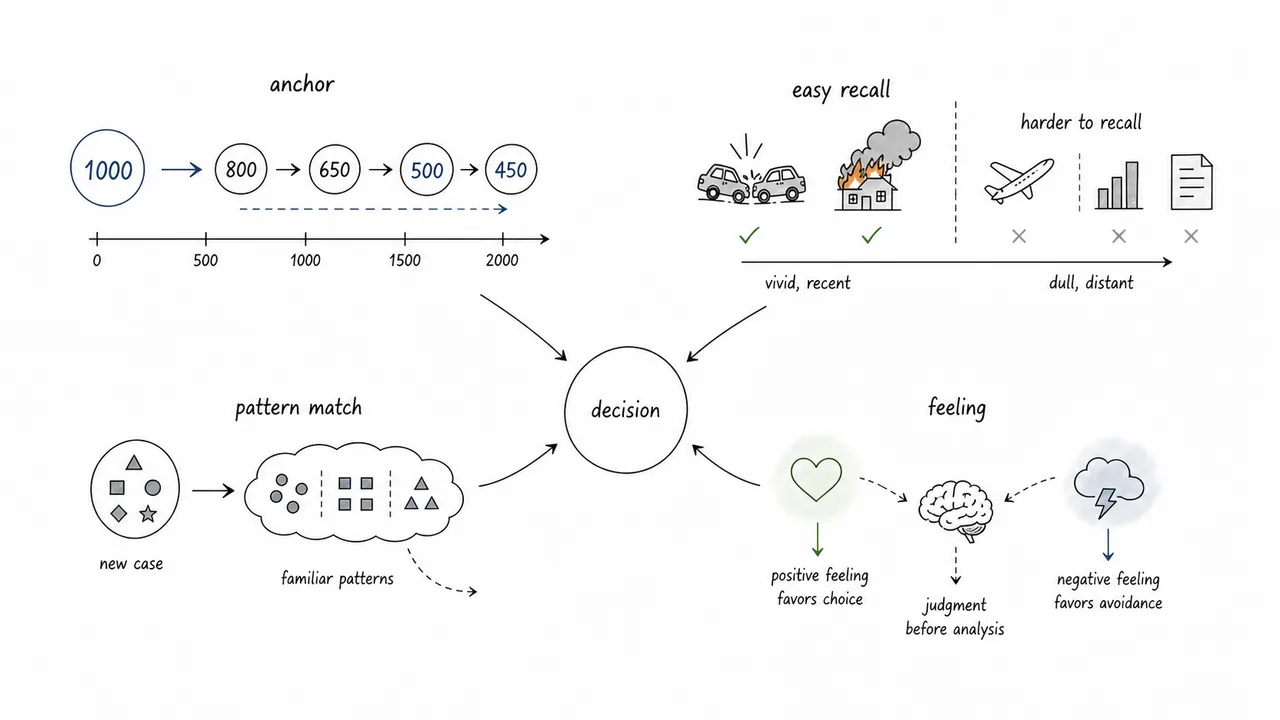
- time is short
- information is incomplete
- full optimisation is unnecessary
- a workable answer is needed quickly
They are useful, but they are not guaranteed to be optimal. Their strength is speed; their weakness is possible bias.
Common heuristic forms include:
- anchoring
- availability
- representativeness
- affect heuristic
So heuristics can be useful tools, but they must be used carefully.
Programmed and Non-Programmed Lens
Another easy way to remember tools is to link them with the type of decision:
Programmed decisions often use
- rules
- routine procedures
- clerical methods
- standard information systems
Non-programmed decisions often use
- judgment
- creativity
- expert consultation
- analytical comparison
This helps solve questions where the examiner asks not for the tool directly, but for the situation in which the tool is suitable.
Worked Examples
Example 1: Need many ideas before evaluation
Best technique: brainstorming.
Example 2: Experts are in different cities and social pressure should be reduced
Best technique: Delphi technique.
Example 3: Best combination under limited resources
Best technique: linear programming.
Example 4: Decision depends on later uncertain events
Best technique: decision tree.
Example 5: A few causes create most of the problem
Best technique: Pareto analysis.
Example 6: Complex project with interdependent tasks
Best technique: CPM or PERT.
Summary Cheat Sheet
| Concept / Topic | Key Details / Explanation |
|---|---|
| Tool selection rule | Decision tools are chosen according to the structure of the problem, not by random preference. First ask whether the problem is routine, novel, qualitative, quantitative, or optimisation-based. |
| Broad approaches | Basic approach families are routine, scientific, quantitative, and creative. |
| Non-quantitative techniques | Important non-quantitative tools are intuition, facts, experience, considered opinion, brainstorming, nominal group technique, and Delphi. |
| Quantitative techniques | Important quantitative tools include marginal analysis, financial analysis, break-even analysis, ratio analysis, linear programming, decision tree, game theory, queuing, simulation, CPM/PERT, and cost-benefit analysis. |
| Supportive modern tools | Also remember affinity diagram, Analytic Hierarchy Process (AHP), paired comparison, Pareto analysis, and conjoint analysis. |
| Heuristics | Heuristics are practical shortcuts that save time, but they trade perfection for speed and can introduce bias. |
| Match-the-tool clues | Brainstorming = idea generation, Delphi = anonymous experts, linear programming = best combination under constraints, decision tree = branching outcomes, Pareto = vital few causes. |
| Exam solving rule | Routine problems favour routine tools; complex and novel problems favour analytical, creative, or consultative techniques. |
Mini Practice
Which technique is best for generating many ideas before criticism begins?
brainstorming. Brainstorming separates idea generation from evaluation.
Which method uses anonymous expert opinion across repeated rounds?
Delphi technique. It is designed to build informed consensus without direct dominance pressure.
Which technique is used to optimise under constraints?
linear programming. It helps choose the best combination when resources are limited.
Which tool helps show branching decision paths and uncertain events?
decision tree. It maps decisions and possible outcomes step by step.
Are heuristics always optimal?
no. They are practical shortcuts, not guaranteed best solutions. ---
Lesson Doubts
Ask questions, get expert answers