👥 Group vs Individual Decision Making
Students often assume that group decisions are automatically better because more people are involved. That is not always true. Some situations require speed, accountability, and confidentiality, which favour individual decisions. Other situations require diverse knowledge, acceptance, and discussion, which favour group decisions. The real skill is knowing which form fits which problem.
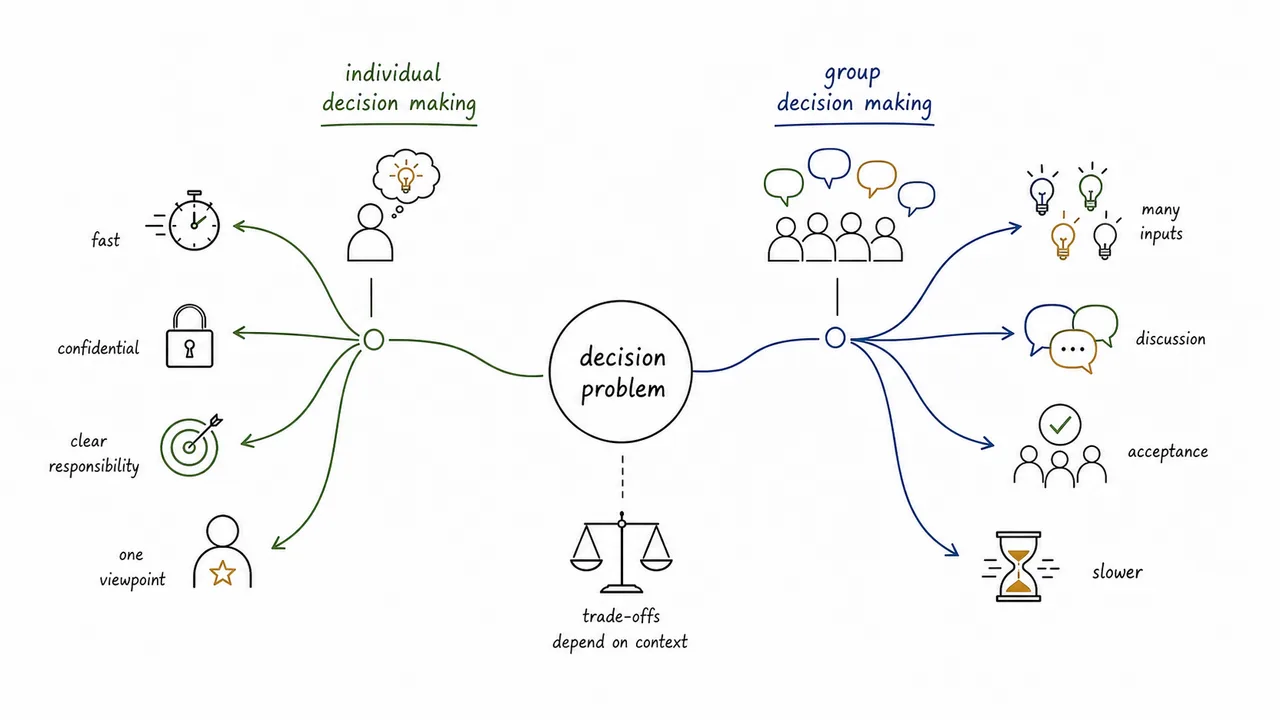
Individual Decision Making
An individual decision is made by one person who holds the authority or responsibility to decide.
Main strengths
- faster action
- clearer accountability
- easier confidentiality
- useful in urgent or routine situations
Main limitations
- limited perspective
- greater chance of personal bias
- lower acceptance if others feel ignored
- weaker knowledge base in complex multidisciplinary issues
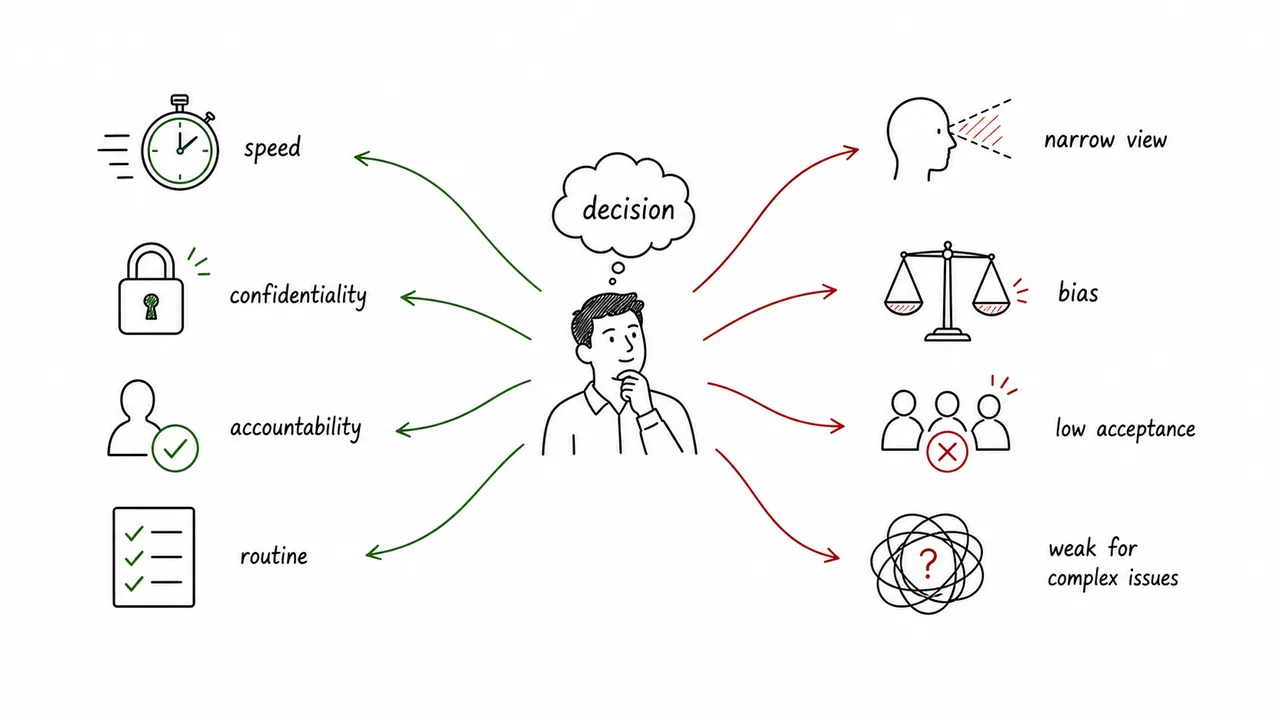
An individual decision is usually preferable when:
- the problem is routine
- the time available is very short
- the authority is clearly vested in one office
- discussion would create avoidable delay
Group Decision Making
A group decision is made through discussion, consultation, committee process, or collective evaluation.
Pro Content Locked
Upgrade to Pro to access this lesson and all other premium content.
₹99 charged monthly · Cancel anytime
- All Agriculture & Banking Courses
- AI Lesson Questions (100/day)
- AI Doubt Solver (50/day)
- Glows & Grows Feedback (30/day)
- AI Section Quiz (20/day)
- 22-Language Translation (100/day)
- Recall Questions (20/day)
- AI Quiz (15/day)
- AI Quiz Paper Analysis (100/day)
- AI Step-by-Step Explanations (100/day)
- Spaced Repetition Recall (FSRS)
- AI Tutor
- Immersive Text Questions
- Audio Lessons — Hindi & English
- Mock Tests & Previous Year Papers
- Summary & Mind Maps
- XP, Levels, Leaderboard & Badges
- Generate New Classrooms
- Voice AI Teacher (AgriDots Live)
- AI Revision Assistant
- Knowledge Gap Analysis
- Interactive Revision (LangGraph)
🔒 Secure via Razorpay · Cancel anytime · No hidden fees
Students often assume that group decisions are automatically better because more people are involved. That is not always true. Some situations require speed, accountability, and confidentiality, which favour individual decisions. Other situations require diverse knowledge, acceptance, and discussion, which favour group decisions. The real skill is knowing which form fits which problem.
Individual Decision Making
An individual decision is made by one person who holds the authority or responsibility to decide.
Main strengths
- faster action
- clearer accountability
- easier confidentiality
- useful in urgent or routine situations
Main limitations
- limited perspective
- greater chance of personal bias
- lower acceptance if others feel ignored
- weaker knowledge base in complex multidisciplinary issues
An individual decision is usually preferable when:
- the problem is routine
- the time available is very short
- the authority is clearly vested in one office
- discussion would create avoidable delay
Group Decision Making
A group decision is made through discussion, consultation, committee process, or collective evaluation.
Main strengths
- more ideas and viewpoints
- wider knowledge base
- better stakeholder acceptance
- stronger support during implementation
Main limitations
- slower process
- risk of conflict or dominance
- diffusion of responsibility
- possibility of compromise that satisfies everyone but solves little
Group decisions are useful when:
- the issue is complex
- several departments are affected
- legitimacy and acceptance matter
- no single person has all the needed information
Comparison Between Individual and Group Decisions
| Basis | Individual Decision | Group Decision |
|---|---|---|
| Speed | Faster | Slower |
| Responsibility | Clear | Shared or diffused |
| Diversity of input | Limited | Wider |
| Confidentiality | Easier | Harder |
| Acceptance | May be lower | Often higher |
| Risk of bias | Personal bias | Group pressure or domination |
This table is useful because many exam questions indirectly ask which side of the comparison is more suitable for a given situation.
Groupthink and Related Dangers
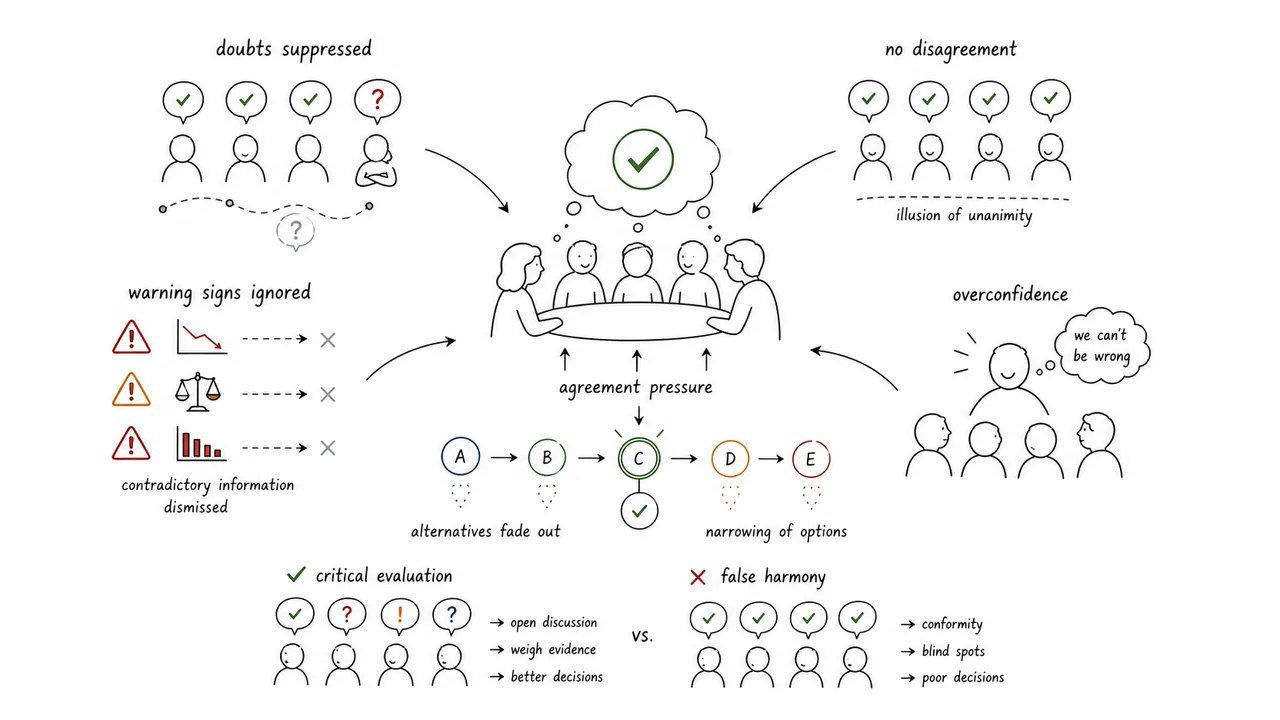
Group decisions are not automatically superior because groups can also think poorly.
Groupthink
Groupthink occurs when the desire for agreement becomes so strong that the group stops critically examining alternatives. Members may:
- suppress doubts
- avoid disagreement
- overestimate the quality of the chosen option
- ignore warning signals
Group polarization
Discussion sometimes pushes the group toward a more extreme version of its initial tendency, either riskier or more conservative.
Dominance problem
One powerful, senior, or vocal member may influence the entire group excessively, reducing the value of collective discussion.
Satisficing and Compromise in Groups
Groups often settle on a solution that is acceptable to everyone rather than best in an absolute sense. This can be practical, but it can also produce mediocre results if the group stops searching too early.
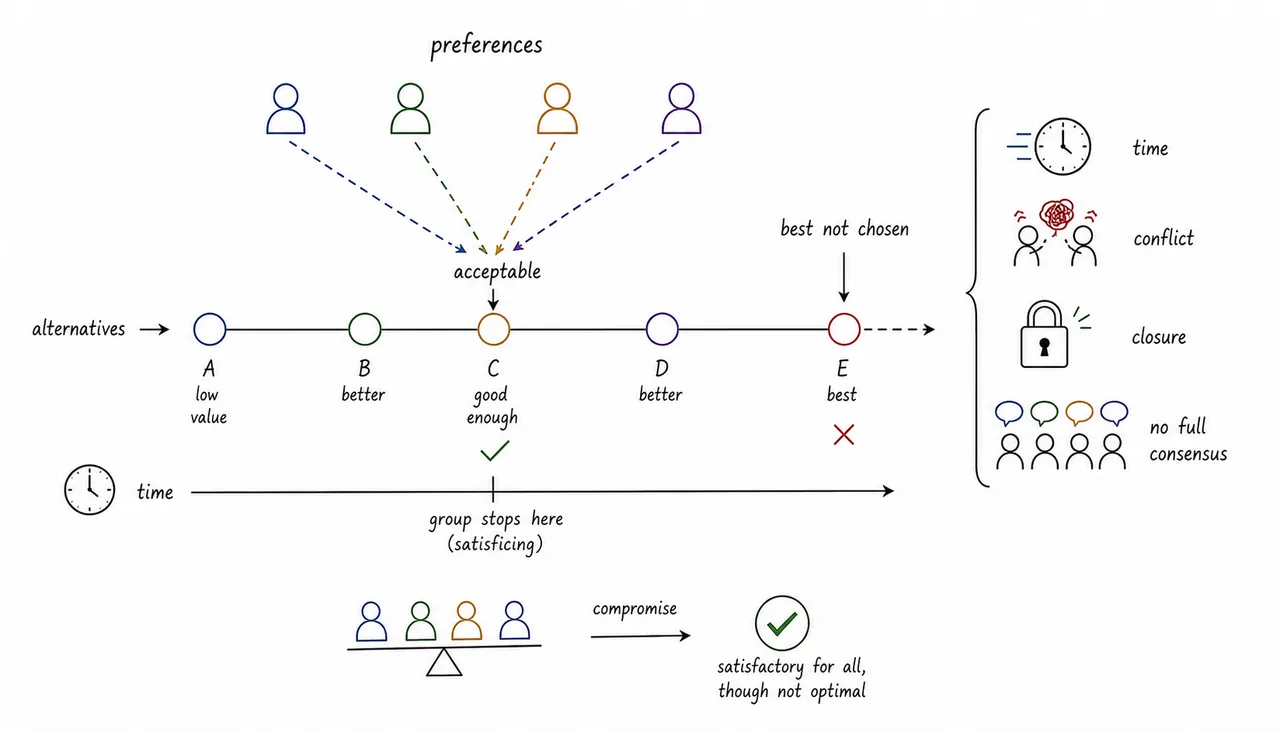
Satisficing in groups happens because:
- members want closure
- conflict is tiring
- time is limited
- perfect consensus is impossible
So the question is not whether compromise is always bad. The real question is whether the compromise remains reasonable and problem-solving.
When to Use Which
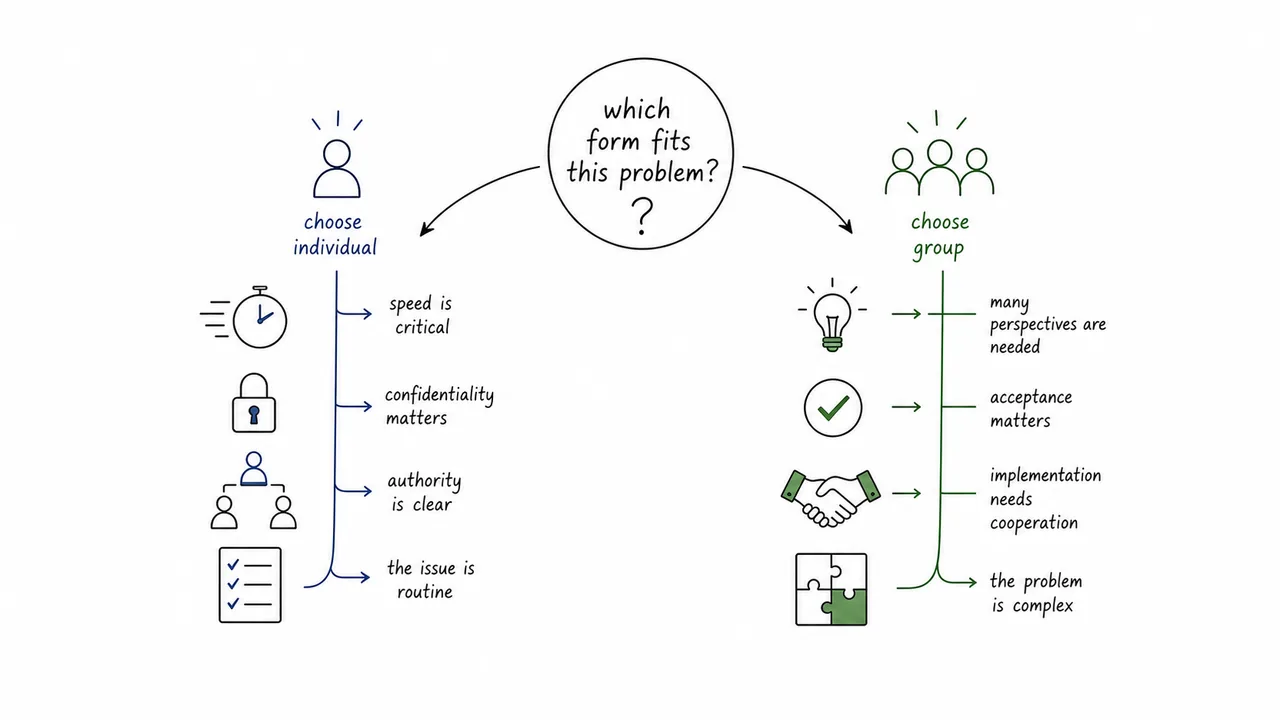
Choose individual decision making when:
- speed is critical
- the issue is routine
- responsibility must remain clearly personal
- confidentiality is essential
Choose group decision making when:
- many perspectives are needed
- acceptance by others matters
- implementation requires cooperation
- the problem is complex and non-routine
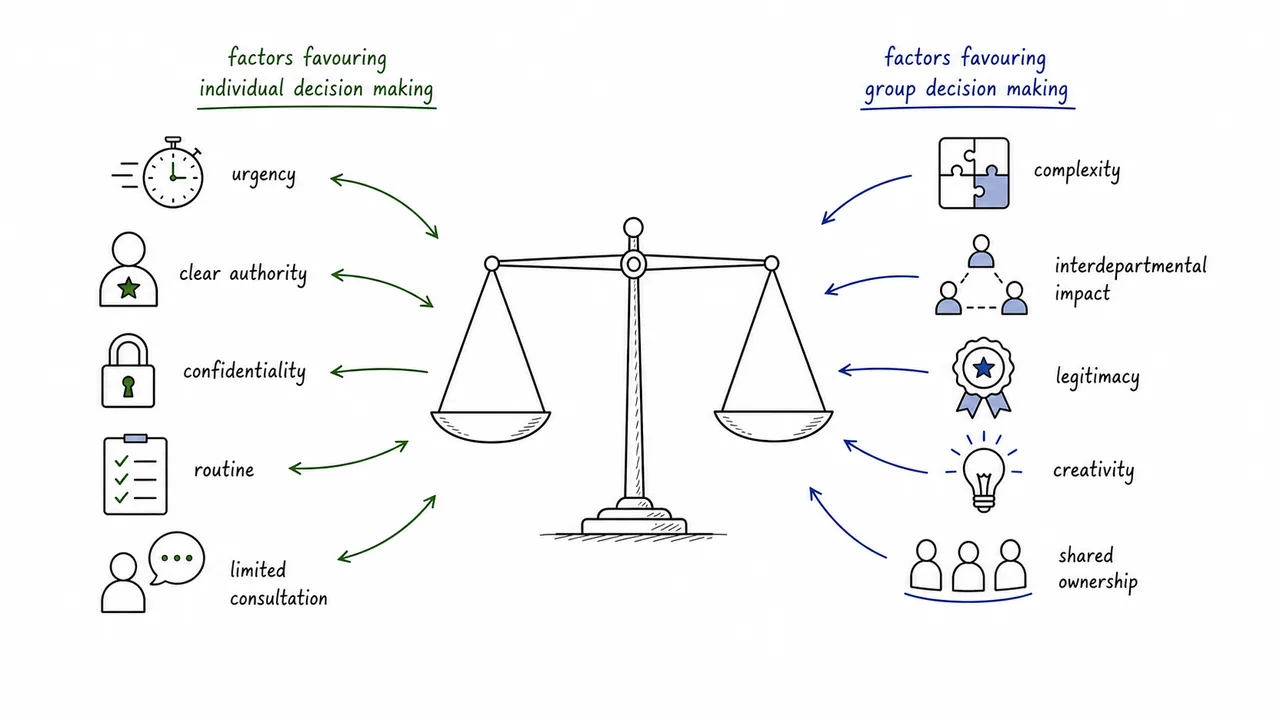
Factors Favouring Each Form
Factors favouring individual decision making
- urgency
- clear authority
- confidentiality
- routine structure
- limited need for consultation
Factors favouring group decision making
- complexity
- interdepartmental impact
- need for legitimacy
- need for creativity
- need for ownership by many people
Worked Examples
Example 1: Emergency response
A supervisor must act immediately to stop a safety hazard.
Best form: individual decision.
Reason: speed and clear accountability matter more than lengthy discussion.
Example 2: New district outreach policy
A large programme affects finance, field operations, training, and public communication.
Best form: group decision.
Reason: the issue is cross-functional and needs wider insight and acceptance.
Example 3: Confidential disciplinary issue
A sensitive complaint must be examined before wider discussion.
Best form: initially individual or very limited decision circle.
Reason: confidentiality and procedural caution matter.
Summary Cheat Sheet
| Concept / Topic | Key Details / Explanation |
|---|---|
| Individual decision making | Best for speed, clear accountability, confidentiality, and routine or urgent matters. |
| Limits of individual decisions | Risks include narrow perspective, personal bias, and lower acceptance by others. |
| Group decision making | Best for wider knowledge, creativity, stakeholder acceptance, and complex cross-functional issues. |
| Limits of group decisions | Main risks are delay, conflict, dominance, shared responsibility, and weak compromise. |
| Groupthink and related dangers | Important group risks include groupthink, group polarization, and domination by one strong member. |
| Satisficing in groups | Groups often settle for an acceptable compromise instead of the absolute best option; this can be practical but also mediocre. |
| Suitability rule | Neither form is always superior. Use individual for urgent/confidential/routine matters and group for complex, acceptance-heavy, multi-stakeholder matters. |
| Exam solving rule | Match the answer to the problem's need for speed vs diversity, secrecy vs participation, and clear responsibility vs broad buy-in. |
Mini Practice
Which form is usually faster?
individual decision making. Fewer people are involved, so coordination delay is low.
Which form usually gives a wider range of inputs?
group decision making. More people mean more viewpoints and more knowledge sources.
What is groupthink?
pressure toward agreement that suppresses critical evaluation. The group appears unified, but the quality of thought becomes weak.
Why can group decisions be weak even when many people are involved?
because dominance, compromise pressure, or shallow consensus can reduce quality. Numbers alone do not guarantee good judgment.
Which form is usually better for a routine confidential issue?
individual decision making. Routine structure and confidentiality favour quick, accountable action. ---
Lesson Doubts
Ask questions, get expert answers