🎲 Decision Criteria Under Risk and Uncertainty
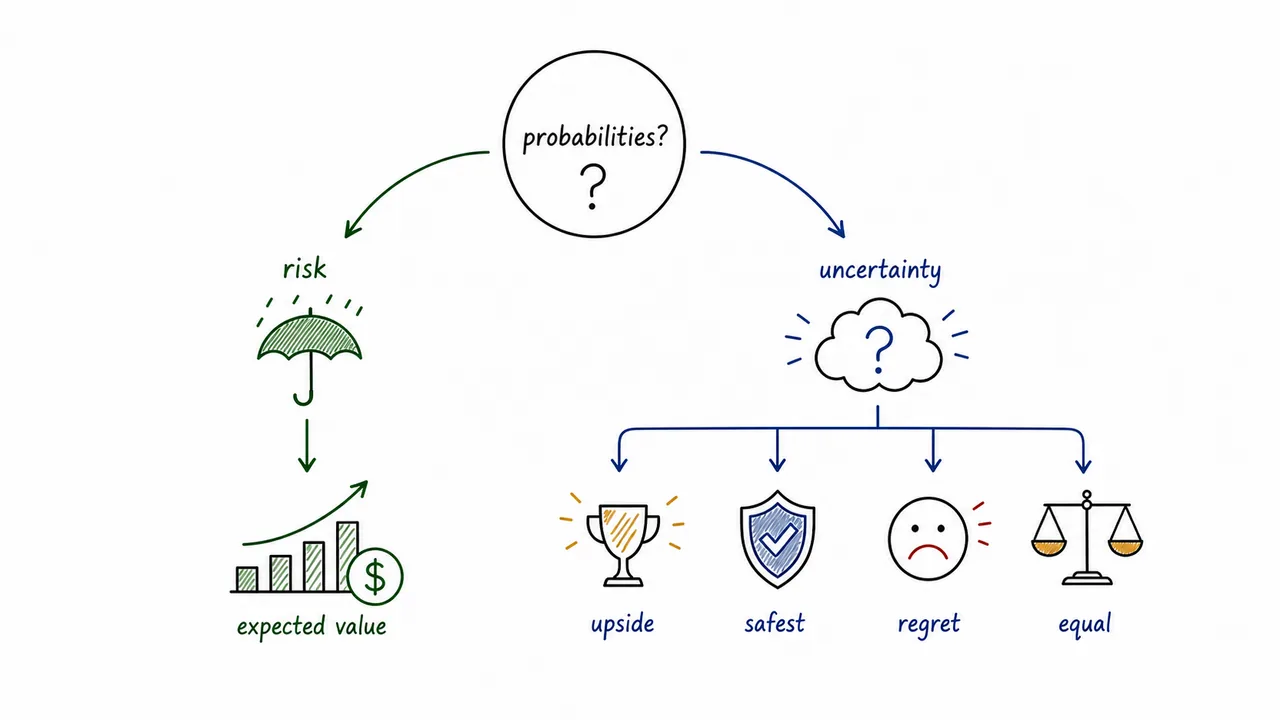
Decision making becomes harder when the future is not fully visible. Sometimes we know the possible outcomes and can estimate their probabilities. Sometimes we know the outcomes but cannot confidently assign probabilities. The first situation is risk; the second is uncertainty. Once that distinction is clear, the choice criteria become much easier to understand.
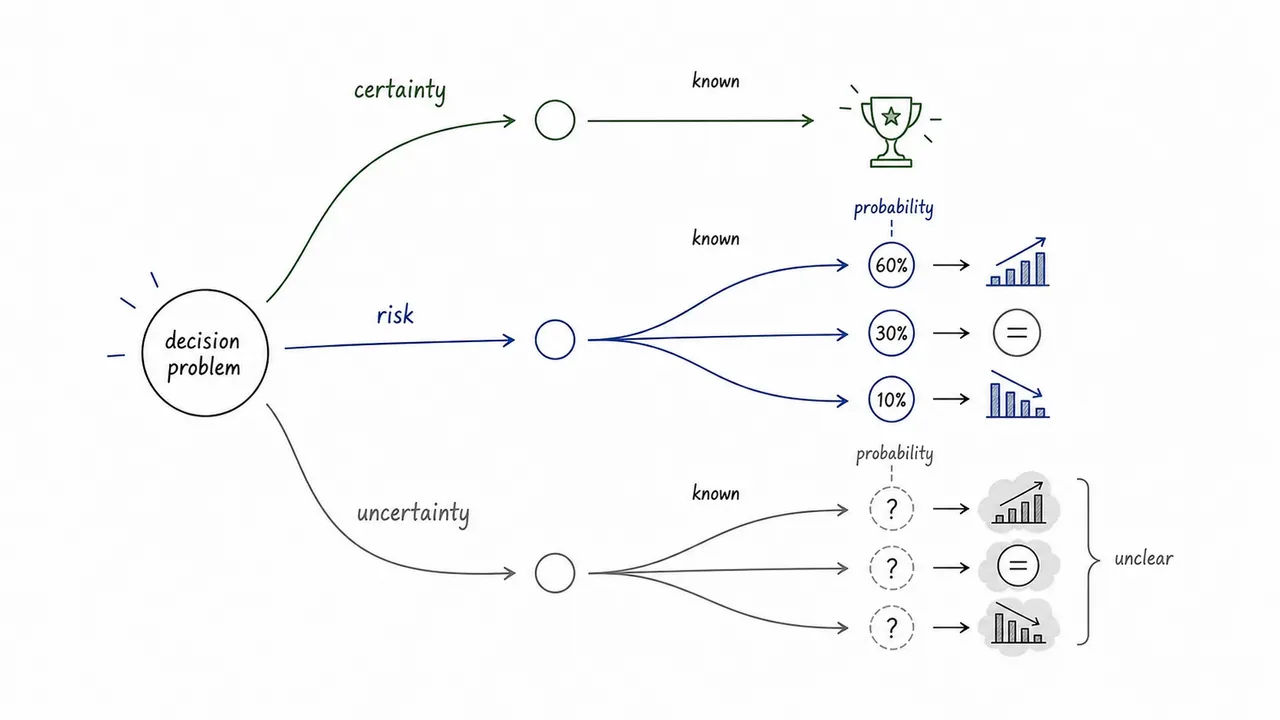
Risk, Uncertainty, and Certainty
Under certainty
The outcome of each alternative is known clearly. The decision problem is simple comparison.
Under risk
The alternatives and possible outcomes are known, and probabilities can be estimated. The issue is not total ignorance; it is probability-based judgment.
Under uncertainty
The alternatives and possible outcomes may be known, but probabilities are not dependable or cannot be assigned confidently.
This distinction matters because under risk we can use probability-based criteria, while under uncertainty we rely more on attitude-based criteria such as optimism, caution, or regret avoidance.
Pro Content Locked
Upgrade to Pro to access this lesson and all other premium content.
₹99 charged monthly · Cancel anytime
- All Agriculture & Banking Courses
- AI Lesson Questions (100/day)
- AI Doubt Solver (50/day)
- Glows & Grows Feedback (30/day)
- AI Section Quiz (20/day)
- 22-Language Translation (100/day)
- Recall Questions (20/day)
- AI Quiz (15/day)
- AI Quiz Paper Analysis (100/day)
- AI Step-by-Step Explanations (100/day)
- Spaced Repetition Recall (FSRS)
- AI Tutor
- Immersive Text Questions
- Audio Lessons — Hindi & English
- Mock Tests & Previous Year Papers
- Summary & Mind Maps
- XP, Levels, Leaderboard & Badges
- Generate New Classrooms
- Voice AI Teacher (AgriDots Live)
- AI Revision Assistant
- Knowledge Gap Analysis
- Interactive Revision (LangGraph)
🔒 Secure via Razorpay · Cancel anytime · No hidden fees
Decision making becomes harder when the future is not fully visible. Sometimes we know the possible outcomes and can estimate their probabilities. Sometimes we know the outcomes but cannot confidently assign probabilities. The first situation is risk; the second is uncertainty. Once that distinction is clear, the choice criteria become much easier to understand.
Risk, Uncertainty, and Certainty
Under certainty
The outcome of each alternative is known clearly. The decision problem is simple comparison.
Under risk
The alternatives and possible outcomes are known, and probabilities can be estimated. The issue is not total ignorance; it is probability-based judgment.
Under uncertainty
The alternatives and possible outcomes may be known, but probabilities are not dependable or cannot be assigned confidently.
This distinction matters because under risk we can use probability-based criteria, while under uncertainty we rely more on attitude-based criteria such as optimism, caution, or regret avoidance.
Core Terms You Must Not Mix Up
Before applying any rule, be clear about the basic language of decision theory:
- alternative: the course of action available to the decision-maker
- state of nature: a future condition not controlled by the decision-maker
- payoff: the result attached to one alternative under one state of nature
- opportunity loss or regret: the amount lost because the best state-wise alternative was not chosen
Most confusion in this chapter starts because students jump to formulas before identifying these four parts of the problem.
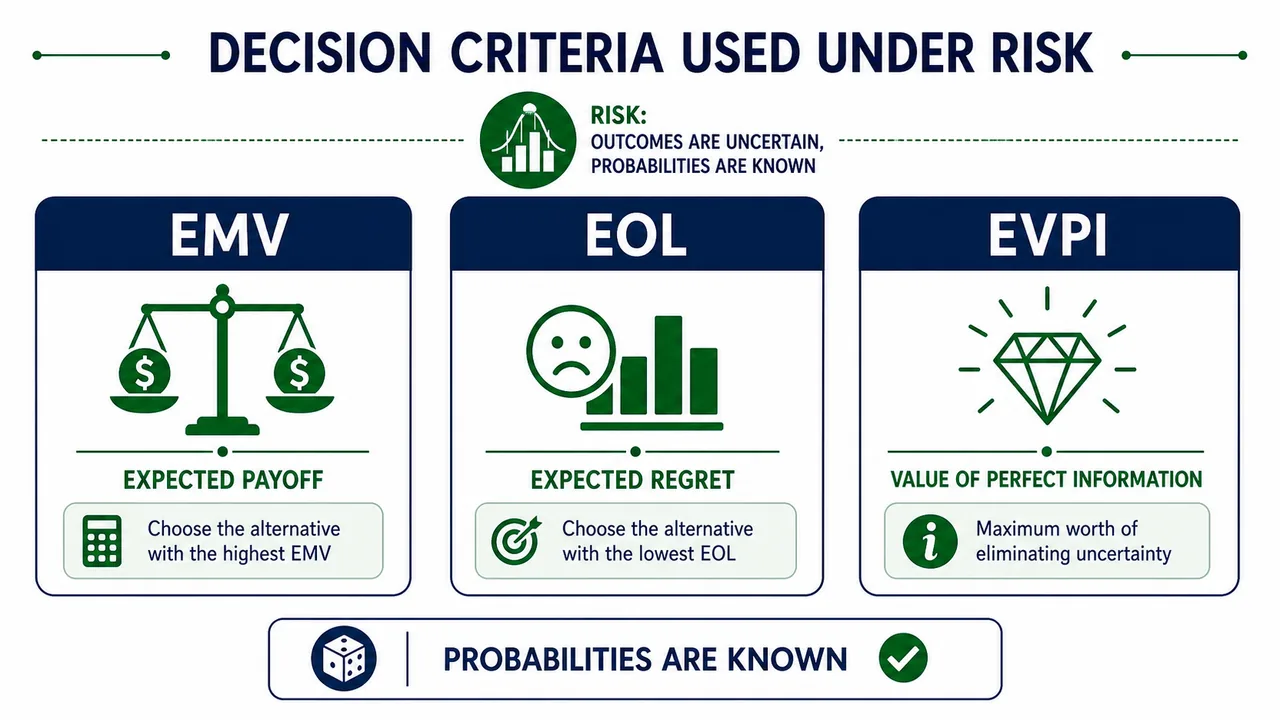
Criteria Used Under Risk
When probabilities are known or can be estimated, the decision-maker can use more structured comparison methods.
Expected Monetary Value or Expected Payoff
Each outcome is multiplied by its probability, and the total expected payoff is computed. The alternative with the best expected value is preferred.
This does not guarantee the best outcome every time; it identifies the best average result over repeated similar decisions.
Expected Opportunity Loss
This compares the expected regret or expected lost opportunity from not choosing the best option under each state. The lower the expected loss, the better the alternative.
Expected Value of Perfect Information
This asks how much a decision-maker should be willing to pay for information that removes uncertainty completely.
The core logic is:
- calculate the best expected value without extra perfect information
- calculate the expected value if the future state were known perfectly in advance
- the difference is the expected value of perfect information
This concept appears whenever a question asks whether buying a survey, report, or consultant's perfect forecast is worth it.
Decision Tree Logic
When one decision leads to later events and later choices, a decision tree helps map the sequence clearly.
The practical order is:
- define the problem
- draw the decision branches
- assign probabilities where risk exists
- estimate payoffs
- work backward from the right side to choose the best expected branch
Criteria Used Under Uncertainty
When probabilities are not available, decision-makers use rules that reflect different attitudes toward the unknown.
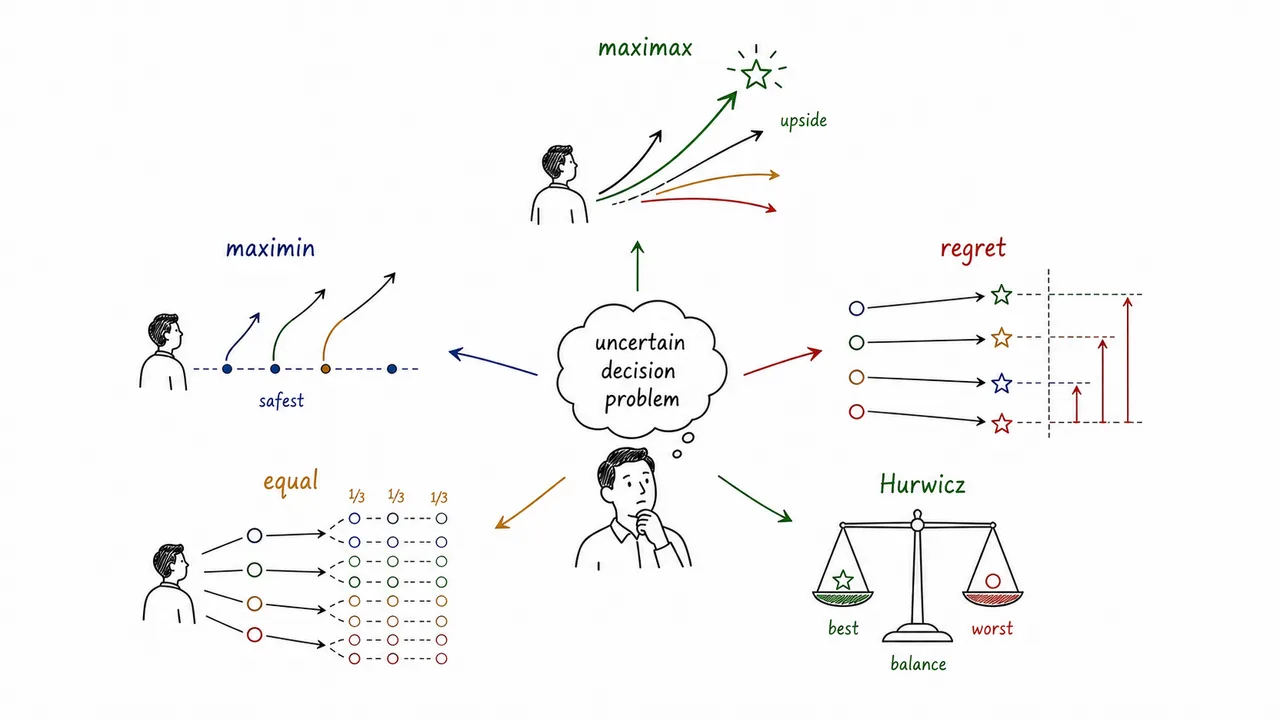
Maximax criterion
This is the optimistic rule.
Steps:
- note the best payoff under each alternative
- choose the alternative with the highest of those best payoffs
Mindset: "I want the greatest possible upside."
Maximin criterion
This is the pessimistic or safety-oriented rule.
Steps:
- note the worst payoff under each alternative
- choose the alternative with the highest among those worst payoffs
Mindset: "I want the safest worst-case position."
Minimax regret criterion
This rule focuses on avoiding future regret.
Steps:
- construct regret values by comparing each outcome with the best possible outcome in that state
- identify the maximum regret for each alternative
- choose the alternative with the smallest maximum regret
Mindset: "I do not want to suffer the largest possible feeling of missed opportunity."
Laplace or insufficient reason criterion
This rule treats all states as equally likely when there is no reliable basis for different probabilities.
Steps:
- assume equal probability for all states
- compute the average payoff
- choose the alternative with the best average payoff
Mindset: "If I cannot justify unequal probabilities, I will treat them equally."
Hurwicz criterion
This rule mixes optimism and pessimism by assigning a coefficient of optimism.
Mindset: "I want a weighted balance between best-case and worst-case thinking."
This criterion is useful when the decision-maker is neither fully optimistic nor fully cautious.
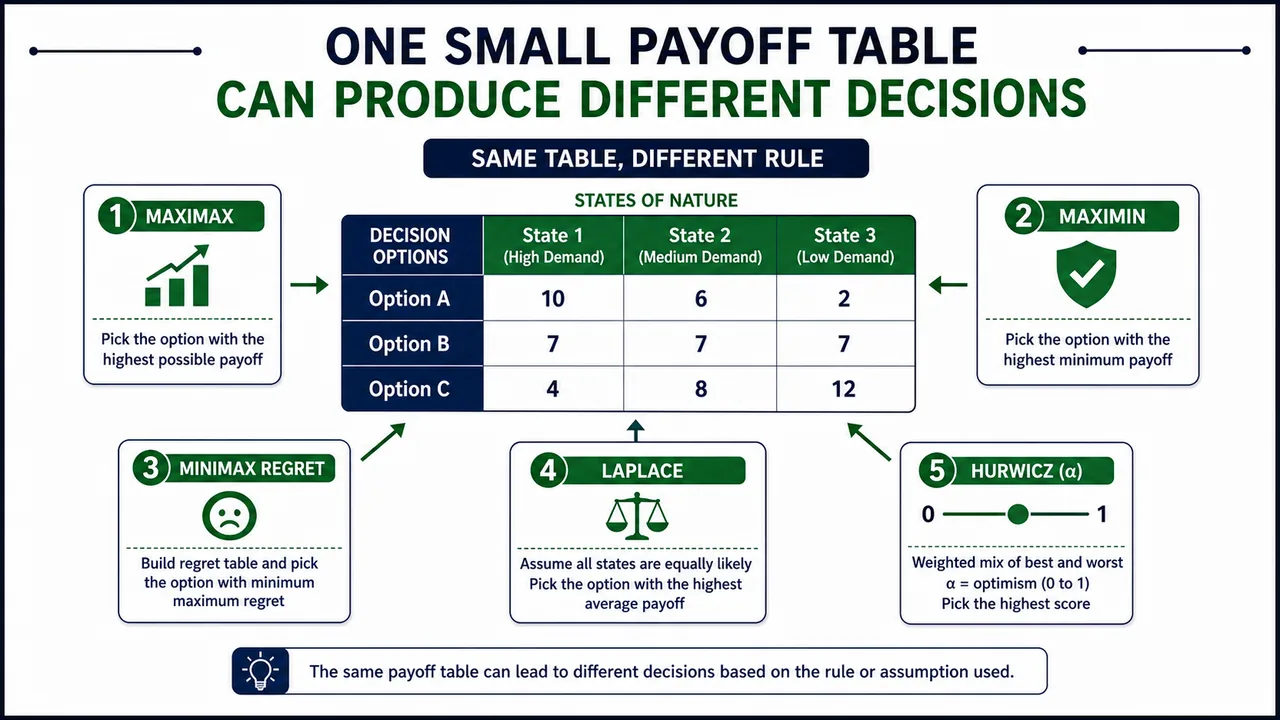
One Small Payoff Table, Five Different Decisions
The same payoff table can produce different answers depending on the rule used. That is the entire logic of this chapter.
| Alternative | Good state | Bad state |
|---|---|---|
| Option A | 120 | -40 |
| Option B | 80 | 20 |
| Option C | 50 | 40 |
How different rules read the same table:
- maximax may prefer Option A because it has the highest upside
- maximin may prefer Option C because its worst outcome is safest
- minimax regret asks which option avoids the largest later regret
- Laplace averages the payoffs if both states are treated as equally likely
- Hurwicz depends on how much weight is given to optimism
This is why memorising one "best" answer is dangerous. The best answer changes with the decision rule.
How to Distinguish the Criteria in Words
Questions often describe the attitude rather than the formula. Use these clues:
- "highest possible gain" -> maximax
- "best among the worst outcomes" -> maximin
- "avoid future regret" -> minimax regret
- "treat all outcomes equally likely" -> Laplace or insufficient reason
- "balance optimism and pessimism" -> Hurwicz
- "probabilities are given" -> risk-based criteria such as expected value
Worked Example Logic
Suppose three alternatives are available and the question says:
- one student wants the largest possible upside
- one manager wants the safest worst-case result
- one officer cannot assign probabilities and treats all states equally
Then the correct classifications are:
- maximax
- maximin
- insufficient reason
If the question instead provides probability values and asks for the best average expected result, the situation has shifted from uncertainty to risk.
Common Mistakes Students Make
- mixing up risk and uncertainty
- forgetting to identify alternatives, states of nature, and payoffs before choosing a criterion
- thinking maximax means "maximum average" rather than "maximum of maximum payoffs"
- confusing maximin with minimax regret
- forgetting that insufficient reason assumes equal likelihood only because there is no reliable basis for anything better
- ignoring that under risk, expected value methods become relevant
- missing that EOL is regret-based and EVPI is information-value based
These mistakes happen because students memorise names but not the logic behind them.
Summary Cheat Sheet
| Concept / Topic | Key Details / Explanation |
|---|---|
| Certainty, risk, uncertainty | Certainty means outcomes are known, risk means probabilities can be estimated, and uncertainty means probabilities cannot be assigned confidently. |
| Rule under risk | When probabilities are available, use probability-based methods such as expected payoff, expected opportunity loss, or decision-tree reasoning. |
| Rule under uncertainty | When probabilities are not available, the criterion depends on the decision-maker's attitude toward the unknown. |
| Core terminology | First identify alternatives, states of nature, payoffs, and possible regret/opportunity loss. |
| Key uncertainty criteria | Maximax = optimistic highest upside; Maximin = cautious safest worst-case; Minimax Regret = minimise maximum regret; Laplace / Insufficient Reason = treat states equally likely; Hurwicz = balance optimism and pessimism. |
| Extra risk tools | Under risk, also remember EOL and EVPI, because some questions ask about regret-based averages or the value of perfect information. |
| Verbal clue method | Many questions are solved by clue words like highest gain, safest worst-case, avoid regret, or no probability basis, even without formula use. |
| Risk vs uncertainty test point | The first exam question should always be: Are probabilities available or not? |
| Common mistakes | Students often confuse maximin with minimax regret or mix up risk and uncertainty because they memorise names without understanding the logic. |
Mini Practice
Which criterion is most optimistic?
maximax. It chooses the alternative with the highest possible best-case payoff.
Which criterion is most safety-oriented?
maximin. It protects against the worst-case outcome.
Which criterion focuses on regret rather than payoff alone?
minimax regret. It tries to minimise the largest possible regret from a wrong choice.
When should the insufficient reason criterion be used?
when probabilities are not known and there is no valid basis for unequal probability assignment. It treats all states as equally likely by assumption.
What is the key feature of risk?
probabilities can be estimated. That is why expected-value style methods become possible under risk. ---
Lesson Doubts
Ask questions, get expert answers