🐪 Camel: Dromedary vs Bactrian, Indian Breeds, Milk and Population
Answer-first camel notes for IBPS AFO and NABARD: one-humped Dromedary vs two-humped Bactrian, Indian camel breeds, camel milk, population, NRCC Bikaner, Surra and Rajasthan Camel Act.
Quick answer: India has only Dromedary camels (Camelus dromedarius) in the field; they are one-humped. The latest completed species census is the 20th Livestock Census 2019, which recorded about 2.52 lakh camels in India, down 37.1% from 2012. Rajasthan has the largest camel population, followed by Gujarat. ICAR-NBAGR lists 9 registered Indian camel breeds.
| Search Query / Exam Prompt | Direct Answer |
|---|---|
| Camel species in India | Dromedary, one-humped camel |
| Bactrian camel humps | Two; Central Asia, not Indian field breed |
| Camel population in India | 2.52 lakh as per 20th Livestock Census 2019 |
| State with highest camel population | Rajasthan |
| Registered camel breeds in India | 9 indigenous breeds as per NBAGR / DAHD breed report |
| Swimming camel breed | Kharai of Gujarat |
| Camel research institute | ICAR-NRCC, Bikaner |
| Most important camel disease | Surra, caused by Trypanosoma evansi |
- Belongs to family Camelidae which includes Camel, Llama, Alpaca, Guanaco and Vicuna. The Camelidae family is a group of large, herbivorous mammals that are well adapted to arid and semi-arid environments. Among these, the camel is the most widely domesticated and economically important member.
- Originated in North America. Although camels are now closely associated with deserts of Asia and Africa, fossil evidence shows that their ancestors first evolved on the plains of North America millions of years ago before migrating to other continents.
Species
👉🏻 The genus Camelus has two species:
Bactrian Camel
 - *Camelus bactrianus*.
- It has two humps. The **two humps** serve as fat reserves, providing the animal with energy and sustenance during long periods without food or water in harsh desert conditions.
- Inhabitant of deserts of central Asia reaching upto Mongolia and western parts of China.
- The bacterian camel is very strongly built and copiously covered with long dark brown hairs on its humps, neck and shoulders, which is essential to Asiatic mountainous terrains which experience extreme low temperature. This thick, shaggy coat acts as **insulation** against the frigid temperatures found at high altitudes and in the continental deserts of Central Asia.
- Chromosome number: 2n = 74 (same as Dromedary).
- *Camelus bactrianus*.
- It has two humps. The **two humps** serve as fat reserves, providing the animal with energy and sustenance during long periods without food or water in harsh desert conditions.
- Inhabitant of deserts of central Asia reaching upto Mongolia and western parts of China.
- The bacterian camel is very strongly built and copiously covered with long dark brown hairs on its humps, neck and shoulders, which is essential to Asiatic mountainous terrains which experience extreme low temperature. This thick, shaggy coat acts as **insulation** against the frigid temperatures found at high altitudes and in the continental deserts of Central Asia.
- Chromosome number: 2n = 74 (same as Dromedary).
IMPORTANT
MCQ Trap — Hump stores FAT, not water! The hump of a camel stores fat (metabolic energy reserve), NOT water. This is one of the most frequently tested misconceptions in competitive exams. Water is stored in the bloodstream and body tissues, not the hump.
Dromedary Camel
 - *Camelus dromedarius*
- It is single humped camel. The **single hump** distinguishes the Dromedary from the Bactrian and stores metabolic fat that the animal draws upon when food and water are scarce.
- It is widespread throughout the Middle-East, India and North Africa.
- Therefore also known as Arabian Camel. The **Indian camel** (found mainly in Rajasthan) is a Dromedary and therefore has **one hump**, not two.
- Represents approximately 90% of the world's camel population. The Bactrian accounts for only ~10%.
- Chromosome number: 2n = 74 (same as Bactrian).
- *Camelus dromedarius*
- It is single humped camel. The **single hump** distinguishes the Dromedary from the Bactrian and stores metabolic fat that the animal draws upon when food and water are scarce.
- It is widespread throughout the Middle-East, India and North Africa.
- Therefore also known as Arabian Camel. The **Indian camel** (found mainly in Rajasthan) is a Dromedary and therefore has **one hump**, not two.
- Represents approximately 90% of the world's camel population. The Bactrian accounts for only ~10%.
- Chromosome number: 2n = 74 (same as Bactrian).
NOTE
India has ONLY Dromedary (one-humped) camels. No Bactrian camels are found in India. All Indian breeds (Bikaneri, Jaisalmeri, Kharai, Mewari, Kachchhi, etc.) belong to Camelus dromedarius.
Utility — Desert Adaptations (Exam Favourite)
TIP
Camel physiology for desert survival — frequently tested in IBPS AFO / NABARD:
- Can drink 100–200 litres at one time (water is distributed directly to body tissues, NOT stored in the hump).
- Can tolerate dehydration of up to 25–30% of body weight — far more than any other domestic animal.
- Red blood cells are oval-shaped (elliptical), unlike the circular RBCs of other mammals. Oval RBCs continue to flow even in thick, dehydrated blood, maintaining circulation.
- Body temperature fluctuates: 34°C at night to 41°C in daytime — this wide range delays sweating and conserves water.
- Urine is highly concentrated; faeces are dry pellets — minimises water loss.
- Can survive without water for 15–20 days in summer (much longer in winter).
- Long eyelashes and nostrils that can close shut — protection from desert sandstorms.
- Acts as a significant power source specially in deserts. Used by BSF in Rajasthan. The Border Security Force (BSF) maintains camel contingents for patrolling the vast stretches of the Thar Desert along the India-Pakistan border, where motorised vehicles are often impractical.
- Camel can carry 200–300 kg load and cover 40–60 km/day as a draught animal.
- Camel wool/hair is used for making blankets and ropes in Rajasthan.
- Camel racing is popular in Rajasthan and Gujarat.
- Milk is a valuable product. FAO-cited composition: Lactose ~4.4% (range 3.5–5.1%), Fat ~3.5% (range 1.2–4.8%), Protein ~3.4% (range 2.15–4.9%), Ash ~0.79%. Note: Indian samples may show higher lactose (up to 7.56%). Camel milk is gaining recognition as a nutritious alternative — it contains ~3× more Vitamin C than cow milk, has insulin-like proteins with anti-diabetic properties, and is being studied for therapeutic use in autism. Marketed commercially by Amul (Gujarat Cooperative) and RCDF (Rajasthan).
TIP
Camel milk special properties (exam points):
- Fat content is low (~1.5–2% in lean seasons; up to 3.5% avg) compared to cow milk (~3.5–4%).
- Contains ~3× more Vitamin C than cow milk — important in desert diets where fresh fruit/vegetables are scarce.
- Contains insulin-like proteins — studied for anti-diabetic and immunological benefits.
- Does NOT curdle easily due to different casein structure — cannot be made into paneer/curd by conventional methods.
- Camel hide is used for making suitcases as well as for large skin receptacles (Kuppas) for storing oils and ghee. Kuppas are traditional large leather containers fashioned from camel hide, widely used in Rajasthan for the safe storage of edible oils and ghee.
- Used for meat purpose. Camel meat is consumed in several Middle-Eastern and African countries and is considered a lean source of protein.
- Camel can halt desert's advance. Unlike cattle and sheep, which graze on the ground vegetal cover and thus expose the precious topsoil to the action of wind and rain, camels browses on the upper storeys of vegetation; they also range more widely while browsing. This browsing habit makes camels uniquely suited for desert conservation, as they do not strip the ground-level vegetation that holds the soil together, thereby helping to prevent desertification.
Reproductive Parameters
IMPORTANT
Key reproductive parameters (high-yield exam facts):
- Gestation period: 365–395 days (~13 months) — stated as average 390 days in most texts. This is the longest gestation among domestic animals in India.
- Sexual maturity: 3–4 years (both male and female).
- Inter-calving interval: 24–30 months (breeds once in ~2 years).
- Males in musth (rut): show aggressive behaviour, increased testosterone, and dark secretion from poll glands (behind the ear). Musth is an exam-specific term for camel rut.
Reason for Reducing Population
- Long gestation period 390 days (average). This is significantly longer than cattle (approximately 280 days), which means it takes over a year for a single calf to be born, severely limiting the rate of population growth.
- Cow camel gives birth to one calf at a time and breeds once in 2 years. The combination of single births and a two-year breeding interval results in very slow natural herd expansion.
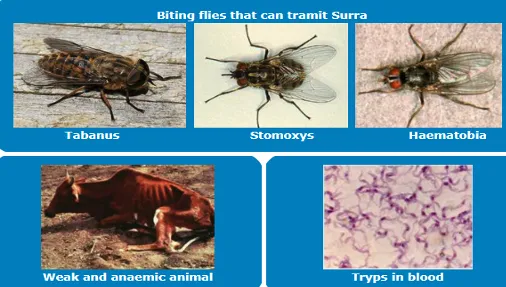
- Abortion is common in Indian camel due to either Trypanosomiasis (Surra disease) or scarcity of food. Surra is a parasitic disease caused by Trypanosoma evansi, transmitted through biting flies, and is one of the most economically devastating diseases affecting camels in India. It leads to high rates of abortion, further contributing to population decline.
India Camel Population Statistics
- As per the 20th Livestock Census (2019), India has approximately ~2.5 lakh (250,000) camels.
- This represents a decline of 37.1% from the 2012 (19th Livestock Census) figures — India's camel population has shown consistent decline over four successive censuses.
- Rajasthan leads with ~2.13 lakh camels (~85% of India's total). Second largest population is in Gujarat (~0.28 lakh).
- The decline is attributed to mechanisation of agriculture, restrictions under the Rajasthan Camel Act 2015, and reduced utility of camels in modern farming.
NOTE
As per 20th Livestock Census 2019, the exact figure is 2.52 lakh (252,000) camels. Some sources round to ~2.5 lakh. Rajasthan holds 80%+ of India's total camel population.
(Source: PIB Press Release, Ministry of Fisheries, Animal Husbandry & Dairying)
Indian Camel Breeds
As per ICAR-NBAGR / DAHD breed reporting, India has 9 registered indigenous camel breeds. The most frequently tested breeds are Bikaneri, Jaisalmeri, Kachchhi, Kharai and Mewari, but newer exam questions may ask the full nine-breed list.
NOTE
All Indian camel breeds belong to the Dromedary (Camelus dromedarius) species — one hump only. Rajasthan accounts for 80%+ of India's camel population and has the maximum number of breeds.
Indian Camel Breeds — One-Line Exam Table
| Breed | Main State / Tract | High-Yield Feature |
|---|---|---|
| Bikaneri | Rajasthan, Haryana, Punjab | Largest / heavy breed; draught and milk |
| Jaisalmeri | Rajasthan | Best racing and riding; BSF desert patrol association |
| Kachchhi | Gujarat | Good dairy type; Kutch tract |
| Kharai | Gujarat coast | Swims in seawater; browses mangroves |
| Mewari | Rajasthan | Heavy load and hilly/rocky tract adaptation |
| Mewati | Rajasthan, Haryana | Dual-purpose; Mewat tract |
| Jalori | Rajasthan | Draught type of Jalor region |
| Marwari | Rajasthan | Fast pace and endurance |
| Malvi | Madhya Pradesh / Rajasthan region | Listed among registered indigenous camel breeds |
Major Indian breeds are recognized by the NBAGR (National Bureau of Animal Genetic Resources); NRCC, Bikaner maintains and studies key camel genetic resources.
1. Bikaneri (Bikaner)
- State: Rajasthan (Bikaner region)
- Largest Indian camel breed
- Used for pack, draft, and milk; known for good milk yield
- Commonly used in agricultural operations
2. Jaisalmeri (Jaisalmer)
- State: Rajasthan (Jaisalmer/Barmer region)
- Best racing and riding camel in India; lean body with long legs
- Used by the Border Security Force (BSF) for patrolling the Indo-Pakistan border
- Considered the most elegant of Indian breeds
3. Kharai
- State: Gujarat (Kutch and Saurashtra coast)
- Uniquely, can swim in seawater and browses on mangroves — the only amphibious camel breed
- Smaller body size; adapted to coastal and tidal environments
- Declared India's 9th recognized camel breed by NBAGR
4. Mewari
- State: Mewar region, Rajasthan
- Used for heavy load carrying and ploughing; large, robust body
- Suited to agricultural work in rocky terrain
5. Kachchhi
- State: Gujarat (Kutch region)
- Another Gujarati breed distinct from Kharai
- Used for riding and milk production
6. Jalori
- State: Jalor district, Rajasthan
- Draught-type breed; suited to agricultural operations in southern Rajasthan
7. Marwari
- State: Marwar region, Rajasthan
- Known for fast pace and endurance; used for riding and racing
8. Mewati
- State: Rajasthan and Haryana (Mewat tract)
- Dual-purpose breed; important because it is often missed when students memorize only Rajasthan desert breeds
9. Malvi
- State: Madhya Pradesh / Rajasthan adjoining Malwa tract
- Registered indigenous breed; useful for "total number of registered camel breeds" questions
TIP
Breed memory trick for exams: Rajasthan-heavy breeds — Bikaneri (Biggest), Jaisalmeri (Jockey/racing), Mewari (heavy load), Jalori (Jalor), Marwari (Marwar/fast), plus Mewati and Malvi. Gujarat breeds — Kharai (swims/Koastal) and Kachchhi (Kutch).
(Source: NRCC — https://nrccamel.icar.gov.in/camelbreed.php)
Camel Diseases (Exam-Relevant)
| Disease | Causative Agent | Key Feature |
|---|---|---|
| Surra | Trypanosoma evansi | Transmitted by biting flies; causes abortion, weakness, death; most devastating camel disease in India |
| Mange | Sarcoptes scabiei | Skin disease; highly contagious; causes intense itching, hair loss |
| Camel Pox | Orthopoxvirus | Pustular skin disease; vaccine available; distinct from smallpox |
NOTE
Surra is caused by Trypanosoma evansi and is the primary infectious cause of abortion in Indian camels. It is transmitted by biting flies (Tabanus spp., Stomoxys spp.) and is also covered in the parasitic diseases chapter (02-07).
NRCC — National Research Centre on Camels
- Full name: ICAR-National Research Centre on Camels (NRCC), Bikaner, Rajasthan
- Established in 1984 as Project Directorate on Camels; upgraded to full NRCC status in 1995
- Maintains herds of all four major Indian breeds: Bikaneri, Jaisalmeri, Kachchhi, and Mewari
- Conducts research on camel milk, breeding, nutrition, health, and diseases
- Nodal institution for camel genetic resource conservation in India
(Source: https://nrccamel.icar.gov.in/)
Rajasthan Camel Act 2015
- Rajasthan declared the camel its State Animal in 2014.
- Enacted: Rajasthan Camel (Prohibition of Slaughter and Regulation of Temporary Migration or Export) Act, 2015
- The Act prohibits slaughter of camels and restricts their movement/export out of Rajasthan.
- Paradoxical impact: The Act has accelerated population decline — farmers cannot sell unproductive or old camels, making ownership economically unviable. Many farmers stopped maintaining camels altogether.
- Conservationists argue the Act needs amendment to allow regulated trade while preventing slaughter.
References
6 sources • [1] [2] [3] [4] [5] [6]
References
Camel Quick Revision Tables
| Concept / Topic | Key Details |
|---|---|
| Family | Camelidae (includes Camel, Llama, Alpaca, Guanaco, Vicuna) |
| Origin | North America (migrated to Asia & Africa) |
| Bactrian Camel | Camelus bactrianus; two humps; Central Asia (Mongolia, China); thick dark brown hair |
| Dromedary Camel | Camelus dromedarius; single hump; Middle East, India, North Africa; AKA Arabian Camel |
| Indian camel type | Dromedary (one hump) — found mainly in Rajasthan |
| Camel milk (FAO) | Lactose ~4.4% (3.5–5.1%), Fat ~3.5% (1.2–4.8%), Protein ~3.4% (2.15–4.9%), Ash ~0.79% |
| Camel milk special properties | ~3× Vitamin C of cow milk; insulin-like proteins; anti-diabetic; marketed by Amul & RCDF |
| Kuppas | Large leather containers from camel hide for storing oils and ghee |
| Desert conservation | Camels browse upper storeys of vegetation; do not strip ground cover → prevent desertification |
| BSF usage | Border Security Force uses camels (Jaisalmeri) for patrolling Thar Desert |
| Gestation period | 390 days (average) — much longer than cattle (~280 days) |
| Breeding interval | Once in 2 years; single calf per birth |
| Surra disease | Caused by Trypanosoma evansi; transmitted by biting flies; causes abortion in camels |
| Reasons for declining population | Long gestation, single births, 2-year breeding gap, Surra-induced abortions, food scarcity, Camel Act |
| Camel utility | Draught power, milk, meat, hide (Kuppas), desert patrol |
| Bactrian vs Dromedary key difference | 2 humps vs 1 hump; cold mountain terrain vs hot desert |
| Hump stores | FAT (not water) — very common MCQ trap |
| Chromosome number | 2n = 74 — same for both Dromedary and Bactrian |
| Dromedary % of world camels | ~90% of world camel population |
| India population (2019) | 2.52 lakh (252,000); down 37.1% from 2012; Rajasthan 80%+ (~2.13 lakh); Gujarat ~0.28 lakh |
| Rajasthan Camel Act 2015 | Prohibition of slaughter + export; camels declared State Animal 2014; paradoxically accelerated decline |
| NRCC | ICAR-National Research Centre on Camels, Bikaner; est. 1984 (upgraded 1995); 4 breeds maintained |
| Dehydration tolerance | Up to 25–30% of body weight |
| Water intake at once | 100–200 litres |
| Body temp range | 34°C (night) to 41°C (day) — conserves water by delaying sweating |
| RBC shape | Oval/elliptical — functions even in dehydrated state |
| Sexual maturity | 3–4 years |
| Gestation (full range) | 365–395 days (~13 months); avg stated as 390 days |
| Inter-calving interval | 24–30 months |
| Male rut | Musth — aggressive behaviour, secretion from poll glands |
| Draught capacity | 200–300 kg load; 40–60 km/day |
| NBAGR registered breeds | 9 breeds total in India |
| Mange causative agent | Sarcoptes scabiei |
| Camel Pox causative agent | Orthopoxvirus (vaccine available) |
Indian Camel Breeds (NBAGR Recognized)
| Breed | State | Key Feature |
|---|---|---|
| Bikaneri | Rajasthan (Bikaner) | Largest Indian breed; dual-purpose (milk + transport/draft) |
| Jaisalmeri | Rajasthan (Jaisalmer) | Best racing/riding; used by BSF; lean, long-legged |
| Kharai | Gujarat (Kutch/Saurashtra) | Swims in seawater; browses mangroves |
| Mewari | Rajasthan (Mewar) | Heavy load/ploughing; large body |
| Kachchhi | Gujarat (Kutch) | Riding and milk; distinct from Kharai |
| Jalori | Rajasthan (Jalor) | Draught type; agricultural work |
| Marwari | Rajasthan (Marwar) | Fast pace; riding and racing |
| Mewati | Rajasthan/Haryana | Mewat tract; dual-purpose |
| Malvi | Madhya Pradesh/Rajasthan | Malwa tract; registered indigenous breed |
Summary Cheat Sheet
| Concept | Key Details |
|---|---|
| Camel family | Camelidae; includes camel, llama, alpaca, guanaco, and vicuna |
| Main camel types | Bactrian = two humps; Dromedary = one hump |
| Indian camel type | India mainly has the dromedary camel, especially in Rajasthan |
| Hump fact | Camel hump stores fat, not water |
| Camel milk | Rich in vitamin C; known for insulin-like proteins; marketed by Amul and RCDF |
| Key adaptation | Oval RBCs, high dehydration tolerance, delayed sweating, and ability to drink 100–200 litres at once |
| Reproduction | Sexual maturity 3–4 years; gestation about 390 days; breeding interval about 2 years |
| Major disease | Surra caused by Trypanosoma evansi; important cause of abortion and decline |
| Population trend | India had about 2.52 lakh camels in 2019, with a sharp decline from 2012 |
| Rajasthan role | Rajasthan holds 80%+ of India's camel population and treats camel as the State Animal |
| Research institute | ICAR-NRCC, Bikaner is the key camel research centre |
| Important Indian breeds | Bikaneri, Jaisalmeri, Kharai, Mewari, Kachchhi, Jalori, Marwari, Mewati, Malvi |
Lesson Doubts
Ask questions, get expert answers