🪱 Root-Knot Nematode (Meloidogyne)
The No. 1 nematode pest -- species in India, giant cell biology, gall formation, above/below-ground symptoms, and integrated management
Having covered the basics of nematology in Section 1 -- from body organisation to management principles -- we now examine individual nematode species in detail. We begin with the most economically important one.
A vegetable farmer in Andhra Pradesh uproots a wilting tomato plant and notices swollen, knotted roots covered with bead-like galls. These galls are the handiwork of the root-knot nematode (Meloidogyne spp.) -- the number one nematode pest of agriculture worldwide. With the ability to reproduce without mating and complete 7--8 generations per year, a single female can turn a healthy field into a severely infested one within a single season.
This lesson covers:
- Etymology and discovery -- Berkeley (1855), Barber (1901) in India
- Important species in India -- M. incognita, M. hapla, M. graminicola, and others
- Biology -- giant cell formation, parthenogenetic reproduction, sexual differentiation
- Symptoms -- above-ground vs below-ground, galls vs Rhizobium nodules
- Integrated management -- cultural, chemical, biological, and resistant varieties
Etymology and Discovery
- Meloidogyne = Greek: melon (apple/gourd) + oides (resembling) + gyne (female) = apple-shaped females.
- Berkeley (1855) first reported root galls on greenhouse cucumber in England.
- In India, first reported by Barber in 1901 on tea (Kerala) -- also the first ever plant parasitic nematode reported from India.
Important Species in India
| Species | Distribution / Host | Key Feature |
|---|---|---|
| M. incognita | Throughout India; vegetables (tomato, potato, brinjal, chilli, okra, cucurbits) | Most widespread; greatest economic losses |
| M. hapla | Temperate/hilly areas only | Northern root-knot nematode |
| M. arenaria | Gujarat; groundnut | Associated with sandy soils |
| M. graminicola | Eastern India; rice | Adapted to waterlogged conditions |
| M. exigua | Karnataka; coffee | Specific to coffee roots |
| M. brevicauda | Assam; tea | -- |
The perineal pattern (ridges and grooves on the vulva-anus area) is the primary morphological tool for species identification -- unique to each species like a fingerprint.
Pro Content Locked
Upgrade to Pro to access this lesson and all other premium content.
₹99 charged monthly · Cancel anytime
- All Agriculture & Banking Courses
- AI Lesson Questions (100/day)
- AI Doubt Solver (50/day)
- Glows & Grows Feedback (30/day)
- AI Section Quiz (20/day)
- 22-Language Translation (100/day)
- Recall Questions (20/day)
- AI Quiz (15/day)
- AI Quiz Paper Analysis (100/day)
- AI Step-by-Step Explanations (100/day)
- Spaced Repetition Recall (FSRS)
- AI Tutor
- Immersive Text Questions
- Audio Lessons — Hindi & English
- Mock Tests & Previous Year Papers
- Summary & Mind Maps
- XP, Levels, Leaderboard & Badges
- Generate New Classrooms
- Voice AI Teacher (AgriDots Live)
- AI Revision Assistant
- Knowledge Gap Analysis
- Interactive Revision (LangGraph)
🔒 Secure via Razorpay · Cancel anytime · No hidden fees
Having covered the basics of nematology in Section 1 -- from body organisation to management principles -- we now examine individual nematode species in detail. We begin with the most economically important one.
A vegetable farmer in Andhra Pradesh uproots a wilting tomato plant and notices swollen, knotted roots covered with bead-like galls. These galls are the handiwork of the root-knot nematode (Meloidogyne spp.) -- the number one nematode pest of agriculture worldwide. With the ability to reproduce without mating and complete 7--8 generations per year, a single female can turn a healthy field into a severely infested one within a single season.
This lesson covers:
- Etymology and discovery -- Berkeley (1855), Barber (1901) in India
- Important species in India -- M. incognita, M. hapla, M. graminicola, and others
- Biology -- giant cell formation, parthenogenetic reproduction, sexual differentiation
- Symptoms -- above-ground vs below-ground, galls vs Rhizobium nodules
- Integrated management -- cultural, chemical, biological, and resistant varieties
Etymology and Discovery
- Meloidogyne = Greek: melon (apple/gourd) + oides (resembling) + gyne (female) = apple-shaped females.
- Berkeley (1855) first reported root galls on greenhouse cucumber in England.
- In India, first reported by Barber in 1901 on tea (Kerala) -- also the first ever plant parasitic nematode reported from India.
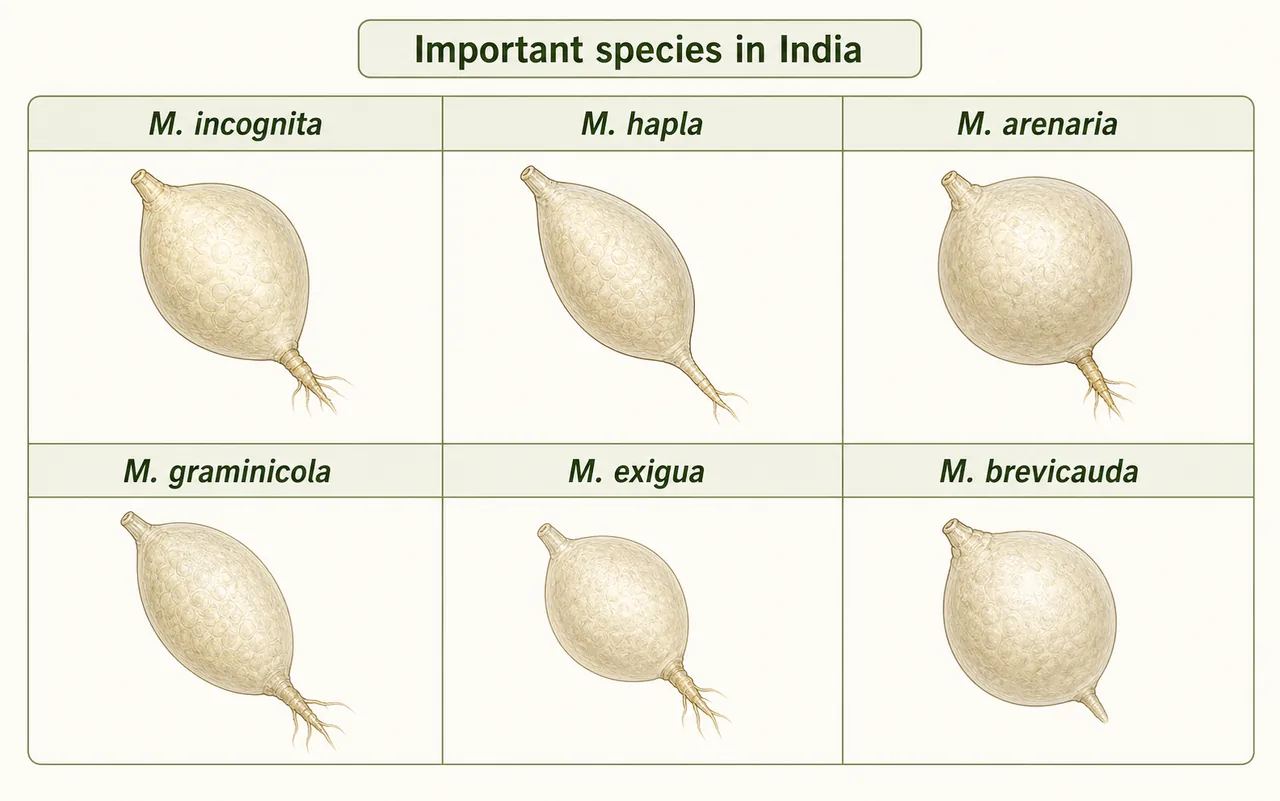
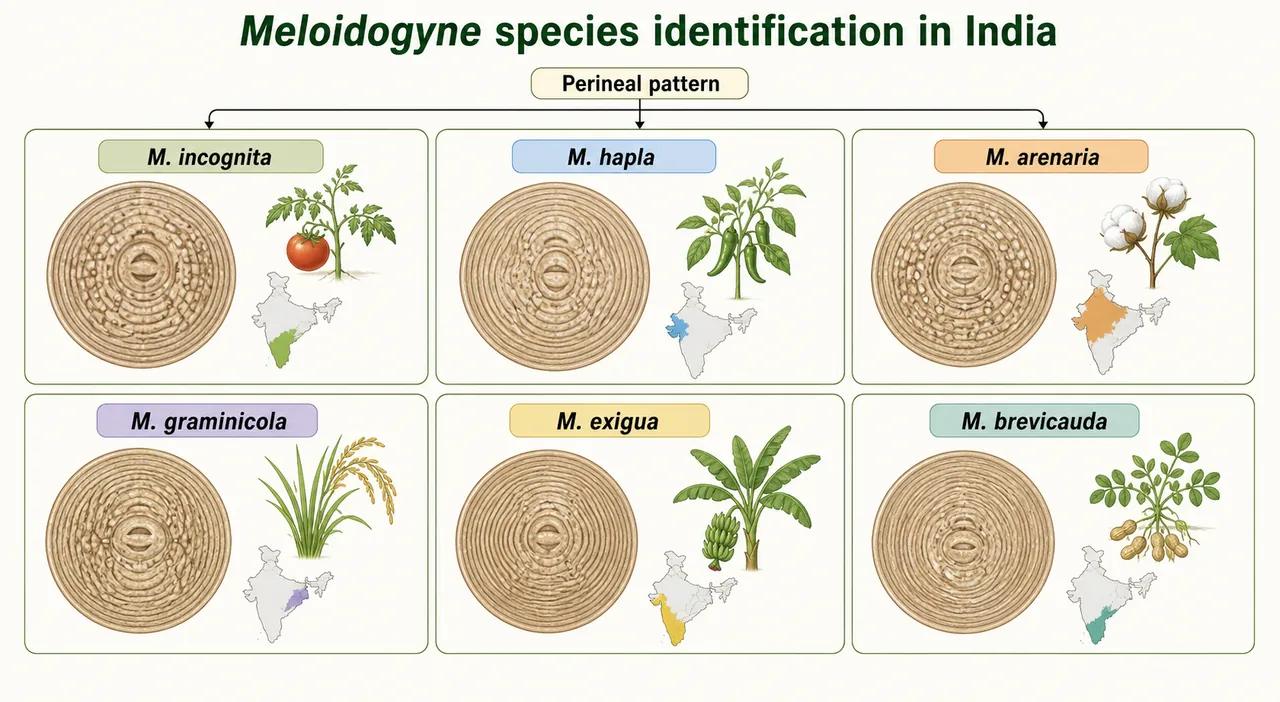
Important Species in India
| Species | Distribution / Host | Key Feature |
|---|---|---|
| M. incognita | Throughout India; vegetables (tomato, potato, brinjal, chilli, okra, cucurbits) | Most widespread; greatest economic losses |
| M. hapla | Temperate/hilly areas only | Northern root-knot nematode |
| M. arenaria | Gujarat; groundnut | Associated with sandy soils |
| M. graminicola | Eastern India; rice | Adapted to waterlogged conditions |
| M. exigua | Karnataka; coffee | Specific to coffee roots |
| M. brevicauda | Assam; tea | -- |
The perineal pattern (ridges and grooves on the vulva-anus area) is the primary morphological tool for species identification -- unique to each species like a fingerprint.
Biology and Life Cycle
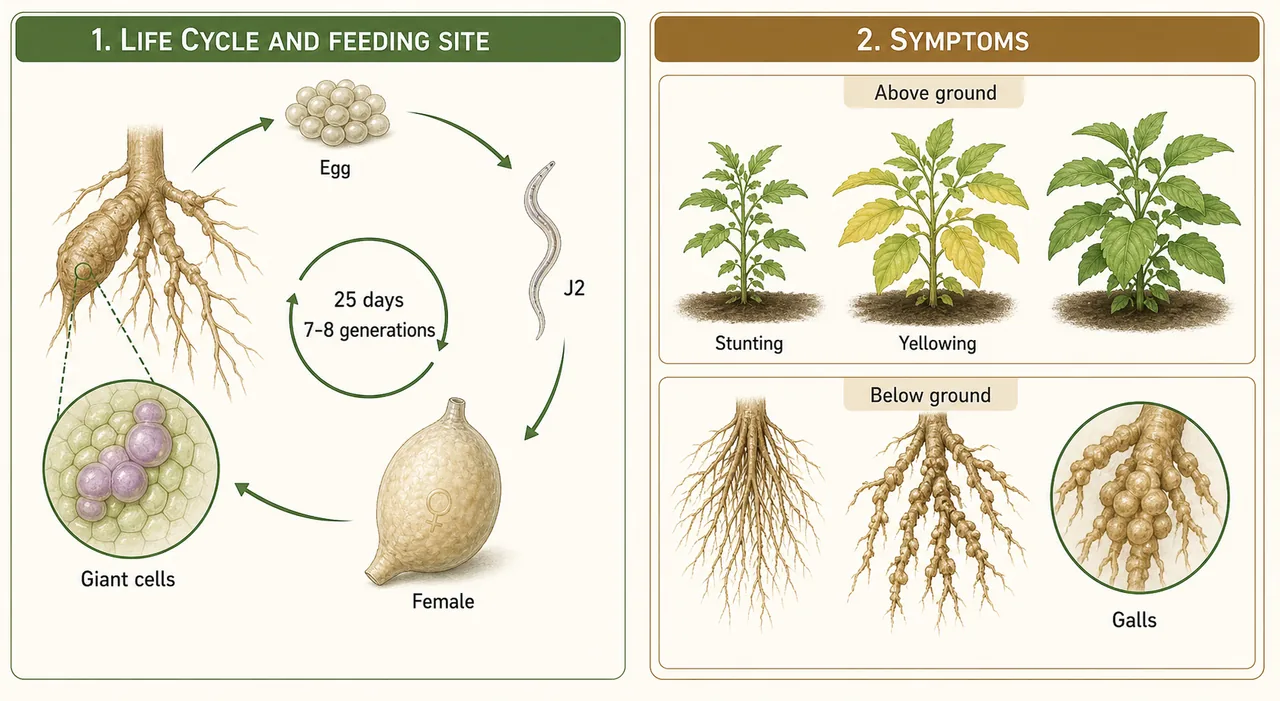
Root-knot nematodes are sedentary endoparasites with a rapid life cycle that enables explosive population growth. Understanding their biology explains why they are the most damaging nematode group worldwide.
Key Biological Facts
| Feature | Details |
|---|---|
| Parasitism type | Sedentary endoparasite of underground plant parts |
| Eggs per female | 200--400 in a gelatinous matrix (egg mass) |
| Infective stage | J2 (second-stage juvenile) -- the only stage that can initiate new infection |
| Hatching trigger | Normal soil conditions (does not require host root exudates) |
| Site of attack | Meristematic zone (just behind root tip) |
| Feeding site | Pericycle region -- induces giant cells (syncytium) |
| Reproduction | Primarily parthenogenetic (without mating) |
| Life cycle duration | 25 days at 25--30 degrees C (optimum) |
| Generations per year | 7--8 overlapping generations |
Giant Cell Formation
The feeding J2 secretes enzymes that cause:
- Hypertrophy -- enlargement of cells (karyokinesis without cytokinesis)
- Formation of 6--10 giant cells -- multinucleate, metabolically active cells that serve as the nematode's nutritional lifeline
- Giant cells contain dense cytoplasm, enlarged nuclei, abundant mitochondria and Golgi bodies
The giant cells cause the characteristic root galls (knots) by disrupting the plant's hormone (auxin/IAA) system. The nematode's protease enzyme converts tryptophan to excess IAA, causing swelling.
Sexual Differentiation
- Sex differentiates in late J2 stage: genital primordium becomes 'V' shaped in females and 'I' shaped in males.
- Sexual reversal: Under adverse conditions (overcrowding, poor nutrition), more males develop instead of females.
- Males are vermiform and mobile; females are sedentary and pyriform (swollen).
Symptoms
Nematode damage produces two categories of symptoms. Only the below-ground signs are diagnostic -- above-ground symptoms can be confused with nutrient deficiency or water stress.
Above Ground (Non-Diagnostic)
Stunted growth, yellowing, wilting during hot dry periods, undersized fruits, reduced yields. These symptoms cannot confirm root-knot infestation alone.
Below Ground (Diagnostic)
Root galls (knots) -- the hallmark symptom -- caused by hypertrophy and hormonal imbalance at feeding sites.
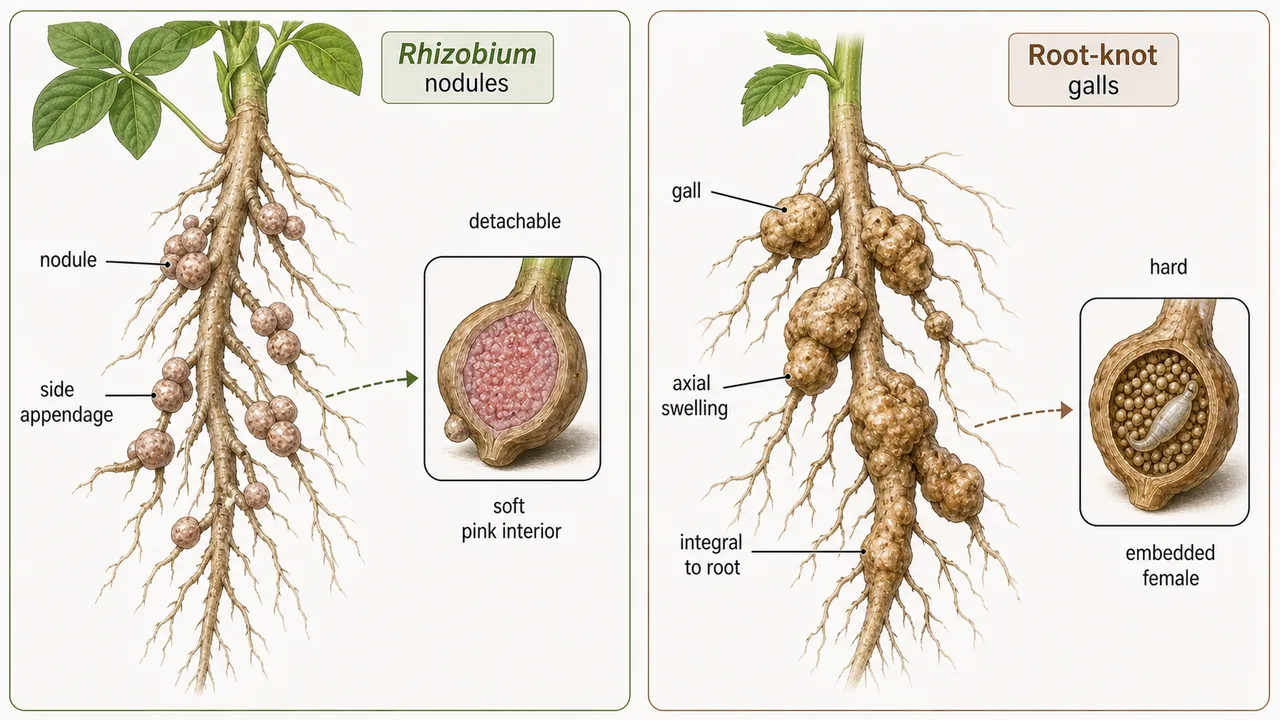
Root-Knot Galls vs Rhizobium Nodules
| A. Leguminous nodules | B. Root knots |
|---|---|
| Bacterial nodules are side appendages, soft and can be detached easily. | The nematode galls are axial swellings of the root itself. That means they are deeply seated in the root system. And hence cannot be easily detachable. |
| Root Nodules are spongy in consistency. | Root Knots are hard in consistency. |
Quick field test: Cut the swelling open. Rhizobium nodules are easily detachable with a pinkish interior (nitrogen fixation). Root-knot galls are integral to the root and contain embedded nematodes.
Integrated Management
| Method | Details |
|---|---|
| Deep summer ploughing | 2--3 ploughings in May/June to kill quiescent J2 by heat exposure |
| Crop rotation | With non-host crops; intercropping with marigold (Tagetes sp.) |
| Trap crop | Cowpea (highly susceptible) -- plant and destroy before reproduction |
| Chemical | Carbofuran @ 1 kg a.i./ha (Furadan) |
| Biological (fungus) | Paecilomyces lilacinus -- egg parasite (oviparasite) |
| Biological (bacterium) | Pasteuria penetrans -- larval parasite |
| Other bioagents | Pseudomonas fluorescens, Trichoderma harzianum, T. viride, Bt. kurstaki |
Resistant Varieties
Resistant Varieties for Root-Knot Nematode
| Crop | Resistant Varieties |
|---|---|
| Tomato | PNR-7, Hissar Lalit, SL-120 |
| Brinjal | Black Beauty, Neelkantha |
| Chilli | Pusa Jwala |
Summary Table
| Feature | Key Fact |
|---|---|
| Scientific name | Meloidogyne spp. |
| Common name | Root-knot nematode |
| Rank | No. 1 nematode pest worldwide |
| First report (World) | Berkeley, 1855, cucumber, England |
| First report (India) | Barber, 1901, tea, Kerala |
| Parasitism | Sedentary endoparasite |
| Infective stage | J2 |
| Reproduction | Primarily parthenogenetic |
| Life cycle | 25 days (25--30 degrees C) |
| Generations/year | 7--8 |
| Feeding site | Giant cells (syncytium) in pericycle |
| Diagnostic symptom | Root galls/knots |
| Species identification | Perineal pattern |
| Key nematicide | Carbofuran @ 1 kg a.i./ha |
| Key biocontrol | Paecilomyces lilacinus (egg parasite) |
| Most widespread species (India) | M. incognita |
TIP
Exam mnemonic -- "PGHS" for Meloidogyne key facts: Parthenogenetic reproduction, Giant cells (6--10) for feeding, Hypertrophy causes galls, Sedentary endoparasite.
References
- Dropkin, V.H. 1980. Introduction to plant nematology. John Wiley and sons, INC. New York.
- Singh, R.S and Sitaramaiah, K. 1994. Plant pathogens. The plant parasitic nematodes. Oxford & IBH Pub. Co. Pvt. Ltd. New Delhi.
- Parvata Reddy, P. 1983. Plant nematology. Agricole Pub. Co., New Delhi.
- Walia, R. K and Bajaj, H. K (2014). Textbook of Introductory Plant Nematology. Directorate of Knowledge Management in Agriculture, ICAR, New Delhi.
- Kumar, V., Khan, M.R. & Walia, R.K. Crop Loss Estimations due to Plant-Parasitic Nematodes in Major Crops in India. Natl. Acad. Sci. Lett. 43, 409-412 (2020).
- Figure 1: Source: A: Maggenti, 1981, B-E: Franklin, 1973
Summary Cheat Sheet
| Concept / Topic | Key Details |
|---|---|
| Scientific name | Meloidogyne spp. |
| Common name | Root-knot nematode |
| Rank | No. 1 nematode pest worldwide |
| First report (World) | Berkeley, 1855, cucumber, England |
| First report (India) | Barber, 1901, tea, Kerala |
| Parasitism | Sedentary endoparasite |
| Infective stage | J2 |
| Reproduction | Primarily parthenogenetic |
| Life cycle | 25 days (25--30 degrees C) |
| Generations/year | 7--8 |
| Feeding site | Giant cells (syncytium) in pericycle |
| Diagnostic symptom | Root galls/knots |
| Species identification | Perineal pattern |
| Key nematicide | Carbofuran @ 1 kg a.i./ha |
| Key biocontrol | Paecilomyces lilacinus (egg parasite) |
| Most widespread species (India) | M. incognita |
TIP
Next: Lesson 02 covers cyst nematodes (Heterodera and Globodera) -- Molya disease, syncytium formation, and the quarantine potato cyst nematode.