📏 Order & Comparison - Advanced
Multi-variable ordering with designations, departments, corporate hierarchies, and combined ranking puzzles
Order & Comparison Puzzles - Advanced
Advanced ordering puzzles combine ranking with multiple variables — each person has a designation, department, city, or item in addition to their rank. These are frequently asked in Mains-level exams.
Multi-Variable Ordering Structure
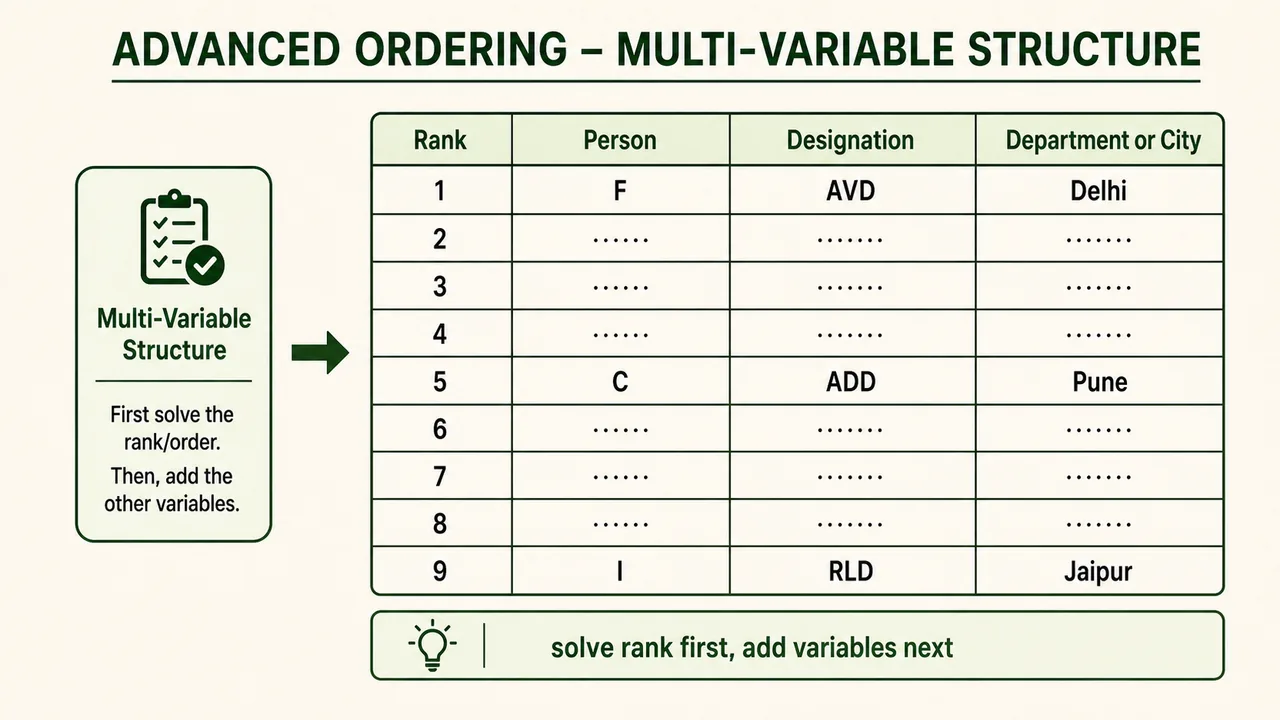
In advanced ordering puzzles, you need to track:
- Rank/Position — the ordered sequence
- Person name — who occupies which rank
- Variable 1 — designation, department, color, etc.
- Variable 2 — city, fruit, car brand, etc.
Your grid becomes:
| Rank | Person | Designation | Department/City |
|---|---|---|---|
| 1 (Highest) | |||
| 2 | |||
| ... | |||
| N (Lowest) |
Department Hierarchy Puzzles
Common Media Company Hierarchy (9 departments): ED > AVD > CD > PRD > ADD > ACD > PD > LD > RLD
(Executive Department > Audio-Visual > Creative > Production > Advertisement > Accounts > Planning > Legal > Research & Legal Development)
Pro Content Locked
Upgrade to Pro to access this lesson and all other premium content.
₹99 charged monthly · Cancel anytime
- All Agriculture & Banking Courses
- AI Lesson Questions (100/day)
- AI Doubt Solver (50/day)
- Glows & Grows Feedback (30/day)
- AI Section Quiz (20/day)
- 22-Language Translation (100/day)
- Recall Questions (20/day)
- AI Quiz (15/day)
- AI Quiz Paper Analysis (100/day)
- AI Step-by-Step Explanations (100/day)
- Spaced Repetition Recall (FSRS)
- AI Tutor
- Immersive Text Questions
- Audio Lessons — Hindi & English
- Mock Tests & Previous Year Papers
- Summary & Mind Maps
- XP, Levels, Leaderboard & Badges
- Generate New Classrooms
- Voice AI Teacher (AgriDots Live)
- AI Revision Assistant
- Knowledge Gap Analysis
- Interactive Revision (LangGraph)
🔒 Secure via Razorpay · Cancel anytime · No hidden fees
Order & Comparison Puzzles - Advanced
Advanced ordering puzzles combine ranking with multiple variables — each person has a designation, department, city, or item in addition to their rank. These are frequently asked in Mains-level exams.
Multi-Variable Ordering Structure
In advanced ordering puzzles, you need to track:
- Rank/Position — the ordered sequence
- Person name — who occupies which rank
- Variable 1 — designation, department, color, etc.
- Variable 2 — city, fruit, car brand, etc.
Your grid becomes:
| Rank | Person | Designation | Department/City |
|---|---|---|---|
| 1 (Highest) | |||
| 2 | |||
| ... | |||
| N (Lowest) |
Department Hierarchy Puzzles
Common Media Company Hierarchy (9 departments): ED > AVD > CD > PRD > ADD > ACD > PD > LD > RLD
(Executive Department > Audio-Visual > Creative > Production > Advertisement > Accounts > Planning > Legal > Research & Legal Development)
Example: 9 persons in a media company, each in a different department. The person in ED has the highest rank. Solve who is in which department.
Approach:
- The department hierarchy directly determines the rank — ED is rank 1, RLD is rank 9
- Map persons to departments, which automatically gives their rank
- Use conditions to narrow down person-to-department assignments
Corporate Position Ordering
Standard Corporate Hierarchy (lowest to highest): AM < MG < DGM < GM < AGM < CGM < VP < SVP < ED < MD < CEO
(Assistant Manager < Manager < Deputy GM < General Manager < Additional GM < Chief GM < Vice President < Senior VP < Executive Director < Managing Director < CEO)
Example: 7 persons have different corporate positions. Each also drives a different colored car. Conditions link positions and car colors.
Approach:
- List the 7 positions used (e.g., AM through ED if 7 are used)
- Rank is determined by position: CEO/highest position = rank 1
- Assign persons to positions using conditions
- Then map car colors as the second variable
Solved Example: Departments + Ranking
Question: Nine persons — A, B, C, D, E, F, G, H, I — work in 9 departments of a media company. The hierarchy is: ED > AVD > CD > PRD > ADD > ACD > PD > LD > RLD.
Conditions:
- C works in ADD
- Only 3 persons rank above D
- B ranks immediately above G
- F works in AVD
- A ranks below C but above H
- E ranks immediately below D
- I works in RLD
Solution:
From hierarchy: ED(1) > AVD(2) > CD(3) > PRD(4) > ADD(5) > ACD(6) > PD(7) > LD(8) > RLD(9)
From (1): C is in ADD = rank 5 From (4): F is in AVD = rank 2 From (7): I is in RLD = rank 9
From (2): Only 3 above D, so D = rank 4 (PRD) From (6): E immediately below D(4), so E = rank 5 — but C is at 5! Contradiction.
Wait — "immediately below" means next rank. E = rank 5 conflicts with C. So D cannot be rank 4.
Re-read: "Only 3 persons rank above D" = D is rank 4. But rank 4 = PRD and rank 5 = ADD = C. E immediately below D(4) = rank 5 = C's spot.
In this type of puzzle, each rank corresponds to a department. Since C is in ADD (rank 5) and D is rank 4, E must be rank 5 — but that's C. So the puzzle conditions would be designed differently in an actual exam.
The key takeaway is the approach:
- Map departments to ranks first (hierarchy gives you the rank order)
- Use direct department assignments to fix some positions
- Use relative conditions ("above", "immediately below") to place remaining persons
- Cross-check all conditions at the end
Combined Ordering: Boxes + Fruits + Weights
Example Pattern: 7 boxes are arranged in order of weight. Each box contains a different fruit.
Here you have three variables:
- Position (by weight — heaviest to lightest)
- Box identifier (A, B, C...)
- Fruit (Apple, Mango, Banana...)
Strategy:
- If weights are given as numbers, sort them first to get positions
- Then map box letters and fruits using conditions
- Conditions may mix all three: "Box A has mangoes and is heavier than Box C"
Employees with Designations + Cities
Example: 6 employees with different designations (Clerk, PO, SO, AGM, DGM, GM) belong to different cities (Delhi, Mumbai, Chennai, Kolkata, Pune, Jaipur).
Grid setup:
| Rank | Employee | Designation | City |
|---|---|---|---|
| 1 (Highest) | GM | ||
| 2 | DGM | ||
| 3 | AGM | ||
| 4 | SO | ||
| 5 | PO | ||
| 6 (Lowest) | Clerk |
Approach:
- The designation hierarchy is fixed — ranks are predetermined
- Assign employees to designations using conditions
- Assign cities as the second variable
- Conditions may link employees to cities, designations, or both
Handling "Rank from Bottom" vs "Rank from Top"
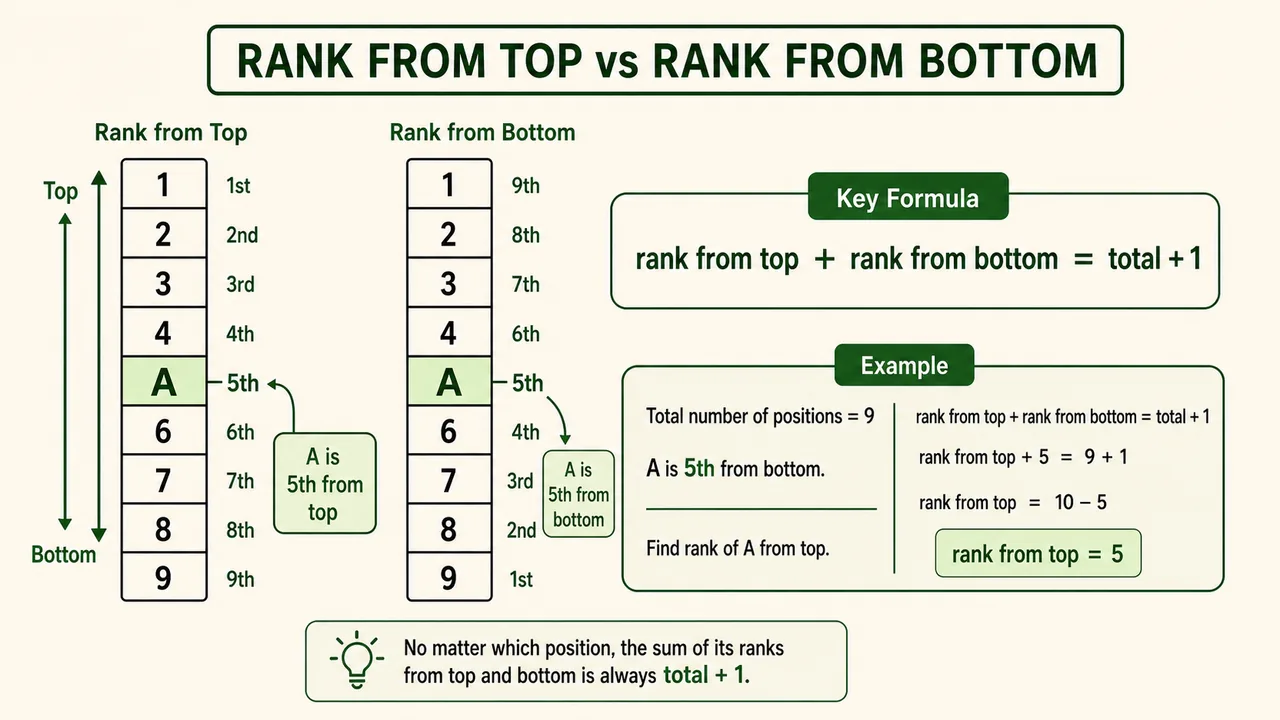
Some conditions use rank from both ends:
- "A's rank from top is 3" = A is 3rd in the sequence
- "A's rank from bottom is 5" = A is 5th from the bottom
Formula: Rank from top + Rank from bottom = Total + 1
So if there are 9 persons and A's rank from bottom is 5: Rank from top = 9 + 1 - 5 = 5th from top
Complex Conditions in Advanced Ordering
| Condition | Interpretation |
|---|---|
| "As many persons above A as below B" | Count above A = Count below B |
| "The difference in ranks of A and B is 3" | |Rank(A) - Rank(B)| = 3 |
| "A's rank is the average of B's and C's rank" | Rank(A) = (Rank(B) + Rank(C)) / 2 |
| "Number of persons between A and B equals persons between C and D" | |Rank(A) - Rank(B)| - 1 = |Rank(C) - Rank(D)| - 1 |
Speed Tips
- Pre-write the designation hierarchy on rough paper before reading conditions
- When a hierarchy is given in the question, number each designation immediately (1 for highest)
- Multi-variable ordering needs a clean, spacious grid — don't cramp your rough work
- For "as many above X as below Y" type conditions, use algebra: if X is at rank a and Y is at rank b, then (a - 1) = (Total - b), so a + b = Total + 1
- Solve the ranking first, assign variables second — don't try to do both simultaneously