📏 Order & Comparison - Basic
Learn ranking and ordering puzzles - height, weight, age, experience, and designation-based comparisons
Order & Comparison Puzzles - Basic
Order and comparison puzzles require you to arrange persons in a specific sequence based on some measurable attribute like height, weight, age, experience, or designation rank.
Types of Ordering
Ascending Order (Increasing): Smallest/shortest/youngest at position 1, largest at last position.
Descending Order (Decreasing): Tallest/heaviest/oldest at position 1, smallest at last position.
Convention: Unless specified, questions typically use descending order for "ranking" — rank 1 = tallest/heaviest/most experienced.
Notation System
Use these symbols for quick rough work:
| Symbol | Meaning |
|---|---|
| A > B | A is taller/heavier/older than B |
| A < B | A is shorter/lighter/younger than B |
| A >> B | A is much taller (not immediately next to B in ranking) |
| A = B | A and B have the same value (rare in puzzles) |
Key Terminology
| Exam Phrase | Meaning |
|---|---|
| "A is taller than B" | A > B (A ranks above B) |
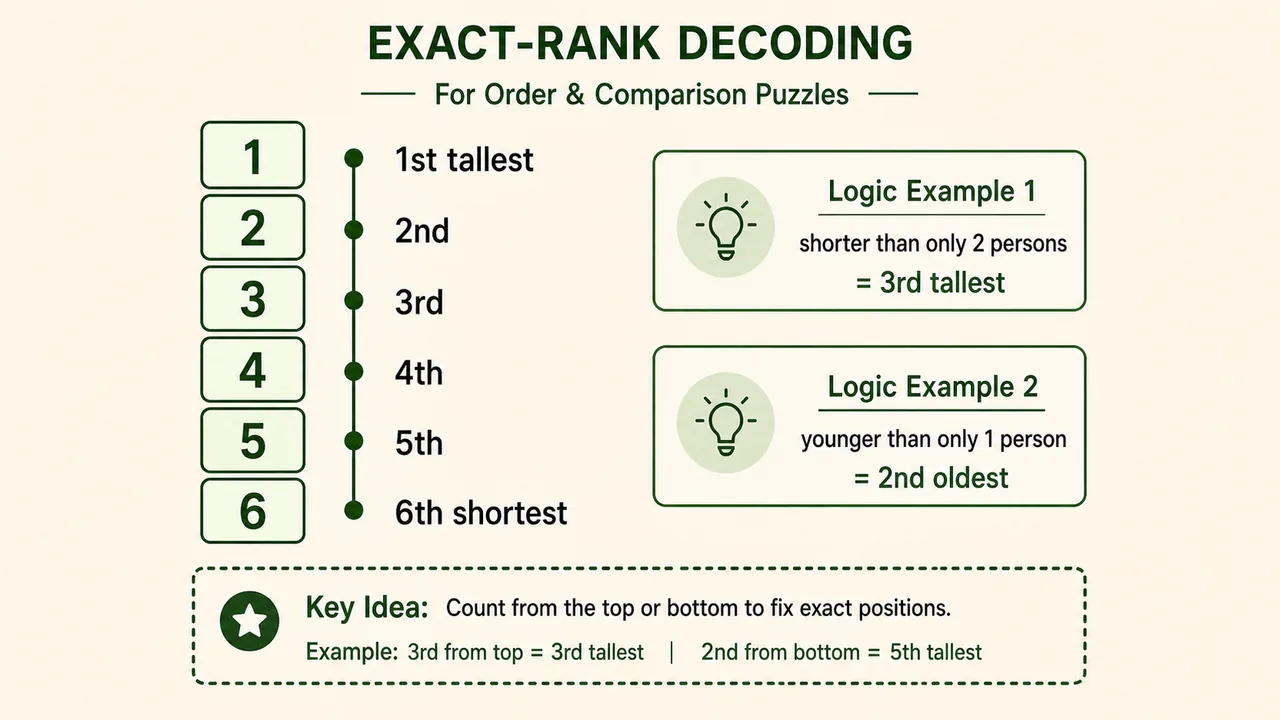
| "A is shorter than only 2 persons" | Only 2 persons are taller than A (A is 3rd tallest) |
| "A is taller than at least 3 persons" | A ranks 1st, 2nd, 3rd, 4th, or 5th from top (at least 3 below) |
| "A is neither the tallest nor the shortest" | A is not at rank 1 or last rank |
| "A is immediately taller than B" | A and B are adjacent in ranking, A is one rank above B |
| "Only one person is between A and B" | One person ranks between them |
| "A is shorter than B but taller than C" | B > A > C |
Height-Based Ordering
Example: Six persons A, B, C, D, E, F have different heights.
Pro Content Locked
Upgrade to Pro to access this lesson and all other premium content.
₹99 charged monthly · Cancel anytime
- All Agriculture & Banking Courses
- AI Lesson Questions (100/day)
- AI Doubt Solver (50/day)
- Glows & Grows Feedback (30/day)
- AI Section Quiz (20/day)
- 22-Language Translation (100/day)
- Recall Questions (20/day)
- AI Quiz (15/day)
- AI Quiz Paper Analysis (100/day)
- AI Step-by-Step Explanations (100/day)
- Spaced Repetition Recall (FSRS)
- AI Tutor
- Immersive Text Questions
- Audio Lessons — Hindi & English
- Mock Tests & Previous Year Papers
- Summary & Mind Maps
- XP, Levels, Leaderboard & Badges
- Generate New Classrooms
- Voice AI Teacher (AgriDots Live)
- AI Revision Assistant
- Knowledge Gap Analysis
- Interactive Revision (LangGraph)
🔒 Secure via Razorpay · Cancel anytime · No hidden fees
Order & Comparison Puzzles - Basic
Order and comparison puzzles require you to arrange persons in a specific sequence based on some measurable attribute like height, weight, age, experience, or designation rank.
Types of Ordering
Ascending Order (Increasing): Smallest/shortest/youngest at position 1, largest at last position.
Descending Order (Decreasing): Tallest/heaviest/oldest at position 1, smallest at last position.
Convention: Unless specified, questions typically use descending order for "ranking" — rank 1 = tallest/heaviest/most experienced.
Notation System
Use these symbols for quick rough work:
| Symbol | Meaning |
|---|---|
| A > B | A is taller/heavier/older than B |
| A < B | A is shorter/lighter/younger than B |
| A >> B | A is much taller (not immediately next to B in ranking) |
| A = B | A and B have the same value (rare in puzzles) |
Key Terminology
| Exam Phrase | Meaning |
|---|---|
| "A is taller than B" | A > B (A ranks above B) |
| "A is shorter than only 2 persons" | Only 2 persons are taller than A (A is 3rd tallest) |
| "A is taller than at least 3 persons" | A ranks 1st, 2nd, 3rd, 4th, or 5th from top (at least 3 below) |
| "A is neither the tallest nor the shortest" | A is not at rank 1 or last rank |
| "A is immediately taller than B" | A and B are adjacent in ranking, A is one rank above B |
| "Only one person is between A and B" | One person ranks between them |
| "A is shorter than B but taller than C" | B > A > C |
Height-Based Ordering
Example: Six persons A, B, C, D, E, F have different heights.
Conditions:
- A is taller than C but shorter than B
- D is the shortest
- E is taller than A but shorter than B
- F is taller than C but shorter than A
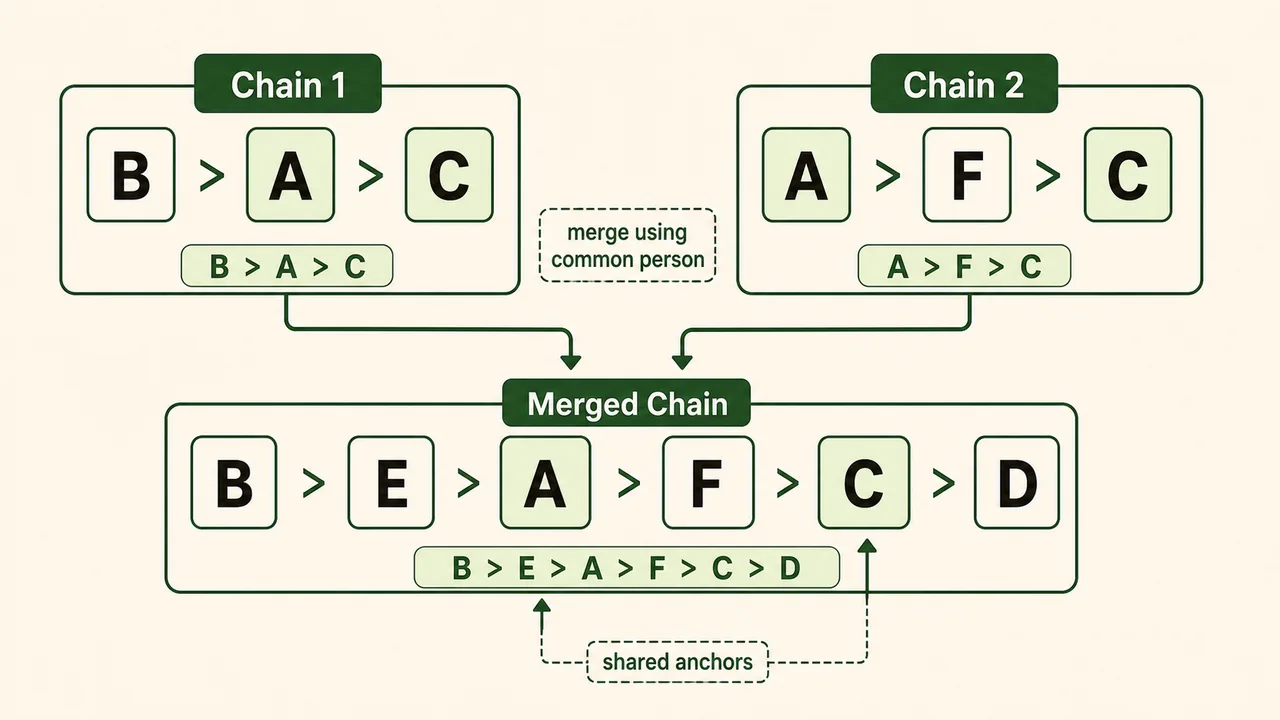
Solution: From (1): B > A > C From (3): B > E > A (E is between B and A, and from (1) B > A, so B > E > A) Wait, (3) says E > A and E < B. Combined with (1) B > A > C:
B > E > A > C (since both E and A are below B, and E > A)
From (4): A > F > C
So far: B > E > A > F > C
From (2): D is shortest, so D is below C: B > E > A > F > C > D
Ranking (tallest to shortest): B, E, A, F, C, D
Weight-Based Ordering with Specific Values
Sometimes weights are given as specific numbers.
Example: E weighs 80 kg. A weighs more than E. C weighs less than E but more than D. B weighs the most. F weighs less than D.
Solution: B is heaviest (rank 1). A > 80 (A weighs more than 80 kg) C < 80, C > D F < D
So: B > A > E(80) > C > D > F
Designation-Based Ranking
Some puzzles use official designation hierarchies as the ranking base. You must know these:
Police Designations (highest to lowest): DGP > IGP > DIG > SSP > SP > ASP > ACP > API > SI > ASI
Corporate Designations (lowest to highest): AM < MG < DGM < GM < AGM < CGM < VP < SVP < ED < MD < CEO
Publishing House Designations: Executive < Manager < Senior Manager < Assistant Director < Director < VP
Tip: The question will usually mention the hierarchy order. But for police and corporate designations, memorizing these saves time.
Dual Parameter Ordering
In some puzzles, persons are ranked on two parameters simultaneously.
Example: Hills with both height and width:
| Hill | Height Rank | Width Rank |
|---|---|---|
| A | 3rd tallest | 2nd widest |
| B | 1st tallest | 5th widest |
| ... | ... | ... |
Key insight: The two rankings are independent. The tallest hill is not necessarily the widest. Solve each parameter separately, then combine.
Cookies/Items Counting Order
Example: 8 boxes contain different numbers of cookies. P has the most cookies. The number of cookies between Q and R is 3.
In this type, "between Q and R" means the number of persons ranked between them, NOT the difference in cookie counts. Read carefully!
Solved Example: Age and Experience
Question: Six persons have different ages. B is older than D. Only 2 persons are older than C. A is younger than only one person. E is older than B. F is the youngest.
Solution:
- A is younger than only 1 person = A is 2nd oldest
- Only 2 persons are older than C = C is 3rd oldest
- E > B (E older than B)
- F is youngest (rank 6)
Rank 1 (oldest): ? — must be the one person older than A Rank 2: A Rank 3: C Rank 4, 5: B, D, E (but E > B and B > D)
E must be above B, and B above D. If E is at rank 4, B at rank 5... but we need E > B > D and D > F.
Wait: E > B > D (from conditions). E is rank 1 (only one person older than A means A is rank 2, and E > B means E could be rank 1).
Actually: "A is younger than only one person" = 1 person is older than A = A is rank 2. That one person older than A must be determined. E > B > D, and "only 2 persons older than C" = C is rank 3.
Rank 1: E (since E > B and E needs to be above A for consistency) Rank 2: A Rank 3: C Rank 4: B (E > B, and B > D) Rank 5: D Rank 6: F (youngest)
Order (oldest to youngest): E > A > C > B > D > F
Common Traps
- "Shorter than only 2 persons" means rank 3 from top (2 persons taller), NOT rank 2
- "At least 3 persons taller" means rank 4 or below (could be 4th, 5th, etc.)
- Ascending vs Descending confusion — always clarify which end is rank 1
- "Between A and B" in ordering context means persons ranked between them, not distance
- Designation puzzles — the question may list hierarchy from top to bottom OR bottom to top. Read carefully.
Speed Tips
- Write the ranking as a vertical line: Top (tallest/heaviest) at top, Bottom at bottom
- Place definite ranks first ("A is the tallest" = rank 1)
- Use "only X persons above/below" to calculate exact rank
- For chains like A > B > C, write them as a connected string
- When two chains intersect (share a common person), merge them immediately