🏢 Floor Based Puzzles - Advanced
Floor puzzles with extra variables, vacant floors, floor shifting, and combined odd/even constraints
Floor Based Puzzles - Advanced
Advanced floor puzzles add complexity layers on top of the basic arrangement — extra variables (colors, items), vacant floors, and floor-shifting conditions. These appear frequently in both Prelims and Mains.
Floor Puzzles with Extra Variables
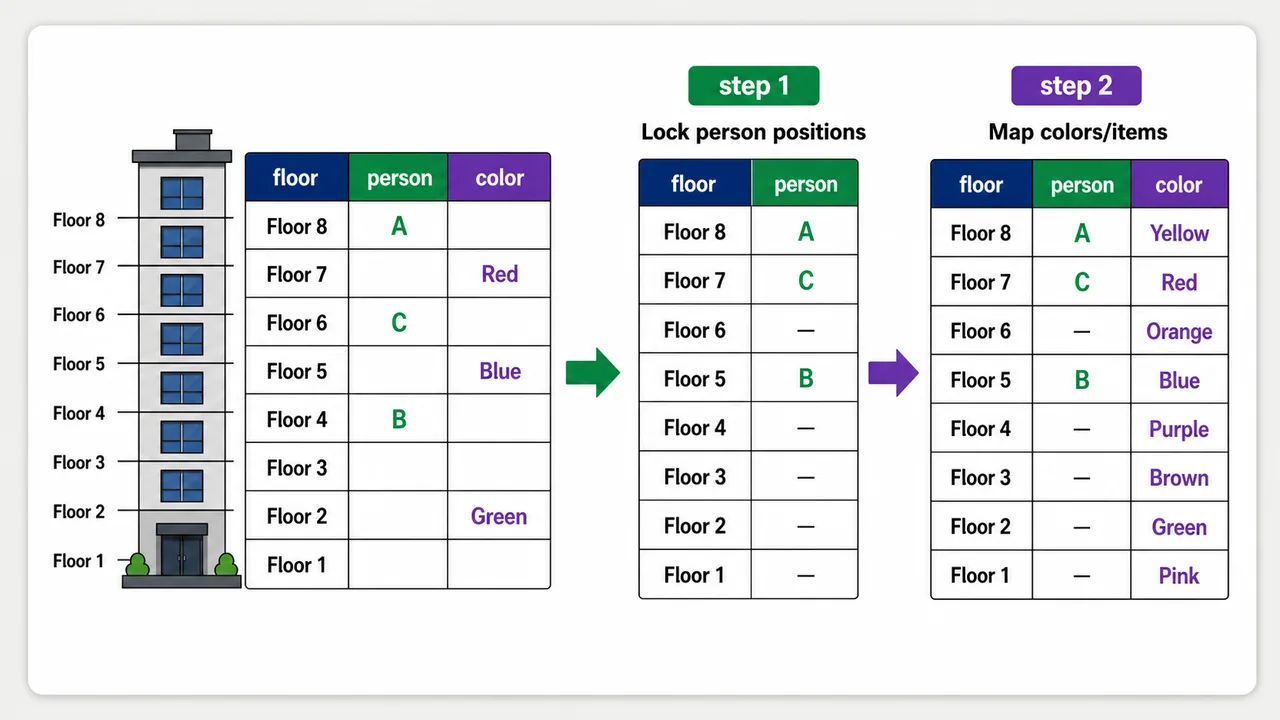
In these puzzles, each person on a floor also has an associated variable like a color, item, city, or profession.
Grid setup:
| Floor | Person | Color/Item |
|---|---|---|
| 8 (Top) | ||
| 7 | ||
| 6 | ||
| 5 | ||
| 4 | ||
| 3 | ||
| 2 | ||
| 1 (Ground) |
Strategy: Solve the person-to-floor assignment first (using Part A/B methodology), then map variables as a second step.
Vacant Floor Concept
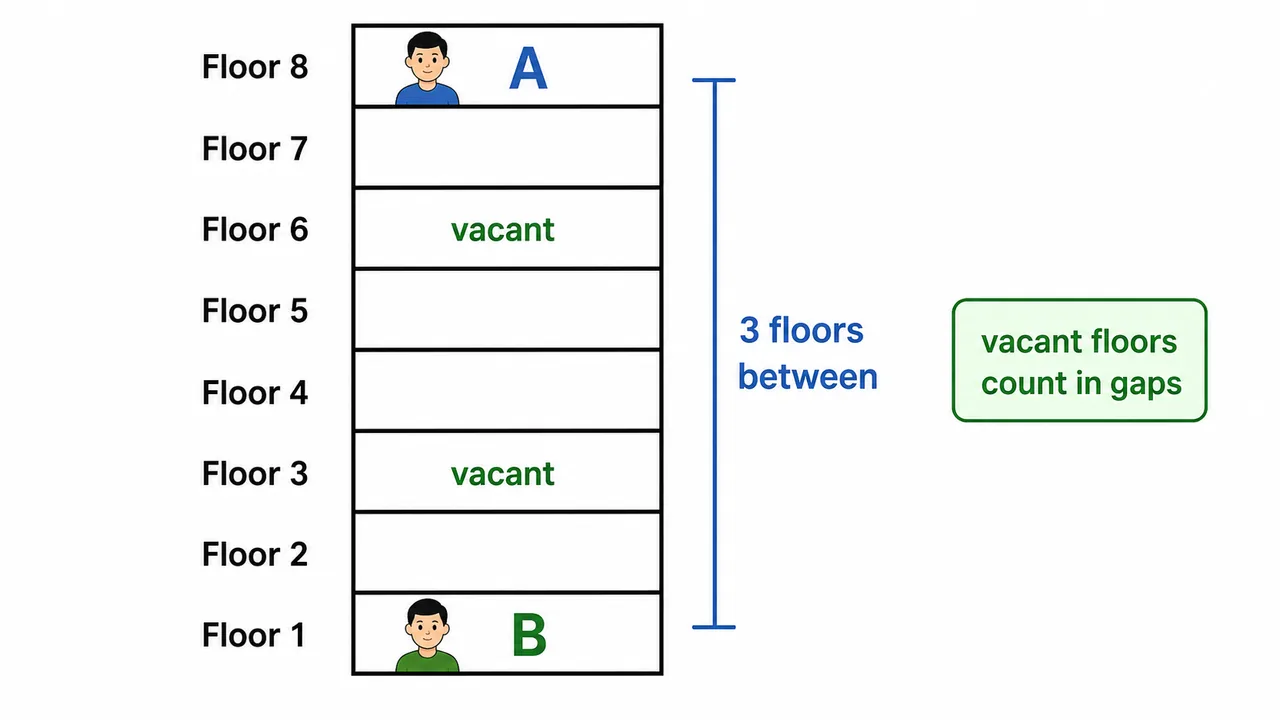
In some puzzles, not all floors are occupied. For example, 6 persons on an 8-floor building means 2 floors are vacant.
Key implications:
- Vacant floors can be anywhere (unless restricted by conditions)
- Gap calculations still count vacant floors: "3 floors between A and B" includes vacant floors in the count
- Conditions like "no one lives immediately above A" could mean the floor above A is vacant
Notation: Mark vacant floors with a dash (-) or "V" in your grid.
Pro Content Locked
Upgrade to Pro to access this lesson and all other premium content.
₹99 charged monthly · Cancel anytime
- All Agriculture & Banking Courses
- AI Lesson Questions (100/day)
- AI Doubt Solver (50/day)
- Glows & Grows Feedback (30/day)
- AI Section Quiz (20/day)
- 22-Language Translation (100/day)
- Recall Questions (20/day)
- AI Quiz (15/day)
- AI Quiz Paper Analysis (100/day)
- AI Step-by-Step Explanations (100/day)
- Spaced Repetition Recall (FSRS)
- AI Tutor
- Immersive Text Questions
- Audio Lessons — Hindi & English
- Mock Tests & Previous Year Papers
- Summary & Mind Maps
- XP, Levels, Leaderboard & Badges
- Generate New Classrooms
- Voice AI Teacher (AgriDots Live)
- AI Revision Assistant
- Knowledge Gap Analysis
- Interactive Revision (LangGraph)
🔒 Secure via Razorpay · Cancel anytime · No hidden fees
Floor Based Puzzles - Advanced
Advanced floor puzzles add complexity layers on top of the basic arrangement — extra variables (colors, items), vacant floors, and floor-shifting conditions. These appear frequently in both Prelims and Mains.
Floor Puzzles with Extra Variables
In these puzzles, each person on a floor also has an associated variable like a color, item, city, or profession.
Grid setup:
| Floor | Person | Color/Item |
|---|---|---|
| 8 (Top) | ||
| 7 | ||
| 6 | ||
| 5 | ||
| 4 | ||
| 3 | ||
| 2 | ||
| 1 (Ground) |
Strategy: Solve the person-to-floor assignment first (using Part A/B methodology), then map variables as a second step.
Vacant Floor Concept
In some puzzles, not all floors are occupied. For example, 6 persons on an 8-floor building means 2 floors are vacant.
Key implications:
- Vacant floors can be anywhere (unless restricted by conditions)
- Gap calculations still count vacant floors: "3 floors between A and B" includes vacant floors in the count
- Conditions like "no one lives immediately above A" could mean the floor above A is vacant
Notation: Mark vacant floors with a dash (-) or "V" in your grid.
| Floor | Person |
|---|---|
| 8 | C |
| 7 | — (vacant) |
| 6 | A |
| 5 | E |
| 4 | — (vacant) |
| 3 | B |
| 2 | D |
| 1 | F |
Floor Shifting
Floor shifting puzzles add a twist after the initial arrangement:
- First, you solve the original arrangement
- Then, some or all persons shift floors according to given rules
- You must determine the new arrangement
Common shifting rules:
- "A moves 2 floors up" — A's new floor = original floor + 2
- "All persons on odd floors move one floor up" — everyone on 1,3,5,7 goes to 2,4,6,8
- "A and B interchange their floors" — they swap positions
Example: Original: A on floor 3, B on floor 6 After shift: "A moves 3 floors up" — A goes to floor 6. But B is on 6! Resolution depends on whether they swap or B also moves.
Odd/Even Combined with Variables
Example conditions:
- "The person on an even floor likes Red"
- "A lives on an odd floor and does not like Blue"
- "The person who likes Green lives on a floor above the person who likes Yellow"
These conditions link floor parity to variables, creating powerful elimination tools.
Approach:
- First identify which floors are odd/even
- Apply variable-parity links to narrow down options
- Then use relative conditions (above/below) to finalize
Solved Example: 8 Persons with Colors
Question: Eight persons A-H live on floors 1-8. Each likes a different color — Red, Blue, Green, Yellow, White, Black, Pink, Orange.
Conditions:
- A lives on floor 6 and likes Green
- The person on floor 3 likes Red
- B lives on an even floor below A and likes Blue
- 2 floors between C and D. C is above D.
- D likes Yellow
- E lives immediately above the person who likes White
- F lives on floor 1
- G lives on an odd floor above floor 4
- H likes Pink
Solution:
Definite: A = 6 (Green), F = 1, Red at floor 3
From (3): B is on even floor below 6. Even floors below 6: 2 or 4. B likes Blue.
From (8): G on odd floor above 4. Odd floors above 4: 5 or 7.
From (4): 2 floors between C and D, C above D. |C - D| = 3. Possible pairs: (4,1)F is at 1 so D is not 1 unless... (5,2), (6,3)A is at 6, (7,4), (8,5)
Let's try: C = 7, D = 4. Then from (3): B is at 2 (since 4 is taken by D).
From (8): G at 5 or 7. If C = 7, then G = 5.
Remaining: E and H on floors 3 and 8.
From (6): E is immediately above the White person. If E = 3, White person is at 2 (B). But B likes Blue. Contradiction. If E = 8, White person is at 7 (C). C likes White. That works.
So E = 8, H = 3 (likes Pink, but floor 3 has Red... contradiction! Floor 3 person likes Red, and H likes Pink).
Let me try H = 3 and H likes Red AND Pink? No — each person likes ONE color.
This means H cannot be at floor 3 since the person at floor 3 likes Red but H likes Pink.
So E must be at floor 3 (E likes Red? Let's check) and H at floor 8. But E at floor 3: from (6), E immediately above White person means White person at floor 2 (B). B likes Blue, not White. Contradiction again.
Let me try different C-D pair: C = 5, D = 2. Then B must be at 4 (only even floor below 6 available, since D is at 2 now). Wait, B can be at 2 or 4. D is at 2, so B = 4.
G on odd above 4: G = 5 or 7. C = 5, so G = 7.
Remaining: E and H at 3 and 8. Floor 3 = Red. H likes Pink, so H is not at 3. H = 8, E = 3 (likes Red).
From (6): E at 3, immediately above White person at 2 (D). From (5): D likes Yellow, not White. Contradiction.
Try C = 8, D = 5. But A = 6, D = 5. G at odd above 4: 5 (taken by D) or 7. G = 7.
B at even below 6: 2 or 4. C = 8.
Remaining after A=6, C=8, D=5, F=1, G=7: B, E, H at floors 2, 3, 4.
Floor 3 = Red. B likes Blue, so B is not at 3 unless Blue = Red (impossible). B at 2 or 4. H likes Pink, not Red. So H is not at 3. H at 2 or 4. E at 3 (likes Red).
From (6): E at 3, immediately above person at 2 who likes White. If B = 2, B likes Blue not White. So H = 2 (likes White? But H likes Pink!). Contradiction.
If H = 4, B = 2. Person at 2 = B likes Blue, not White. Contradiction.
The approach is clear even when examples are tricky: solve positions first, then map colors using linked conditions.
Strategy for Advanced Floor Puzzles
- Solve person positions first (ignore variables initially if possible)
- Use variable-linked conditions to determine which variable goes where
- Vacant floors add uncertainty — try different vacant floor positions if needed
- Floor shifting requires a two-phase solution — solve original, then apply shifts
Speed Tips
- For variable puzzles, draw TWO columns (Person | Variable) from the start
- When a condition links a floor number to a variable ("floor 3 = Red"), write it directly in the grid immediately
- For vacant floor puzzles, count: if 6 persons on 8 floors, mark 2 positions as "vacant" and try different combinations
- Don't solve variables and positions simultaneously — it's faster to fix positions first, then assign variables