🏢 Floor Based Puzzles - Mod Advance
Multiple building puzzles with distribution across buildings, fruit preferences, and sum conditions
Floor Based Puzzles - Mod Advance
Mod-Advance floor puzzles introduce multiple buildings where persons are distributed across different buildings, each with their own floors. This adds a new dimension to the standard floor puzzle.
Multiple Buildings Concept
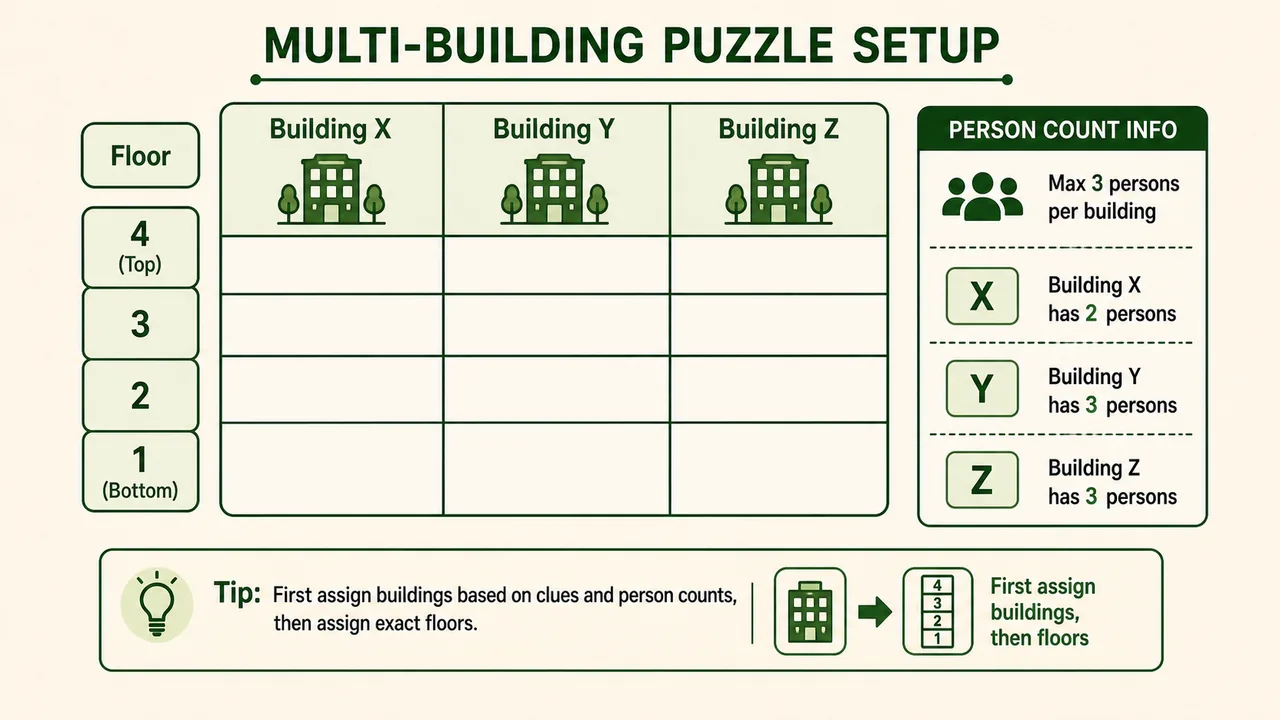
Instead of a single building, you now have 2-3 buildings (often named A, B, C or X, Y, Z):
- Each building has a limited number of floors (typically 3-5)
- A maximum capacity per building may be specified (e.g., "max 4 persons per building")
- Each person lives in exactly one building on one floor
Grid setup for 3 buildings, 4 floors each:
| Floor | Building A | Building B | Building C |
|---|---|---|---|
| 4 (Top) | |||
| 3 | |||
| 2 | |||
| 1 (Ground) |
Distribution Conditions
Common conditions in multi-building puzzles:
| Condition | Meaning |
|---|---|
| "A and B live in the same building" | Both are in Building A, B, or C together |
| "C and D live in different buildings" | C and D are NOT in the same building |
| "Maximum 4 persons in each building" | No building has more than 4 occupants |
| "Building A has the most persons" | Count of people in A > count in B and C |
| "No building is empty" | Each building has at least 1 person |
Floor + Variable (Fruit Preferences)
In mod-advance puzzles, each person often has a variable like a fruit preference in addition to their building and floor.
Pro Content Locked
Upgrade to Pro to access this lesson and all other premium content.
₹99 charged monthly · Cancel anytime
- All Agriculture & Banking Courses
- AI Lesson Questions (100/day)
- AI Doubt Solver (50/day)
- Glows & Grows Feedback (30/day)
- AI Section Quiz (20/day)
- 22-Language Translation (100/day)
- Recall Questions (20/day)
- AI Quiz (15/day)
- AI Quiz Paper Analysis (100/day)
- AI Step-by-Step Explanations (100/day)
- Spaced Repetition Recall (FSRS)
- AI Tutor
- Immersive Text Questions
- Audio Lessons — Hindi & English
- Mock Tests & Previous Year Papers
- Summary & Mind Maps
- XP, Levels, Leaderboard & Badges
- Generate New Classrooms
- Voice AI Teacher (AgriDots Live)
- AI Revision Assistant
- Knowledge Gap Analysis
- Interactive Revision (LangGraph)
🔒 Secure via Razorpay · Cancel anytime · No hidden fees
Floor Based Puzzles - Mod Advance
Mod-Advance floor puzzles introduce multiple buildings where persons are distributed across different buildings, each with their own floors. This adds a new dimension to the standard floor puzzle.
Multiple Buildings Concept
Instead of a single building, you now have 2-3 buildings (often named A, B, C or X, Y, Z):
- Each building has a limited number of floors (typically 3-5)
- A maximum capacity per building may be specified (e.g., "max 4 persons per building")
- Each person lives in exactly one building on one floor
Grid setup for 3 buildings, 4 floors each:
| Floor | Building A | Building B | Building C |
|---|---|---|---|
| 4 (Top) | |||
| 3 | |||
| 2 | |||
| 1 (Ground) |
Distribution Conditions
Common conditions in multi-building puzzles:
| Condition | Meaning |
|---|---|
| "A and B live in the same building" | Both are in Building A, B, or C together |
| "C and D live in different buildings" | C and D are NOT in the same building |
| "Maximum 4 persons in each building" | No building has more than 4 occupants |
| "Building A has the most persons" | Count of people in A > count in B and C |
| "No building is empty" | Each building has at least 1 person |
Floor + Variable (Fruit Preferences)
In mod-advance puzzles, each person often has a variable like a fruit preference in addition to their building and floor.
Example: 8 persons live across 3 buildings. Each person likes a different fruit (Apple, Mango, Banana, Orange, Grape, Papaya, Watermelon, Guava).
Grid:
| Floor | Building A | Fruit | Building B | Fruit | Building C | Fruit |
|---|---|---|---|---|---|---|
| 4 | ||||||
| 3 | ||||||
| 2 | ||||||
| 1 |
Sum Conditions
A unique feature of mod-advance puzzles is floor number sum conditions:
- "The sum of floor numbers in Building A is 10" — if A has persons on floors 1, 3, 2, 4: sum = 1+3+2+4 = 10
- "The sum of floor numbers of A and B is 7" — Floor(A) + Floor(B) = 7
Quick calculation: For 4 floors (1,2,3,4), total sum = 10. If a building has all 4 floors occupied, their sum is 10.
Common sums for reference:
- 3 floors (1,2,3): max sum = 6
- 4 floors (1,2,3,4): max sum = 10
- 5 floors (1,2,3,4,5): max sum = 15
Solved Example: 8 Persons, 3 Buildings
Question: 8 persons (A-H) live in 3 buildings (X, Y, Z). Each building has 4 floors (1-4). Not all floors in every building are occupied. Each person likes a different fruit.
Conditions:
- A and C live in Building X
- B lives on floor 4 of Building Y
- D likes Mango and lives on floor 1
- E and F live in the same building
- The sum of floor numbers in Building X is 5
- G lives on floor 3 and does not live in Building X
- H lives immediately above E
- No building has more than 3 persons
Solution:
From (1): A and C in Building X From (2): B in Building Y, floor 4 From (3): D on floor 1 (building unknown), likes Mango From (6): G on floor 3, not in Building X. G is in Y or Z.
From (8): Max 3 per building. Building X has A and C (2 so far, max 1 more).
From (5): Sum in Building X = 5. A and C are in X. Their floor numbers must sum to 5 (if only them) or include one more person.
If only A and C in X: Floor(A) + Floor(C) = 5. Options: (1,4), (2,3), (4,1), (3,2) If 3 persons in X: three floor numbers sum to 5. Options: (1,1,3) no duplicates needed — (1,2,2) no — must be distinct floors. So: (1,2,2) impossible. Actually floor numbers 1-4, all different: minimum 3 persons = 1+2+? No three distinct from {1,2,3,4} sum to 5: 1+2+2=5 (not distinct). 1+1+3=5 (not distinct). So we can't have 3 persons with distinct floors summing to 5. Therefore Building X has only A and C.
Floor(A) + Floor(C) = 5. Options with distinct floors: (1,4) or (2,3).
From (7): H immediately above E (same building, consecutive floors). From (4): E and F same building.
If D is on floor 1 — could D be in Building X? Then Building X would have A, C, D = 3 persons with sum = Floor(A) + Floor(C) + 1 = 5, meaning Floor(A) + Floor(C) = 4. Options: (1,3) but D is also on 1 so duplicate floor. Not possible if same floor in same building means only 1 person per floor.
So D is not in Building X. D is in Y or Z.
Remaining: D, E, F, G, H across Buildings Y and Z (along with B in Y).
From (6): G on floor 3, in Y or Z. From (2): B on floor 4 in Y.
Building Y can have max 3: B + up to 2 more. Building Z can have max 3.
From (4) and (7): E, F in same building. H immediately above E (same building as E). So E, F, H are all in the same building.
If E, F, H in Building Y: Y would have B, E, F, H = 4 persons. Exceeds max 3. Not possible. So E, F, H are in Building Z.
Remaining: D and G in Y or Z. Y has B (1 person), can take 2 more. Z has E, F, H (3) — full. So D and G are in Building Y.
Building Y: B (floor 4), D (floor 1), G (floor 3). That's 3 persons. Building Z: E, F, H. From (7): H immediately above E. Possible: E=1,H=2 or E=2,H=3 or E=3,H=4.
Building X: A and C with floors summing to 5. Options: (1,4) or (2,3).
Final arrangement (one possibility with A=2, C=3 in X):
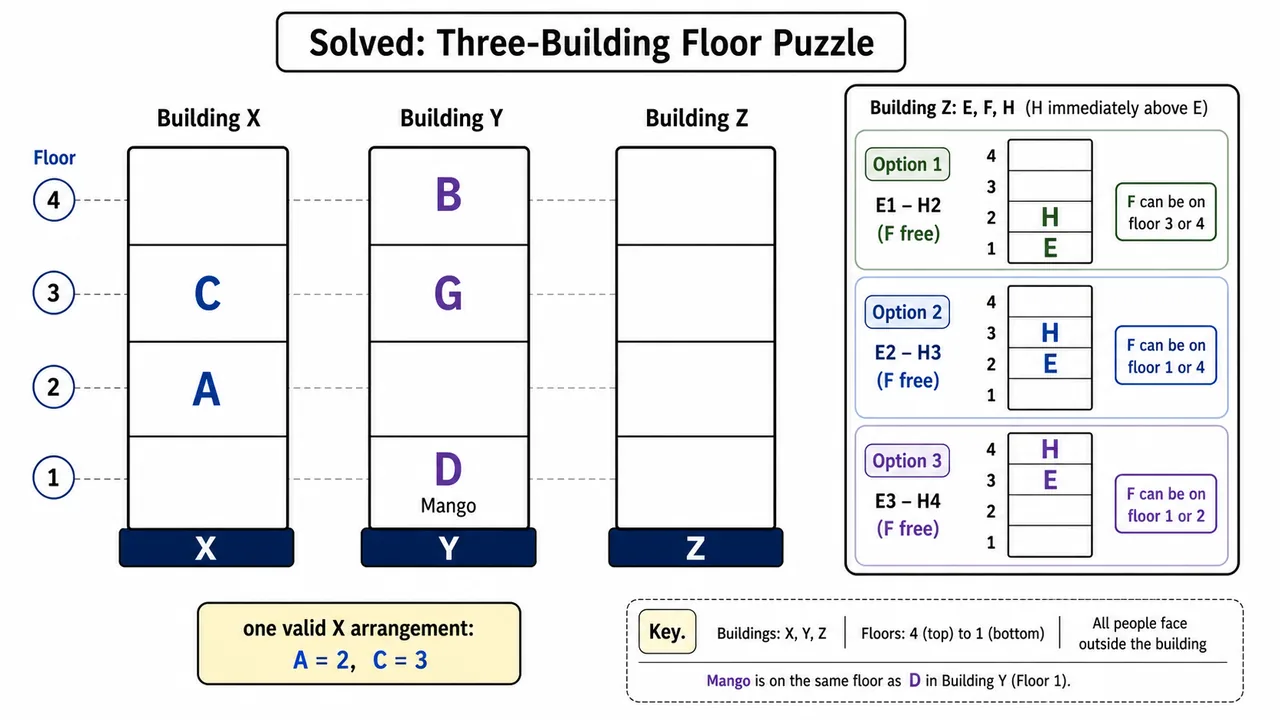
| Floor | Building X | Building Y | Building Z |
|---|---|---|---|
| 4 | — | B | H or F |
| 3 | C | G | E or F |
| 2 | A | — | H or F |
| 1 | — | D (Mango) | E or F |
Strategy for Multi-Building Puzzles
- Identify building assignments first — who is in which building
- Use capacity constraints to distribute persons across buildings
- Then solve floor positions within each building — treat each building as a mini floor puzzle
- Sum conditions help fix floor numbers — calculate which combinations give the required sum
- "Same building" / "different building" conditions are the most powerful constraints — use them first
Speed Tips
- Draw separate columns for each building from the start
- Count persons per building after each placement to check capacity
- For sum conditions, pre-calculate all possible floor combinations that give the target sum
- Multi-building puzzles are essentially multiple small floor puzzles — break them down and solve each building separately once you know who is where