🚜Tractors and Power Tillers
History, types (wheel, track, purpose-based), components (engine, clutch, PTO, differential), selection criteria, and power tillers — India as world's largest tractor market
India produces half the world’s tractors and is the largest tractor market globally. With the 31-40 HP segment accounting for 60% of sales, tractors have become the cornerstone of Indian farm mechanisation. Understanding their types, components, and selection criteria is critical for every agricultural professional — and a favourite topic in competitive exams.
- Tractor is a self-propelled power unit having wheels or tracks for operating agricultural implements and machines including trailers. In other words, a tractor is a multipurpose farm vehicle that provides the pulling force and power needed to run various types of agricultural machinery, from ploughs and seed drills to trailers used for transporting farm produce. The word “tractor” comes from the Latin word “trahere” meaning “to pull.”
- Tractor engine is used as a prime mover for active tools and stationary farm machinery through Power Take-Off shaft (PTO) or belt pulley. This means the engine does not just move the tractor forward — it also transfers rotational energy to attached implements via the PTO shaft or a belt pulley, enabling them to perform tasks like threshing, pumping water, or running generators.
-
India is the world’s largest manufacture of tractors with 50% of world’s output in 2016. It is also the world’s largest tractor market. This dominance reflects India’s vast agricultural sector, where mechanization has been steadily increasing to improve farm productivity and reduce manual labour.
-
Mahindra & Mahindra is the largest manufacturer of tractors in the world in volume and Indian market lead in the tractor industry with share of ~44% as on FY18.
-
Most popular tractor found in India 31-40 HP segment, which account near about 60% of total sales in our country. This range is considered ideal for small to medium-sized Indian farms where versatility, affordability, and fuel efficiency matter the most.
-
Highest tractor production in India: Mahindra > TAFE > Escort
NOTE
Key tractor facts for exams: India = largest tractor manufacturer and market. Most popular segment = 31-40 HP (60% of sales). Top producers = Mahindra > TAFE > Escort.
History of tractor development
-
The present tractor is the result of gradual development of machine in different stages. Understanding this history helps appreciate how modern tractors evolved from simple steam-powered engines to the highly efficient diesel machines used today.
- 1890: The word tractor appeared first on record in a patent issued on a tractor or traction engine invented by George H. Harris of Chicago
- 1906: Successful gasoline tractor was introduced by Charles W. Hart and Charles H. Parr of Charles City, Iowa
- 1908: First Winnipeg tractor trails were held
- 1911: First tractor demonstration was held at Omaha (Nebraska)
- 1915-1919: Power take off was introduced. The PTO was a revolutionary development, as it allowed the engine to power attached implements directly, greatly expanding the tractor’s usefulness beyond simple pulling.
- 1920-1924: All purpose was developed
- 1936-1937: Diesel engine was used in tractor and pneumatic tires were introduced. Pneumatic tyres replaced the earlier steel wheels, providing better traction, shock absorption, and the ability to travel on roads.
- 1950-1960: Manufacturing of diesel tractors on extensive basis throughout the world was taken up.
-
Tractor in India:
- 1960-1961: Tractor manufacturing was started in India by first manufacturer Eicher Good Earth. (Faridabad, Haryana)
- 1961: TAFE tractor manufactured started.
- 1965: Gujarat tractor Ltd.
- 1965: Mahindra & Mahindra entered the tractor market.
- 1971: Escorts Tractor Ltd. Started producing Ford Tractors
- 1973: Manufacture of HMT Tractor was started
- 1974: Manufacture of Pitti and Kirlosker Tractor was started 1975 - Harsha Tractors was established
- 1981: Auto tractors were started
- 1982: Universal Tractors was established
- 1983-2003: GTCL tractors, M.M Tractors, Sonalika, VST, L&T, Bajaj Tractors were produced
IMPORTANT
For exams, remember: First tractor manufacturer in India = Eicher Good Earth (1960-61, Faridabad). Mahindra entered in 1965 and now leads the market.
Types of tractor
- Basis of classification:
- The tractors can be classified based on the following:
- Type of Construction
- Type of Drive
- The purpose for which the usage is done
Each classification approach helps farmers and engineers choose the right tractor for specific working conditions, terrain, and agricultural tasks.
Classification based on the type of construction
Riding type tractor
- The driver can easily sit and drive the machine. This is the most common configuration for medium and large farms, where the operator needs to cover large areas with minimal physical fatigue.
- Ex: General purpose four wheel tractor.
Walking type tractor
- The operator walks along side. These tractors are compact, lightweight, and suited for small landholdings or terraced fields where larger machines cannot operate efficiently.
- Ex: Power tiller
Classification based on the type of drives
Track type tractors

-
Also called Chain Type or Crawlers Type.
-
In these types of Tractors, instead of wheels, one track is fitted on either side. This track gets drive from the sprocket run by real axle shaft. The continuous track distributes the tractor’s weight over a larger surface area, reducing ground pressure and preventing the machine from sinking in soft or muddy soil.
-
To steer the Tractor, there is no steering gear fitted. Here, the machine is steered by applying brakes to one side of the track while the other track is in motion. This method of steering is called skid steering or differential steering.
-
The Track Type Tractors are further classified into Half Track and Full Track types of tractors.
Half Track Type
-
In these types of Tractors, a small track chain is fitted at the rear end only while tyres are fitted at the front axle.
-
These tractors used for:
- Reclaiming barren lands and are not much used for agricultural tasks.
- These machines are fitted with tracks in such a way that the contact area with ground is larger and facilitates in increased traction power.
- These machines are very useful in dams and in areas where earth moving tasks are required.
Wheel Type Tractors
-
These are most commonly used agricultural tractors. They can run fast and wheel tyres absorb a certain amount of field shocks also. Their popularity comes from their versatility — they can work on farms and also travel on roads at reasonable speeds.
-
These can further divided as:
- Two wheel tractors: These tractors are used for small farms, hilly area and gardening purposes and are called power tillers.
- Three-wheel tractors: These tractors were very popular 15 years back but now its place has been taken by four wheel tractors. These tractors had single or dual wheel fitted at the front end in the centre and were considered good for negotiating shorter turns.
- Four-wheel tractors: These are most commonly used tractors in the country. These are also known as all-purpose tractors. On the basis of available power, these have been classified as:
- Small tractors: 15 to 25 hp
- Medium tractors: 25 to 45 hp
- Large tractors: > 45 hp
-
Inflation pressure of rear wheel of tractor: 0.8-1.5 kg/cm2. The lower pressure on rear wheels increases the contact area with the ground, which improves traction during field operations like ploughing.
-
Inflation pressure of front wheel of tractor: 1.5-2.5 kg/cm2. Higher pressure is maintained in front wheels for better steering response and stability.
-
A pneumatic tires life: 6000 working hour for drawbar work.
TIP
Tyre pressure rule: Rear wheels = Lower pressure (0.8-1.5) for better traction. Front wheels = Higher pressure (1.5-2.5) for better steering. This is opposite to what you might intuitively expect!
Classification based on the purpose for which they are used:
-
Utility Tractors:
- It is a general-purpose machine and is designed for ploughing and driving any other equipment through its drive and is considered good for such farms where farmer cannot afford more machines to perform specific jobs.
- It is not being manufactured at present in the country.
-
Row Crop Tractor:
- This is an all-round machine and is designated in such a way that it meets all the agricultural demands like ploughing, harrowing, levelling, pulling seed drills, weed control, running different machines like water pumps, threshers using belt pulley.
- Row-crop tractor is tailored specifically to the growing of crops grown in rows, and most especially to cultivating these crops.
- These tractors are universal machines, capable of both primary tillage and cultivation of a crop. They have adjustable wheel spacing to match different row widths.
-
Orchard Type:
- These special type Farm machines are only used in Orchards.
- These tractors have big height so that while sitting on the tractor the driver can easily pluck the fruits or the trees can easily be trimmed.
- There is no part of this machine outside the surface and this allows easy passage in between the trees. The streamlined body prevents branches from getting caught or damaged as the tractor moves through narrow rows of fruit trees.
-
Industrial Tractor:
- These types of machines are also known as Tuggers.
- They are useful in pulling loads and are fitted with crane boom for easy lifting of loads.
-
Garden Tractor:
- These machines fall in the power range of 1 to 10 HP (Horse Power) and have very small construction size.
- They are mostly used for grass cutting or for making flower beds in the garden.
- The wheels fitted to such machines are having the size of a scooter and have a thicker depth.
-
Rotary Tillers
- They fall under the category of Walking Type tractors and are used in small fields or on hills where fields are smaller in size and are at different height levels.
- Here, ordinary equipment cannot work efficiently.
- Blades are fitted to the tillers for the purpose of preparing seed beds efficiently by pulverizing the content of soil. The rotating blades break up, churn, and mix the soil in a single pass, making it ready for sowing without the need for multiple tillage operations.
-
Earth Moving Tractors
- These farm machines are heavy in weight and quite strong.
- They are available in both track and tyre type varieties.
- Their primary usage is for doing earth moving work on dams, quarries and different types of constructional works.
Tractor components:
A tractor is made of the following main units:
Each component plays a critical role in the overall functioning of the tractor. Together, they convert fuel energy into useful mechanical work at the wheels, PTO, and hydraulic systems.
- I.C. engine:
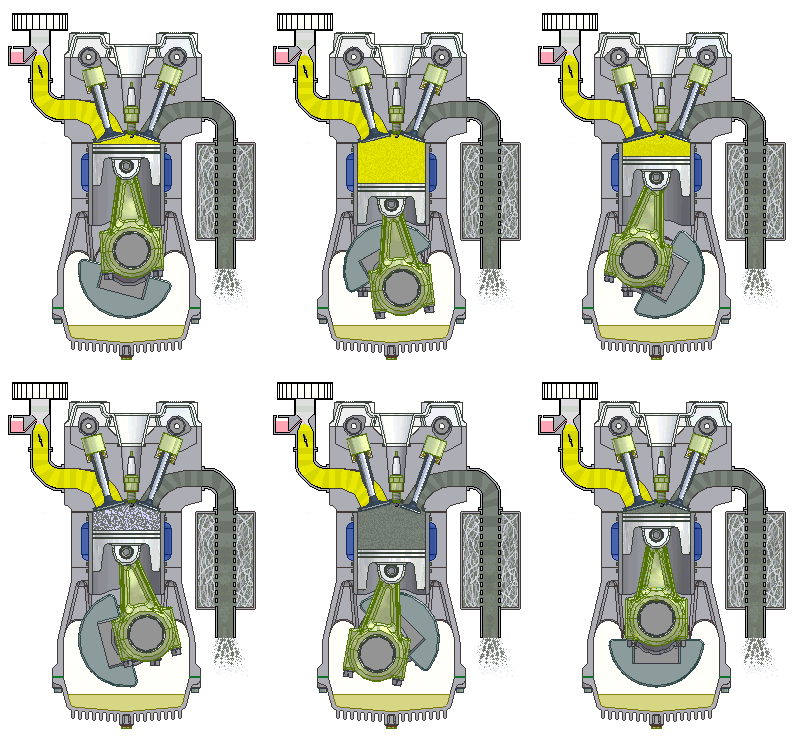
- Most common diesel engine. Diesel engines are preferred over petrol engines in tractors because they produce higher torque at lower RPMs, are more fuel-efficient, and are more durable under heavy loads.
- I.C. of suitable horse power is used as a prime mover in a tractor.
- Engines ranging from 8 to 200 hp are used in agricultural tractors.
- In India, four wheel tractors for agricultural operations are fitted with 25 to 80 hp.
- Walking type tractors are fitted with 8 to 12 hp engines.
- Clutch: connects and disconnects the tractor engine from the transmission gear and drive wheels. Friction clutch is used in four-wheel tractors, while dog clutch is used in power tillers. The clutch is essential for smooth gear changes and for stopping the tractor without shutting down the engine. A friction clutch uses friction plates that press together to transmit power, while a dog clutch uses interlocking teeth and is simpler in design, suitable for the lower power requirements of a power tiller.

- Transmission gear: selective sliding type and constant mesh type. The transmission transfers engine power to the wheels at different speed-torque ratios. In a selective sliding type, gears slide into engagement, while in a constant mesh type, all gears are always meshed and engagement happens through dog clutches or synchronizers, providing smoother shifting. Most modern tractors use constant mesh transmission.

- Differential unit: differential unit is a special arrangement of gear to permit one of the rear wheels of the tractor to rotate slower or faster than the other. This is critical during turning — the outer wheel must travel a longer path and therefore rotate faster than the inner wheel. Without a differential, turning would cause wheel slippage and excessive tyre wear.

NOTE
The differential lock is a feature that locks both rear wheels to rotate at the same speed. It is engaged when the tractor is stuck in mud or soft soil to prevent one wheel from spinning freely while the other stays stationary.
- Final drive: final drive is a gear reduction unit in the power trains between the differential and the drive wheels. It provides the final speed reduction and corresponding torque multiplication before power reaches the wheels, allowing the tractor to exert strong pulling force at low speeds.

- Slogging/lugging ability: In diesel engine, torque is considerably high at lower than rated speed, this behavior is called slogging or lugging ability. This is a highly desirable characteristic in tractors because when the tractor encounters a heavy load (such as deep ploughing in hard soil), the engine speed drops but the torque increases, allowing the tractor to power through without stalling. A good lugging ability means the tractor can handle temporary overloads gracefully.
- Steering mechanism

- Hydraulic control

The hydraulic system is one of the most important tractor components. It enables the operator to raise, lower, and control the depth of mounted implements from the tractor seat. The three-point hitch hydraulic system is the universal standard for attaching implements to tractors.
- Hitch system

- Brakes

Tractors have two independent rear brake pedals that can be operated separately for sharp turns (applying one brake while turning) or locked together for road travel. This dual brake system also helps in tight-radius turning during field operations.
- Power take-off unit (PTO):
- It is a device that transfers an engine’s mechanical power to another piece of equipment. AFO 2018
- 70-80% power is extracted by PTO. This makes the PTO the primary power delivery mechanism of a tractor — far more power is transmitted through the PTO to run implements like rotavators, harvesters, and sprayers than is used at the drawbar for pulling.

Selection of Tractor:
Choosing the right tractor is a critical decision for a farmer, as it directly impacts farm productivity, operational costs, and the longevity of the investment. The following factors should be carefully evaluated:
- Land holding:
- Under a mono cropping/single cropping pattern, it is normally recommended to consider 1 hp for every 2 hectares of land.
- In other words, one tractor 20-25 hp is suitable for 40-hectare farm. IBPS AFO 2018
- Cropping pattern:
- Generally, 1.5 hectare/hp has been recommended where adequate irrigation facility are available and more than one crop is taken. So, a 30-35 hp tractor is suitable for 40 hectares of land. AIC 2017
- The reasoning is that multiple crops per year increase the total number of field operations (ploughing, sowing, irrigation, harvesting), requiring more tractor power relative to the area.
IMPORTANT
Tractor selection rule: Mono-cropping = 1 hp per 2 ha (20-25 hp for 40 ha). Multi-cropping = 1.5 ha per hp (30-35 hp for 40 ha). More crops per year means you need a more powerful tractor for the same land area.
- Soil condition: A tractor with less wheel base, higher ground clearance and low overall weight may work successfully in lighter soils but will not be able to give sufficient depth in black cotton soils. Black cotton soils (also called vertisols) are heavy, sticky, and expansive, requiring tractors with greater weight and higher horsepower to achieve adequate ploughing depth.
-
Climatic condition: For very hot zone and desert area, air cooled engines are preferred over water cooled engines. Similarly, for higher altitude air cooled engines are preferred because water cooled engines are liable to be frozen at high altitudes. Air cooled engines eliminate the risk of coolant freezing and do not require a radiator, making them simpler to maintain in extreme conditions.
-
Repair facilities: It should be ensured that the tractor to be purchased has a dealer at nearby place with all the technical skills for repair and maintenance of the machine. This practical consideration can save significant downtime during critical farming seasons.
-
Running cost: Tractors with less specific fuel consumption should be preferred over others so that the running cost may be less. Specific fuel consumption refers to the amount of fuel consumed per unit of power output — a lower value indicates a more fuel-efficient engine.
-
Initial cost and resale value: While keeping the resale value in mind, the initial cost should not be very high, otherwise higher amount of interest have to be paid. Brands with good resale value (like Mahindra) are preferred by farmers as they represent a safer investment.
Power Tiller

Power tillers occupy an important niche in Indian agriculture, especially for small and marginal farmers who cannot afford or practically use a full-sized tractor. They are the bridge between animal power and tractor mechanization.
- What is a Power Tiller?
- It is a walking type tractor. The operator walks behind the power tiller, holding the two handles of the power tiller in his own hands.
- Power tiller maybe called a single axle walking type tractor, though a riding seat is provided in certain designs.
-
It is a prime mover in which the direction of travel and its control for field operation is performed by the operator walking behind it.
-
It is also known as Hand tractor or walking type tractor. The concept of power tiller came in the world in the year 1920.
-
Japan is the first country to use power tiller on large scale. In Japan, the first successful model of power tiller was designed in the year 1947. Japan’s small, terraced rice paddies made full-sized tractors impractical, which is why power tillers became so popular there and remain so even today.
-
In India power tiller was introduced in the year 1963.
-
Manufacturing of several makes of power tillers like Iseki, Sato, Krishi, Kubota, Yanmar and Mitsubishi were started in India after 1962.
-
All the power tillers are fitted with an I.C. engine. At present, most of the power tillers are fitted with diesel engine.
-
Only Iseki made have used kerosene engine. All other manufacturers use diesel engines.
-
The other makers like Kubota, Mitsubishi, Krishi, Yanmar and Satoh have used diesel engines in India.
-
Usually 2 to 4 ply pneumatic tyres are used in power tillers. The pressure of the tyre ranges from 1.1 to 1.4 kg/cm2.
Power Tiller vs Tractor - Quick Comparison
| Feature | Power Tiller | Tractor |
|---|---|---|
| HP Range | 8-12 hp | 25-80 hp |
| Land Command | 5 ha | 15 ha |
| Type | Walking type | Riding type |
| Clutch | Dog clutch | Friction clutch |
| Best for | Small farms, hilly terrain | Medium to large farms |
| Origin | Japan (1920/1947) | USA/Europe (1890s) |
Summary Cheat Sheet
| Concept / Topic | Key Details |
|---|---|
| India | World’s largest tractor manufacturer (50% of world output) and market |
| Mahindra & Mahindra | Largest tractor manufacturer globally; ~44% Indian market share |
| Most popular HP segment | 31-40 HP — accounts for 60% of total sales |
| Top producers (India) | Mahindra > TAFE > Escort |
| First in India | Eicher Good Earth (1960-61, Faridabad); Mahindra entered 1965 |
| Tractor word origin | First recorded in patent by George H. Harris (1890, Chicago) |
| PTO introduced | 1915-1919; extracts 70-80% of engine power |
| Diesel engine in tractor | 1936-1937; pneumatic tyres also introduced |
| Wheel types | Two-wheel (power tiller), Three-wheel, Four-wheel (most common) |
| Four-wheel HP classes | Small 15-25, Medium 25-45, Large >45 HP |
| Rear tyre pressure | 0.8-1.5 kg/cm² (lower for better traction) |
| Front tyre pressure | 1.5-2.5 kg/cm² (higher for steering) |
| Tyre life | 6000 working hours for drawbar work |
| Clutch types | Friction clutch (tractor); Dog clutch (power tiller) |
| Differential unit | Allows rear wheels to rotate at different speeds during turning |
| Mono-cropping | 1 hp per 2 ha; 20-25 hp for 40 ha farm |
| Multi-cropping | 1.5 ha per hp; 30-35 hp for 40 ha farm |
| Hot zones/high altitude | Prefer air-cooled engines |
| Power tiller origin | Concept in 1920; Japan first large-scale user (1947 model) |
| Power tiller in India | Introduced 1963; engine 8-12 hp |
| Power tiller tyre pressure | 1.1-1.4 kg/cm² |
| Iseki | Only maker using kerosene engine; all others use diesel |
| Stroke-bore ratio (tractor) | About 1.25 |
| Garden tractor | 1-10 HP; used for grass cutting, flower beds |
Pro Content Locked
Upgrade to Pro to access this lesson and all other premium content.
₹2388 billed yearly
- All Agriculture & Banking Courses
- AI Lesson Questions (100/day)
- AI Doubt Solver (50/day)
- Glows & Grows Feedback (30/day)
- AI Section Quiz (20/day)
- 22-Language Translation (30/day)
- Recall Questions (20/day)
- AI Quiz (15/day)
- AI Quiz Paper Analysis
- AI Step-by-Step Explanations
- Spaced Repetition Recall (FSRS)
- AI Tutor
- Immersive Text Questions
- Audio Lessons — Hindi & English
- Mock Tests & Previous Year Papers
- Summary & Mind Maps
- XP, Levels, Leaderboard & Badges
- Generate New Classrooms
- Voice AI Teacher (AgriDots Live)
- AI Revision Assistant
- Knowledge Gap Analysis
- Interactive Revision (LangGraph)
🔒 Secure via Razorpay · Cancel anytime · No hidden fees
India produces half the world’s tractors and is the largest tractor market globally. With the 31-40 HP segment accounting for 60% of sales, tractors have become the cornerstone of Indian farm mechanisation. Understanding their types, components, and selection criteria is critical for every agricultural professional — and a favourite topic in competitive exams.
- Tractor is a self-propelled power unit having wheels or tracks for operating agricultural implements and machines including trailers. In other words, a tractor is a multipurpose farm vehicle that provides the pulling force and power needed to run various types of agricultural machinery, from ploughs and seed drills to trailers used for transporting farm produce. The word “tractor” comes from the Latin word “trahere” meaning “to pull.”
- Tractor engine is used as a prime mover for active tools and stationary farm machinery through Power Take-Off shaft (PTO) or belt pulley. This means the engine does not just move the tractor forward — it also transfers rotational energy to attached implements via the PTO shaft or a belt pulley, enabling them to perform tasks like threshing, pumping water, or running generators.
-
India is the world’s largest manufacture of tractors with 50% of world’s output in 2016. It is also the world’s largest tractor market. This dominance reflects India’s vast agricultural sector, where mechanization has been steadily increasing to improve farm productivity and reduce manual labour.
-
Mahindra & Mahindra is the largest manufacturer of tractors in the world in volume and Indian market lead in the tractor industry with share of ~44% as on FY18.
-
Most popular tractor found in India 31-40 HP segment, which account near about 60% of total sales in our country. This range is considered ideal for small to medium-sized Indian farms where versatility, affordability, and fuel efficiency matter the most.
-
Highest tractor production in India: Mahindra > TAFE > Escort
NOTE
Key tractor facts for exams: India = largest tractor manufacturer and market. Most popular segment = 31-40 HP (60% of sales). Top producers = Mahindra > TAFE > Escort.
History of tractor development
-
The present tractor is the result of gradual development of machine in different stages. Understanding this history helps appreciate how modern tractors evolved from simple steam-powered engines to the highly efficient diesel machines used today.
- 1890: The word tractor appeared first on record in a patent issued on a tractor or traction engine invented by George H. Harris of Chicago
- 1906: Successful gasoline tractor was introduced by Charles W. Hart and Charles H. Parr of Charles City, Iowa
- 1908: First Winnipeg tractor trails were held
- 1911: First tractor demonstration was held at Omaha (Nebraska)
- 1915-1919: Power take off was introduced. The PTO was a revolutionary development, as it allowed the engine to power attached implements directly, greatly expanding the tractor’s usefulness beyond simple pulling.
- 1920-1924: All purpose was developed
- 1936-1937: Diesel engine was used in tractor and pneumatic tires were introduced. Pneumatic tyres replaced the earlier steel wheels, providing better traction, shock absorption, and the ability to travel on roads.
- 1950-1960: Manufacturing of diesel tractors on extensive basis throughout the world was taken up.
-
Tractor in India:
- 1960-1961: Tractor manufacturing was started in India by first manufacturer Eicher Good Earth. (Faridabad, Haryana)
- 1961: TAFE tractor manufactured started.
- 1965: Gujarat tractor Ltd.
- 1965: Mahindra & Mahindra entered the tractor market.
- 1971: Escorts Tractor Ltd. Started producing Ford Tractors
- 1973: Manufacture of HMT Tractor was started
- 1974: Manufacture of Pitti and Kirlosker Tractor was started 1975 - Harsha Tractors was established
- 1981: Auto tractors were started
- 1982: Universal Tractors was established
- 1983-2003: GTCL tractors, M.M Tractors, Sonalika, VST, L&T, Bajaj Tractors were produced
IMPORTANT
For exams, remember: First tractor manufacturer in India = Eicher Good Earth (1960-61, Faridabad). Mahindra entered in 1965 and now leads the market.
Types of tractor
- Basis of classification:
- The tractors can be classified based on the following:
- Type of Construction
- Type of Drive
- The purpose for which the usage is done
Each classification approach helps farmers and engineers choose the right tractor for specific working conditions, terrain, and agricultural tasks.
Classification based on the type of construction
Riding type tractor
- The driver can easily sit and drive the machine. This is the most common configuration for medium and large farms, where the operator needs to cover large areas with minimal physical fatigue.
- Ex: General purpose four wheel tractor.
Walking type tractor
- The operator walks along side. These tractors are compact, lightweight, and suited for small landholdings or terraced fields where larger machines cannot operate efficiently.
- Ex: Power tiller
Classification based on the type of drives
Track type tractors
-
Also called Chain Type or Crawlers Type.
-
In these types of Tractors, instead of wheels, one track is fitted on either side. This track gets drive from the sprocket run by real axle shaft. The continuous track distributes the tractor’s weight over a larger surface area, reducing ground pressure and preventing the machine from sinking in soft or muddy soil.
-
To steer the Tractor, there is no steering gear fitted. Here, the machine is steered by applying brakes to one side of the track while the other track is in motion. This method of steering is called skid steering or differential steering.
-
The Track Type Tractors are further classified into Half Track and Full Track types of tractors.
Half Track Type
-
In these types of Tractors, a small track chain is fitted at the rear end only while tyres are fitted at the front axle.
-
These tractors used for:
- Reclaiming barren lands and are not much used for agricultural tasks.
- These machines are fitted with tracks in such a way that the contact area with ground is larger and facilitates in increased traction power.
- These machines are very useful in dams and in areas where earth moving tasks are required.
Wheel Type Tractors
-
These are most commonly used agricultural tractors. They can run fast and wheel tyres absorb a certain amount of field shocks also. Their popularity comes from their versatility — they can work on farms and also travel on roads at reasonable speeds.
-
These can further divided as:
- Two wheel tractors: These tractors are used for small farms, hilly area and gardening purposes and are called power tillers.
- Three-wheel tractors: These tractors were very popular 15 years back but now its place has been taken by four wheel tractors. These tractors had single or dual wheel fitted at the front end in the centre and were considered good for negotiating shorter turns.
- Four-wheel tractors: These are most commonly used tractors in the country. These are also known as all-purpose tractors. On the basis of available power, these have been classified as:
- Small tractors: 15 to 25 hp
- Medium tractors: 25 to 45 hp
- Large tractors: > 45 hp
-
Inflation pressure of rear wheel of tractor: 0.8-1.5 kg/cm2. The lower pressure on rear wheels increases the contact area with the ground, which improves traction during field operations like ploughing.
-
Inflation pressure of front wheel of tractor: 1.5-2.5 kg/cm2. Higher pressure is maintained in front wheels for better steering response and stability.
-
A pneumatic tires life: 6000 working hour for drawbar work.
TIP
Tyre pressure rule: Rear wheels = Lower pressure (0.8-1.5) for better traction. Front wheels = Higher pressure (1.5-2.5) for better steering. This is opposite to what you might intuitively expect!
Classification based on the purpose for which they are used:
-
Utility Tractors:
- It is a general-purpose machine and is designed for ploughing and driving any other equipment through its drive and is considered good for such farms where farmer cannot afford more machines to perform specific jobs.
- It is not being manufactured at present in the country.
-
Row Crop Tractor:
- This is an all-round machine and is designated in such a way that it meets all the agricultural demands like ploughing, harrowing, levelling, pulling seed drills, weed control, running different machines like water pumps, threshers using belt pulley.
- Row-crop tractor is tailored specifically to the growing of crops grown in rows, and most especially to cultivating these crops.
- These tractors are universal machines, capable of both primary tillage and cultivation of a crop. They have adjustable wheel spacing to match different row widths.
-
Orchard Type:
- These special type Farm machines are only used in Orchards.
- These tractors have big height so that while sitting on the tractor the driver can easily pluck the fruits or the trees can easily be trimmed.
- There is no part of this machine outside the surface and this allows easy passage in between the trees. The streamlined body prevents branches from getting caught or damaged as the tractor moves through narrow rows of fruit trees.
-
Industrial Tractor:
- These types of machines are also known as Tuggers.
- They are useful in pulling loads and are fitted with crane boom for easy lifting of loads.
-
Garden Tractor:
- These machines fall in the power range of 1 to 10 HP (Horse Power) and have very small construction size.
- They are mostly used for grass cutting or for making flower beds in the garden.
- The wheels fitted to such machines are having the size of a scooter and have a thicker depth.
-
Rotary Tillers
- They fall under the category of Walking Type tractors and are used in small fields or on hills where fields are smaller in size and are at different height levels.
- Here, ordinary equipment cannot work efficiently.
- Blades are fitted to the tillers for the purpose of preparing seed beds efficiently by pulverizing the content of soil. The rotating blades break up, churn, and mix the soil in a single pass, making it ready for sowing without the need for multiple tillage operations.
-
Earth Moving Tractors
- These farm machines are heavy in weight and quite strong.
- They are available in both track and tyre type varieties.
- Their primary usage is for doing earth moving work on dams, quarries and different types of constructional works.
Tractor components:
A tractor is made of the following main units:
Each component plays a critical role in the overall functioning of the tractor. Together, they convert fuel energy into useful mechanical work at the wheels, PTO, and hydraulic systems.
- I.C. engine:
- Most common diesel engine. Diesel engines are preferred over petrol engines in tractors because they produce higher torque at lower RPMs, are more fuel-efficient, and are more durable under heavy loads.
- I.C. of suitable horse power is used as a prime mover in a tractor.
- Engines ranging from 8 to 200 hp are used in agricultural tractors.
- In India, four wheel tractors for agricultural operations are fitted with 25 to 80 hp.
- Walking type tractors are fitted with 8 to 12 hp engines.
- Clutch: connects and disconnects the tractor engine from the transmission gear and drive wheels. Friction clutch is used in four-wheel tractors, while dog clutch is used in power tillers. The clutch is essential for smooth gear changes and for stopping the tractor without shutting down the engine. A friction clutch uses friction plates that press together to transmit power, while a dog clutch uses interlocking teeth and is simpler in design, suitable for the lower power requirements of a power tiller.
- Transmission gear: selective sliding type and constant mesh type. The transmission transfers engine power to the wheels at different speed-torque ratios. In a selective sliding type, gears slide into engagement, while in a constant mesh type, all gears are always meshed and engagement happens through dog clutches or synchronizers, providing smoother shifting. Most modern tractors use constant mesh transmission.
- Differential unit: differential unit is a special arrangement of gear to permit one of the rear wheels of the tractor to rotate slower or faster than the other. This is critical during turning — the outer wheel must travel a longer path and therefore rotate faster than the inner wheel. Without a differential, turning would cause wheel slippage and excessive tyre wear.
NOTE
The differential lock is a feature that locks both rear wheels to rotate at the same speed. It is engaged when the tractor is stuck in mud or soft soil to prevent one wheel from spinning freely while the other stays stationary.
- Final drive: final drive is a gear reduction unit in the power trains between the differential and the drive wheels. It provides the final speed reduction and corresponding torque multiplication before power reaches the wheels, allowing the tractor to exert strong pulling force at low speeds.
- Slogging/lugging ability: In diesel engine, torque is considerably high at lower than rated speed, this behavior is called slogging or lugging ability. This is a highly desirable characteristic in tractors because when the tractor encounters a heavy load (such as deep ploughing in hard soil), the engine speed drops but the torque increases, allowing the tractor to power through without stalling. A good lugging ability means the tractor can handle temporary overloads gracefully.
- Steering mechanism
- Hydraulic control
The hydraulic system is one of the most important tractor components. It enables the operator to raise, lower, and control the depth of mounted implements from the tractor seat. The three-point hitch hydraulic system is the universal standard for attaching implements to tractors.
- Hitch system
- Brakes
Tractors have two independent rear brake pedals that can be operated separately for sharp turns (applying one brake while turning) or locked together for road travel. This dual brake system also helps in tight-radius turning during field operations.
- Power take-off unit (PTO):
- It is a device that transfers an engine’s mechanical power to another piece of equipment. AFO 2018
- 70-80% power is extracted by PTO. This makes the PTO the primary power delivery mechanism of a tractor — far more power is transmitted through the PTO to run implements like rotavators, harvesters, and sprayers than is used at the drawbar for pulling.
Selection of Tractor:
Choosing the right tractor is a critical decision for a farmer, as it directly impacts farm productivity, operational costs, and the longevity of the investment. The following factors should be carefully evaluated:
- Land holding:
- Under a mono cropping/single cropping pattern, it is normally recommended to consider 1 hp for every 2 hectares of land.
- In other words, one tractor 20-25 hp is suitable for 40-hectare farm. IBPS AFO 2018
- Cropping pattern:
- Generally, 1.5 hectare/hp has been recommended where adequate irrigation facility are available and more than one crop is taken. So, a 30-35 hp tractor is suitable for 40 hectares of land. AIC 2017
- The reasoning is that multiple crops per year increase the total number of field operations (ploughing, sowing, irrigation, harvesting), requiring more tractor power relative to the area.
IMPORTANT
Tractor selection rule: Mono-cropping = 1 hp per 2 ha (20-25 hp for 40 ha). Multi-cropping = 1.5 ha per hp (30-35 hp for 40 ha). More crops per year means you need a more powerful tractor for the same land area.
- Soil condition: A tractor with less wheel base, higher ground clearance and low overall weight may work successfully in lighter soils but will not be able to give sufficient depth in black cotton soils. Black cotton soils (also called vertisols) are heavy, sticky, and expansive, requiring tractors with greater weight and higher horsepower to achieve adequate ploughing depth.
-
Climatic condition: For very hot zone and desert area, air cooled engines are preferred over water cooled engines. Similarly, for higher altitude air cooled engines are preferred because water cooled engines are liable to be frozen at high altitudes. Air cooled engines eliminate the risk of coolant freezing and do not require a radiator, making them simpler to maintain in extreme conditions.
-
Repair facilities: It should be ensured that the tractor to be purchased has a dealer at nearby place with all the technical skills for repair and maintenance of the machine. This practical consideration can save significant downtime during critical farming seasons.
-
Running cost: Tractors with less specific fuel consumption should be preferred over others so that the running cost may be less. Specific fuel consumption refers to the amount of fuel consumed per unit of power output — a lower value indicates a more fuel-efficient engine.
-
Initial cost and resale value: While keeping the resale value in mind, the initial cost should not be very high, otherwise higher amount of interest have to be paid. Brands with good resale value (like Mahindra) are preferred by farmers as they represent a safer investment.
Power Tiller
Power tillers occupy an important niche in Indian agriculture, especially for small and marginal farmers who cannot afford or practically use a full-sized tractor. They are the bridge between animal power and tractor mechanization.
- What is a Power Tiller?
- It is a walking type tractor. The operator walks behind the power tiller, holding the two handles of the power tiller in his own hands.
- Power tiller maybe called a single axle walking type tractor, though a riding seat is provided in certain designs.
-
It is a prime mover in which the direction of travel and its control for field operation is performed by the operator walking behind it.
-
It is also known as Hand tractor or walking type tractor. The concept of power tiller came in the world in the year 1920.
-
Japan is the first country to use power tiller on large scale. In Japan, the first successful model of power tiller was designed in the year 1947. Japan’s small, terraced rice paddies made full-sized tractors impractical, which is why power tillers became so popular there and remain so even today.
-
In India power tiller was introduced in the year 1963.
-
Manufacturing of several makes of power tillers like Iseki, Sato, Krishi, Kubota, Yanmar and Mitsubishi were started in India after 1962.
-
All the power tillers are fitted with an I.C. engine. At present, most of the power tillers are fitted with diesel engine.
-
Only Iseki made have used kerosene engine. All other manufacturers use diesel engines.
-
The other makers like Kubota, Mitsubishi, Krishi, Yanmar and Satoh have used diesel engines in India.
-
Usually 2 to 4 ply pneumatic tyres are used in power tillers. The pressure of the tyre ranges from 1.1 to 1.4 kg/cm2.
Power Tiller vs Tractor - Quick Comparison
| Feature | Power Tiller | Tractor |
|---|---|---|
| HP Range | 8-12 hp | 25-80 hp |
| Land Command | 5 ha | 15 ha |
| Type | Walking type | Riding type |
| Clutch | Dog clutch | Friction clutch |
| Best for | Small farms, hilly terrain | Medium to large farms |
| Origin | Japan (1920/1947) | USA/Europe (1890s) |
Summary Cheat Sheet
| Concept / Topic | Key Details |
|---|---|
| India | World’s largest tractor manufacturer (50% of world output) and market |
| Mahindra & Mahindra | Largest tractor manufacturer globally; ~44% Indian market share |
| Most popular HP segment | 31-40 HP — accounts for 60% of total sales |
| Top producers (India) | Mahindra > TAFE > Escort |
| First in India | Eicher Good Earth (1960-61, Faridabad); Mahindra entered 1965 |
| Tractor word origin | First recorded in patent by George H. Harris (1890, Chicago) |
| PTO introduced | 1915-1919; extracts 70-80% of engine power |
| Diesel engine in tractor | 1936-1937; pneumatic tyres also introduced |
| Wheel types | Two-wheel (power tiller), Three-wheel, Four-wheel (most common) |
| Four-wheel HP classes | Small 15-25, Medium 25-45, Large >45 HP |
| Rear tyre pressure | 0.8-1.5 kg/cm² (lower for better traction) |
| Front tyre pressure | 1.5-2.5 kg/cm² (higher for steering) |
| Tyre life | 6000 working hours for drawbar work |
| Clutch types | Friction clutch (tractor); Dog clutch (power tiller) |
| Differential unit | Allows rear wheels to rotate at different speeds during turning |
| Mono-cropping | 1 hp per 2 ha; 20-25 hp for 40 ha farm |
| Multi-cropping | 1.5 ha per hp; 30-35 hp for 40 ha farm |
| Hot zones/high altitude | Prefer air-cooled engines |
| Power tiller origin | Concept in 1920; Japan first large-scale user (1947 model) |
| Power tiller in India | Introduced 1963; engine 8-12 hp |
| Power tiller tyre pressure | 1.1-1.4 kg/cm² |
| Iseki | Only maker using kerosene engine; all others use diesel |
| Stroke-bore ratio (tractor) | About 1.25 |
| Garden tractor | 1-10 HP; used for grass cutting, flower beds |
Knowledge Check
Take a dynamically generated quiz based on the material you just read to test your understanding and get personalized feedback.
Lesson Doubts
Ask questions, get expert answers