🪢 Endocrine System
Glandular System, Endocrine and Ecocrine Glands
In the previous lesson, we studied the reproductive system and seven types of insect reproduction. Now we examine the hormonal machinery that controls growth, moulting, and metamorphosis: the endocrine system.
Glandular System
Postal service analogy: Insect glands work in two ways -- exocrine glands are like hand-delivering a letter through a pipe (duct) directly to the recipient (target organ). Endocrine glands are like broadcasting a radio message (hormone) into the bloodstream (haemolymph) -- any organ tuned to that frequency receives the signal. This ductless broadcasting is how JH, ecdysone, and other hormones control moulting and metamorphosis across the entire body simultaneously.
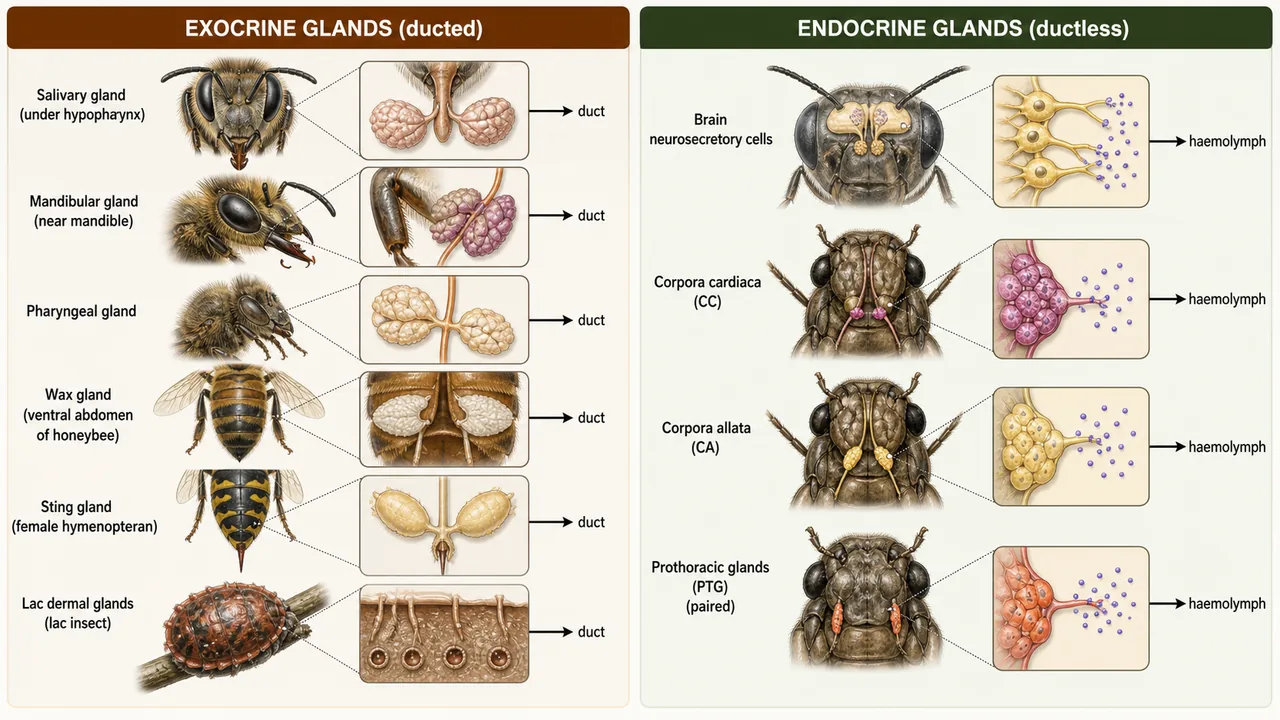
Glandular system is otherwise called as secretory system and is divided into two major groups based on the presence or absence of ducts.
This lesson covers:
- Exocrine glands -- silk, wax, venom, salivary, and other secretory glands
- Endocrine glands -- neurosecretory cells, corpora cardiaca, corpora allata, and prothoracic glands
- Hormonal control -- how JH, ecdysone, and PTTH regulate moulting and metamorphosis
Exocrine glands
- Glands with duct. Exocrine glands have a dedicated duct (tube) through which they deliver their secretions directly to the target site, such as the body surface, mouth, or a specific organ.
- Salivary glands: Salivary glands are modified labial glands which secrete saliva and open beneath hypopharynx.
- In insects, saliva serves diverse functions depending on the species -- it can lubricate food, contain digestive enzymes, anticoagulants (in blood-feeders), or even silk proteins (as in silkworm larvae where the labial glands are modified into silk glands).
- Mandibular glands: Secrete saliva in caterpillars when salivary glands are modified into silk glands.
- In queen bee it secretes queen substance.
- The queen substance (also called queen mandibular pheromone) is a chemical signal that inhibits ovary development in worker bees and maintains colony cohesion.
- Maxillary glands: Secretions are useful to lubricate mouth parts.
- Pharyngeal glands: Secrete bee milk or royal jelly in nurse bee. Royal jelly is a protein-rich secretion fed to all young larvae for the first three days. Larvae destined to become queens continue receiving royal jelly throughout their development, which triggers the queen developmental pathway.
- Stink glands (Repugnatorial glands): Secrete bad smelling substance. e.g. Stink bugs, bed bugs.
- These glands produce volatile chemicals such as aldehydes and alkanes that serve as defensive secretions to repel predators.
- Pheromone glands: Found in abdominal terminalia of one sex and its secretions are released outside to attract opposite sex of the same species. Pheromones are species-specific chemical signals used for mate attraction, trail marking, alarm signalling, and other forms of intraspecific communication.
- Wax glands: Dermal glands producing wax in bees and mealy bugs.
- In honeybees, four pairs of wax glands on the ventral abdomen produce wax scales used for comb construction.
- In mealy bugs, wax glands cover the body with a protective waxy coating.
- Sting glands: Modified accessory glands secreting venom in worker bees and wasps.
- The sting apparatus is actually a modified ovipositor (egg-laying organ), which is why only females (workers and queens) can sting.
- Lac glands: Dermal glands secreting resinous substance in lac insect.
- These specialised epidermal glands distributed across the body of the lac insect (Kerria lacca) secrete the lac resin that forms the commercially valuable encrustation.
Endocrine system
- Glands without duct.
- Unlike exocrine glands, endocrine glands are ductless -- they release their secretions (hormones) directly into the haemolymph (insect blood), which then carries the hormones to target organs throughout the body.
- It consists of ductless gland that secretes chemicals called hormones, it released directly into haemolymph of insects.
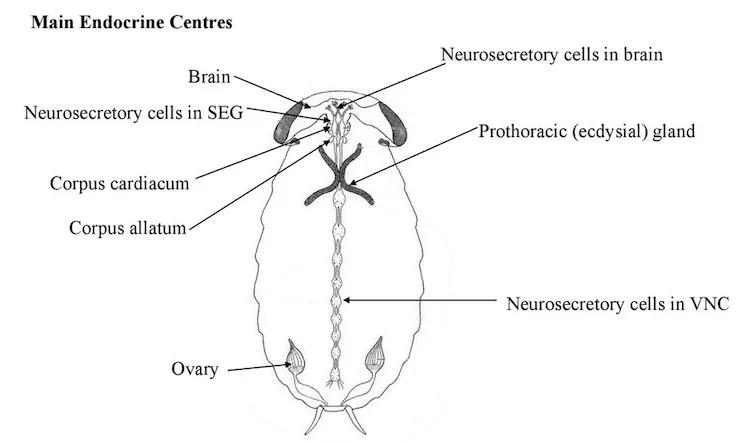
- Insect endocrine system is structurally and functionally integrated with nervous system: This close integration is called the neuroendocrine system, where nerve cells and endocrine glands work together to coordinate long-term processes like growth, moulting, metamorphosis, and reproduction.
- They secrete hormones which travel in the blood to various organs of the body coordinating their long-term activities.
- Endocrine organs are of two types.
- Neuro-secretory cells in the central nervous system
- Specialized endocrine glands such as
- Corpora cardiaca
- Corpora allata
- Prothoracic glands
Neurosecretory cells (NSC)
- These are typical neurons with secretory activity.
- They produce hormones which act directly on effector organs, or they may act on other endocrine glands which in turn are stimulated to secrete hormones. Neurosecretory cells are unique because they combine the properties of both nerve cells (electrical impulse conduction) and endocrine cells (hormone production), forming the critical link between the nervous and endocrine systems.
- They occur in the mid region of brain and central nervous system. Their axons lead out from the brain, posteriorly, most often cross each other and emerge out of the brain to enter in to or lie opposed to the corpora cardiaca.
- The secretions of neurosecretory cells are called brain hormone or activator hormones.
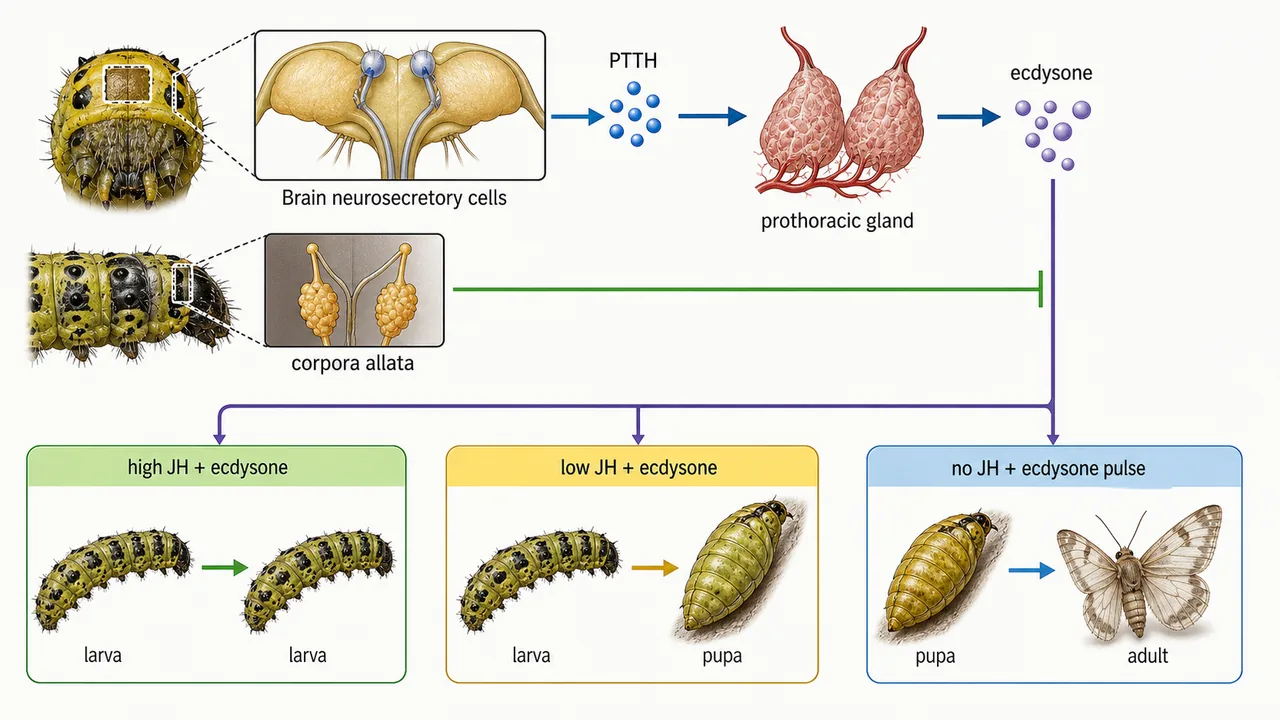
- The brain hormone (also known as prothoracicotropic hormone, PTTH) is the master regulatory signal that triggers the cascade of hormonal events leading to moulting and metamorphosis.
Corpora Cardiaca (CC)
- It is small, paired structure known as neurohaemal organ. Major function is storage and release of hormones. A neurohaemal organ is a structure where hormones produced by neurosecretory cells are stored and released into the haemolymph -- it acts as a hormonal relay station.
- They are paired structures, lying in close association with neurosecretory cells of brain. Each corpus cardiacum is transversed by neurosecretory axons from the brain.
- Neurosecretions from brain, on reaching corpus cardiacum, is stored and periodically released into the blood.
- The corpora cardiaca also produce their own hormones, including adipokinetic hormone (AKH), which mobilises lipids from the fat body for energy during flight.
Corpora Allata (CA)
- They are glandular bodies, usually situated one on either side of the Oesophagous.
- They may be fused to a single median organ as in higher Diptera.
- Paired glands located behind corpora cardiaca.
- Each is connected with Corpus cardiac of the same side by a nerve which carries fibres from NSC.
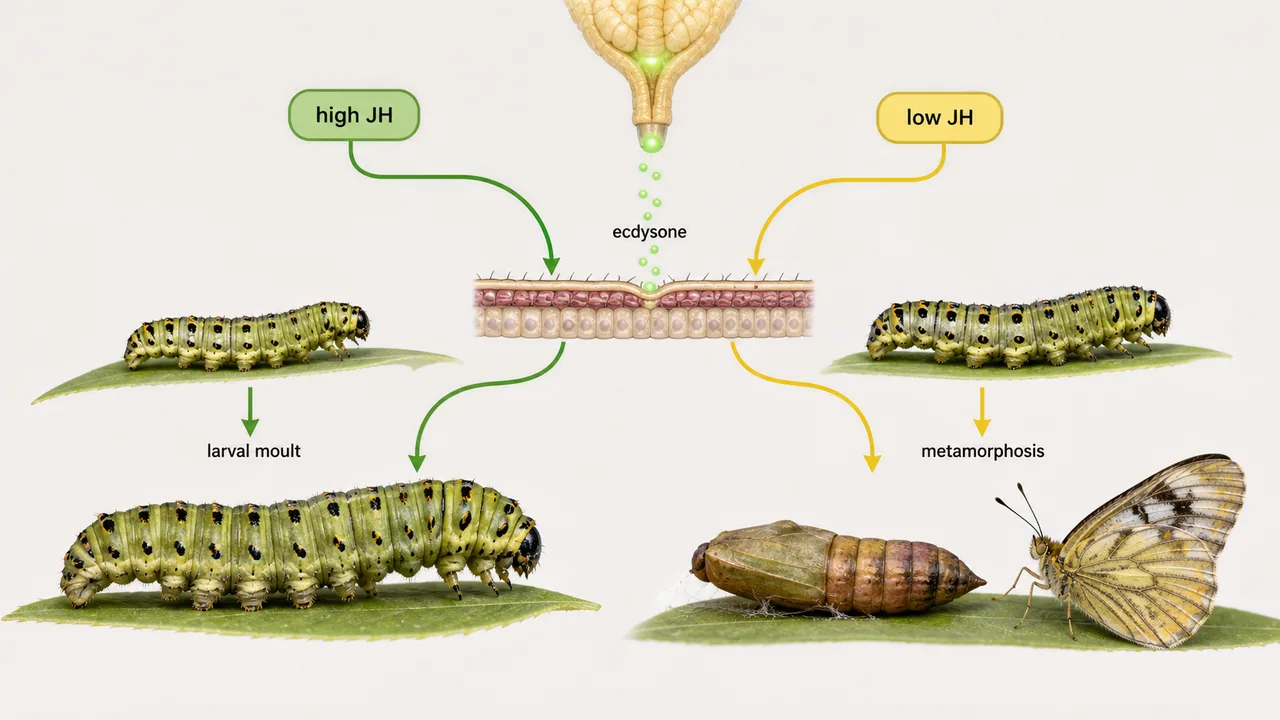
- Under the influence of brain hormone, corpora allata secretes Juvenile hormone (JH) or neotenin. Juvenile hormone is one of the most important hormones in insect physiology. Its presence during moulting ensures that the insect moults into another larval/nymphal stage rather than advancing toward the adult form.
- It inhibit metamorphosis in young insects. Therefore, JH helps to keep the insect in young stage only.
- When JH levels are high, the insect remains immature.
- When JH levels drop (particularly during the last larval instar), the insect undergoes metamorphosis to the pupal or adult stage.
- This is how the insect's body "decides" when it is time to transform.
- It is needed for egg maturation and functioning of male accessory glands.
- In adult insects, JH takes on a reproductive role -- it stimulates vitellogenesis (yolk protein production) in females and promotes the development of male accessory glands needed for sperm transfer.
Prothoracic Glands (PTG)
- They are two in number and placed mostly in thoracic region (near prothorax).
- It secrete moulting hormone (MH), called Ecdysone under the influence of brain hormone. Ecdysone (specifically 20-hydroxyecdysone, the active form) is a steroid hormone that triggers the entire moulting process -- from the separation of the old cuticle (apolysis) to the formation of the new cuticle beneath it.
- Moulting hormone helps in insects in the initiation and process of moulting.
- The interplay between JH and ecdysone determines the outcome of each moult: high ecdysone + high JH = larval-to-larval moult; high ecdysone + low JH = larval-to-pupal (or pupal-to-adult) moult.
- This hormonal balance is the central mechanism controlling insect metamorphosis.
- Except in Thysanura (which moult as adults) and solitary locusts, the prothoracic glands break down soon after final moult to adults, so they are seen only in immature forms but not in adults.
- The degeneration of prothoracic glands after the final moult ensures that adults do not continue moulting, as the rigid exoskeleton of the adult form is permanent.
Additional Endocrine Facts
- JH is absent in the Egg stage — Juvenile Hormone is only produced once the larva begins to develop; eggs are hormonally quiescent.
- Pharate stage = the developmental period between Apolysis (separation/detachment of old cuticle from epidermis) and Ecdysis (actual physical shedding of the old cuticle).
- During this phase, the new cuticle is forming beneath the old one.
- Scale insect nymphs: After the 1st moult, both male and female nymphs of scale insects lose their eyes, antennae, and legs — becoming sessile.
TIP
Pro Content Locked
Upgrade to Pro to access this lesson and all other premium content.
₹99 charged monthly · Cancel anytime
- All Agriculture & Banking Courses
- AI Lesson Questions (100/day)
- AI Doubt Solver (50/day)
- Glows & Grows Feedback (30/day)
- AI Section Quiz (20/day)
- 22-Language Translation (100/day)
- Recall Questions (20/day)
- AI Quiz (15/day)
- AI Quiz Paper Analysis (100/day)
- AI Step-by-Step Explanations (100/day)
- Spaced Repetition Recall (FSRS)
- AI Tutor
- Immersive Text Questions
- Audio Lessons — Hindi & English
- Mock Tests & Previous Year Papers
- Summary & Mind Maps
- XP, Levels, Leaderboard & Badges
- Generate New Classrooms
- Voice AI Teacher (AgriDots Live)
- AI Revision Assistant
- Knowledge Gap Analysis
- Interactive Revision (LangGraph)
🔒 Secure via Razorpay · Cancel anytime · No hidden fees
In the previous lesson, we studied the reproductive system and seven types of insect reproduction. Now we examine the hormonal machinery that controls growth, moulting, and metamorphosis: the endocrine system.
Glandular System
Postal service analogy: Insect glands work in two ways -- exocrine glands are like hand-delivering a letter through a pipe (duct) directly to the recipient (target organ). Endocrine glands are like broadcasting a radio message (hormone) into the bloodstream (haemolymph) -- any organ tuned to that frequency receives the signal. This ductless broadcasting is how JH, ecdysone, and other hormones control moulting and metamorphosis across the entire body simultaneously.
Glandular system is otherwise called as secretory system and is divided into two major groups based on the presence or absence of ducts.
This lesson covers:
- Exocrine glands -- silk, wax, venom, salivary, and other secretory glands
- Endocrine glands -- neurosecretory cells, corpora cardiaca, corpora allata, and prothoracic glands
- Hormonal control -- how JH, ecdysone, and PTTH regulate moulting and metamorphosis
Exocrine glands
- Glands with duct. Exocrine glands have a dedicated duct (tube) through which they deliver their secretions directly to the target site, such as the body surface, mouth, or a specific organ.
- Salivary glands: Salivary glands are modified labial glands which secrete saliva and open beneath hypopharynx.
- In insects, saliva serves diverse functions depending on the species -- it can lubricate food, contain digestive enzymes, anticoagulants (in blood-feeders), or even silk proteins (as in silkworm larvae where the labial glands are modified into silk glands).
- Mandibular glands: Secrete saliva in caterpillars when salivary glands are modified into silk glands.
- In queen bee it secretes queen substance.
- The queen substance (also called queen mandibular pheromone) is a chemical signal that inhibits ovary development in worker bees and maintains colony cohesion.
- Maxillary glands: Secretions are useful to lubricate mouth parts.
- Pharyngeal glands: Secrete bee milk or royal jelly in nurse bee. Royal jelly is a protein-rich secretion fed to all young larvae for the first three days. Larvae destined to become queens continue receiving royal jelly throughout their development, which triggers the queen developmental pathway.
- Stink glands (Repugnatorial glands): Secrete bad smelling substance. e.g. Stink bugs, bed bugs.
- These glands produce volatile chemicals such as aldehydes and alkanes that serve as defensive secretions to repel predators.
- Pheromone glands: Found in abdominal terminalia of one sex and its secretions are released outside to attract opposite sex of the same species. Pheromones are species-specific chemical signals used for mate attraction, trail marking, alarm signalling, and other forms of intraspecific communication.
- Wax glands: Dermal glands producing wax in bees and mealy bugs.
- In honeybees, four pairs of wax glands on the ventral abdomen produce wax scales used for comb construction.
- In mealy bugs, wax glands cover the body with a protective waxy coating.
- Sting glands: Modified accessory glands secreting venom in worker bees and wasps.
- The sting apparatus is actually a modified ovipositor (egg-laying organ), which is why only females (workers and queens) can sting.
- Lac glands: Dermal glands secreting resinous substance in lac insect.
- These specialised epidermal glands distributed across the body of the lac insect (Kerria lacca) secrete the lac resin that forms the commercially valuable encrustation.
Endocrine system
- Glands without duct.
- Unlike exocrine glands, endocrine glands are ductless -- they release their secretions (hormones) directly into the haemolymph (insect blood), which then carries the hormones to target organs throughout the body.
- It consists of ductless gland that secretes chemicals called hormones, it released directly into haemolymph of insects.
- Insect endocrine system is structurally and functionally integrated with nervous system: This close integration is called the neuroendocrine system, where nerve cells and endocrine glands work together to coordinate long-term processes like growth, moulting, metamorphosis, and reproduction.
- They secrete hormones which travel in the blood to various organs of the body coordinating their long-term activities.
- Endocrine organs are of two types.
- Neuro-secretory cells in the central nervous system
- Specialized endocrine glands such as
- Corpora cardiaca
- Corpora allata
- Prothoracic glands
Neurosecretory cells (NSC)
- These are typical neurons with secretory activity.
- They produce hormones which act directly on effector organs, or they may act on other endocrine glands which in turn are stimulated to secrete hormones. Neurosecretory cells are unique because they combine the properties of both nerve cells (electrical impulse conduction) and endocrine cells (hormone production), forming the critical link between the nervous and endocrine systems.
- They occur in the mid region of brain and central nervous system. Their axons lead out from the brain, posteriorly, most often cross each other and emerge out of the brain to enter in to or lie opposed to the corpora cardiaca.
- The secretions of neurosecretory cells are called brain hormone or activator hormones.
- The brain hormone (also known as prothoracicotropic hormone, PTTH) is the master regulatory signal that triggers the cascade of hormonal events leading to moulting and metamorphosis.
Corpora Cardiaca (CC)
- It is small, paired structure known as neurohaemal organ. Major function is storage and release of hormones. A neurohaemal organ is a structure where hormones produced by neurosecretory cells are stored and released into the haemolymph -- it acts as a hormonal relay station.
- They are paired structures, lying in close association with neurosecretory cells of brain. Each corpus cardiacum is transversed by neurosecretory axons from the brain.
- Neurosecretions from brain, on reaching corpus cardiacum, is stored and periodically released into the blood.
- The corpora cardiaca also produce their own hormones, including adipokinetic hormone (AKH), which mobilises lipids from the fat body for energy during flight.
Corpora Allata (CA)
- They are glandular bodies, usually situated one on either side of the Oesophagous.
- They may be fused to a single median organ as in higher Diptera.
- Paired glands located behind corpora cardiaca.
- Each is connected with Corpus cardiac of the same side by a nerve which carries fibres from NSC.
- Under the influence of brain hormone, corpora allata secretes Juvenile hormone (JH) or neotenin. Juvenile hormone is one of the most important hormones in insect physiology. Its presence during moulting ensures that the insect moults into another larval/nymphal stage rather than advancing toward the adult form.
- It inhibit metamorphosis in young insects. Therefore, JH helps to keep the insect in young stage only.
- When JH levels are high, the insect remains immature.
- When JH levels drop (particularly during the last larval instar), the insect undergoes metamorphosis to the pupal or adult stage.
- This is how the insect's body "decides" when it is time to transform.
- It is needed for egg maturation and functioning of male accessory glands.
- In adult insects, JH takes on a reproductive role -- it stimulates vitellogenesis (yolk protein production) in females and promotes the development of male accessory glands needed for sperm transfer.
Prothoracic Glands (PTG)
- They are two in number and placed mostly in thoracic region (near prothorax).
- It secrete moulting hormone (MH), called Ecdysone under the influence of brain hormone. Ecdysone (specifically 20-hydroxyecdysone, the active form) is a steroid hormone that triggers the entire moulting process -- from the separation of the old cuticle (apolysis) to the formation of the new cuticle beneath it.
- Moulting hormone helps in insects in the initiation and process of moulting.
- The interplay between JH and ecdysone determines the outcome of each moult: high ecdysone + high JH = larval-to-larval moult; high ecdysone + low JH = larval-to-pupal (or pupal-to-adult) moult.
- This hormonal balance is the central mechanism controlling insect metamorphosis.
- Except in Thysanura (which moult as adults) and solitary locusts, the prothoracic glands break down soon after final moult to adults, so they are seen only in immature forms but not in adults.
- The degeneration of prothoracic glands after the final moult ensures that adults do not continue moulting, as the rigid exoskeleton of the adult form is permanent.
Additional Endocrine Facts
- JH is absent in the Egg stage — Juvenile Hormone is only produced once the larva begins to develop; eggs are hormonally quiescent.
- Pharate stage = the developmental period between Apolysis (separation/detachment of old cuticle from epidermis) and Ecdysis (actual physical shedding of the old cuticle).
- During this phase, the new cuticle is forming beneath the old one.
- Scale insect nymphs: After the 1st moult, both male and female nymphs of scale insects lose their eyes, antennae, and legs — becoming sessile.
TIP
Remember the hormone-gland pairs: JH = Just stay young (produced by Corpora allata) and Ecdysone = Exit old skin (produced by Prothoracic gland).
Summary Cheat Sheet
| Concept / Topic | Key Details |
|---|---|
| Exocrine glands | Ducted glands -- deliver secretions directly to target site |
| Endocrine glands | Ductless glands -- release hormones into haemolymph |
| Salivary glands | Modified labial glands; open beneath hypopharynx; lubricate food, contain enzymes |
| Mandibular glands | Secrete queen substance in queen bee; saliva in caterpillars |
| Pharyngeal glands | Secrete royal jelly in nurse bee |
| Wax glands | 4 pairs on ventral abdomen of honeybee; waxy coating in mealybugs |
| Sting glands | Modified accessory glands; sting = modified ovipositor; only females sting |
| Lac glands | Dermal glands of Kerria lacca; produce commercial lac resin |
| Pheromone glands | Species-specific chemical signals; mate attraction, alarm, trail marking |
| Neurosecretory cells (NSC) | In brain; produce brain hormone (PTTH); master regulatory signal |
| Corpora Cardiaca (CC) | Neurohaemal organ; stores and releases brain hormone + produces adipokinetic hormone (AKH) |
| Corpora Allata (CA) | Secretes Juvenile Hormone (JH / neotenin); high JH = stay immature; low JH = metamorphosis |
| Prothoracic Glands (PTG) | Secrete moulting hormone (ecdysone); triggers moulting process; degenerate after final moult |
| JH + Ecdysone interplay | High ecdysone + high JH = larval moult; high ecdysone + low JH = pupal/adult moult |
TIP
Next: The next lesson covers metamorphosis -- the dramatic transformations controlled by the very hormones we studied here.
References
1 source
References
Lesson Doubts
Ask questions, get expert answers