👾 Metamorphosis -- Types, Immature Stages, and Life Cycles
Ametamorphosis, incomplete and complete metamorphosis, types of eggs, larvae (caterpillar, grub, maggot, naiad), pupae (obtect, exarate, coarctate), and cocoons
In the previous lesson, we studied the endocrine system -- the hormones (JH, ecdysone, PTTH) that control insect development. Now we see those hormones in action: metamorphosis, the structural transformation from immature to adult.
A cotton farmer watches a caterpillar chew through bolls, yet the adult moth that laid the eggs feeds only on nectar. How can the same species have such different bodies and diets at different life stages? The answer is metamorphosis -- the dramatic transformation that most insects undergo. Knowing the type of metamorphosis tells a farmer which life stage causes damage and when to apply control measures (e.g., target the larval stage of bollworm, not the adult moth).
This lesson covers:
- Three types of metamorphosis -- ametamorphosis, incomplete, and complete
- Immature stages -- egg types, larval forms, and pupal types
- Cocoons and pupation -- protective structures during the vulnerable pupal stage
What Is Metamorphosis?
- Greek: Meta (change) + Morph (form/structure).
- The series of changes in growth and development an insect undergoes from birth to maturity, involving morphological, physiological, and behavioural transformations.
Think of the three types like this: Ametamorphosis = a baby that looks like a tiny adult and just grows bigger (like a silverfish). Incomplete metamorphosis = a child that gradually develops adult features through visible stages -- like growing wings step by step (grasshopper nymph → adult). Complete metamorphosis = a total makeover -- the body is completely rebuilt inside a cocoon, emerging as an entirely different-looking creature (caterpillar → pupa → butterfly).
- The hard exoskeleton cannot stretch, so the insect must moult (shed its old cuticle) to grow.
- The number of moults is generally 5--6.
Types of Metamorphosis
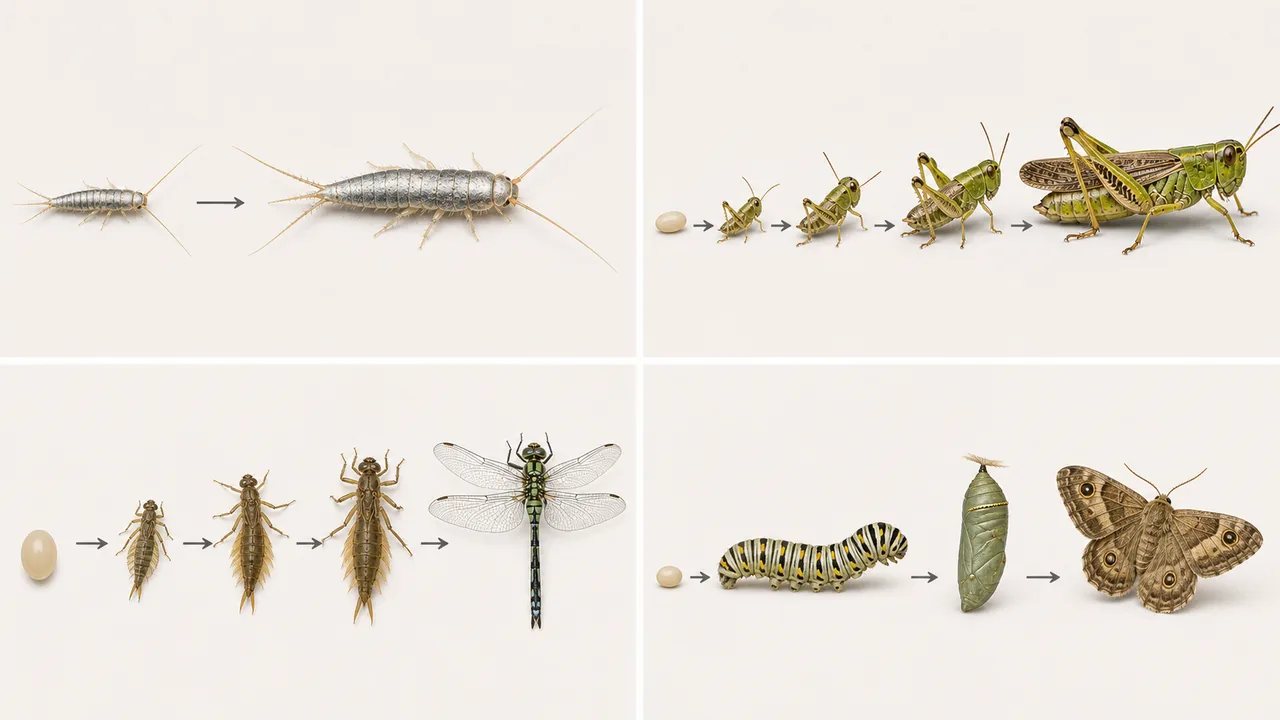
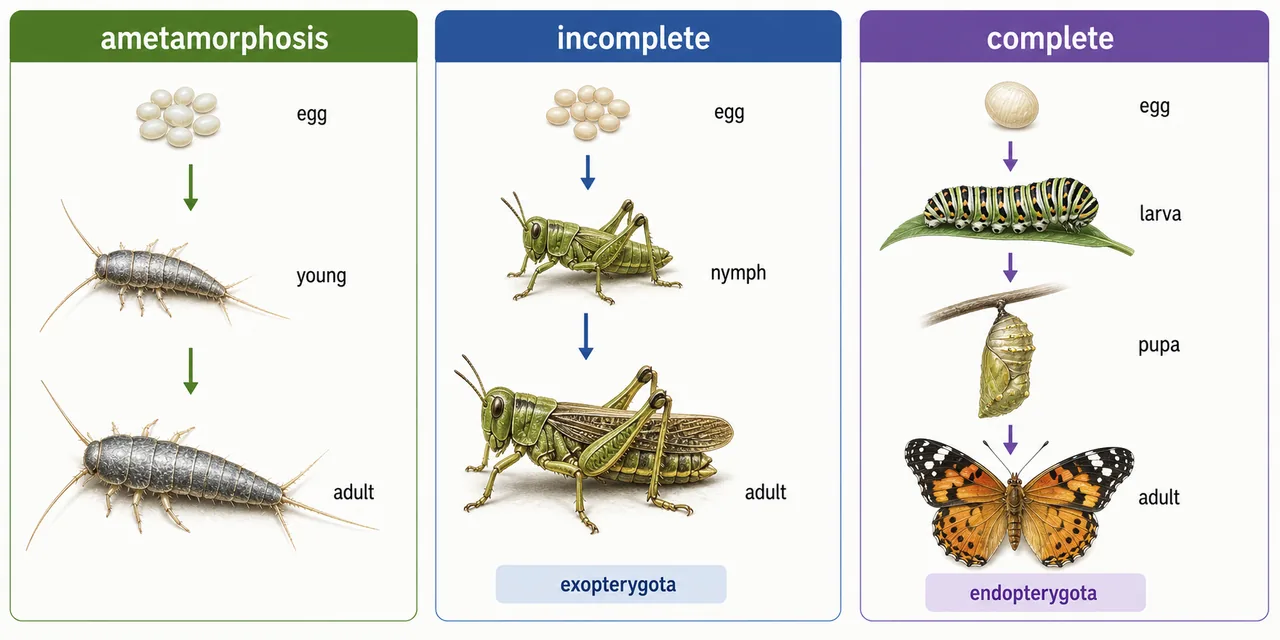
Fast comparison rule: if there is no pupa, you are in the ametabolous or incomplete group. If there is a distinct pupa, it is holometamorphosis.
1. Ametamorphosis (No Metamorphosis)
- Young resemble adults in all characters except body size; no dramatic transformation.
- Growth is by gradual size increase and development of reproductive organs.
- Young and adults continue to moult even after reaching adulthood (unique among insects).
- Examples: Apterygotes -- silverfish, springtails (the most primitive living insects).
2. Incomplete Metamorphosis (Hemimetamorphosis / Simple / Direct)
Life cycle: Egg → Nymph → Adult (no pupal stage -- development is direct and simple)
- Nymph resembles the adult except for wings (wing buds present, growing with each moult).
- Wings develop externally → hence called Exopterygota (exo = outside).
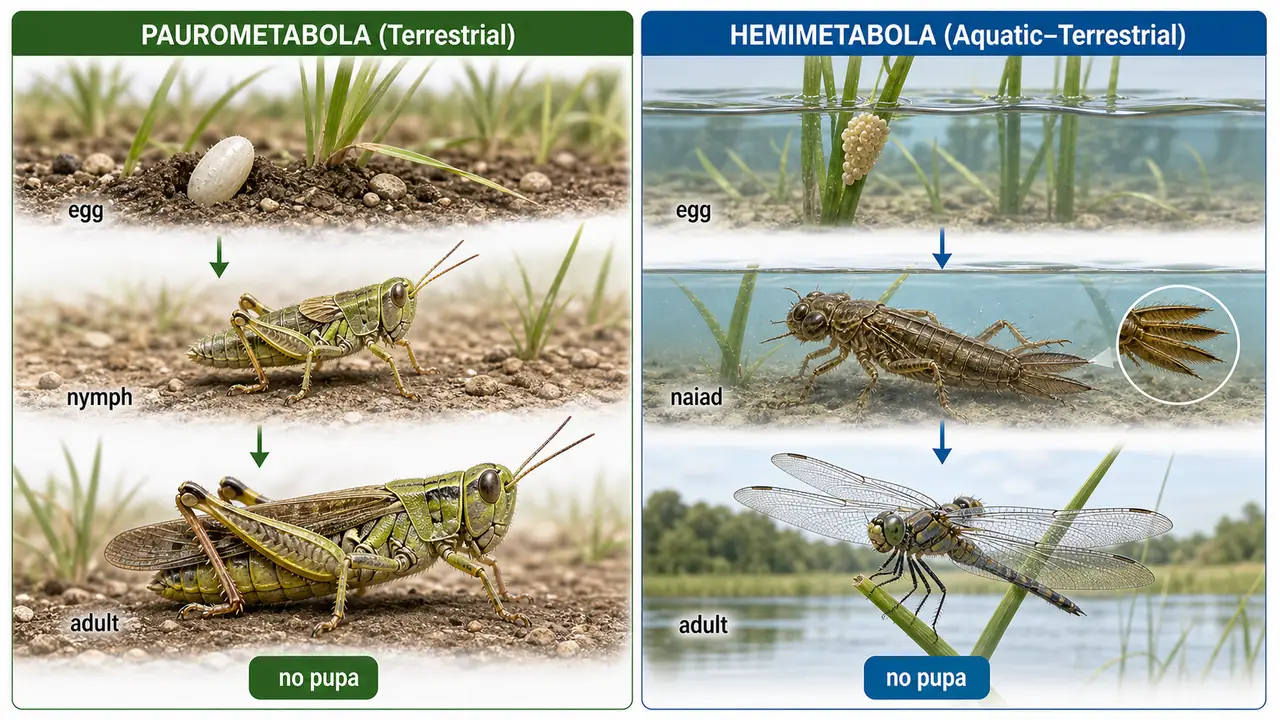
a) Paurometabola (Gradual Metamorphosis)
| Feature | Detail |
|---|---|
| Young called | Nymphs (terrestrial) |
| Resemblance | Nymphs resemble adults (same habitat, compound eyes, mouthparts) |
| Wing development | Wing buds appear externally in later instars |
| Genitalia | Gradual development |
| Examples | Orthoptera (locust, grasshopper, cockroach), Thysanoptera (thrips), Isoptera (termites), Hemiptera (aphids, leafhoppers) |
Crop connection: Grasshopper nymphs and adults both damage crops with biting-chewing mouthparts -- both stages need to be controlled.
b) Hemimetabola (Incomplete Metamorphosis with Aquatic Immatures)
| Feature | Detail |
|---|---|
| Young called | Naiads (aquatic; from Greek mythology: water nymph) |
| Difference from adults | Naiads are aquatic, breathe by tracheal gills; adults are aerial |
| Special feature | In dragonfly naiads, the labium is modified into a mask -- a spring-loaded grasping arm for capturing prey (fish, tadpoles) |
| Examples | Odonata (dragonfly, damselfly, mayfly) |
3. Holometamorphosis (Complete Metamorphosis)
Life cycle: Egg → Larva → Pupa → Adult (indirect development -- pupal stage intervenes)
| Feature | Detail |
|---|---|
| Larval vs. adult | Differ in body structure and habits |
| Legs | Larva may have thoracic + abdominal legs, or no legs at all; adult has only thoracic legs |
| Compound eyes | Absent in larva |
| Wing development | Wings develop internally (imaginal discs) → called Endopterygota (endo = inside) |
| Prevalence | Over 80% of all insect species |
| Order | Examples |
|---|---|
| Coleoptera | Beetles, weevils |
| Lepidoptera | Moths, butterflies, silkworm |
| Diptera | Flies |
| Hymenoptera | Sawflies, bees, ants, wasps |
Agricultural key insight: In holometabolous pests, only the larval stage typically causes crop damage (e.g., caterpillar of bollworm, grub of white grub). The adult stage is often for dispersal and reproduction only.
Comparison of Metamorphosis Types
| Feature | Ametamorphosis | Incomplete | Complete |
|---|---|---|---|
| Stages | Egg → Young → Adult | Egg → Nymph → Adult | Egg → Larva → Pupa → Adult |
| Pupal stage | Absent | Absent | Present |
| Wing development | None (wingless) | External (Exopterygota) | Internal (Endopterygota) |
| Young resembles adult? | Yes (except size) | Yes (except wings/genitalia) | No (completely different) |
| Adult moulting | Yes (continues) | No | No |
| Examples | Silverfish | Grasshopper, dragonfly | Beetle, butterfly, fly |
| Prevalence | Rare (primitive) | ~18% | >80% |
Immature Stages
Egg Stage
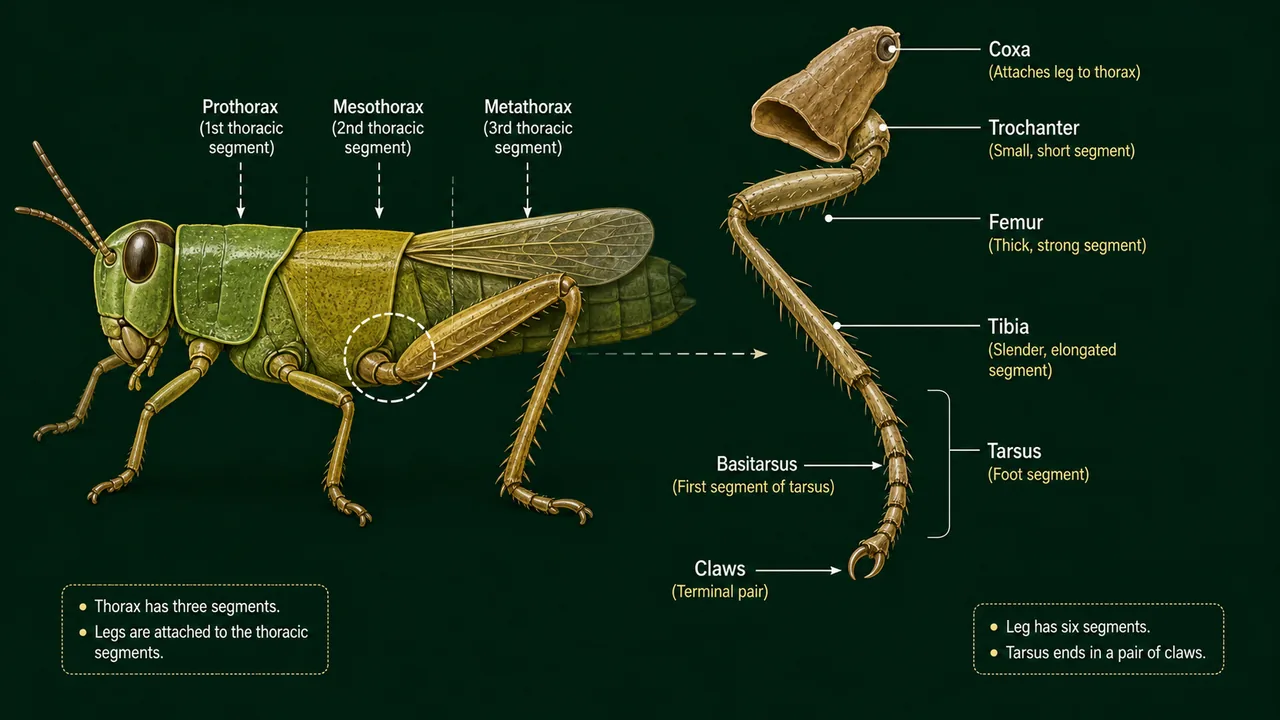
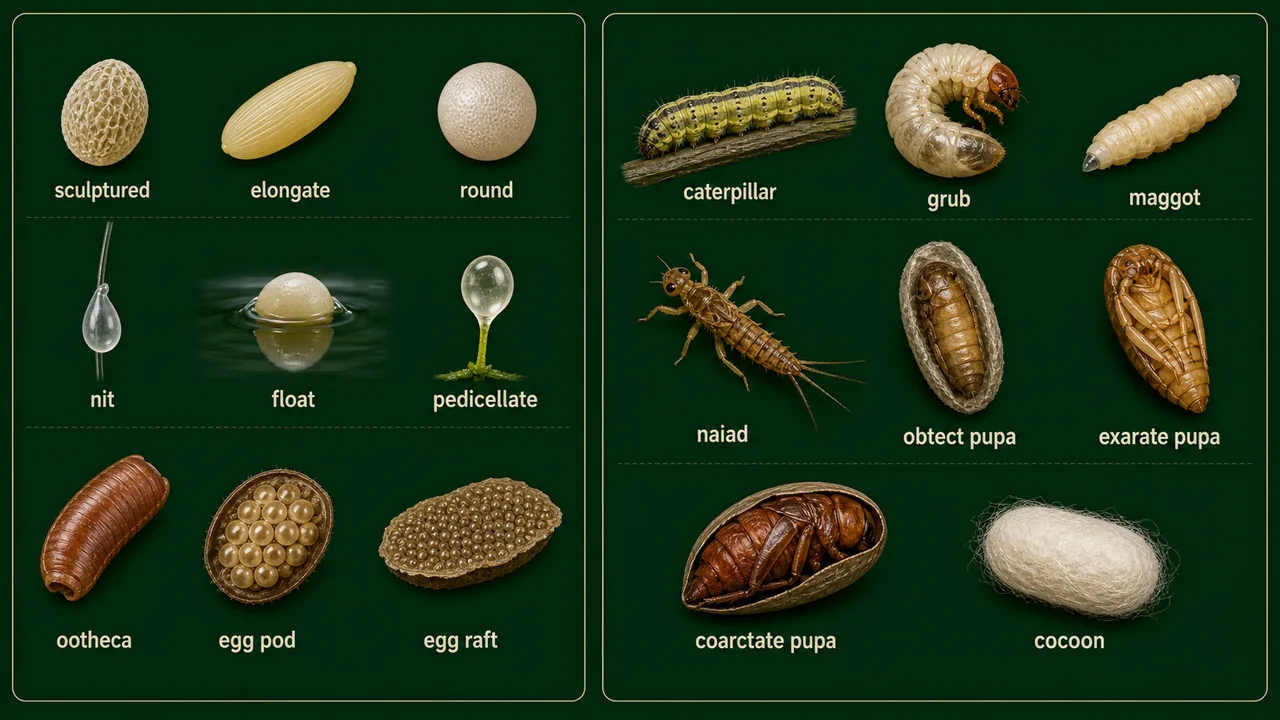
Most insects are oviparous (lay eggs). The outer shell is the chorion (with micropyles for sperm entry and aeropyles for gas exchange).
Singly Laid Eggs
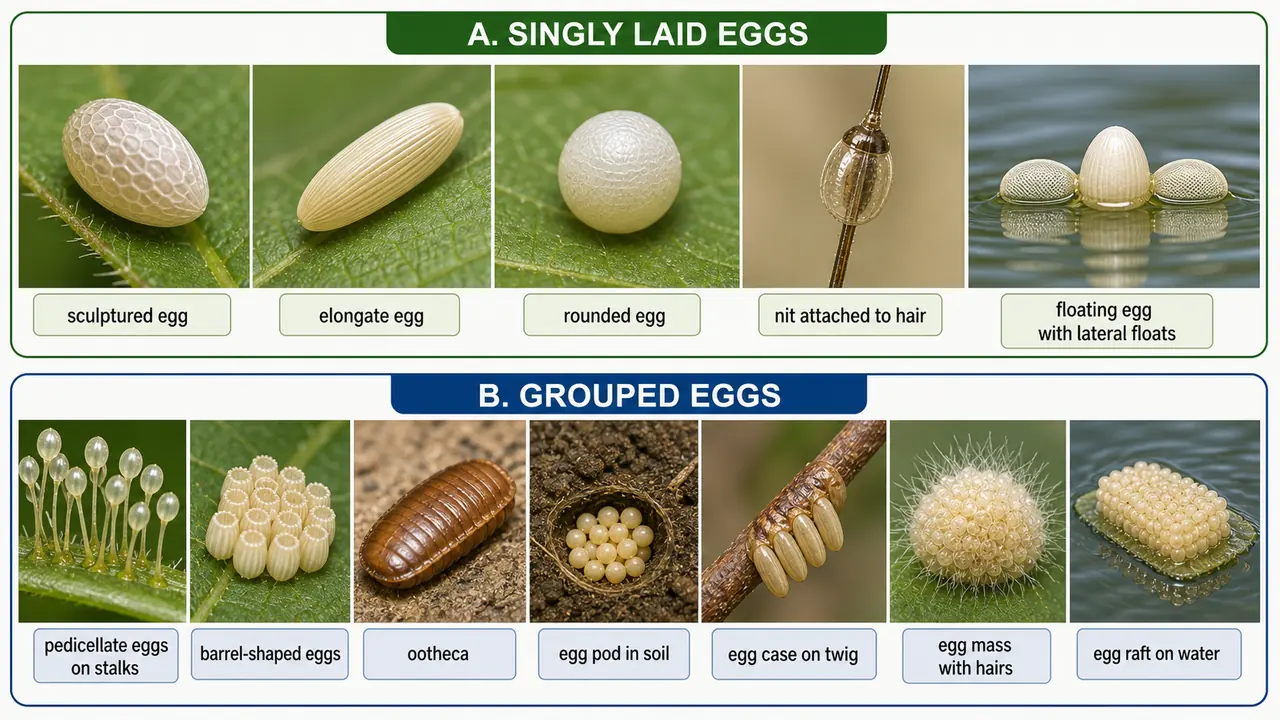
| Type | Shape | Example |
|---|---|---|
| Sculptured | Reticulate markings and ridges | Castor butterfly |
| Elongate | Cigar-shaped | Sorghum shoot fly |
| Rounded | Spherical/globular | Citrus butterfly |
| Nit | Cemented to hair base | Head louse |
| Egg with float | Boat-shaped with lateral floats | Anopheles mosquito |
Eggs Laid in Groups
| Type | Description | Example |
|---|---|---|
| Pedicellate | On silken stalks (~1.25mm); protects from crawling predators | Green lacewing fly |
| Barrel-shaped | Compact barrel form | Stink bug |
| Ootheca | Brown bean-like chitinous capsule (30--40 eggs) | Cockroach |
| Egg pod | Frothy material in soil; plug prevents drying | Grasshopper |
| Egg case | Foamy secretion (spumaline) hardens on twigs | Mantid |
| Egg mass | Covered with body hairs for protection and camouflage | Rice stem borer |
| Egg raft | 200--300 eggs standing vertically in boat-shaped mass on water | Culex mosquito |
Larval Stage
The active growing stage of holometabolous insects. The immature stage names vary by order:
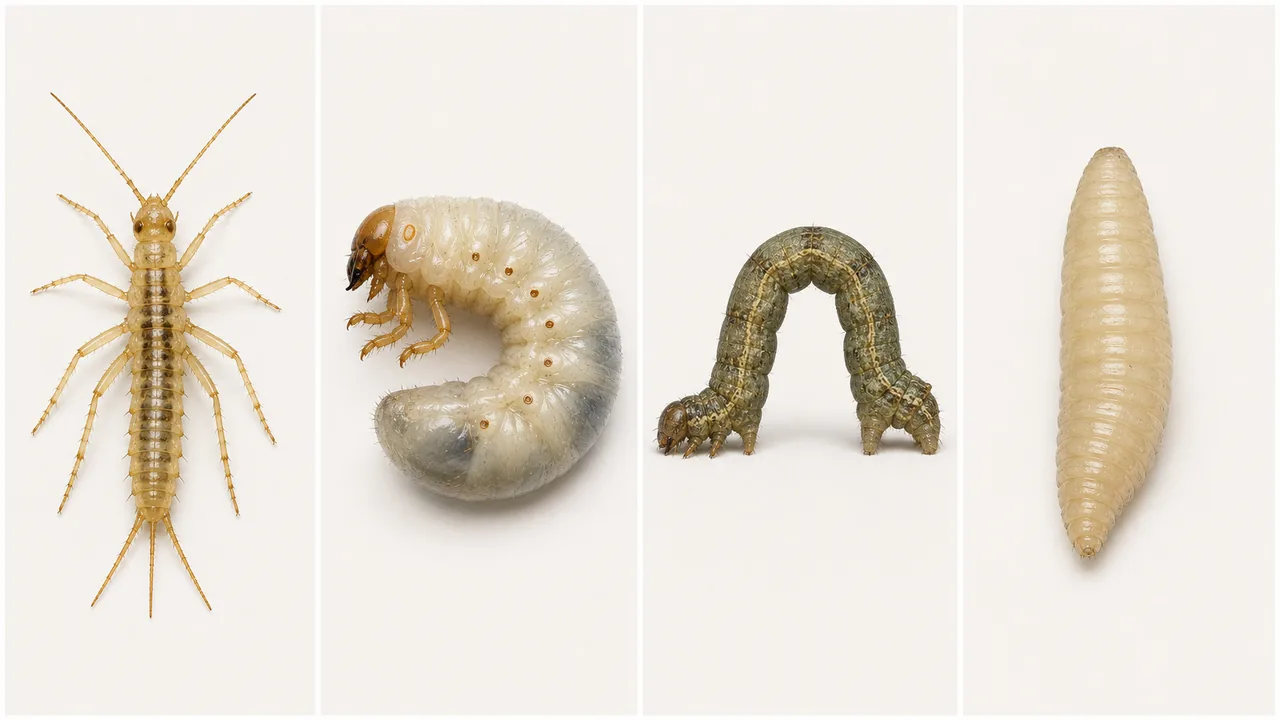
Reading shortcut: first check for legs, then look at body shape, then ask whether the head capsule is obvious. Those three checks usually identify the larval type immediately.
| Name | Order | Examples |
|---|---|---|
| Nymph | Orthoptera, Hemiptera | Grasshopper, aphid, jassid, whitefly |
| Caterpillar | Lepidoptera | Bollworm, borers, loopers |
| Grub | Coleoptera, Hymenoptera | Beetles, weevils, bees, sawfly |
| Maggot | Diptera | All flies (except whitefly and mustard sawfly) |
| Naiad | Odonata | Dragonfly, damselfly |
Three Types of Larvae (by leg number)
A. Oligopod (thoracic legs only, no abdominal legs)
| Subtype | Body Shape | Legs | Activity | Example |
|---|---|---|---|---|
| Campodeiform | Elongate, dorso-ventrally flattened, sclerotised | Long thoracic legs; cerci often present | Active predators | Ladybird beetle grub, antlion grub |
| Scarabaeiform | C-shaped, stout, subcylindrical | Short thoracic legs; no cerci | Sluggish; burrowing into wood/soil | Rhinoceros beetle grub |
B. Polypod / Eruciform (thoracic legs + 2--5 pairs of abdominal prolegs)
| Subtype | Key Feature | Example |
|---|---|---|
| Hairy caterpillar | Dense, sparse, or tufted body hairs (irritating/venomous, defensive) | Red hairy caterpillar |
| Slug caterpillar | Thick, short, fleshy; retractile head; venomous spines (scoli); also called "platform larva" | Slug caterpillar |
| Semilooper | 3--4 pairs of prolegs (some rudimentary) | Castor semilooper (Achoea janata) |
| Looper | Only 2 pairs of prolegs (segments 6 and 10); arching "measuring worm" gait | Mango looper |
Field identification: Count prolegs! 4--5 pairs = typical caterpillar. 3--4 pairs = semilooper. 2 pairs = looper.
C. Apodous (no legs -- legless larvae)
Based on head capsule development:
| Subtype | Head Capsule | Mandible Action | Example |
|---|---|---|---|
| Eucephalous | Well-developed (functional mandibles, stemmata, antennae) | Transverse | Mosquito wriggler, red palm weevil grub |
| Hemicephalous | Reduced, retractable into thorax | Vertical | Horse fly larva, robber fly larva |
| Acephalous | Absent; only mouth hooks and internal sclerites; also called vermiform | -- | Housefly maggot |
Pupal Stage
The resting, inactive transitional stage of holometabolous insects where larval tissues undergo histolysis (breakdown) and histogenesis (rebuilding) -- the larval body is essentially dismantled and reconstructed into the adult form.
Most common confusion: cocoon is not a pupa type. It is a cover around the pupa, while obtect, exarate, and coarctate describe the pupa itself.
Three Types of Pupae
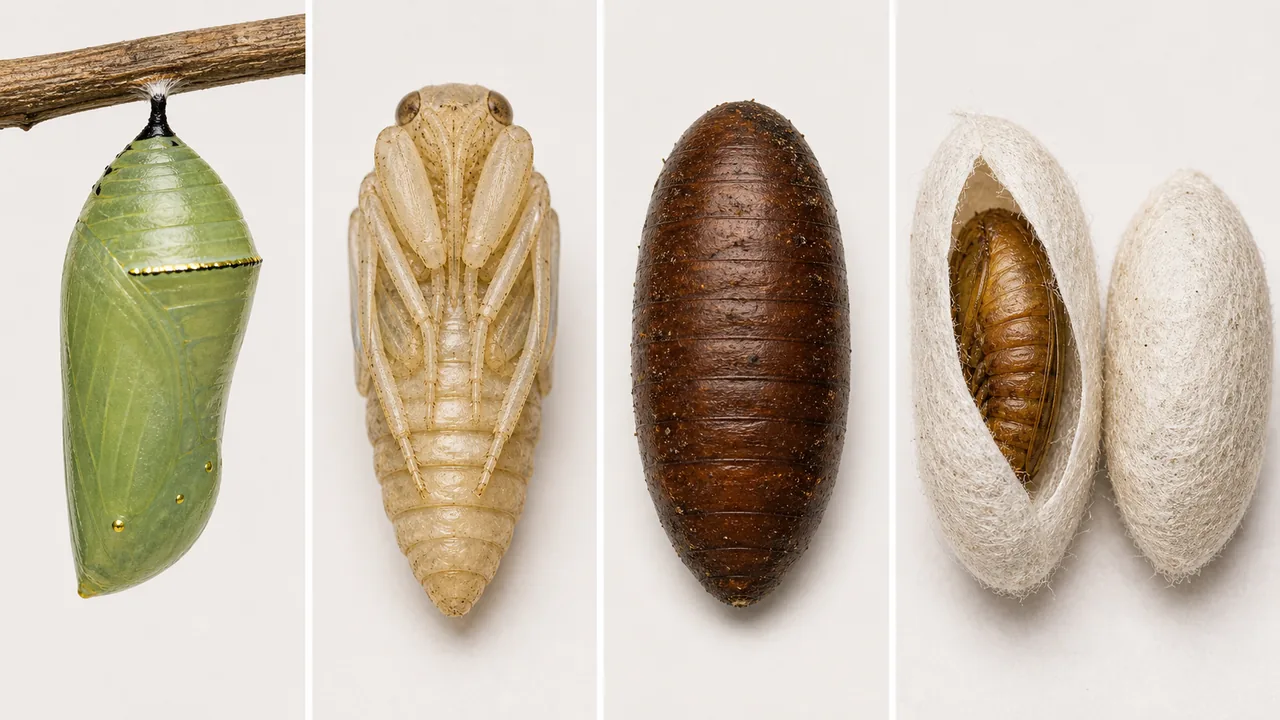
| Type | Appendages | Key Feature | Example |
|---|---|---|---|
| Obtect | Glued to body (cemented, immovable) | Smooth, compact; appendage surfaces more sclerotised | Butterflies (chrysalis -- from Greek chrysos = gold), mosquito (tumbler -- comma-shaped, active, uses anal paddles) |
| Exarate | Free (not glued) | Soft, pale; can often move appendages | Most Coleoptera |
| Coarctate | Exarate pupa inside hardened last larval skin | Brown, barrel-shaped case = puparium; no visible appendages | Fly pupa (Diptera) |
Chrysalis vs. Cocoon: A chrysalis is the pupa itself (obtect type, often golden). A cocoon is a protective cover around the pupa (made of silk, soil, hair, etc.).
Pupal Protection (Cocoons)
The pupal stage lacks mobility and is the most vulnerable stage. Cocoons provide protection:
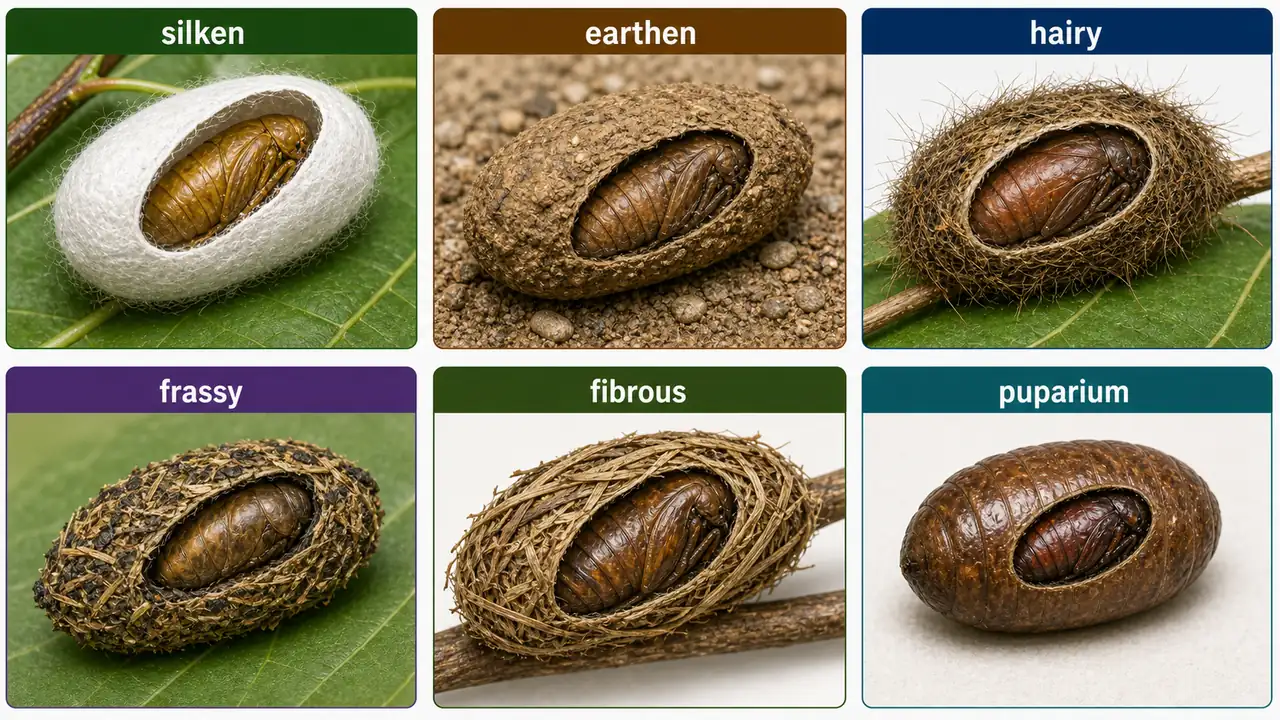
| Types of cocoons | Materials used | Example |
|---|---|---|
| Silken cocoon | Silk | Silkworm |
| Earthen cocoon | Soil + saliva | Gram pod borer |
| Hairy cocoon | Body hairs | Woolly bear |
| Frassy cocoon | Frass + saliva | Coconut black headed caterpillar |
| Fibrous cocoon | Fibres | Red palm weevil |
| Puparium | Hardened last larval skin | House fly |
Additional Metamorphosis Facts
- Naiad = immature stage of aquatic insects such as dragonflies, damselflies, and mayflies (Order Odonata and Ephemeroptera).
- Anamorphosis = unique developmental pattern in Protura where immatures begin with only 9 abdominal segments and add 3 more during successive moults, reaching the full 12 segments of the adult.
Dormancy Types
| Type | Trigger | Description |
|---|---|---|
| Aestivation | Summer / high temperature | Dormancy during hot, dry conditions |
| Hibernation | Winter / low temperature | Dormancy during cold conditions |
| Diapause | Genetically programmed | Hormonally controlled arrest; triggered by photoperiod/temperature cues regardless of current conditions |
| Cryptobiosis | Extreme desiccation/conditions | Quiescent state with no visible metabolism; reversible when favourable conditions return |
Exam Tips
Incomplete metamorphosis has ONE intermediate stage (nymph), not two. The statement "two intermediate stages" is incorrect -- a classic trick question.
Maggot = Acephalous. Housefly maggots have no head capsule. Remember: "Maggot = Missing head."
Chrysalis pupa = Lepidoptera (butterflies). Tumbler = mosquito pupa. Both are obtect type.
Coarctate = fly pupa inside puparium (hardened last larval skin). Not a separate pupa type -- it is an exarate pupa inside a case.
Looper = 2 pairs prolegs. Semilooper = 3--4 pairs. Count the prolegs to identify.
Oligopod → Exarate pupa. Polypod → Obtect pupa. All oligopod larvae produce exarate pupae.
Summary Cheat Sheet
| Concept | Key Detail |
|---|---|
| Metamorphosis | Greek: change of form; series of developmental changes |
| Ametamorphosis | No transformation; silverfish, springtails |
| Paurometabola | Gradual; terrestrial nymphs; grasshopper, thrips |
| Hemimetabola | Aquatic naiads; dragonfly, damselfly |
| Holometamorphosis | Complete; egg-larva-pupa-adult; >80% of insects |
| Exopterygota | Wings develop externally (incomplete metamorphosis) |
| Endopterygota | Wings develop internally (complete metamorphosis) |
| Caterpillar | Larva of Lepidoptera |
| Grub | Larva of Coleoptera / Hymenoptera |
| Maggot | Larva of Diptera (acephalous) |
| Naiad | Aquatic immature of Odonata |
| Campodeiform | Active predator larva; elongate, long legs |
| Scarabaeiform | C-shaped; sluggish burrower |
| Looper | 2 pairs prolegs (segments 6, 10) |
| Obtect pupa | Appendages glued; chrysalis (butterfly), tumbler (mosquito) |
| Exarate pupa | Appendages free; most beetles |
| Coarctate pupa | Exarate inside puparium; flies |
| Cocoon | Protective cover around pupa (silk, soil, hair, frass) |
TIP
Next: The final lesson asks the big question: why are insects so dominant? -- bringing together all the morphological and physiological advantages we have studied.
References
1 source
References
Lesson Doubts
Ask questions, get expert answers