🟤 Soils of Uttar Pradesh
An exam-focused explanation of Uttar Pradesh's main soil types, especially Bangar, Khadar, red soils, laterite, sandy soils, and Usar/Reh, with their crop suitability and reclamation logic.
Introduction
Soil is one of the most important links between geography and agriculture. If you understand UP soils properly, many later questions on crops, irrigation, productivity, and problem lands become much easier.
The key pattern is simple:
- the Gangetic Plain is dominated by alluvial soil
- the southern rocky belt brings in red and lateritic influences
- scattered problem patches create Usar/Reh soil
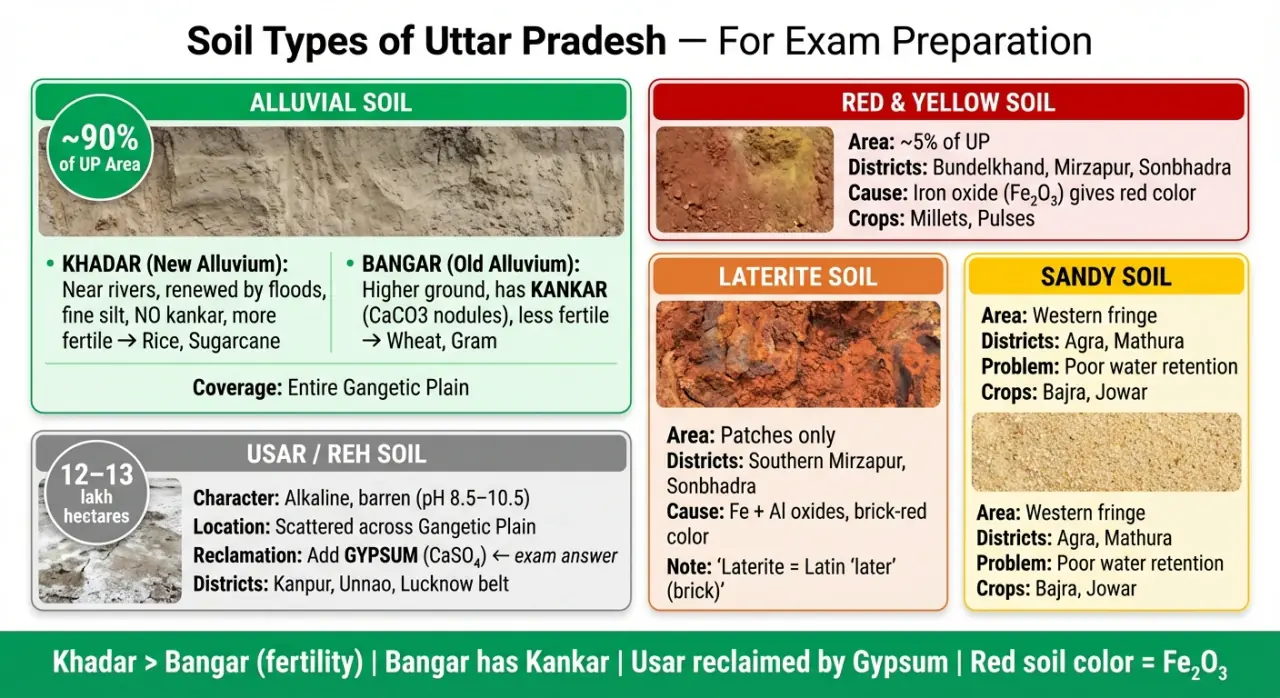
Major Soil Types of UP
| Soil Type | Hindi Name | Area Coverage | Region |
|---|---|---|---|
| Alluvial | जलोढ़ मिट्टी | ~90% | Gangetic Plain |
| Red & Yellow | लाल और पीली | ~5% | Bundelkhand, Mirzapur, Sonbhadra |
| Laterite | लेटराइट | Small patches | Southern UP (Mirzapur, Sonbhadra) |
| Sandy / Balu | बालू / रेतीली | Small areas | Western semi-arid fringe |
| Usar / Reh | ऊसर / रेह | Scattered | Alkaline patches across plains |
These area shares are best treated as approximate teaching values, especially outside the dominant alluvial category. The exam priority is usually distribution plus suitability, not precise percentage arithmetic.
1. Alluvial Soil (जलोढ़ मिट्टी)
Alluvial soil is the most important soil in UP, deposited by the Ganga, Yamuna, and their tributaries. It is divided into two sub-types:
This is the single most important soil topic in UP GK because it connects directly with the agricultural dominance of the Gangetic Plain.
Bangar vs Khadar — The Critical Distinction
| Feature | Bangar (बांगर) | Khadar (खादर) |
|---|---|---|
| Hindi meaning | Old alluvium (पुरानी जलोढ़) | New alluvium (नई जलोढ़) |
| Location | Higher ground, away from rivers | Low-lying areas, near river banks |
| Age | Older deposits (Pleistocene) | Recent deposits (Holocene) |
| Composition | More clay, silt; contains kankar (calcium carbonate nodules) | Fine silt, sand; no kankar |
| Fertility | Less fertile (nutrients leached over time) | More fertile (renewed by annual floods) |
| Color | Darker, sometimes brownish | Light grey to yellowish |
| Flooding | Not flooded regularly | Flooded during monsoon |
| Crops | Wheat, gram, barley | Rice, sugarcane, vegetables |
Kankar (calcium carbonate nodules) in Bangar soil is a very common exam question. These hard nodules impede root growth and reduce fertility.
For exam memory, the easiest contrast is:
- Bangar = older, slightly higher, more kankar, relatively less fertile
- Khadar = newer, lower, floodplain-linked, more fertile
Nutrient Profile of Alluvial Soil
| Nutrient | Status |
|---|---|
| Nitrogen | Generally deficient |
| Phosphorus | Low to medium |
| Potassium | Medium to high |
| Organic matter | Low (due to intensive farming) |
| pH | Neutral to slightly alkaline (7.0–8.5) |
| Texture | Sandy loam to clayey loam |
2. Red & Yellow Soil (लाल और पीली मिट्टी)
| Feature | Detail |
|---|---|
| Location | Bundelkhand (Jhansi, Lalitpur, Hamirpur), Mirzapur, Sonbhadra |
| Parent rock | Granite, gneiss (crystalline igneous rocks) |
| Color | Red due to iron oxide (Fe₂O₃); yellow when hydrated |
| Texture | Sandy to loamy; porous |
| Fertility | Low — deficient in nitrogen, phosphorus, and humus |
| pH | Acidic to neutral (5.5–7.0) |
| Suitable crops | Millets, groundnut, pulses, coarse grains |
Red and yellow soils matter because they reflect the southern hard-rock belt, not the alluvial plain. So they usually appear in questions linked with Bundelkhand, Mirzapur, and Sonbhadra.
3. Laterite Soil (लेटराइट मिट्टी)
| Feature | Detail |
|---|---|
| Location | Small patches in southern Mirzapur and Sonbhadra |
| Formation | Intense leaching under high temperature and rainfall |
| Color | Brick red |
| Composition | Rich in iron and aluminium oxides; poor in silica |
| Fertility | Very low — heavily leached |
| Suitable crops | Cashew, tea (with heavy manuring); generally poor for cereals |
The word "Laterite" comes from Latin later = brick. This soil hardens like brick when exposed to air.
In UP, laterite is not a dominant statewide soil. It is better remembered as a minor southern-patch soil associated with strong leaching and poor fertility.
4. Sandy Soil (बालू / रेतीली मिट्टी)
| Feature | Detail |
|---|---|
| Location | Western fringes of UP — Agra, Mathura, semi-arid zones |
| Texture | Coarse; very high sand content |
| Water retention | Very poor — water drains rapidly |
| Fertility | Low — poor organic matter |
| pH | Alkaline (8.0+) |
| Suitable crops | Bajra, jowar, moth bean; requires irrigation for wheat |
5. Usar / Reh Soil (ऊसर / रेह मिट्टी)
Usar soil is the most problematic soil type in UP — it is alkaline, saline, and largely barren.
| Feature | Detail |
|---|---|
| Hindi names | ऊसर (Usar), रेह (Reh), कल्लर (Kallar) |
| Location | Scattered patches across the Gangetic Plain — Lucknow, Unnao, Raebareli, Pratapgarh, Aligarh |
| Cause | Poor drainage → waterlogging → salts accumulate on surface |
| pH | Highly alkaline (8.5–10.5) |
| Surface | White salt crust visible; barren appearance |
| Area | Large scattered problem patches reported across UP |
Reclamation of Usar Soil
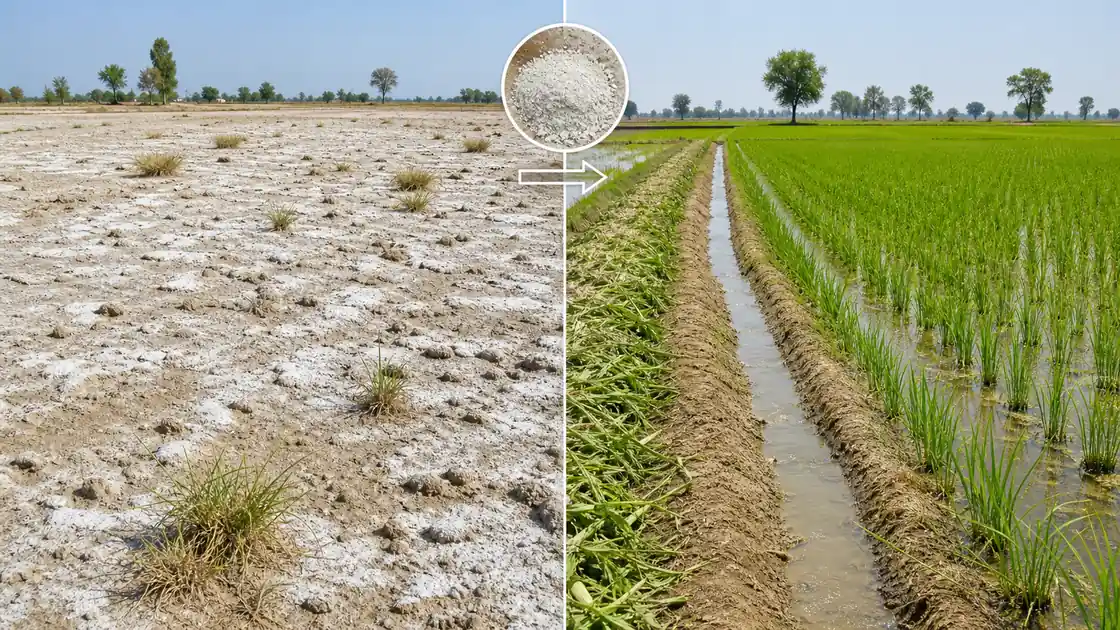
| Method | Action |
|---|---|
| Gypsum application | Most effective — replaces sodium with calcium, reduces alkalinity |
| Green manuring | Dhaincha (Sesbania) grown and ploughed back into soil |
| Rice cultivation | Standing water helps leach salts downward |
| Improved drainage | Prevents waterlogging and salt accumulation |
| Pyrite application | Used in some areas to reduce pH |
Gypsum (CaSO₄) is the standard amendment for Usar reclamation — this is a very frequently asked question.
This is one of the most exam-important practical links in the lesson:
- problem: sodic/alkaline surface
- standard remedy: gypsum
- supporting measures: drainage, green manuring, rice-based reclamation
Soil-Crop Suitability Table
| Soil Type | Best Suited Crops | Region |
|---|---|---|
| Khadar (new alluvial) | Rice, sugarcane, vegetables, banana | River floodplains |
| Bangar (old alluvial) | Wheat, gram, barley, mustard | Higher plains |
| Red & Yellow | Millets, pulses, groundnut | Bundelkhand |
| Laterite | Tea, cashew (with amendments) | Southern UP patches |
| Sandy | Bajra, jowar, moth bean | Western semi-arid |
| Usar (alkaline) | Rice (after gypsum treatment) | Reclaimed patches |
Soil Health Card Scheme (मृदा स्वास्थ्य कार्ड)
| Parameter | Detail |
|---|---|
| Launched | 19 February 2015 by PM Modi (from Suratgarh, Rajasthan) |
| Objective | Provide soil nutrient status to every farmer |
| Cycle | Card issued every 2 years |
| Tests | 12 parameters — N, P, K, S, Zn, Fe, Cu, Mn, B, pH, EC, Organic Carbon |
| Benefit | Farmers get crop-specific fertilizer recommendations |
| UP status | Large-scale implementation in the state; exact distributed-card counts can change over time |
This scheme is useful in the lesson because it connects soil geography with practical farm management. Still, exact cumulative card counts are administratively time-sensitive, so the stable exam fact is the purpose and 2-year cycle, not the running total.
Summary Cheat Sheet
| Term | Quick Recall |
|---|---|
| Dominant soil | Alluvial (~90%) |
| Bangar | Old alluvium; has kankar; less fertile |
| Khadar | New alluvium; near rivers; more fertile |
| Kankar | CaCO₃ nodules in Bangar soil |
| Red soil location | Bundelkhand, Mirzapur, Sonbhadra |
| Red soil color cause | Iron oxide (Fe₂O₃) |
| Usar/Reh pH | 8.5–10.5 (highly alkaline) |
| Usar reclamation | Gypsum (CaSO₄) application |
| Usar area in UP | Large scattered alkaline patches across the plains |
| Soil Health Card | Every 2 years; 12 parameters |
| Alluvial N status | Deficient |
| Laterite meaning | Latin "later" = brick |
Lesson Doubts
Ask questions, get expert answers