💧 Ramsar Wetlands — Conservation Stories
Deep dive into UP's Ramsar wetland sites — Upper Ganga, Saman, Samaspur, Sandi, Sarsai Nawar, Sur Sarovar, Bakhira, Haiderpur, Patna Bird Sanctuary and Shekha Jheel for Uttar Pradesh GK.
What Makes a Ramsar Site?
The Ramsar Convention (1971, Ramsar, Iran) is an international treaty for the conservation and sustainable use of wetlands. India became a signatory in 1982. A wetland qualifies for Ramsar designation if it meets at least one of nine criteria, including:
- Supports vulnerable, endangered, or critically endangered species
- Regularly supports 20,000+ waterbirds
- Is an important source of food, spawning ground, or nursery for fish
- Supports 1% or more of a biogeographic population of a waterbird species
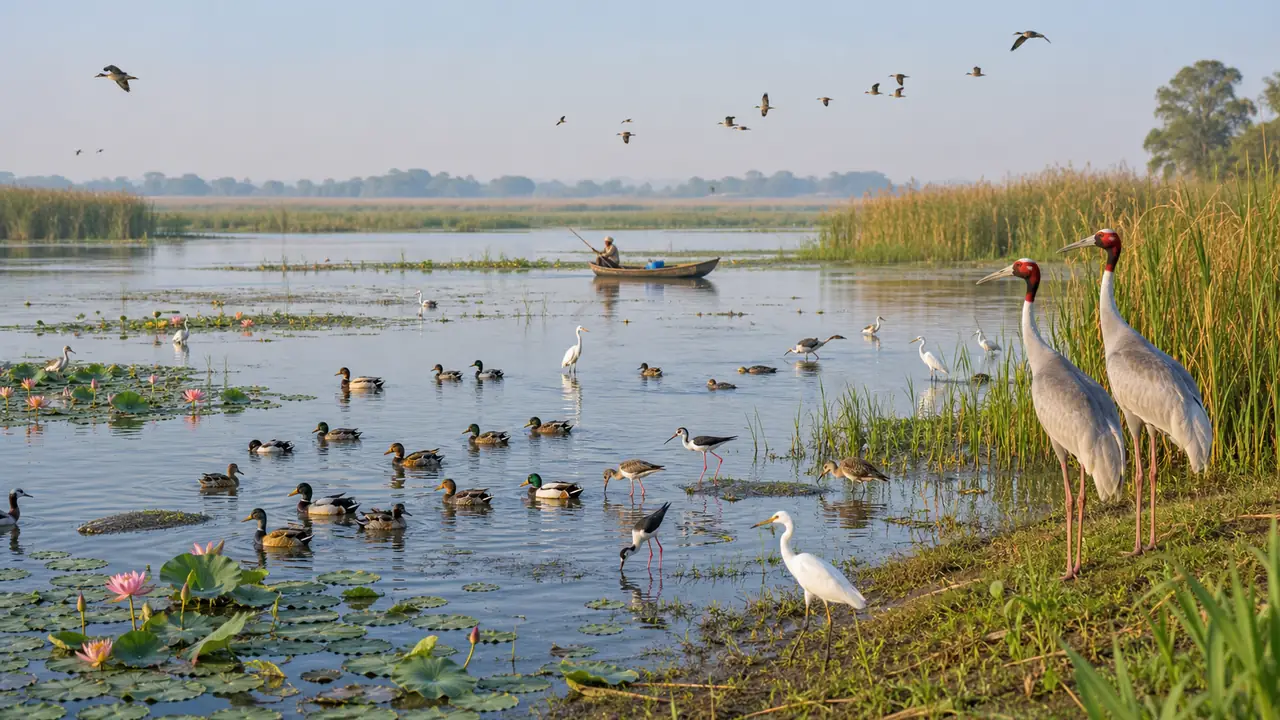
As of June 3, 2026, UP has 12 Ramsar sites. This reflects the Gangetic plain's extraordinary network of lakes, marshes, floodplain wetlands, and riverine systems.
Exam Tip: The total number of Ramsar sites in UP changes as new sites are added. Always check the latest count, but remember the core sites below.
1. Shaheed Chandra Shekhar Azad Bird Sanctuary / Nawabganj Jheel (Unnao)
| Parameter | Details |
|---|---|
| Location | Unnao district (~40 km from Lucknow) |
| Ramsar Designation | 2019 |
| Area | ~2.25 sq km |
| Type | Freshwater marsh/lake |
| Key Species | Sarus crane, painted stork, white ibis |
| Migratory Birds | Pintail, shoveler, common teal, gadwall |
| Significance | Critical wintering ground; Sarus crane habitat year-round |
Nawabganj is a natural ox-bow lake fed by monsoon rainfall. Its proximity to Lucknow makes it one of the most accessible wetland birding destinations in central UP.
2. Parvati Aranga (Gonda)
| Parameter | Details |
|---|---|
| Location | Gonda district (eastern UP) |
| Ramsar Designation | 2019 |
| Area | ~7.22 sq km |
| Type | Floodplain wetland connected to Saryu/Ghaghra river |
| Key Species | Fishing cat, smooth-coated otter, Gangetic dolphin |
| Bird Species | 120+ species including migratory ducks |
| Significance | Floodplain ecosystem with high fish diversity |
Parvati Aranga functions as a natural floodwater retention basin — it absorbs excess monsoon flow from the Ghaghra, reducing downstream flooding while sustaining a rich fishery that supports local livelihoods.
3. Saman Bird Sanctuary (Mainpuri)
| Parameter | Details |
|---|---|
| Location | Mainpuri district |
| Ramsar Designation | 2019 |
| Area | ~5.26 sq km |
| Type | Freshwater marsh |
| Key Species | Sarus crane (major breeding ground) |
| Other Birds | Painted stork, open-billed stork, spoonbill |
| Significance | One of the most important Sarus crane nesting sites globally |
Exam Tip: Saman (Mainpuri) and Sarsai Nawar (Etawah) are the two most critical Sarus crane breeding wetlands in UP. They are often confused — remember: Saman = Mainpuri, Sarsai Nawar = Etawah.
4. Samaspur Bird Sanctuary (Rae Bareli)
| Parameter | Details |
|---|---|
| Location | Rae Bareli district |
| Ramsar Designation | 2019 |
| Area | ~8.0 sq km |
| Type | Freshwater lake and surrounding wetlands |
| Key Species | Migratory ducks, Sarus crane, painted stork |
| Wintering Birds | Bar-headed goose, greylag goose, common pochard |
| Significance | Major wintering ground for Palearctic migrants |
Samaspur receives significant numbers of wintering waterfowl from November to February. The lake and its marshy periphery provide both foraging and roosting habitat.
5. Sandi Bird Sanctuary (Hardoi)
| Parameter | Details |
|---|---|
| Location | Hardoi district |
| Ramsar Designation | 2019 |
| Area | ~3.09 sq km |
| Type | Reservoir-based wetland (British-era irrigation tank) |
| Key Species | Sarus crane, painted stork, bar-headed goose |
| Fish Species | Important local fishery |
| Significance | Combination of irrigation utility and bird habitat |
Sandi is unique because it is a man-made reservoir (constructed during British rule for irrigation) that has evolved into a thriving wetland ecosystem. It demonstrates how artificial water bodies can develop significant ecological value over time.
6. Sarsai Nawar (Etawah)
| Parameter | Details |
|---|---|
| Location | Etawah district |
| Ramsar Designation | 2019 |
| Area | ~1.61 sq km |
| Type | Freshwater marsh |
| Key Species | Sarus crane — major breeding wetland |
| Other Species | Painted stork, black-necked stork |
| Significance | Highest density of breeding Sarus cranes |
Sarsai Nawar, despite its small size, is arguably the single most important wetland for Sarus crane reproduction in India. The Etawah-Mainpuri landscape supports the world's densest Sarus crane population.
7. Upper Ganga River (Bijnor-Haridwar Stretch)
| Parameter | Details |
|---|---|
| Location | Bijnor district (UP) extending to Haridwar (Uttarakhand) |
| Ramsar Designation | 2005 |
| Area | ~265.9 sq km |
| Type | Riverine wetland |
| Key Species | Gharial, mugger crocodile, Gangetic dolphin |
| Other Species | Smooth-coated otter, mahseer fish |
| Significance | One of the cleanest stretches of the Ganga |
This is the oldest Ramsar site in UP (2005). The stretch between Bijnor barrage and Haridwar retains relatively clean water before the Ganga enters the heavily polluted middle segment.
8. Sur Sarovar / Keetham Lake (Agra)
| Parameter | Details |
|---|---|
| Location | Agra district (near Taj Mahal) |
| Ramsar Designation | 2020 |
| Area | ~4.31 sq km |
| Type | Reservoir-fed lake |
| Key Species | Sarus crane, painted stork, spoonbill |
| Special Feature | Wildlife SOS Bear Rescue Centre nearby |
| Tourism | Popular birding spot for Agra visitors |
Sur Sarovar lies along the Agra-Delhi highway and combines wildlife value with tourism potential. The adjacent bear rescue facility rehabilitates sloth bears freed from the "dancing bear" trade.
9. Bakhira Tal (Sant Kabir Nagar)
| Parameter | Details |
|---|---|
| Location | Sant Kabir Nagar district (eastern UP) |
| Ramsar Designation | 2021 |
| Area | ~29 sq km |
| Type | Largest natural freshwater lake in UP |
| Key Species | Over 30,000 migratory birds annually |
| Migratory Visitors | Greylag goose, bar-headed goose, pintail, shoveler |
| Significance | Massive wintering congregation site |
Bakhira Tal's sheer size makes it a regionally significant stopover and wintering site. Its Ramsar designation was a major conservation achievement for eastern UP.
Exam Tip: Bakhira Tal = largest natural freshwater lake in UP. Do not confuse with man-made reservoirs. Located in Sant Kabir Nagar.
10. Haiderpur Wetland
| Parameter | Details |
|---|---|
| Location | Muzaffarnagar-Bijnor region |
| Ramsar Designation | 2021 |
| Area | ~69.08 sq km |
| Type | Riverine / floodplain wetland |
| Key Species | Waterbirds, fish, wetland mammals |
| Significance | Ganga-linked wetland with major migration value |
Haiderpur is important because it shows that Ramsar wetlands in UP are not limited to small bird lakes; some are much broader floodplain systems tied to large rivers.
11. Patna Bird Sanctuary (Etah)
| Parameter | Details |
|---|---|
| Location | Etah district |
| Ramsar Designation | 2026 |
| Type | Small wetland bird sanctuary |
| Key Species | Painted stork, spoonbill, open-billed stork |
| Significance | Breeding and feeding habitat for colonial waterbirds |
Patna Bird Sanctuary became important in current affairs because its Ramsar inclusion in 2026 raised UP's count further.
12. Shekha Jheel Bird Sanctuary (Aligarh)
| Parameter | Details |
|---|---|
| Location | Aligarh district |
| Ramsar Designation | 2026 |
| Type | Freshwater jheel / wetland |
| Key Species | Migratory waterbirds and wetland birds |
| Significance | UP's 12th Ramsar site as of June 3, 2026 |
Shekha Jheel is important mainly as a current-affairs wetland addition. For exams, remember the pair:
- Patna Bird Sanctuary -> 2026 addition
- Shekha Jheel -> 2026 addition
Conservation Challenges
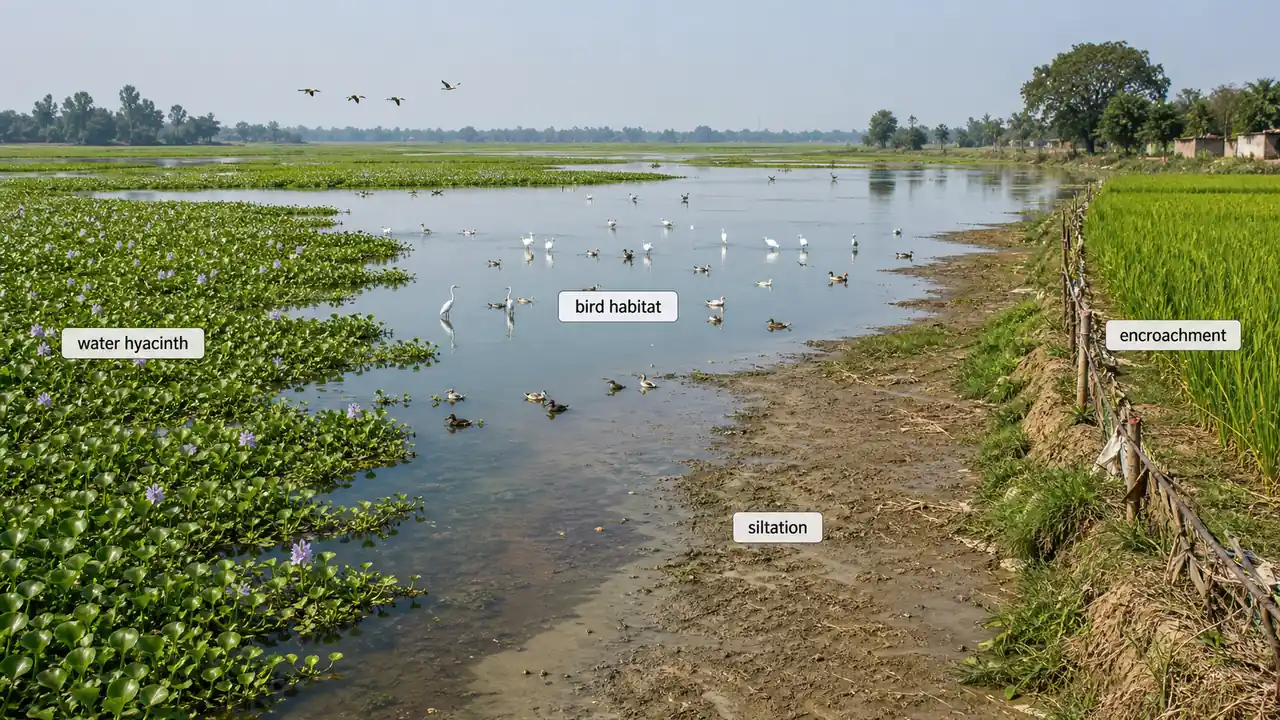
Despite Ramsar designation, UP's wetlands face serious threats:
| Challenge | Description |
|---|---|
| Encroachment | Agricultural and urban expansion into wetland margins |
| Pollution | Sewage, pesticide runoff, industrial effluents |
| Invasive Species | Water hyacinth (Eichhornia crassipes) — chokes water bodies |
| Siltation | Soil erosion fills wetlands, reducing depth |
| Fishing Pressure | Overharvesting depletes fish stocks |
| Climate Change | Altered monsoon patterns affect water levels |
The National Plan for Conservation of Aquatic Eco-systems (NPCA) — which merged the earlier National Lake Conservation Plan and National Wetland Conservation Programme — provides central funding for Ramsar site management.
Complete Ramsar Sites Reference Table
| # | Site | District | Year | Area (sq km) | Type |
|---|---|---|---|---|---|
| 1 | Upper Ganga | Bijnor stretch | 2005 | 265.9 | Riverine |
| 2 | Shaheed Chandra Shekhar Azad (Nawabganj) | Unnao | 2019 | 2.25 | Ox-bow lake |
| 3 | Parvati Aranga | Gonda | 2019 | 7.22 | Floodplain |
| 4 | Saman | Mainpuri | 2019 | 5.26 | Marsh |
| 5 | Samaspur | Rae Bareli | 2019 | 8.0 | Lake |
| 6 | Sandi | Hardoi | 2019 | 3.09 | Reservoir |
| 7 | Sarsai Nawar | Etawah | 2019 | 1.61 | Marsh |
| 8 | Sur Sarovar | Agra | 2020 | 4.31 | Lake |
| 9 | Haiderpur | Muzaffarnagar-Bijnor | 2021 | 69.08 | Wetland |
| 10 | Bakhira Tal | Sant Kabir Nagar | 2021 | 29.0 | Natural lake |
| 11 | Patna Bird Sanctuary | Etah | 2026 | ~1.1 | Bird sanctuary wetland |
| 12 | Shekha Jheel Bird Sanctuary | Aligarh | 2026 | — | Jheel / wetland |
Summary Cheat Sheet
| Item | Quick Fact |
|---|---|
| Total Ramsar Sites (as of June 3, 2026) | 12 |
| Oldest | Upper Ganga (2005, Bijnor) |
| Largest Natural Lake | Bakhira Tal (29 sq km, Sant Kabir Nagar) |
| Sarus Crane Breeding | Saman (Mainpuri) + Sarsai Nawar (Etawah) |
| Near Lucknow | Shaheed Chandra Shekhar Azad / Nawabganj (Unnao) |
| Near Taj Mahal | Sur Sarovar (Agra) |
| Floodplain Type | Parvati Aranga (Gonda) |
| 2026 Additions | Patna Bird Sanctuary, Shekha Jheel |
| Biggest Threat | Water hyacinth + encroachment |
Lesson Doubts
Ask questions, get expert answers